#CareerAdvice : How to Prepare for the Three Most Common Types of #Negotiation at Work…Preparation is crucial no matter what you’re negotiating. But you Might Need to Adapt How you Prepare Depending on your Objective.

There is one common component that can make or break any negotiation–research and preparation. It doesn’t matter whether you’re trying to make a convincing case for why you deserve a promotion, or whether you’re trying to convince your boss that you need more resources to complete the project that they assigned to your team.

However,  how you gear up for that negotiation will probably differ case-by-case. You should quantify your achievements, for example, when you ask for a raise. But when you’re trying to tell your boss that you need hire an additional team member, you should focus on what you could achieve if given more resources.

Here are three common circumstances where you’ll probably find yourself negotiating at work, and how to prepare in each situation.

1. WHEN YOU GET A JOB OFFER

In most cases it’s in your best interest to negotiate when you get a job offer. As Camille Sweeney and Josh Gosfield previously wrote for Fast Company, many employers admit to lowballing initial offers because they anticipate that the candidate will try to negotiate. In 2011, an article in the Journal of Organizational Behavior found that those who do ask for more end up getting an additional $5,000 a year. That’s a lot of money when you think of how it can compound over the years for future earnings.

So how what kind groundwork do you need to get a better offer? Tracy Saunders, a former recruiter and the founder of the Women’s Job Search Network, tells Fast Company that when it comes to job offer negotiations, the most important thing is to gain as much understanding on that company as possible.

Find a trusted colleague, or someone who has formerly worked there and knows the ins and outs of how their compensation system works. If you don’t know anyone, Saunders suggests looking at sites like Quora or forums where people are talking to each other. She discourages candidates from relying too much on sites like Glassdoor or Payscale, just because the comments are not heavily monitored, and without background context, it’s hard to gauge how accurate the reviews are.

Ideally, you should already be doing this research during the interviewing process, says Lisa Gates, negotiation consultant and the cofounder of She Negotiates. You should be digging up everything you can about the company, Gates said. Look at whether they’ve been in the news, their pain points, and do a thorough background search on who will be interviewing you. Before you go into the negotiation, figure out how your past achievements and experience can help the company. Gates also recommends framing these things as a narrative (and have a few up your sleeve)–ideally that contains “crisis, drama, and resolution.”

Identify situations where you fixed something that was broken, says Gates. Ideally, that story should mirror potential situations you might face in your new role. When you communicate to the company your value in terms and language that they understand, it becomes easier to justify why you should be offered a higher salary (or any other terms you might want to ask for.)


Related: Your cheat sheet to negotiating these five perks with your next job offer


Like this Article ?  Share It !You now can easily enjoy/follow/share Today our Award Winning Articles/Blogs with Now Over 2.5 Million Growing  Participates Worldwidein our various Social Media formats below:

FSC LinkedIn Network:   www.linkedin.com/in/fscnetwork

Facebook:  http://www.facebook.com/pages/First-Sun-Consulting-LLC-Outplacement-Services/213542315355343?sk=wall

Google+:  https://plus.google.com/115673713231115398101/posts?hl=en

Twitter: Follow us @ firstsunllc

Question: Want the ‘the best/current articles/blogs on the web’ on Job Search, Resume, Advancing/Changing your Career, or simply Managing People?

Answer: Simply go to our FSC Career Blog below & type(#career, #leadership, #life) in Blog Search:  https://www.firstsun.com/fsc-career-blog/

What Skill Sets do You have to be ‘Sharpened’ ?

Continue of article:

2. WHEN YOU’RE ASKING FOR A PROMOTION, OR NEGOTIATING ITS TERMS

It’s true that some companies have their own policies and rules when it comes to promotion–but according to Gates, she still believes that there is still a tendency for companies to see what they can get away with. This is why in a lot of instances, it’s on you, the employee, to make the case for why you deserve a title change and raise.

To an extent, the preparation for promotion conversations are similar to negotiating job offers. Gates tells Fast Company, “talk about the major things that you’ve done that point you in the direction for this process.” This means figuring out how your achievements translates to numbers. Of course, it would be ideal if you can point to an increase in revenue. However, if your job is not directly tied to that, there are other metrics you can use. Laura Breiman, Codecademy’s data science curriculumlead, told Fast Company in an email to think of data as “a common factor to turn your results into numbers.”

“Plan to give concrete examples of how your work has moved the business. Think about the things your boss is worrying about. Is it leads? revenue? site traffic? Hone in on one specific metric. As you work toward that goal, build the analysis that attributes your work to this number.”

Gates also emphasized that a “big piece” of that preparation should be “building your influence.” “You have to be networking with everyone you work with in your team and your department, but also managing up and finding out what people need. Let them who you are and what you’re doing. So many people do not do this and they think of it as glad-handing and self-promotion. Well if not you, then who?” When you build relationships with those “who have the ear of the decision maker,” for example, you also can get them to advocate on behalf of you.

Finally, Gates recommends that employees should see the negotiation process as transactional, and relational. It’s not about presenting your demands and not stopping until the other party concedes. It’s about making sure that both parties find a solution that meets both their demands.


Related: How your personality style affects your negotiation style 


3. WHEN YOU’RE ASKING SOMETHING YOU WANT/NEED AT WORK

When it comes to negotiating for resources–or even asking your boss for benefits like working remotely or flexible hours, Gates recommends viewing the negotiation prep like putting together a proposal. She tells Fast Company that one should say something along the lines of “I’d like to propose an idea that in order to accomplish this goal, we’re either going to have to do a and b.” She then suggests using that proposition as a brainstorming tool, and being open to other outcomes. “Don’t have it be carved in stone and say, this is the only way it can work,” she warns.

When you’re preparing the proposal, Gates encourages that you should present the benefits to the company the same way you’d make a case for the promotion. How much money will you save? How much more revenue will you bring? How will your productivity increase? How will this improve your company’s reputation in the market?

At the end of the day, “negotiation is really about value creation and problem solving,” Gates says. Prepare as much as possible in terms of arguing how your solution benefits the company, but “be prepared to improvise with the moving parts.” After all, you’ll be talking to human beings with their own emotions and agendas–and that comes with a level of unpredictability.

Anisa is the Assistant Editor for Fast Company’s Leadership section. She covers everything from personal development, entrepreneurship and the future of work.

 More


FastCompany.com | August 16, 2018 | BY ANISA PURBASARI HORTON 5 MINUTE READ

#CareerAdvice : #ResumeWriting – 10 #ResumeTips You Haven’t Heard Before..After All, #HiringManagers & #Recruiters Generally only Spend About 7 Seconds Reading your Resume Before Deciding Whether to Move Forward or Not.

Having a well-crafted resume can be the key to getting your foot in the door at the company of your dreams. But figuring out how to make your resume fully representative of your experience and also stand out is easier said than done.

Don’t let this happen to you!

After all, hiring managers and recruiters generally only spend about 7 seconds reading your resume before deciding whether to move forward or not. Most people know the basics of how to put together a decent work history, but here are some tips you probably haven’t heard before that can help your resume stand up to the 7-second test.

1. Only include your address if it works in your favor.

If you’re applying to positions in the city or town you already live in, then go ahead and include your address. In this case, it lets the hiring manager know you’re already in the area and could theoretically start working right away.

But if you’re targeting jobs in another area and you’d need to move in order to start working, it’s probably a good idea to leave your current address off of your resume. Why? Recruiters are sometimes less excited to interview candidates from another city or state, since they often require relocation fees.

Like this Article ?  Share It !    You now can easily enjoy/follow/share Today our Award Winning Articles/Blogs with Now Over 2.5 Million Growing  Participates Worldwide in our various Social Media formats below:

FSC LinkedIn Network:   www.linkedin.com/in/fscnetwork

Facebook:  http://www.facebook.com/pages/First-Sun-Consulting-LLC-Outplacement-Services/213542315355343?sk=wall

Google+:  https://plus.google.com/115673713231115398101/posts?hl=en

Twitter: Follow us @ firstsunllc

Question: Want the ‘the best/current articles/blogs on the web’ on Job Search, Resume, Advancing/Changing your Career, or simply Managing People?

Answer: Simply go to our FSC Career Blog below & type(#career, #leadership, #life) in Blog Search:  https://www.firstsun.com/fsc-career-blog/

What Skill Sets do You have to be ‘Sharpened’ ?

Continue of article:

2. Be a name dropper.

It may be poor form to drop names in everyday life, but you absolutely should do it on your resume. If you’ve worked with well-known clients or companies, go ahead and include them by name. Something like: “Closed deals with Google, Toyota and Bank of America” will get recruiters’ attention in no time flat.

3. Utilize your performance reviews.

You might not think to look to your annual review for resume material, but checking out the positive feedback you’ve received in years past can help you identify your most noteworthy accomplishments and best work attributes—two things that should definitely be highlighted on your resume. Including specific feedback you’ve received and goals you’ve met can help you avoid needing to use “fluff” to fill out your work experience.

4. Don’t go overboard with keywords.

Many companies and recruiters use keyword-scanning software as a tool to narrow the job applicant pool. For this reason, it’s important to include keywords from the job description in your resume—but don’t go overboard. Recruiters can spot “keyword stuffing” a mile away.

5. Use common sense email etiquette.

There are two types of email addresses you shouldn’t use on your resume or when applying to a job via email: your current work email address, or an overly personal or inappropriate email address, like loverguy22@gmail.com. Stick with something professional based on your name in order to make the best possible impression.

6. When it comes to skills, quality over quantity.

There’s no need to list skills that most people in the job market have (Think: Microsoft Office, email, Mac and PC proficient), which can make it look like you’re just trying to fill up space on the page. Keep your skills section short, and only include impactful skills that are relevant to the job you’re applying to.

7. Choose to share social accounts strategically.

Including links to social media accounts on a resume is becoming more and more common. But it’s important to distinguish between professional accounts—like a LinkedIn profile or Instagram account you manage for work—and non-professional ones, like your personal Twitter or Facebook account. While it might be tempting to include a personal account in order to show recruiters who you are, you’re better off only listing accounts that are professionally-focused. Save your winning personality for an in-person interview.

8. Use hobbies to your advantage.

Not all hobbies deserve a place on your resume, but some do. Hobbies that highlight positive personality qualities or skills that could benefit you on the job are worth including. For example, running marathons (shows discipline and determination) and blogging about something related to your field (shows creativity and genuine interest in your work) are hobbies that will cast you in the best possible light and might pique a recruiter’s interest.

9. Skip generic descriptors.

Hardworking, self-motivated, self-sufficient, proactive, and detail-oriented are all words you’ll find on most people’s resumes. But most job seekers are motivated and hardworking, so these traits don’t really set you apart from the rest of the applicant pool. Instead, focus on the specific skills and accomplishments that make you different from everyone else applying to the position.

10. Keep an accomplishment journal.

Keeping a log of your work accomplishments and positive feedback as they come up can make putting together or updating your resume significantly easier. Include as many details as possible so you don’t have to spend time tracking them down later.


GlassDoor.com |   | 

#CareerAdvice – 8 Sneaky #SalesTechniques to Try in Your Next #JobInterview . A #MustRead !

When you think about it, closing a sales deal and scoring a job offer really aren’t that different from one another. In both cases, you have to identify the right contacts, thoughtfully reach out to them and convince them that you, above all others, are the right person to help them solve their problems.

The only difference is, while salespeople pitch prospects on a product or service, job seekers are pitching prospective companies on themselves as a candidate.

Given the parallels between the two, job seekers can learn a lot from salespeople. In fact, there are a number tips, tricks and best practices that have emerged in the sales world over the years that those in the market for a new job should keep in mind as they start submitting applications.

We reached out to a handful of sales and career experts for their favorite examples of sales techniques that can also be applied to the job search — try them out today to set yourself apart from the competition!

1. Do Your Homework

Whether you’re trying to sell a product or apply for a job, you need to take the time to do some research on the opportunity at hand first.

“No salesperson would ever call into a prospect without thoroughly researching the company and tailoring their approach. Your job search should be no different,” says Jeff Monaghan, Marketing Lead at staffing firm Akraya, Inc. “Your resume, cover letter and any emails you send should have content specific to the company and position you are applying for.”

Novice job seekers and salespeople often think this will take longer, but a generic mass blast will yield far less results than an informed, targeted approach.

“In my 20 years in the staffing business, I can tell you that you will get better results taking the time to customize 10 resumes and cover letters than submitting 30 that are generic. You might spend more time on the 10, but it will result in a shorter amount of overall time to land that perfect job,” Monaghan adds.

Like this Article ?  Share It !    You now can easily enjoy/follow/share Today our Award Winning Articles/Blogs with Now Over 2.5 Million Growing  Participates Worldwide in our various Social Media formats below:

Facebook:  http://www.facebook.com/pages/First-Sun-Consulting-LLC-Outplacement-Services/213542315355343?sk=wall

Twitter: Follow us @ firstsunllc

Question: Want the ‘the best/current articles/blogs on the web’ on Job Search, Resume, Advancing/Changing your Career, or simply Managing People?

Answer: Simply go to our FSC Career Blog below & type(#career, #leadership, #life) in Blog Search:  https://www.firstsun.com/fsc-career-blog/

What Skill Sets do You have to be ‘Sharpened’ ?

Continue of article:

2. Go to the Decision-Maker

Salespeople often talk about prospects in terms of gatekeepers versus decision-makers. Decision-makers are those who will have the ultimate say in whether or not they will purchase a product or service, while a gatekeeper is somebody who serves as an obstacle in the path to the decision-maker (think: an Executive Assistant compared to a CEO). In order to streamline the process, salespeople often try to reach out to the decision-makers from the get-go.

For job seekers, “recruiters are gatekeepers,” Monaghan says. Sure, they source and screen candidates, but they rarely have the final say in the hiring process. For that, you need to reach out to the hiring manager (or above).

“Figure out who runs the department of the job you are applying for and email them directly. Can’t figure out who that person is? Go even higher. Are you applying for a marketing position? Check the website to see who the VP of Marketing is and email them directly,” Monaghan advises. “Chrome extensions like Hunter will help you find email addresses. Just make sure your email is short and to the point and really showcases why you’d be a great fit. The VP will likely refer you to the manager. You have now been referred to the decision maker and are on your way.”

3. Use SPIN Selling

One strategy savvy salespeople use is the SPIN technique: (Situation, Problem, Implication, Needs-payoff). This is a way of engaging a prospect by identifying what their pain points are, and discussing how you can address them.

“SPIN selling is a proven sales methodology and is based off a comprehensive study of over 35,000 sales calls,” says life and career coach Nick Hatter. Hatter recommends that job seekers wishing to leverage this technique “ask the company what the situation is with the role, what are their key problems as a company and how those problems affect the company (eg. time, money, stress, etc.). Then ask them how the company could benefit if those problems could be solved. Finally, ask them that if you could help solve those problems, what would stop them from hiring you.”

4. Mirror Your Interviewer

One thing the best salespeople and the most effective job seekers have in common: they both prioritize building relationships with others. As the old saying goes, it’s not about what you know — it’s about who you know. One easy hack for developing an instant rapport with your interviewer is to “mirror” them.

“Mirroring is a technique in which one person actively adopts the behaviors and mannerisms of another person, attempting to become their mirror image. It is based on the premise that individuals subconsciously trust and like people that exhibit similar qualities,” says Mollie Moric, career advisor and hiring manager at ResumeGenius.

This isn’t to say you need to change your entire personality, but even something as small as mimicking an interviewer’s hand gesture or repeating a phrase you hear them say can earn you points.

“If done successfully, candidates form a bond with the interviewer that will make them more likely to be selected from a long list of interviewees. This is an especially helpful technique when candidates are looking for a way to stand out in a crowd of equally qualified and personable competitors,” Moric adds.

5. Compliment the Company

Another classic way of endearing yourself to a sales prospect is complimenting them. After all, people do business with who they like, and it’s pretty hard not to like someone who makes you feel good about yourself. However, you need to make sure it comes from a genuine place.

“Flattery really can sell — as long as it is sincere. Perhaps the company did an impressive project a few years ago, or maybe they have a high profile client or they have a prestigious award. Tell them how you’re really impressed by the company because of it, and what you loved about it,” Hatter recommends. “Directors, C-Level and founders love this kind of flattery, as they feel they can take some of the credit for it given they operate at such high levels. It also shows you’ve done your research on the company, and you’re not just applying for ‘yet another job,’ which makes them feel more special.”

6. Share Your Success Stories

Many companies with an active sales presence will highlight case studies on their websites to show prospects how they’ve been able to help similar clients in the past, which in turn allows prospects to envision how the company might be able to help them. As a job seeker, you won’t be expected to produce case studies, but you can share anecdotes that illustrate your prior success.

“Just as salespeople tell of how their product or service has solved a problem for X number of customers, or how it saved them on average X dollars per year, show how you have advanced company objectives for your previous employers and clients,” recommends Christopher K. Lee, career consultant and founder of Purpose Redeemed. “Tell stories, and where possible, quantify them to show the scale of your work. At the end of the day, most employers (indeed, most people) are risk-averse. You want to make them feel confident that hiring you is undoubtedly the right decision.”

7. Make It a Two-Way Conversation

Sure, companies want to get to know you — but you should also show that you want to get to know them.

“Top sales pros listen to their prospects more than they do talk at their prospects. Creating this conversational attribute is unlocked by informed curiosity and asking questions,” says Zac Kerr, VP of Business Development at Sales Rabbit.

This is especially important to keep in mind when your interviewer inevitably asks if you have any questions for them.

“Use online research to arrive at a few questions that are from your heart and mind, so when asked they are felt, not just heard. Then, when the interviewer responds, be ready to ask another question that unfolds or unpacks more detail about what they just said,” Kerr adds. “An easy method to quickly formulate questions on the fly as to ask a what, why, when how question, i.e. ‘What caused that to happen? Why did you feel that way? What did you do about it? How long did that last?’”

8. Follow Up

It might not be the most creative or fun task, but following up with a prospect can (and often does) mean the difference between radio silence and a successful sale — and the same is true for job seekers.

Follow-up emails offer an opportunity for candidates to ensure their application has been received, thank an interviewer for their time, reiterate their enthusiasm for the role and restate what makes them an ideal candidate for the position,” Moric explains.

“There are two scenarios in which it is appropriate for a candidate to use follow-up correspondence to communicate with a hiring manager. The first is if a candidate has not received a response one week after a company has stopped accepting applications for the position. In this instance, the candidate should send a follow-up email confirming their application has been received and restating their interest in the position,” Moric continues. “Second, a candidate should send a follow-up correspondence within twenty-four hours of receiving an interview. In this instance, many hiring managers use follow-up correspondences after an interview (or lack thereof) as a way of actively assessing a candidate’s proactive work ethic.”

While there’s no universal way to guarantee that you get a job offer, there certainly are a number of things you can do to improve your odds. Who knows? Using these tried-and-true sales techniques might just help you get that much closer to your dream job.


GlassDoor.com |   |

#CareerAdvice : #ChangingCareer – Considering a #CareerSwitch ? Here’s How to Write your #Résumé …Making the Decision to #ChangeCareers is a Huge Undertaking, so Here’s How to Make Sure you Get the Job you Want.

Making the decision to change careers is a huge undertaking. Not only do you have to be willing to acquire new skills and step outside your comfort zone, but you also have to be able to sell your past experience to recruiters and hiring managers.

DO YOUR RESEARCH

“It’s critical to talk to those who are in the careers you want to go into to find out what they would want to see in a resume,” says Denise Riebman, a career development specialist. What are the hot terms in the field right now? The most in-demand skills and relevant knowledge? These are things you need to find out, then incorporate into your resume where you can.


Related: What career changers wished they knew about making the switch 


HIGHLIGHT TRANSFERABLE SKILLS

“When you’re changing careers, it’s assumed that your recent work experience will not perfectly align with the role you’re now targeting,” says Amanda Augustine, career advice expert for TopResume. “To ensure your resume isn’t immediately trashed by the ‘bots’ or a recruiter, you need demonstrate that you possess the skills necessary to do the job well, even if this new job isn’t a natural next step after your previous role.”

That’s where transferable skills come in. “Some transferable skills are universal, regardless of the field: leadership, communication, analytical skills, and many others,” Augustine says. But to find industry-specific ones, you’ll want to conduct informational interviews and review the job descriptions you’re targeting. Look for commonalities between the postings, and you should get a good idea of what skills hiring managers are looking for.

“If you need help, create a word cloud out of the job descriptions using a site like Wordle to identify which skills are emphasized the most across multiple job postings,” Augustine suggests.


Related: This is how to change careers without spiraling into the unknown


Like this Article ?  Share It !You now can easily enjoy/follow/share Today our Award Winning Articles/Blogs with Now Over 2.5 Million Growing  Participates Worldwidein our various Social Media formats below:

FSC LinkedIn Network:   www.linkedin.com/in/fscnetwork

Facebook:  http://www.facebook.com/pages/First-Sun-Consulting-LLC-Outplacement-Services/213542315355343?sk=wall

Google+:  https://plus.google.com/115673713231115398101/posts?hl=en

Twitter: Follow us @ firstsunllc

Question: Want the ‘the best/current articles/blogs on the web’ on Job Search, Resume, Advancing/Changing your Career, or simply Managing People?

Answer: Simply go to our FSC Career Blog below & type(#career, #leadership, #life) in Blog Search:  https://www.firstsun.com/fsc-career-blog/

What Skill Sets do You have to be ‘Sharpened’ ?

Continue of article:

SHOW, DON’T TELL

This is good advice for any resume, but it’s especially important for career changers. Why? Well, you’ll be able to not only highlight transferable skills, but also prove that you’re excellent at them.

“Use statistics and numbers to show concrete information about the value you bring,” recommends Dustin Polk, president and executive resume writer at Oracle Resumes. “Instead of just saying ‘developed and implemented innovative process improvements,’ say ‘increased operational efficiency and annual revenues by 13% by developing and implementing innovative process improvements.’ Show the value you bring, don’t just claim to bring it with nothing to back it up.”

LEARN THE LINGO

“Each industry has its own jargon–terminology, acronyms, and initialisms that only make sense to people who are familiar with the field,” Augustine says. “It’s your job to figure out how to translate your experience and past successes into terms that will resonate with your new target audience. Subscribe to industry-specific publications and follow their social media accounts, set up Google alerts for some of the major players in the space, and attend trade shows and other events that are relevant to your target field to gain this insight. Then update your resume accordingly.”


Related: 5 books to read when you’re considering making a big change 


USE YOUR SPACE WISELY

“You don’t have unlimited space,” Polk points out. “You get one to two pages to fill with your most impressive accomplishments and qualifications.” Especially if you have a long job history in a previous career, this can be difficult to enforce.

“Many people will turn into a sort of hoarder when writing their resume,” Polk says. “You can’t fit 18 bullet points of details for a job you had in 2002. It’s barely relevant, and a busy hiring manager won’t read it. If they want extreme details on the things you’ve done, your resume has already done its job, and you’ll be getting a call for an interview. Keep it clear, concise, and as relevant to your new industry as possible.”

PUT EDUCATION IN THE RIGHT PLACE

Most resume advice tells you that once you’re a few years out of school, you should move your education down to the bottom of your resume. This is true for the most part, but there’s an important exception career changers may want to consider. “If you recently earned a degree relevant to your new field, place your education section before your experience section,” Polk recommends. “Make sure they see that new degree. If it came with a designation, put that with your name at the top of the page, i.e. ‘John Smith, MBA.’ ”

CHOOSE YOUR FORMAT WISELY

Sometimes, a functional resume–one that highlights skills above job history and is generally not chronological–is recommended for career changers, as it allows candidates to showcase what they choose. “While I strongly discourage professionals from using a functional resume format, some career changers find it easy to present their marketable skills in this structure,” Augustine says. “A word of caution: Recruiters despise this resume format and most applicant tracking systems (ATS) have difficulty reading and parsing your resume’s information when it’s presented this way.” That means you could automatically get rejected just for using the wrong resume format.

The consensus among experts? Stick with a chronological format, providing more or less detail for each job, depending on how transferable your responsibilities and accomplishments were.

REMEMBER THAT YOU’RE MORE THAN YOUR RESUME

Having a great resume is no doubt important, but when you’re a career changer, there are things that matter more. “Especially when you are making a career shift, connecting with people in the field through authentic relationship building can give you a leg up, so that someone is willing to take a chance on you–no matter what is on your resume,” Riebman points out.


FastCompany.com | August 14, 2018 | BY JULIA MALACOFF—GLASSDOOR 4 MINUTE READ

#Leadership : The Secrets of the Most #ProductivePeople -How to be Busy without Feeling Overwhelmed…“Busy” Doesn’t really Mean “Productive”; Here’s How to Switch your Focus to What Really Matters.

At most moments in the day, we’re busy doing something; however, there’s a big difference between being busy and productive and just being busy. It’s easy to fall into the latter category when days are filled with never-ending tasks. Lately, though, admitting that you’re “busy” has gotten a bad rap.

When you find yourself feeling busy, slow down and take stock to see if those things you’re working on are things you should be tackling at all or at that moment,”

“The term ‘busy’ became a badge of honor,” says Mike Vardy, founder of the Productivityist website. “Being busy shows you’re important; you’ve got things going on. Having that status symbol is one of the reasons why people held onto it.”

But “busy” doesn’t really mean “productive,” and it can often lead to a feeling of overwhelm. Henry David Thoreau once said, “It is not enough to be busy. So are the ants. The question is: What are we busy about?”

“Once you start to look at that, the term ‘busy’ loses some of its luster,” says Vardy. “Throwing around the word ‘busy,’ is like using the F word; it’s only powerful in specific situations.”


RelatedWhy You Need to Stop Bragging About How Busy You Are


Like this Article ?  Share It !You now can easily enjoy/follow/share Today our Award Winning Articles/Blogs with Now Over 2.5 Million Growing  Participates Worldwidein our various Social Media formats below:

FSC LinkedIn Network:   www.linkedin.com/in/fscnetwork

Facebook:  http://www.facebook.com/pages/First-Sun-Consulting-LLC-Outplacement-Services/213542315355343?sk=wall

Google+:  https://plus.google.com/115673713231115398101/posts?hl=en

Twitter: Follow us @ firstsunllc

Question: Want the ‘the best/current articles/blogs on the web’ on Job Search, Resume, Advancing/Changing your Career, or simply Managing People?

Answer: Simply go to our FSC Career Blog below & type(#career, #leadership, #life) in Blog Search:  https://www.firstsun.com/fsc-career-blog/

What Skill Sets do You have to be ‘Sharpened’ ?

Continue of article:

THE PROBLEM WITH “BUSY”

The word “busy” is defined as being “engaged in action.” The bad kind of busy is taking action without being engaged in it and doing so repeatedly, says Vardy.

“It’s spending time getting your email inbox to zero without being engaged with everything that lands there first,” he says. “It’s surfing the web without a clear objective in mind before opening the browser. It’s decluttering your space–physical and/or digital–without putting a plan in place first.

“The right kind of busy depends on intention before attention. The wrong kind of busy attracts attention before intention.”

Busy can also be isolating. Inevitably someone will ask you what you’re doing or how you’ve been, and if your reflex answer is “busy” it can be dismissive and shut down conversations. “The person often responds with, ‘Sorry, didn’t mean to bug you,’ and backs away,” says Vardy.

Saying you’re “crazy busy” is even worse. “Not only am I busy, I’m frantically busy,” says Vardy. “I don’t think it’s meant to be a conversation stopper. It’s meant to say, ‘This is how important I am. I have this stuff.’ We all have stuff. We’re all busy.”

HOW TO MAKE “BUSY” GOOD

Busy can be good, but you first need to answer Thoreau’s question–busy doing what?

“If you’re engaged in action, are those actions moving you forward in a way that’s truly productive?” asks Vardy. “Checking email, for example, is not a definition of being productive. What you’re doing should be an act of will.”

To get some clarity on whether you’re engaged in productive action or engaged in busywork, reframe your words. In her book 168 Hours: You Have More Time Than You Think, author Laura Vanderkam writes, “Instead of saying, ‘I don’t have time,’ say, ‘It’s not a priority,’ and see how that feels.” Changing the sentence helps you be objective and determine if you’re spending time on the right things.

Similarly, saying “I’m busy” is like saying, “I don’t have time for this.” Instead, Vardy suggests reframing the phrase to “My attention right now is on …” or “I’m busy doing these things.”

“That gives you a lot more to go with,” he says. “For example, ‘I’m busy working on my book,’ or ‘I’m focusing on building my online platform.’ Having a better phrase allows you to take that word back and make ‘busy’ matter.”


Related: Asking this one question can make you feel like you have more time


When you tell others what you’re giving your attention to, you create more of a conversation with someone who is asking for your time. “You can add, ‘I can’t talk to you right now because I’m focusing on this,’ but simply saying you’re busy has lost its power because it doesn’t have any meat behind it,” says Vardy.

Productivity is about slowing down to figure out if you’re doing the right things in first place, says Vardy. “When you find yourself feeling busy, slow down and take stock to see if those things you’re working on are things you should be tackling at all or at that moment,” he says.


FastCompany.com | August 14, 2018 | BY STEPHANIE VOZZA 3 MINUTE READ


#CareerAdvice -How to Know when a Seemingly Great Opportunity isn’t Right for You…It might seem Logical to say Yes to a #Promotion or a #NewJob . But if it Doesn’t Align with your Long-Term Goal, it Might Not Be the Right Opportunity.

Your boss announced that the company is promoting you, which comes with an impressive new title and a big jump in salary. You accept without thinking about it, because it would be stupid to turn down a promotion, right?

THINK ABOUT HOW IT RELATES TO YOUR END GOAL

Whether you’re offered a promotion or a new job, you should ask yourself the following questions, says Stacey Gordon, career strategist and founder & CEO of diversity and inclusion consultancy Rework Work:

  • What’s the goal?
  • What’s the end result?
  • What am I expecting to achieve out of it?
  • What are the next steps?

Gordon tells Fast Company that it’s important to figure out what your short-term, mid-term, and long-term opportunities would be in this new role. “Sometimes the long-term opportunity is not immediately apparent,” she points out. “Am I going to get access to more resources? Am I going to get access to more influential people in power? Is this going to increase my salary?”

At times, a promotion means an increase in workload and not much else. For example, if your goal is to get into a leadership position, but the promotion provides next to no opportunities to show off your managerial chops, you might think twice about taking it on, and instead focus on picking up projects where you can demonstrate your people skills.


Related: How to stand out on your first day of a new job


Like this Article ?  Share It !    You now can easily enjoy/follow/share Today our Award Winning Articles/Blogs with Now Over 2.5 Million Growing  Participates Worldwide in our various Social Media formats below:

FSC LinkedIn Network:   www.linkedin.com/in/fscnetwork

Facebook:  http://www.facebook.com/pages/First-Sun-Consulting-LLC-Outplacement-Services/213542315355343?sk=wall

Google+:  https://plus.google.com/115673713231115398101/posts?hl=en

Twitter: Follow us @ firstsunllc

Question: Want the ‘the best/current articles/blogs on the web’ on Job Search, Resume, Advancing/Changing your Career, or simply Managing People?

Answer: Simply go to our FSC Career Blog below & type(#career, #leadership, #life) in Blog Search:  https://www.firstsun.com/fsc-career-blog/

What Skill Sets do You have to be ‘Sharpened’ ?

Continue of article:

DO YOUR RESEARCH BEFORE GOING FOR THE OPPORTUNITY

There are instances when a promotion or new job offer comes out of the blue, but in most cases, you would have had to put yourself in the running before you received an offer. Gordon stresses that during this process, you should start to identify warning signs. “By the time you get to the job offer, you should have already uncovered red flags and then extricate yourself from the end.” Some questions worth asking include, “Is this a revolving door position? How long has somebody been in this role? What’s the manager like in this role? What’s the trajectory in the organization and how does your role fit within that? These are questions that are very difficult to get answers to once you have a job offer,” Gordon says.

When it comes to identifying red flags regarding a promotion, Gordon says it’s a bad sign when you’re being “shoehorned into that role because they can’t find [fusion_builder_container hundred_percent=”yes” overflow=”visible”][fusion_builder_row][fusion_builder_column type=”1_1″ background_position=”left top” background_color=”” border_size=”” border_color=”” border_style=”solid” spacing=”yes” background_image=”” background_repeat=”no-repeat” padding=”” margin_top=”0px” margin_bottom=”0px” class=”” id=”” animation_type=”” animation_speed=”0.3″ animation_direction=”left” hide_on_mobile=”no” center_content=”no” min_height=”none”][anybody] else to fill it.” In that situation, Gordon says, you might find that not only will you have to do that new role, you might end up still doing your current work on top of it.


Related: Should you ever accept a promotion without a raise? 


SEEK ADVICE FROM THOSE WITH DIFFERENT EXPERIENCES

Some people might be more likely to give you bad advice than others, but Gordon recommends that it is still important for you to listen to them. For example, say there is a disgruntled employee who insist that it’s the most toxic environment ever. You don’t want to completely dismiss what they have to say, urges Gordon.

The key, according to Gordon, is to weigh that employee’s perspectives against the perspective of others–whether it’s people in different departments, former employees, and people at different levels of the org chart. After all, “People are people, people have bad days,” Gordon says. “Somebody might tell you awful stuff about an organization, and you have to be able to take that with a grain of salt.”


Related: These are the signs that your boss wants to give you a promotion


IF YOU FIND YOURSELF SAYING I “SHOULD” DO THIS, ASK YOURSELF WHY?

Sometimes your gut is telling you not to take something, but the voice in your head tells you otherwise, telling you that you “should” take that promotion because it would be stupid not to.

Your gut is not perfect at making decisions, but as licensed therapist Melody Wilding told Liz Funk in a previous Fast Company article, your gut is the “collection of all your subconscious experiences.” Therefore, you should at least be aware of what it’s trying to tell you, and dig deep to identify why it’s trying to tell you that. Is your ego dominating your thought process? Do you feel the need to gain external validation?

Gordon tells Fast Company, “If you hear that ‘should’ come out of your mouth, you should think about what’s driving you. Identify that external pressure that you’re feeling and think about how to deal with that.” At the end of the day, you have to experience and live with the decision you make. So before you say yes to an opportunity, make sure that you know how it will impact your life going forward–and you’re happy (or at least at peace) with the answer.

Anisa is the Assistant Editor for Fast Company’s Leadership section. She covers everything from personal development, entrepreneurship and the future of work.

 More


FastCompany.com | August 13, 2018 | BY ANISA PURBASARI HORTON 4 MINUTE READ

[/fusion_builder_column][/fusion_builder_row][/fusion_builder_container]

#CareerAdvice : 10 Toughest #JobInterviewQuestions — And How to Answer Successfully…Yes, we Pulled them from Real #Interviews . Here’s How to Answer each Really Well.

We’ve all been there—pleased that an interview was going really well until the interviewer threw out a real doozy of a question that you just don’t know how to answer. But you don’t have to panic.

We asked career coach Hallie Crawford to give us advice on how to answer the most difficult questions you’ve ever been asked. (Yes, we pulled them from real interviews.) Here’s how to answer each really well.

1. If your current employer had an anniversary party for you, what five words would be written on the cake to describe you?

While it may seem silly, “this question is designed to reveal how you think your manager perceives you,” Crawford says. “Before answering, ask yourself: how do your coworkers describe you? What did your manager commend you on recently?” With the answers to these questions in mind, “don’t be afraid to get a little creative with your reply,” Crawford says. But don’t be too verbose either. “You don’t want to give the impression that your anniversary cake would be too big,” she says, “so try and keep the words short and sweet.”


Like this Article ?  Share It !    You now can easily enjoy/follow/share Today our Award Winning Articles/Blogs with Now Over 2.5 Million Growing  Participates Worldwide in our various Social Media formats below:

FSC LinkedIn Network:   www.linkedin.com/in/fscnetwork

Facebook:  http://www.facebook.com/pages/First-Sun-Consulting-LLC-Outplacement-Services/213542315355343?sk=wall

Google+:  https://plus.google.com/115673713231115398101/posts?hl=en

Twitter: Follow us @ firstsunllc

Question: Want the ‘the best/current articles/blogs on the web’ on Job Search, Resume, Advancing/Changing your Career, or simply Managing People?

Answer: Simply go to our FSC Career Blog below & type(#career, #leadership, #life) in Blog Search:  https://www.firstsun.com/fsc-career-blog/

What Skill Sets do You have to be ‘Sharpened’ ?

Continue of article:

2. Who in history would you want to go to dinner with and why?

Before you answer this one, ask yourself whom you admire, past and present. “Perhaps a writer, an actor, a scientist, or even someone from your industry,” suggests Crawford. Then, consider, “what do you appreciate about their accomplishments? Why do they inspire you? Why do you feel that you would be friends? What would you want to discuss with them at dinner?” Crawford prompts you to ask yourself. “Use these elements when answering.”

3. Name a brand that represents you as a person.

Yep, not a brand you love—but one that embodies who you are. Now that’s a doozy. But it doesn’t have to be tough, Crawford says. “Think about your top personal values,” Crawford advises. “Now think about brands that also have those values. For example, if you value family and ethical practice, think about companies who are family-based, or create products for families who you know don’t do testing on animals, for example. Explain the values that you feel you share with the brand and why those values are important to you.”

4. Please describe an instance where you had to make a decision without all of the necessary information.

You came to the interview prepared, which means you have a list of accomplishments you can work from. Using an accomplishment for this question, “describe the situation and what information was missing and any measurable results achieved,” Crawford instructs. By using an accomplishment, you will show a hiring manager how you can persevere.

5. Sell me on one idea, and then sell me on the opposite of that idea.

“First of all, you want to think of an idea before you can start answering the question,” says Crawford. You may not have to come up with your own idea. “Ask the hiring manager if they have a specific idea in mind,” says Crawford. “If not, consider a recent idea that you discussed with your team or with coworkers. What was your position and why? What was the opposite position and why? Use those arguments. In this question, it is important that you sound convincing when presenting both ideas. This will provide insight into whether you are able to present ideas to your team—even if you don’t agree with the idea.”

6. If a coworker had an annoying habit, and it hindered your quality of work, how would you resolve it?

This may seem like a perplexing question, but it’s “designed to get to you how you deal with others,” explains Crawford. “Draw from a real-life experience if possible. What annoyed you? How did you resolve it? Is there a more effective way to handle the situation if it would happen again? Identify the annoying habit and then outline the steps you would take to try and resolve the situation while maintaining a good relationship with your coworker.”

7. What part of the newspaper do you read first? What does this say about you?

“This kind of question is asked to get to know you better as a person,” says Crawford. And while “at first glance, this seems a fairly easy question,” she says, it’s not. So, “before you answer, think about what genre of articles appeals to you: technology, fashion, current events,” Crawford advises. “Now determine if there is a way to link the genre that appeals to you as a professional. For example, if you are drawn to articles about technology, you could explain that your love of technology means that you enjoy learning new ways of doing things, you are open to change, and look to stay on top of current trends.”

8. Throw your resume aside and tell me what makes you you.

This is another question designed not to trip you up, Crawford says, but to get to know you better. “Keep in mind that they may have looked you up online and have your cover letter, so do your best not to just repeat something they have already read about you,” she says. “Instead, is there a background story about how you got into your industry? Can you explain your unique selling proposition—why you are unique in your industry? Or, you could explain your top three values and why they are important to you.”

9. What’s wrong with your past or current employer?

At all costs, “remember that you want to avoid bashing your current or past employer and the company,” warns Crawford. “This question is designed to find out why you are looking for a new job. Instead of focusing on them, focus on you. Are you looking for more career growth that what is offered where you currently work? Or a more challenging position?”

10. Tell me about the worst manager you ever had.

Before you bash your last boss, “remember that your hiring manager has your resume and knows where you have worked, so your managers won’t be completely anonymous,” warns Crawford. “However, you might explain a type of management style that wasn’t ideal for you. And if you haven’t had a bad manager, don’t make one up. Let the hiring manager know that you honestly have gotten along with your previous managers, and focus on how you are able to work with different personality and management styles.”


GlassDoor.com |  |

#Leadership : #Manager -Consider this Before you Become Friends with your #Boss ….Boss-Employee Relationships can be Complicated–Much More So than Between Colleagues Who are at the Same Level.

Back in the day, I worked full-time for an electronics company where I got to collaborate with fun, creative colleagues and help design some really interesting products. Not only were my coworkers great, but my boss was also a downright wonderful human being with whom I got along really well–so well, in fact, that we started spending time together outside the office.

That generally meant going out to lunch together a few times a week or grabbing the occasional drink after work, and I was good with that. But when I decided to host a barbecue for a bunch of friends one summer, I was torn as to whether I should include my boss on the guest list.

I’m sure I’m not the only person who’s faced the “befriend the boss or not” dilemma. And frankly, my conflict was understandable. Boss-employee friendships can be complicated, much more so than relationships with workplace peers.

Maybe it was the imbalance of power at play that made me uneasy. Maybe it was my fear that if I angered my boss on a personal level, it would translate into an unpleasant work situation. And that’s why I toyed with that guest list–and the greater issue at hand–for quite some time.


Related: These are 4 types of bosses you’ll have, and how to deal with them 


Like this Article ?  Share It !You now can easily enjoy/follow/share Today our Award Winning Articles/Blogs with Now Over 2.5 Million Growing  Participates Worldwidein our various Social Media formats below:

FSC LinkedIn Network:   www.linkedin.com/in/fscnetwork

Facebook:  http://www.facebook.com/pages/First-Sun-Consulting-LLC-Outplacement-Services/213542315355343?sk=wall

Google+:  https://plus.google.com/115673713231115398101/posts?hl=en

Twitter: Follow us @ firstsunllc

Question: Want the ‘the best/current articles/blogs on the web’ on Job Search, Resume, Advancing/Changing your Career, or simply Managing People?

Answer: Simply go to our FSC Career Blog below & type(#career, #leadership, #life) in Blog Search:  https://www.firstsun.com/fsc-career-blog/

What Skill Sets do You have to be ‘Sharpened’ ?

Continue of article:

TO BEFRIEND YOUR BOSS OR NOT: THAT IS THE QUESTION

Establishing a friendship with a manager certainly has its benefits. For one thing, the closer you grow outside the office, the better your boss is likely to treat you inside the office. That means you might get a bit more slack when it comes to things like pushing back deadlines, leaving early as needed, or working from home. And while your boss will probably claim not to play favorites, the next time a promotion comes up, there’s a good chance your name will make it to the top of the list.

There’s also something to be said for getting to work directly with someone you relate to on a personal level. We spend so much time at the office that having a boss you consider a friend could make for a much more pleasant, fulfilling experience.


Related: The emotionally intelligent way to give feedback to your boss


But then there’s the downside to look at. Being friends with your boss means automatically commingling your work life and personal life. That’s not necessarily a healthy thing. Plus, if a personal conflict does arise, you’ll have to worry about its impact on your career.

Even if things never sour with your boss, your coworkers might come to resent the fact that you and your manager are buddies. And that could strain those relationships and hurt your career in other ways.

So what’s the solution? Mine was to keep our friendship casual. I would continue to join my boss for lunch or happy hour, but for the most part, we only socialized during or immediately after working hours. I also made a point not to share too many details with him about my personal life, and now that I think about it, he was equally guarded.

And frankly, that arrangement worked out well for us. Had I invited my boss to hang out at my home, it would’ve crossed a line I just wasn’t comfortable with, so instead, we maintained what I like to call a low-grade friendship.

Several months later, my manager left the company, and we stayed in touch for a while until he moved away and our communications grew increasingly sporadic. But whenever his name comes up, I think fondly of the time I spent working for him, all the while being grateful that I had the good sense not to add his name to that guest list.


FastCompany.com | August 10, 2018 | BY MAURIE BACKMAN—THE MOTLEY FOOL 3 MINUTE READ

#CareerAdvice : #YourCareer – 6 Tricks for Surviving Work and #PersonalAdversity …Sometimes, Life is Difficult. But you Can Still Make it Better.

Maybe your job isn’t great. Or, you hate your apartment. Those coworkers you have are so annoying. Or, you may be dealing with life challenges like illness, job loss, or sudden caretaking responsibilities that are getting in the way of some other things that you want to do.

Into each life, some annoyances, obstacles, and misfortune will fall. And while some self-help gurus will tell you to simply ditch what’s making you unhappy or holding you back, sometimes, it’s not that easy.

“Everybody has those constraints and situations that we don’t want to be in,” says licensed clinical social worker and resilience expert Linda Hoopes, PhD, author of Prosilience: Building Your Resilience for a Turbulent WorldYou don’t want to get stuck there, but sometimes, you’re stuck with them for the time being.”

But there are things that you can do to make many situations better and cultivate greater resilience, even as you look for long-term solutions or resolutions, she says.

1. HONOR YOUR OPPONENT

It’s easy to ruminate about why you’re stuck in a bad situation, but challenges are where we learn, says performance coach Bob Litwin, author of Live the Best Story of Your Life: A World Champion’s Guide to Lasting Change. Litwin works with professionals in high-pressure jobs, such as talent agents and hedge fund managers. And sometimes, having a difficult boss or set of circumstances can be a gift.

“Adversity is the ultimate great teacher,” he says. As an elite tennis player, he says his toughest opponents were the ones who made him better. While the difficult situation may seem “just awful,” sometimes they “bounce you in a better direction and teach you how you’re going to be in that situation,” he says. Simply understanding that you have an opportunity to learn from your challenges can give them some previously unseen value, he says.


Like this Article ?  Share It !    You now can easily enjoy/follow/share Today our Award Winning Articles/Blogs with Now Over 2.5 Million Growing  Participates Worldwide in our various Social Media formats below:

FSC LinkedIn Network:   www.linkedin.com/in/fscnetwork

Facebook:  http://www.facebook.com/pages/First-Sun-Consulting-LLC-Outplacement-Services/213542315355343?sk=wall

Google+:  https://plus.google.com/115673713231115398101/posts?hl=en

Twitter: Follow us @ firstsunllc

Question: Want the ‘the best/current articles/blogs on the web’ on Job Search, Resume, Advancing/Changing your Career, or simply Managing People?

Answer: Simply go to our FSC Career Blog below & type(#career, #leadership, #life) in Blog Search:  https://www.firstsun.com/fsc-career-blog/

What Skill Sets do You have to be ‘Sharpened’ ?

Continue of article:

2. BREAK IT DOWN

Many big challenges are really a series of smaller challenges that can seem overwhelming. When you break down the individual components of a situation, they’re easier to address, Hoopes says. For example, a “crappy” job may break down into unpleasant interactions with coworkers and long hours that affect family time. Break down the individual components of what’s making you unhappy, and they’ll be easier to address, she says. Prioritize those that are draining your energy most, she adds.


Related: Why adversity can be the best thing for your career


3. CHANGE WHAT YOU CAN

Even within a bad situation, you can make small changes to improve it and turn it into motivation to make bigger changes, Hoopes says. You can look for opportunities to learn new skills, even in a job you hate. If you’re managing caretaking responsibilities, you might be able to enlist help from others to get some time for yourself. Think creatively about your situation and how you might be able to make small changes to improve it, she says.

In addition, stop beating your head against the wall trying to change things that you can’t, says Paul G. Schempp, PhD, a research professor at the department of kinesiology at the University of Georgia. “We see this with highly successful athletes. Often, people who are less successful focus on things like injuries or ‘The crowd doesn’t like me,’ or ‘I’m not getting enough playing time,’ so they start on this downward spiral, because all they see is the negative things,” he says.

When you start letting go of things over which you have no control and focusing on the things you can improve through small changes, it’s easier to get out of that trap, he says.


Related: How to stay motivated when your company is going through a crisis


4. CHANGE YOUR STORY

When you’re dealing with obstacles or adversity, change the story you’re telling yourself, Litwin says. The way you think about or explain your situation is your story—and most stories have flexibility about them.

“Even if somebody is saying, ‘My situation is much tougher than what you’re saying to me,’ I would say, ‘Okay, well, that’s good, because that story can be flipped too, which is, the tougher I am, the more focused I am at making changes of who I am in order to accomplish what I want.’ We know that plants, when they’re not given that much water, often become stronger because their roots have to work harder to find the water that’s there. That’s a better story about literally plants in dry soil, that they do amazing with very little,” Litwin says. Reframing the issuein this way can make a world of difference in how you view and respond to your circumstances.

A useful tool here is tracking your progress, Schempp says. When you focus on the small changes you’re making to improve things or move away from your challenges, you immediately shift to a place of taking control and making a difference. He refers to a Harvard University study about the “progress principle,” where acknowledging small wins was found to be a powerful motivator.

5. FIND YOUR CALMING PRACTICE

Even as you make changes, it’s important to understand how to calm yourself down when you’re feeling the stress of your challenges, Hoopes says. Whether it’s going for a run, spending some time in your garden, or finding a couple of hours to catch up on a favorite television show, take that time to push your personal “reset” button.

6. DON’T LET OBSTACLES DEFINE YOU

When you’re stuck in a tough time, it can be easy for your self-talk to be dominated by the situation. Remind yourself that your situation doesn’t define you, says counselor and coach Anahid Lisa Derbabian. “Begin to notice critical or discouraging thoughts or words, which can in subtle ways sabotage yourself and keep you stuck. In the moments when you realize that you are doing this, do not blame or shame yourself. Just allow yourself to shift into messaging, which is compassionate and helpful to you,” she says. If possible, ask for help from family or friends to help you recognize these patterns—and also to assist you in making changes or finding the resources you need to do so.

Most of all, use your situation as a source of motivation to make long-term changes that will help you find lasting solutions or ways to adapt to your situation, Hoopes says. “[fusion_builder_container hundred_percent=”yes” overflow=”visible”][fusion_builder_row][fusion_builder_column type=”1_1″ background_position=”left top” background_color=”” border_size=”” border_color=”” border_style=”solid” spacing=”yes” background_image=”” background_repeat=”no-repeat” padding=”” margin_top=”0px” margin_bottom=”0px” class=”” id=”” animation_type=”” animation_speed=”0.3″ animation_direction=”left” hide_on_mobile=”no” center_content=”no” min_height=”none”][There is] a Buddhist saying, ‘Pain is inevitable. Suffering is optional.’ Life just has this stuff in it, and it’s just, ‘Okay, here I am in one of those zones. Now what am I going to do?’” she says.

Gwen Moran writes about business, money and assorted other topics for leading publications and websites. She was named a Small Business Influencer Awards Top 100 Champion in 2015, 2014, and 2012 and is the co-author of The Complete Idiot’s Guide to Business Plans (Alpha, 2010), and several other books.

 More

FastCompany.com | August 10, 2018

[/fusion_builder_column][/fusion_builder_row][/fusion_builder_container]

#CareerAdvice : #SalaryNegoiations – A Step-by-Step Guide to #NegotiatingYourSalary …Negotiating your #Salary Doesn’t Have to Be Scary.

Whether you’ve just been offered a job or you’re gunning for a raise, negotiating your salary can be tricky. Perhaps you hesitate because you don’t want to seem ungrateful—you’re happy to have a job in the first place. Or maybe you’re scared countering a salary offer will lead to the offer being retracted. Or, quite possibly, you just hate negotiating altogether. Whatever your reason, we’ve all been there.

Bottom line, nothing should hold you back from negotiating for the salary you deserve. Instead of backing down at the next negotiation opportunity, follow these steps to navigate the dreaded salary discussion.

HOW TO NEGOTIATE SALARY AFTER A JOB OFFER

Step One: Do Your Research On Salary Standards

First, let’s take a step back. Chances are, during your interview process, someone will ask you about your salary expectations. This moment can be super daunting! Don’t panic. Come prepared.

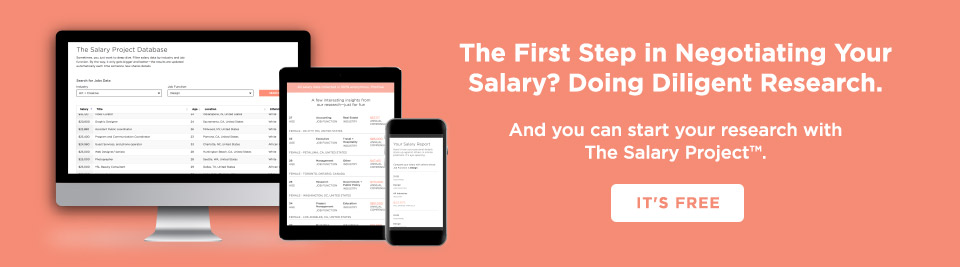
Before your first phone interview, do some research. Scour the web for company review websites (think Glassdoor.com) and look at comparable titles within the company. Then, look at the cross-market salaries of people similarly situated in the industry. Use salary research tools like The Salary Project™ to look at salary data across industries, job titles, and years of experience.

Keep in mind that location is often a major factor in salary. Big city roles can usually command higher salaries because the applicant pool and cost of living are generally much higher. Also note how unique the role is—is this a common position where many people do the same work? If so, there’s probably less salary wiggle room than, say, a specialized position.

Next, evaluate how far you moved the needle at your current job. Make a bulleted list of the things you’ve accomplished and compare those to your original job description. Have you exceeded expectations? If your results are tied to actual company revenue, have those hard numbers handy as well. This is where you’ll humbly explain how talented you are and how your track record proves it.

Not that experienced yet? Be sure you’re fairly assessing the work you’ve actually done instead of what you think you’re capable of doing someday. We know how tough a low salary can be, but keep in mind, you have the rest of your working life to hit your salary goal! Right now focus on hard work and learning.

Be sure you’re fairly assessing the work you’ve actually done instead of what you think you’re capable of doing someday.

Like this Article ?  Share It !    You now can easily enjoy/follow/share Today our Award Winning Articles/Blogs with Now Over 2.5 Million Growing  Participates Worldwide in our various Social Media formats below:

FSC LinkedIn Network:   www.linkedin.com/in/fscnetwork

Facebook:  http://www.facebook.com/pages/First-Sun-Consulting-LLC-Outplacement-Services/213542315355343?sk=wall

Google+:  https://plus.google.com/115673713231115398101/posts?hl=en

Twitter: Follow us @ firstsunllc

Question: Want the ‘the best/current articles/blogs on the web’ on Job Search, Resume, Advancing/Changing your Career, or simply Managing People?

Answer: Simply go to our FSC Career Blog below & type(#career, #leadership, #life) in Blog Search:  https://www.firstsun.com/fsc-career-blog/

What Skill Sets do You have to be ‘Sharpened’ ?

Continue of article:

Step Two: State Your Salary Number

“Where do you want to be salary-wise?” the interviewer says so casually, you’d think she was asking if you’d like cream with your coffee.

Stay cool. This is where men and women tend to differ. Men often give a distinct number based off of market research and self-evaluation. Women tend to give a wishy-washy version of what they’d settle for. If you’ve done your market research and you’ve taken the time to validate what you bring to the table, state your requirements in a concrete fashion, then explain why you feel this number is appropriate.

When the interviewer asks if this number is flexible, simply state you’d be able to reassess once you’ve seen the entire packaged offer. Keep in mind, your “package” could include anything from company equity, vacation days, and growth opportunities, to travel, bonuses, and even awesome office perks—free food anyone?

The younger you are in your career, the more I’d encourage you to consider career growth opportunities over money. Early on, choosing the place that is going to teach you the most will give you the opportunity to learn valuable skills, making you worth more in the future.

Step Three: Counter After the Job Offer

Once you’ve received an initial offer you have some serious negotiating power. They want you, and they’d rather get to a number you’re happy with than start the search all over.

Feel free to counter for more money if they’ve come in lower than your original salary requirement. If they have no flexibility in cash resources, appeal for more vacation days, a signing bonus, more equity, or even a greater annual bonus.

Stay within reason—keep your counter proportionate to the initial offer. Remember back to when the recruiter asked where you wanted to be salary-wise? Your counter offer should fall within the ballpark range of their offer, so no one wastes the other’s time. Chances are you’ll land somewhere in the middle.

According to Linda Babcock, author of Women Don’t Ask, only 7 percent of women negotiate their salary while a staggering 57 men of men do. Those who did ask saw a 7 percent increase in compensation. So ask for more, ladies!

Once you reach an agreement, be sure to thoroughly review your offer letter, sign, and return it within 24 hours. And that’s it! You’ve successfully navigated through negotiating your compensation. Stand proud and let the real work begin.

HOW TO NEGOTIATE A RAISE (BEFORE OR AFTER A PROMOTION)

Step One: Be Proactive and Transparent About the Money

Have an open and honest conversation with your manager, months before review time. Let her know your desire for greater compensation. Don’t wait until the day of your review—by then, it’s too late.
Fairly assess your contributions. What have you done to garner a higher wage? Don’t be fooled into thinking you should get a raise before you perform at the next level. Quite the contrary—you’ll need to prove ahead of time that you are capable of more responsibility, before anyone ups your paycheck.

Be reasonable when negotiating salary by suggesting a number, then backing it up. In addition to recapping your latest and greatest projects, be sure to present research on what others in the industry are making and why you feel your work stacks up.

Once you’ve unearthed what a reasonable raise would look like, ask your boss what she’d like to see performance-wise to help you reach that mark. Let her know you’re willing to work for it.

Your salary is never a reflection of your need for more money. Rent, loans, and other bills are not the concern of your manager. Don’t assume you deserve a raise simply because you have bills to pay. Steer clear of making it personal.

Have an open and honest conversation with your manager, months before review time. Don’t wait until the day of your review—by then, it’s too late.

Step Two: Work Hard First, Negotiate Salary Later

Check in regularly with your manager to see how you’re doing. Be proactive by offering suggestions as to how you can take your position to the next level. Keep track of your own progress. The easiest way to get promoted is to do excellent work at the level you wish to be promoted to.

Don’t shy away. Take on more assignments and regularly ask your manager if there’s more you can be doing. Aim to make her life easier; resurrect important tasks that have fallen off her radar, and be proactive about getting her information she needs ahead of time.

Step Three: Network at Work

Learning to network with employees who are a level or two above you is an excellent way to recruit the support of higher-ups. If you’re perceived as having a peer network of more senior employees, you’ll be that much closer to being perceived as an employee at that level. Instead of blatantly stating you have friends in high places, simply refer to projects you’ve worked on where the stakeholders were more senior.

Follow these three steps and you’re on your way to receiving the raise you deserve come review time. The only thing left to do is persevere. Big salaries and lofty titles are the makings of serious staying power.

CareerContessa.com | BY KATE WESTERVELT  | August 9, 2018