#CareerAdvice : #JobSearch – How to Use #LinkedIn to Add Cold Contacts…Your #Career is About Who you Know, Sure. But it’s Also about Who You can Get to Know. That’s where LinkedIn Comes In.

With over 400 million users, there’s no question LinkedIn reigns supreme as the go-to professional network. From your former roommate to the stranger with your dream job, every savvy woman (and man) seems to have an active account where they regularly post references, professional recommendations, and recommended reads.

If you’re like most users, you’ve probably taken a laissez-faire approach to LinkedIn networking up until now, accepting connection requests from friends or former coworkers when they turn up in your inbox or maybe using LinkedIn’s recommendations to add some people yourself. But that means you’re missing a hugely underutilized opportunity: the network of professionals in your field who you just haven’t met yet.

Navigating that world of untapped connections with poise often brings uncertainty. After all, it’s arguably as hard to reach out to strangers online as it is in person. That’s exactly why we’re breaking down how to use LinkedIn to add cold contacts to three easy steps. Follow these and you’ll significantly up your LinkedIn game. Ready?

HOW TO USE LINKEDIN TO ADD COLD CONTACTS (3 STEPS)

1. FIND A SHARED LINKEDIN CONNECTION OR GROUP

One of the biggest benefits of using LinkedIn to make new contacts? You can visually see connections that you share with others. For example, if you come across a profile of someone you’d like to contact, LinkedIn offers a convenient chart of your mutual connections. Use this to your advantage by reaching out to one of these shared contacts to ask for a virtual introduction, either through LinkedIn or via email.

Obviously, you won’t always have a direct personal connection with someone you’d like to meet, but that’s not the only way forward. Next up, check to see if you’re part of any of the same LinkedIn groups as the person in question. Perhaps you’re members of a professional association, or maybe you both graduated from the same university.

Finding common ground can quickly evolve a cold contact into a warm one. In fact, if you and the person are both members of a group, you can send them a message directly through LinkedIn without having to connect first. Think of it as cutting out the social media middle man.

Charm cold contacts with a personalized connection request. LinkedIn limits you to 300 characters here, but that’s still plenty of space to impress.

Like this Article ?  Share It !    You now can easily enjoy/follow/share Today our Award Winning Articles/Blogs with Now Over 2.5 Million Growing  Participates Worldwide in our various Social Media formats below:

FSC LinkedIn Network:   www.linkedin.com/in/fscnetwork

Facebook:  http://www.facebook.com/pages/First-Sun-Consulting-LLC-Outplacement-Services/213542315355343?sk=wall

Google+:  https://plus.google.com/115673713231115398101/posts?hl=en

Twitter: Follow us @ firstsunllc

Question: Want the ‘the best/current articles/blogs on the web’ on Job Search, Resume, Advancing/Changing your Career, or simply Managing People?

Answer: Simply go to our FSC Career Blog below & type(#career, #leadership, #life) in Blog Search:  https://www.firstsun.com/fsc-career-blog/

What Skill Sets do You have to be ‘Sharpened’ ?

Continue of article:

2. PERSONALIZE YOUR CONNECTION REQUEST

If you aren’t able to turn the cold contact into a warm one through a virtual introduction, your next step is to send a personalized connection request.

LinkedIn allows you to send a connection request when you’d like to add someone new to your network. These potential connections will then receive a notification asking them to accept or decline your invitation. Because the process counts on their approval, without any type of background or explanation, many people are likely to decline an invitation from a stranger.

For this reason, under no accounts send the default “I’d like to add you to my professional network on LinkedIn” message. Trust us on this.

Instead, charm them with a personalized one. LinkedIn limits you to 300 characters here, but that’s still plenty of space to impress them with a short and sweet intro.

The Classic Approach

Hi Jane,
Came across your profile and work at XYZ Company. I’m a fellow aspiring marketing professional and would love to connect.
Regards, 
[fusion_builder_container hundred_percent=”yes” overflow=”visible”][fusion_builder_row][fusion_builder_column type=”1_1″ background_position=”left top” background_color=”” border_size=”” border_color=”” border_style=”solid” spacing=”yes” background_image=”” background_repeat=”no-repeat” padding=”” margin_top=”0px” margin_bottom=”0px” class=”” id=”” animation_type=”” animation_speed=”0.3″ animation_direction=”left” hide_on_mobile=”no” center_content=”no” min_height=”none”][Your Name]

The Admirer Approach

If you’ve seen the person’s work elsewhere (i.e. a publication, conference, networking event, or even through social media), mention it. People love when someone appreciates their hard work. Try something like this:
Hi Jane,
Saw your recent presentation at XYZ conference. I got a lot out of it and would love to chat with you to discuss some questions I had about your work.
Regards,
[Your Name]
Once you’ve successfully connected to someone, you can now send the person a direct message—and you should take advantage of this opportunity every time.

3. SEND A FOLLOW-UP LINKEDIN MESSAGE OR EMAIL

Once you’ve successfully connected to someone, don’t call it a day. You can now send the person a direct message, and you should take advantage of this opportunity every time. Let her know you admire her work or would like to learn more about her career path.

Ask for either an in-person or phone meeting where you can gain more information. Here are some approaches:

The Classic Reach-Out

Hi Jane,
Thank you for connecting with me on LinkedIn. I see that you’ve had a lot of work experience in corporate marketing, a field that I’m hoping to break into. I’ve done a couple of internships in the field and would love your advice on this topic. Would you be willing to speak with me over the phone for 20-30 minutes in the next few weeks? Thanks for your consideration.
Regards,
[Your Name]

The Hybrid Reach-Out

In the case where you’re able to send a message directly without connecting first (i.e., you both share a group), your initial message will look a bit different. Think of it as a combination of Steps 2 and 3. Here’s a good example:
Hi Jane,
I’m a fellow Rice University alumnus who recently graduated with a degree in Marketing. I came across your LinkedIn profile through our alumni group and was intrigued by your work experience in marketing.
I’d love to learn more about your career path and get your perspective on how to best break into the field as a new grad. Would you be willing to speak with me over the phone for 20-30 minutes in the next few weeks? Thanks for your consideration.
Regards,
[Your Name]

BONUS: THE SINGLE BEST TIP WE’VE GOT

In no context should your end goal of adding cold contacts be asking for a job.

You read that right. That part comes later, long after a cold contact warms up. Treat this as your opportunity to ask instead for information and learn more about the person. Informational interviews are great relationship builders, which both expand your network and provide you with tons of helpful career advice and insight from others.

Adding cold contacts on LinkedIn takes more time and effort than simply hitting the “connect” button over and over, but you reap what you sow. Put the time into turning a cold contact into a strong connection that you can keep in touch with over time.

Still feeling shaky about how to master the art of LinkedIn? Enroll in our online course, The LinkedIn Lab, and become a LinkedIn master.
CareerContessa.com | August 29, 2016 | BY KATHERINE NOBLES 

[/fusion_builder_column][/fusion_builder_row][/fusion_builder_container]

#Leadership : #StressManagement – The Difference Between Routine #Burnout & Something Serious…These Days, Most Jobs Come with a Dose of Stress. But if you Can’t Sleep at Night Due to the Anxiety, you Might Have a Bigger Problem.

Have you ever had that feeling when the thought of going to work makes you physically ill? What was once your dream job becomes something you dread on a daily basis. You tell yourself that it’s just a phase, but it’s been days of feeling like this and you can’t seem to generate that spark you once had.

But how do you know when to ask for help, or just book a weekend away? After all, as Lindsay Goldwert pointed out in a previous Fast Company story, for most of us, stress is just part of our jobs. But experiencing it from time to time is different from having it dominate your life. Here’s how to determine when your lack of motivation might be a sign of a bigger problem you need to address.

BURNOUT TAKES MANY DIFFERENT FORMS

There are several common symptoms of burnout–tiredness, lack of productivity, irritability, and in extreme situations, the occurrence of panic attacks. But it manifests in different ways for different people, and there are many underlying issues that lead to it. For Due Quach, the founder and CEO of Calm Clarity, an organization that provides training on growth, leadership and resilience, her interaction with burnout occurred when everything in her professional life was going well, but she lost the motivation that drove her to “succeed” in the first place.

“The way I look at it is, the reason why we do our work is based on extrinsic motivation and extrinsic reward, and [fusion_builder_container hundred_percent=”yes” overflow=”visible”][fusion_builder_row][fusion_builder_column type=”1_1″ background_position=”left top” background_color=”” border_size=”” border_color=”” border_style=”solid” spacing=”yes” background_image=”” background_repeat=”no-repeat” padding=”” margin_top=”0px” margin_bottom=”0px” class=”” id=”” animation_type=”” animation_speed=”0.3″ animation_direction=”left” hide_on_mobile=”no” center_content=”no” min_height=”none”][those are] not aligned with what gives us an intrinsic reward and motivation,” Quach explains. She experienced her burnout while working in the financial industry. Having grown up as a refugee in a crime-ridden, low-income area, she worked in investment banking in order to achieve financial independence. “Once I attained those things, I lost that motivation to continue that slog. My body was telling me [that] I no longer found it rewarding.”

Other possible causes of work burnout might be unfair compensation, unreasonable workload, or too much overtime or after-hours work, according to a 2017 survey by Kronos and Future Workplace. Other reasons include toxic culture or having to work with a difficult boss and colleagues. Whatever the reasons might be, it’s helpful to identify where your feelings might be coming from. That’s the first step in determining the severity of the situation.


Related: These are the reasons why your whole team is burning out 


IDENTIFY WHERE YOUR BRAIN IS OPERATING MOST OF THE TIME

Quach categorizes our brains into three different modes of operation: Brain 1.0, Brain 2.0, and Brain 3.0. As she wrote in her book, Calm Clarity: How to Use Science to Rewire Your Brain for Greater Wisdom, Fulfillment, and JoyBrain 1.0 is what we commonly know as the “fight or flight” mode–when we are afraid and anxious, and have trouble taking information clearly or make sound decisions. “Brain 2.0 is the reward system that’s activated by any reward,” Quach tells Fast Company. Examples might include coffee, substances, achievements, or being a VIP. In her book, she wrote, “When I’m in Brain 2.0, I can get so obsessed with getting the things I want, I impulsively strong-arm people to do things my way. This often leads me to act in ways that make others resent me. In this state, it’s also much harder to resist immediate gratification.” Brain 3.0, is the a state of mind where our activities and bigger purpose in life are aligned. “In Brain 3.0, I experience a deep and lasting sense of contentment, appreciation, and awe for being alive,” Quach wrote.

For those who suspect that they might be experiencing burnout, Quach suggests that they should think of their days like a pie, and identify what percentage of the pie they spend in Brain 1.0, Brain 2.0, and Brain 3.0 in any given day. “Hopefully you’re spending most of your time in Brain 3.0.” As you get closer to burnout, the part that gives you resilience shrinks more and gets closer to zero, she explains. This might be why the job that used to bring you so much energy now saps all the joy out of you. “When I was burning out, I was buying expensive things to try and keep Brain 3.0 activated so I can be more motivated to go to work. At the end of one week I had 10 glasses of wine. When you start to see these things shift, you’re relying more on self-medication,” Quach says. That’s a sign that you’re living in an unhealthy state.


Related: The fastest way to turn around career burnout 


Like this Article ?  Share It !    You now can easily enjoy/follow/share Today our Award Winning Articles/Blogs with Now Over 2.5 Million Growing  Participates Worldwide in our various Social Media formats below:

FSC LinkedIn Network:   www.linkedin.com/in/fscnetwork

Facebook:  http://www.facebook.com/pages/First-Sun-Consulting-LLC-Outplacement-Services/213542315355343?sk=wall

Google+:  https://plus.google.com/115673713231115398101/posts?hl=en

Twitter: Follow us @ firstsunllc

Question: Want the ‘the best/current articles/blogs on the web’ on Job Search, Resume, Advancing/Changing your Career, or simply Managing People?

Answer: Simply go to our FSC Career Blog below & type(#career, #leadership, #life) in Blog Search:  https://www.firstsun.com/fsc-career-blog/

What Skill Sets do You have to be ‘Sharpened’ ?

Continue of article:

CHECK YOUR PHYSICAL SYMPTOMS AND HEALTH HISTORY

Say you realized that you spend most of your time in Brain 1.0, and you feel that it’s time to get some professional help. How do you know who to reach out to? Quach recommends that to determine what kind of help is best–you should pay close attention to your physical symptoms as well as your health history. If your family has a history of depression, for example, and you suspect that your burnout might be a case of neurotransmitter imbalance, it might be worth seeing a psychiatrist. If you’re having trouble sleeping and your lack of sleep is exacerbating your burnout, it’s probably best to make an appointment with a medical doctor who specializes in sleep. If you don’t see any physical symptoms and it’s just about a lack of drive, perhaps a life coach might be a good person to contact. After all, you might just need someone to help you see “what is and isn’t a good career option for you, and see if reshaping your career makes sense,” Quach says.


Related: How employee burnout became an epidemic and what it might take to fix it 


ASK YOURSELF WHAT REALLY MATTERS

Physical symptoms aside, burnout is really about not spending your time in a way that aligns with your priorities and values. “There are groups of people who are so used to following the ‘right’ path,” Quach tells Fast Company. You can find many of these people in industries like law, finance, and medicine, Quach says. As a result, you tend to see a lot of burnout in those industries. On the other hand, those who are explorers and have taken more time to build their careers might have more agency over their professional life and have the view that they have a choice in how they shape their job. “When you’re in Brain 3.0, you can initiate the things that you care about. That prevents burnout,” Quach explains.

For those who still struggle to find their purpose, Quach suggests that they try writing a letter to their future aspirational self. “That usually creates a huge change in intrinsic motivation,” she said. Then it’s a matter of tweaking what’s in their environment. “People start to realize that burnout can be avoided because you make choices that express your higher self.”

ABOUT THE AUTHOR

Anisa is the Assistant Editor for Fast Company’s Leadership section. She covers everything from personal development, entrepreneurship and the future of work.

 More


FastCompany.com | August 2, 2018 | BY ANISA PURBASARI HORTON  6 MINUTE READ

[/fusion_builder_column][/fusion_builder_row][/fusion_builder_container]

#CareerAdvice : #Networking – How I Leveraged an #InformationalInterview to Land a #Job …Networking is Something that I Didn’t Value (or even really understand) Before I Stumbled into my First Informational Interview.

THE INITIAL MEETING :

There was a woman in one of my first master’s classes who was very well spoken, and generally quite impressive. Our class only met once a month, and each time she left an impression on me. Finally, after the last class, I approached her and asked if I could meet her for breakfast to learn what she does for a living.

I’ll never forget it, we met on a Saturday morning at The Olde House Café. She told me how she worked in the insurance industry, the finance industry and for the past few years, she’s been in the sports apparel industry. She worked for Under Armour in Baltimore, Maryland. As a lifelong athlete, I envisioned a company run by big, sweaty guys; not intelligent, sophisticated women.

Hearing her story of how she transitioned into different industries and learned from well-seasoned leaders that mentored and coached her along the way was fascinating and encouraging. To my surprise, she asked me a few questions at breakfast, to learn about my background and experiences and asked that I follow up with my resume. I did that, and for the next year and half, we kept in casual contact.

…AND THE FOLLOW-UP

As I was finishing up my degree, I reached out to her and shared that I was starting the job search. She replied with a job offer (as a temp) for me that eventually parlayed into a full-time position—I’ve been living and working in Baltimore ever since.

Today, I still utilize informational interviews as a way to make connections in my industry and expand my network. Additionally, I am now on the receiving end of the informational interviews with messages on LinkedIn. In a given month, I receive about 2 inquiries each week. Given my personal experience and success with informational interviews, I do my best to respond and accept most inquiries.

Like this Article ?  Share It !    You now can easily enjoy/follow/share Today our Award Winning Articles/Blogs with Now Over 2.5 Million Growing  Participates Worldwide in our various Social Media formats below:

FSC LinkedIn Network:   www.linkedin.com/in/fscnetwork

Facebook:  http://www.facebook.com/pages/First-Sun-Consulting-LLC-Outplacement-Services/213542315355343?sk=wall

Google+:  https://plus.google.com/115673713231115398101/posts?hl=en

Twitter: Follow us @ firstsunllc

Question: Want the ‘the best/current articles/blogs on the web’ on Job Search, Resume, Advancing/Changing your Career, or simply Managing People?

Answer: Simply go to our FSC Career Blog below & type(#career, #leadership, #life) in Blog Search:  https://www.firstsun.com/fsc-career-blog/

What Skill Sets do You have to be ‘Sharpened’ ?

Continue of article:

OUR ADVICE

From my own experience requesting an informational interview, I’ve found that being brief and specific is the best way to get a positive response, when you reach out. The most thoughtful element is explaining what you do or what you are interested in. I like to be prepared for these conversations and when people are generic, it doesn’t maximize the time we have to connect. However, I’ve gained enough experience to be prepared for most conversations.
For example, when an undergraduate student contacts me, and I have a book recommendation for them, I always advise them to utilize their college’s careers office since I did not as a student and wish I would have. In speaking with a colleague in the industry, I have an elevator pitch prepared to summarize my role and either an event or newsletter to subscribe to, that they may find valuable.

One aspect that makes informational interviews a great asset to me is that when I have a meaningful and organic connection with someone, as a result of an informational interview that I requested; I stay in touch with them. Typically, I am requesting informational interviews with individuals across the country and sometimes I find myself traveling to the cities where they work; but mostly I keep in contact with regular phone calls.

Professionally, it has been an asset to me to have contacts at different companies for different projects. Personally, if I were to be searching for a career change, I feel confident my network would be a great resource as a result of these informational interviews.

CareerContessa.com | BY KELLY BECKER    | March 06, 2018

#CareerAdvice : #SalaryNegotiations -Why Summer is the Best Time of Year to Ask for a #Promotion And Why Fall is the Worst Time… If you’re Looking for a Promotion, Now’s the Time to Act.

After reviewing data from 3.5 million employees at about 80 companies, workforce analytics provider Visier Analytics found that summer is the best time to get promoted.

“Traditionally, organizations award promotions as recognition for a good year of performance,” says Ian Cook, head of workforce solutions for Visier. “They usually follow a cycle, such as reviews in January and February, and raises and promotions locking in during the second quarter.”

The worst time to ask for a promotion is fall. “[fusion_builder_container hundred_percent=”yes” overflow=”visible”][fusion_builder_row][fusion_builder_column type=”1_1″ background_position=”left top” background_color=”” border_size=”” border_color=”” border_style=”solid” spacing=”yes” background_image=”” background_repeat=”no-repeat” padding=”” margin_top=”0px” margin_bottom=”0px” class=”” id=”” animation_type=”” animation_speed=”0.3″ animation_direction=”left” hide_on_mobile=”no” center_content=”no” min_height=”none”][In late third quarter] companies are taking stock of the year and doing a financial wrap-up,” says Cook. “They’re trying to get the year closed out, and make targets, budgets, and a plan built for next year. They aren’t thinking about promotions because they’re too busy. It’s a natural cycle driven by the financial calendar.”

YOU’LL PROBABLY HAVE TO ASK
If you had a performance review and didn’t get a promotion, circle back and ask for one, says Cook. “While it’s easy for companies to manage everybody at once, it’s not the way employees experience the consumer world, where actions happen in an immediate or short cycle,” says Cook. “You should definitely ask.”

The best way to ask is when you get positive feedback, says Cook. “For example, ‘I’m hearing that I’m performing well and contributing the right kind of work. What opportunities do I have to be recognized?’” he says. “That’s much better than threatening to leave. It could be uncomfortable if your employer has no space to give.”

If you’re a high performer, you have a better chance of getting your request granted. “When it comes to good people, organizations aren’t able to promote fast enough,” says Cook. “Management needs to have their eyes and ears wide open for high performers to make sure to keep pace with their abilities and level of patience. High performers are rarely patient.”


Like this Article ?  Share It !    You now can easily enjoy/follow/share Today our Award Winning Articles/Blogs with Now Over 2.5 Million Growing  Participates Worldwide in our various Social Media formats below:

FSC LinkedIn Network:   www.linkedin.com/in/fscnetwork

Facebook:  http://www.facebook.com/pages/First-Sun-Consulting-LLC-Outplacement-Services/213542315355343?sk=wall

Google+:  https://plus.google.com/115673713231115398101/posts?hl=en

Twitter: Follow us @ firstsunllc

Question: Want the ‘the best/current articles/blogs on the web’ on Job Search, Resume, Advancing/Changing your Career, or simply Managing People?

Answer: Simply go to our FSC Career Blog below & type(#career, #leadership, #life) in Blog Search:  https://www.firstsun.com/fsc-career-blog/

What Skill Sets do You have to be ‘Sharpened’ ?

Continue of article:

AND YOU MIGHT HAVE TO QUIT
Also consider changing companies, especially if you haven’t been in the workforce very long. “At that level of a career, moving makes sense,” says Cook. “There is more opportunity if you think of the workplace like a pyramid, where the bottom is wider and there is more space to go up.”

Summer is a good time to get a promotion by changing companies because job openings often happen during the vacation season.

“When employees are away on holiday resting, they often think, ‘I’m killing myself at work.’ They decide it’s time to move, and come back and take action,” says Cook. “Also, a lot of employees wait for the bonus cycle, which often comes in February or early spring. Then they wait to get paid and then leave.”

The job they vacate may be the promotion you’ve been looking for.


FastCompany.com | August 1, 2018 | BY STEPHANIE VOZZA 2 MINUTE READ

[/fusion_builder_column][/fusion_builder_row][/fusion_builder_container]

#Leadership : #WorkPlace – All your #CoWorkers’ Weird Behavior, Explained…. A Psychologist Breaks Down the Three Factors that Drive most People’s Actions. Understand These, and your Colleagues’ Behavior Won’t Seem so Puzzling.

Succeeding at work requires understanding other people’s actions and the motivations behind them: Did your colleague intentionally word her email in a way meant to undermine your credibility? Did your client fail to call back because he’s thinking of using another supplier? Did your boss pass you in the hallway without smiling because she’s angry at something you said in your last meeting?

There’s a good chance that, without realizing it, you habitually choose a particular type of explanation for other people’s behavior. And the one you tend to choose matters, because it determines how you react. If you misdiagnose the cause of someone’s actions, you run the risk of doing something that could make a situation worse. To avoid that, it helps to understand the primary factors that drive most people’s actions. Here are the top three worth thinking about anytime you’re puzzling over something a colleague might’ve done or said, and determining how best to respond.


Related: How these 4 different personality types find motivation


1. TRAITS

This is arguably the most common factor people use when thinking about other people’s behavior. A trait is a stable tendency someone displays in their interactions with the world. Many (but not all) of these traits reflect personality characteristics that guide people’s choices and actions. For example, you may assume your colleague said something to undercut your credibility because you know her to be manipulative. This tendency of hers corresponds to the common personality characteristic of Machiavellianism, which reflects the degree to which individuals try to manipulate others for their own gain.

Yet despite how often we use traits to explain others’ behaviors, psychological studies generally suggest that personality characteristics account for only around 20%–30% of differences in individuals’ behavior (and the real world, of course, is even messier than controlled studies). That means you probably need to look beyond traits to understand what other people are doing and why they’re doing it.


Related: These personality tests found things out that only my mom knows


Like this Article ?  Share It !    You now can easily enjoy/follow/share Today our Award Winning Articles/Blogs with Now Over 2.5 Million Growing  Participates Worldwide in our various Social Media formats below:

FSC LinkedIn Network:   www.linkedin.com/in/fscnetwork

Facebook:  http://www.facebook.com/pages/First-Sun-Consulting-LLC-Outplacement-Services/213542315355343?sk=wall

Google+:  https://plus.google.com/115673713231115398101/posts?hl=en

Twitter: Follow us @ firstsunllc

Question: Want the ‘the best/current articles/blogs on the web’ on Job Search, Resume, Advancing/Changing your Career, or simply Managing People?

Answer: Simply go to our FSC Career Blog below & type(#career, #leadership, #life) in Blog Search:  https://www.firstsun.com/fsc-career-blog/

What Skill Sets do You have to be ‘Sharpened’ ?

Continue of article:

2. SITUATIONS

Situational circumstances play a big role in what people do and don’t do. So when you’re trying to evaluate what a coworker has done, you also need to think about the context in which they’ve done it. Suppose you left two messages for a client who hasn’t called you back. See if there’s anything you know about that client’s work that might help you figure out what’s going on. You might notice, for instance, that it’s toward the end of their fiscal year, and so they may be dealing with budgets.

Considering the context might sound like an easy or obvious thing to do, but our tendency to interpret events based on personality traits can make situational factors hard to see. To help you out, imagine yourself in the other person’s shoes for a moment: What might be going on around you that would lead you to act as that person did? Even if you can’t diagnose their behavior accurately this way, it may help you avoid assuming that the primary reason for their action was a trait.

3. GOALS

The third big determinant of someone’s actions is their current goals. Most of us overestimate our own impact on people’s behavior. As a result, we assume that we ourselves somehow figure into the explanation for why somebody’s acting in a particular way, when in reality we don’t. It’s much more likely they have some other goal in mind that’s driving what they do.

For example, your boss may have passed you in the hallway without smiling because she’s late for a meeting with a senior executive. She is isn’t angry at you for some prior comment (a situation), and she isn’t generally a cold person (a trait); she’s just mentally preparing for her next meeting (a goal) while on the run. So before jumping to conclusions about someone’s behavior, ask yourself what goals might lead them to act as they did.

As a general strategy, it’s smart to mentally cycle through the traits, situations, and goals that might be motivating your coworkers’ perplexing behavior. The more possibilities you consider, the better prepared you’ll be to respond effectively.

FastCompany.com | 08.01.18 | THE SCIENCE OF WORK

#CareerAdvice : #CareerNetworking – Three Surprising Ways your #Network can Help your #JobSearch … #Networking Doesn’t Always Lead to #Referrals or #Introductions to #HiringManagers . But Sometimes your Contacts can Prove Helpful in Ways you Hadn’t Expected.

My professional network has never led directly to a job opportunity. I’ve had people on the inside graciously pass along my resume and extend referrals, but while I’ve landed interviews this way, they’ve never crystallized into an offer. In fact, every job offer I’ve ever received has come about the old-fashioned way: by applying to a job posting.

NETWORKING LETS YOU PRACTICE TALKING ABOUT YOUR WORK

If it’s been at least a year since your last job search, there’s a good chance you’re out of practice describing your work to people outside your organization. There’s actually an art to answering the familiar question, “So what do you do?” and since most interviews kick off with, “Tell me a little about yourself,” networking conversations can actually double as interview prep.

Networking with people while you’re job hunting forces you to get beyond those boring one-line summaries of your current job description. As you start telling folks in your network what you’re looking to do next, you’ll also have to characterize your strengths and interests, drum up examples of recent projects you’re proud of, and make connections between your current role and your ambitions for the next stage in your career.

Articulating all of this takes practice. Plus, in addition to helping you refine your pitch to hiring managers and recruiters, this also gives your network a clearer sense of what opportunities to keep a lookout for on your behalf.

Here’s what to ask your contacts:

  • “Does the experience I’ve just described make sense? And does it sound interesting?
  • “Based on what I’ve told you, what sounds like my top strength? What about my biggest weakness?”

Related: How to answer “What do you do?” without boring anyone


Like this Article ?  Share It !    You now can easily enjoy/follow/share Today our Award Winning Articles/Blogs with Now Over 2.5 Million Growing  Participates Worldwide in our various Social Media formats below:

FSC LinkedIn Network:   www.linkedin.com/in/fscnetwork

Facebook:  http://www.facebook.com/pages/First-Sun-Consulting-LLC-Outplacement-Services/213542315355343?sk=wall

Google+:  https://plus.google.com/115673713231115398101/posts?hl=en

Twitter: Follow us @ firstsunllc

Question: Want the ‘the best/current articles/blogs on the web’ on Job Search, Resume, Advancing/Changing your Career, or simply Managing People?

Answer: Simply go to our FSC Career Blog below & type(#career, #leadership, #life) in Blog Search:  https://www.firstsun.com/fsc-career-blog/

What Skill Sets do You have to be ‘Sharpened’ ?

Continue of article:

TALKING TO YOUR NETWORK HELPS YOU FOCUS (OR EXPAND) YOUR SEARCH

You may never have had a professional mentor, but as soon as you mention you’re job searching, just about everyone snaps into mentorship mode. They’re quick to ask questions about your current job and what you’re hoping for in the next one. They grill you about where you’re looking and whether you’ve landed any interviews yet. They wrack their brains for people they know that you might want to talk to.

This knee-jerk generosity can be helpful, or not. (Your friend’s new roommate might not know a damn thing about your industry even though he’s really excited to help.) But these discussions can be clarifying even when they don’t cough up job leads. Sometimes you’ll notice somebody interpreting your work history in a different light than you see it, which could cue you to reframe your experience in future career conversations. Other times someone may suggest a company or a type of role that you hadn’t considered before. And once in a while, a contact with deeper experience in your field might brush away worries about your competitive weaknesses and put their finger on something completely different that you should really focus on.

These networking interactions can lead you to shift your strategy, sometimes in small ways and sometimes much more radically. The best part is that even people who are relatively ignorant about your field or career ambitions can still help you adjust your game plan, whether it’s to find focus or think more broadly.

Here’s what to ask your contacts:

  • For people who are less knowledgable about your field: “Hypothetically, If I were to leave my field, what types of other roles do you think I’d be qualified for?”
  • For those who know a lot about your field: “What types of candidates do you think I’m most likely to be competing with for this role? Should I consider different types of positions?”

Related: These two exercises can help you radically think your career


YOUR NETWORK CAN HELP YOU VET JOB OFFERS

In my experience, a professional network is most effective at helping you size up job opportunities. Sometimes the hardest part of the hiring process isn’t crafting a great resume or preparing for an interview, it’s deciding whether to take the job once it’s finally offered.

The folks in your network might not know the hiring manager or an HR rep inside the company, but they’re much more likely to know someone who works there and can speak generally about their experiences on the inside. This is often the real benefit of those “weak connections”; the people who know the people you know, even though they’ve never met you, probably won’t give you an endorsement. But many are happy to jump on a 20-minute call with you and share their thoughts on the position you’re applying to, plus any words of caution or advice.

All of this is underappreciated intel. If you can land these conversations before going on a job interview or even before applying, they’ll help you tailor the way you position your candidacy. These second-degree contacts can also clue you into potential drawbacks and suggest good questions to ask about the team, the work culture, and the demands of the role. And if someone has already agreed to chat with you about a job opportunity, they probably won’t blink when you ask if there are any other insiders they might be willing to introduce you to. Before you know it, you’ll have tapped into a brain trust of in-the-know contacts who can share critical insight to guide your strategy and decision making.

Here’s what to ask your contacts:

  • When you’re looking for company insiders: “Do you know any current or former employees at X company who might be willing to chat with me about their experience there?”
  • After speaking with company insiders: “Thanks for chatting with me! If you can think of anyone else you work with who may have some insight into the role I’m pursuing, I’d love to be connected.”

Related: 4 questions to help answer the big one: “Should I take this job?”


So no, your immediate network might not be much help in connecting you with the top decision makers for the specific job opportunities that appeal to you. But if you give them a chance, your professional contacts can probably help you out much more–and in many more ways–than you think.

ABOUT THE AUTHOR

Rich Bellis is Associate Editor of Fast Company’s Leadership section.

 More


FastCompany.com | July 31, 2018 | BY RICH BELLIS 5 MINUTE READ

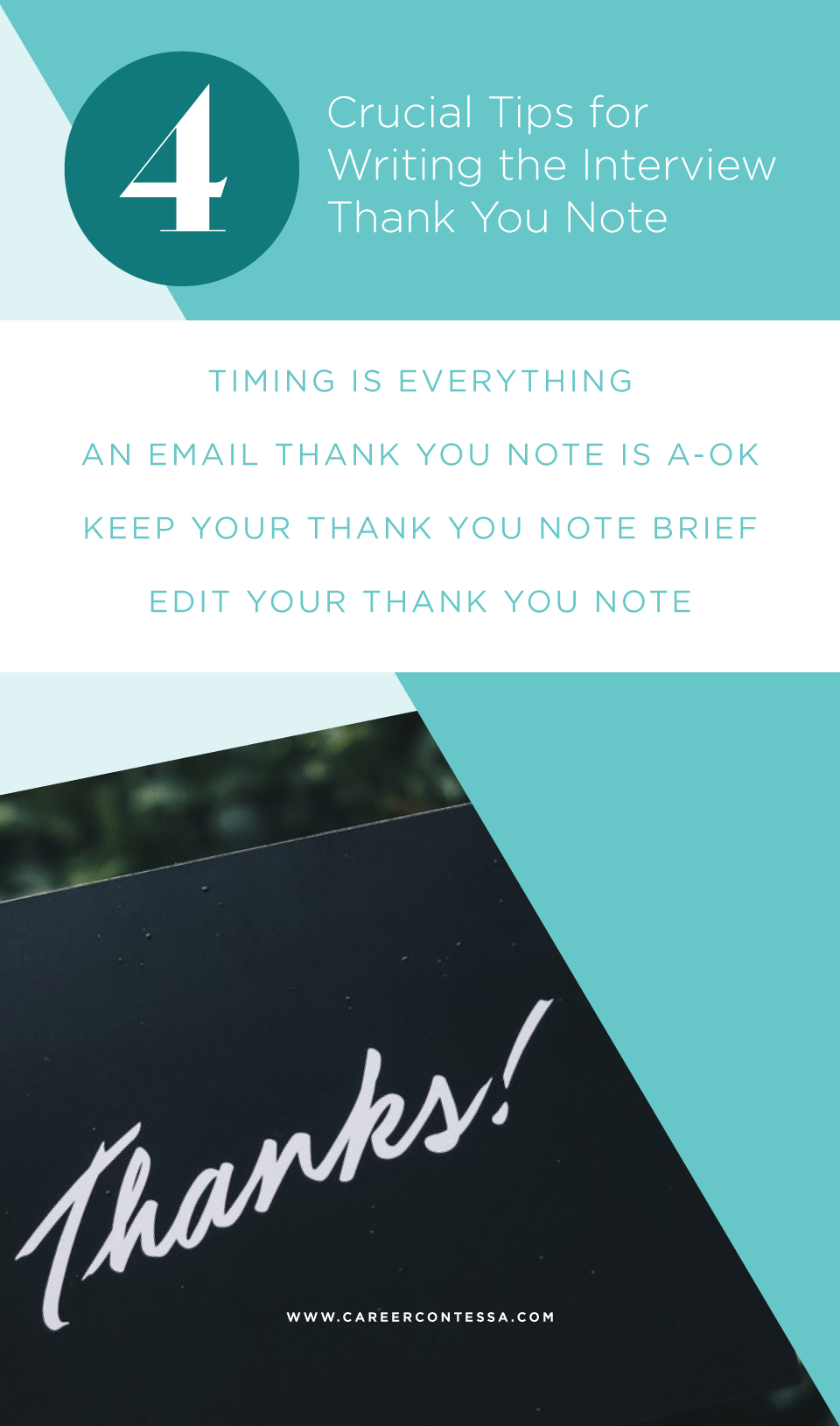
#BestofFSCBlog : #JobSearch – Four(4) Crucial Tips for Writing the Interview Thank You Note. So you Really Want this Job?  

So you really want this job?  You have likely already written a captivating cover letterundergone a brief phone interview and finally, were invited into the office for an interview. The interview went swimmingly (because you prepped for it like a pro)? Awesome! Now that you’re exiting the office building of your (hopeful) future job, it’s time for your next step.
Enter: the thank you note. The thank you note should be a no-brainer. It is a perfect way for a candidate to give herself the final edge over other candidates in the interview process.
Writing the thank you note does not have to be an exhaustive process. However, a candidate can (and should!) use it as an opportunity to edge out the other candidates.

TIMING IS EVERYTHING

Interviewing is an arduous process for any job candidate. In much the same way, it can be a stressful time for the hiring manager. My number one piece of advice in writing a thank you note for a job you really want?
Do it right away. Even if you killed the interview and expect a call saying “You’re hired!” by the end of the day, write the note. Express your gratitude and keep your candidacy fresh in the hiring manager’s mind. DO NOT wait until a week later when you haven’t heard anything to shoot off a “by the way, thanks” email.
A well-timed thank you note after an interview is a perfect way to reiterate your excitement to join the team. Aim to send your thank you note no within 24 hours of the end of the interview.

Like this Article ?  Share It !You now can easily enjoy/follow/share Today our Award Winning Articles/Blogs with Now Over 2.5 Million Growing  Participates Worldwidein our various Social Media formats below:

FSC LinkedIn Network:   www.linkedin.com/in/fscnetwork

Facebook:  http://www.facebook.com/pages/First-Sun-Consulting-LLC-Outplacement-Services/213542315355343?sk=wall

Google+:  https://plus.google.com/115673713231115398101/posts?hl=en

Twitter: Follow us @ firstsunllc

Question: Want the ‘the best/current articles/blogs on the web’ on Job Search, Resume, Advancing/Changing your Career, or simply Managing People?

Answer: Simply go to our FSC Career Blog below & type(#career, #leadership, #life) in Blog Search:  https://www.firstsun.com/fsc-career-blog/

What Skill Sets do You have to be ‘Sharpened’ ?

Continue of article:

AN EMAIL THANK YOU NOTE IS A-OK

We know you still have that Laura Ashley stationery your grandma gave you for your high school graduation. We know it’s embossed with your initials.
However, 87 percent of hiring managers view email as a perfectly acceptable means of delivering your thank you note. Since we have already established that timing is everything, email is going to be your best bet.

KEEP YOUR THANK YOU NOTE BRIEF

By this point in the interview process, your hiring manager has likely learned a ton about you. Do not use the thank you note to reiterate the play-by-play.
You can (and should) use it as a means to communicate one point you may have neglected to make, to expand on an idea or simply to express feelings of excitement for the job itself. Since the hiring manager is also busy interviewing, reading resumes, and communicating with other stakeholders, keep your note on point.

EDIT YOUR THANK YOU NOTE

So far, we have focused heavily on the speed and brevity of this note. But that doesn’t mean it’s informal! Make sure to use a formal greeting, write clear (and concise!) sentences, and sign off formally. This is not a one-liner to say “Thanks, Dude!”
Just as easily as a thank you note can impress a hiring manager, it can also detract from the whole process. A spelling error or flippant manner of writing can undo your progress. Write your thank you note, read it over a few times aloud, spell check it, and get a second pair of eyeballs on it if you can.
Crucial Tips Interview Thank You
CareerContessa.com | BY CAILEEN KEHAYAS  |  July 25, 2018

#Leadership : #HiringEmployees – Here’s What Most People get Wrong about “Passion”….These Days, many People See Passion as Something they Either Have or Don’t Have. Here Are the Reasons Why That’s the Wrong Mentality.

Yes, it’s cliché. But while we all seem to get that marriage requires more than a little love and affection, there’s still this pervasive myth that passion is the secret key to your career.

Don’t get me wrong. Passion counts for a lot, especially if you’re tasked with convincing someone to give you a shot.

When it comes to making career transitions for happiness, I’m not just a poster child–I’m a freeway billboard. In my own work, I’ve made not one pivot but three, and in each of those instances, I convinced someone to take a chance on me despite an unconventional resume. They saw something that didn’t fit on one page of cream-colored paper, and I benefited from that. So talking the talk definitely counts for something.

But there’s something about this post-millennial era that’s got it twisted (post-millennial Rihanna reference definitely intended). Too many of us have lost track of the nuances.

With the rise of buzzwords like “manifesting” and “passion projects,” there’s another underlying belief system at play: that wanting something badly enough actually makes you qualified to have it.

Much like a happily-ever-after plot line, underneath all the talk about boundless passion or a candidate’s personal goals-slash-dreams, there’s just not much meaning.


Related: How to tell the difference between a career pivot and a distraction 


THE MYTH OF THE BIG ENTRANCE

I often see this mentality in cover letters when we’re hiring. Sentence after sentence argues (usually incredibly articulately) about how transcendent the experience of working with us will be.

“There’s nothing I’ve ever wanted more than to work at Career Contessa improving the lives of women every day.”

These are lovely words, and I imagine many people automatically react to them the same way I did: It feels good to hear that the work your company does means so much to someone. And it’s easy–especially after that ego boost–to think that their chutzpah equals professional tenacity. But does it really?

I’ve had an interview where someone told me I should hire her because she was ready to harness her abundant creativity. Others have told me they can’t wait for a flexible work environment that will let them explore their outside interests. Once, a 23-year-old told me that getting hired would help her grow her personal brand and following (lucky me?).

As I’m listening, there’s a common thread that’s hit-you-over-the-head clear, and it’s not “this person is star employee material.” It’s more like: me, me, me.

“I want a career that fulfills me.”

“I love that this job gives me flexibility, so I can work on my other projects.”

“This is the perfect stepping stone toward my ultimate goal of working for myself.”

It’s not that these are bad things to think, exactly–it’s that there are more complex thoughts and conversations to have. Thoughts like these are big-picture thinking taken to extremes like a climactic scene from some ’90s Meg Ryan movie. Much like a happily-ever-after plotline, underneath all the talk about boundless passion or a candidate’s personal goals/dreams, there’s just not much meaning.

Almost every time I’ve hired someone who sells solely their unbridled passion, breezing over their past work, or concrete experiences, I’ve come to regret it.

Like this Article ?  Share It !    You now can easily enjoy/follow/share Today our Award Winning Articles/Blogs with Now Over 2.5 Million Growing  Participates Worldwide in our various Social Media formats below:

FSC LinkedIn Network:   www.linkedin.com/in/fscnetwork

Facebook:  http://www.facebook.com/pages/First-Sun-Consulting-LLC-Outplacement-Services/213542315355343?sk=wall

Google+:  https://plus.google.com/115673713231115398101/posts?hl=en

Twitter: Follow us @ firstsunllc

Question: Want the ‘the best/current articles/blogs on the web’ on Job Search, Resume, Advancing/Changing your Career, or simply Managing People?

Answer: Simply go to our FSC Career Blog below & type(#career, #leadership, #life) in Blog Search:  https://www.firstsun.com/fsc-career-blog/

What Skill Sets do You have to be ‘Sharpened’ ?

Continue of article:

CUE THE FLAGGING DEDICATION

What these conversations lack is the collaborative element that real, lasting professional relationships need. Because if work is about innovation and empathy, there’s more to it than what any one of us wants to do. It’s about how we can adapt and change each other and do real work together.

There’s this inherent privilege in the passion-is-everything perspective, and maybe that’s why it bothers me so much. If you’re responsible for making rent and paying down student loans, you don’t get to plan your life solely around your passion projects. You earn time to focus on those, courtesy of a whole lot of hard work. So this idea that passion is The Answer, that’s reserved for a very few people–the ones who can “just quit” when the going gets tough.

Almost every time I’ve hired someone who sells solely their unbridled passion, breezing over their past work or concrete experiences, I’ve come to regret it.

They fail to meet deadlines. They balk at busy work. They give notice after three months because they’ve committed to too many other side projects. They’re the sort of personalities who wind up with two- or four-month jobs on their resumes and not much more. They fall through.

When you’re focused solely on the personal endpoint–your own success, full stop–how can you make space for all the work that needs to get done in between? And if your eye is only on the prize, how are you supposed to stay energized when the process takes longer than expected?

Newsflash: It always does.


Related: Ask yourself these questions at every stage of your career


AND THEN THERE’S THE PASSION JUDGMENT

There’s more to it than that as well. There’s also the fact that many of us don’t know what we’re passionate about, and thanks to the rise of the passion-first mentality, we tend to feel like we’re failing if we don’t. We look at others with all that conviction and energy, and we think they must have it figured out. That comparison can affect us in various ways, but the scariest is that it threatens to have an adverse effect: It can stunt our growth.

If you approach every job with an open perspective, chances are the experience will help you with your growth. Even a terrible job can teach you what industry suits you or make you realize what you’re innately great at. But if you don’t give it a chance–because it’s not what you think is your passion, right now, right this second–how will you ever really keep evolving?

Passion these days is a black-and-white myth. We tend to believe that either you have it or you don’t. And like most things, inflexible thinking will ruin us.

Work first, passion second. Because what is passion, really, if you’re not willing to fight for it?


Related: 7 ways to make your job meaningful again


GIVE ME THE DEDICATED DOERS, NOT THE PASSIONATE DREAMERS

I’m not interested in the passionate dreamers or the “currently working on” hustlers as much as I’m interested in the people who work in the gray zones somewhere in between. These are the people who never cease to impress and surprise you. They’re also the ones who challenge you. They make you think–and work–differently.

A friend of mine, a creative director for a fashion brand, once listened in silence as a 19-year-old told her that once her modeling career finished, she’d “just become a creative director since I love styling.”

Just become.

That friend climbed ranks over a decade one production assistant job at a time, worked 60-hour weeks or more, and moved across the country twice for new opportunities. She loves her job today more than anything, precisely because she worked her ass off to get there. Passion came later.

Work first, passion second. Because what is passion, really, if you’re not willing to fight for it?

There’s a similar adage that goes something like this, “Don’t do anything for five minutes that you wouldn’t do for five years.” It’s one that people rarely linger on, maybe because it makes us uncomfortable. Such a span seems dramatically out of sync with our iPhone-laden era. And that’s precisely why the five-plus-yearers are that much more impressive to me.

It’s not that I’m asking people to give up all their passion or to stick it out in a job that makes them miserable. But when I think about the sort of people I see with flourishing careers, they’re never the Passionates, they’re the Commitments. The ones who don’t treat “passion” as their everything but simply as the product of putting effort into working, questioning, and exploring. They’re not the biggest show-stealers, but they’re doing more than alright.

FastCompany.com | July 29, 2018 | BY KIT WARCHOL—CAREER CONTESSA 6 MINUTE READ

#CareerAdvice : #ResumeWriting – 6 Ways to Make the Skills Section Shine on a #Resume …Here are a Few More Tips on How to Make the #SkillsSection on your Resume Truly Shine.

For many resume writers, the “skills section” presents a unique quagmire. On the one hand, you want to showcase as many skills as you can to show your competence. On the other hand, you don’t want to make it look like you’re padding your resume, and you definitely don’t want to list skills that you’re only half-competent at.

Resume writer Anish Majumdar recommends building your skills section by writing out the skills you need at your current job, and then reviewing your list and circling skills that correlate with your target position. “Finally, underline those circled skills which can be proven on your resume. These are the ones you need to focus on,” writes Majumdar.

Once you’ve done that, here are a few more tips on how to make the skills section on your resume truly shine:

1. Give it all you’ve got

Don’t be shy about layering on your skills – both hard and soft skills. Just because you’re a software engineer doesn’t mean you don’t need to showcase your communication, cross-sector collaboration, and time management abilities. In fact, listing those skills alongside your competency with Java and Python will make you stand out from the crowd. Layering your resume with skills can serve to give recruiters a well-rounded, multi-faceted image of you.

2. Only include the good stuff

That being said, you need to make sure you’re not putting skills on your resume merely to bulk it up. Certain skills, like knowing how to use Microsoft Word or email, are too basic to distinguish you from other candidates. These competencies are obvious to recruiters, and should not be placed on your resume. If the answer to the question “can every other applicant to the job write that they have this skill?” is yes, you might want to reconsider taking up precious resume real estate with the skill.


Like this Article ?  Share It !    You now can easily enjoy/follow/share Today our Award Winning Articles/Blogs with Now Over 2.5 Million Growing  Participates Worldwide in our various Social Media formats below:

FSC LinkedIn Network:   www.linkedin.com/in/fscnetwork

Facebook:  http://www.facebook.com/pages/First-Sun-Consulting-LLC-Outplacement-Services/213542315355343?sk=wall

Google+:  https://plus.google.com/115673713231115398101/posts?hl=en

Twitter: Follow us @ firstsunllc

Question: Want the ‘the best/current articles/blogs on the web’ on Job Search, Resume, Advancing/Changing your Career, or simply Managing People?

Answer: Simply go to our FSC Career Blog below & type(#career, #leadership, #life) in Blog Search:  https://www.firstsun.com/fsc-career-blog/

What Skill Sets do You have to be ‘Sharpened’ ?

Continue of article:

3. Bulk your skills up

No, this doesn’t mean by padding your resume with skills you don’t have! If there are certain skills that you find would be helpful to have for the jobs you’re applying to, but you don’t currently have, it might be time to take a class or do a training on these skills. It also might be a question of brushing up certain skills, so that you can show them off, like upgrading your “intermediate proficiency” in Spanish to “professional working proficiency”. Investing time and money in these skills now can have big payoffs in the future.

4. Be straightforward

The skills section of your resume is not the place to sugarcoat. What you see as a rose-colored picture of a certain skill might simply be seen as a fib by a recruiter. Let’s take the Spanish example again. Suppose you say you have “professional working proficiency”, when you really just spent a semester abroad in Spain when you were in college 10 years ago, and haven’t practiced the language since. A portion of your job interview is conducted in Spanish – yikes! Or even worse, you get the job, and your first assignment is to interface with an Argentinian client – completely in Spanish. Chances are you won’t be at the job for much longer. Even little resume fibs can cause big trouble.

5. Showcase your transferable skills

Especially if you’re transitioning careers, showing off your transferable skills is critical to fleshing out the skills section of your resume. Transferable skillsinclude things like leadership, analytics, communication through writing, public speaking, mathematical reasoning, or organizing meetings. These type of skills can give you the boost you need in showcasing your experience.

6. Back yourself up

Soft skills like “coordination with sub-contractors” can sound intangible and airy – which is why you shouldn’t be afraid to back yourself up with a few examples and numbers. “Coordinated weekly with 12 subcontractors to drive a project slated to take 6 months to a 3-month completion time” packs more of a punch, and lets whoever’s reading your resume visualize better your abilities.

GlassDoor.com |  

#CareerAdvice : #OnBoarding – Starting A #NewJob ? Follow ‘The 30/60/90 Plan’…By Organizing & Prioritizing, you Can Make the Most Out of the Initial Stages of your New Job.

Starting a new job comes with a multitude of emotions, some good and some bad. Fortunately, the wonders of organization come to the rescue, yet again, as the transition is eased through the 30/60/90-day plan.

An unfamiliar routine, or lack of a routine altogether, can cause for added stress as well as the growing pressures to impress and succeed at the new position. Although your stress may build for a variety of reasons, getting organized always alleviates the nervous tension at the hip of getting started.

A plan of any sort provides us with a tangible version of where we are going and where we want to be, all while tracking our progress and achievements along the way. By planning out your goals of the first 30, 60, and 90 days on the job, you have created your own vision and you are sure to take advantage of your full potential as a new hire.

In just a small time frame, you are expected to learn how to do your job successfully, in addition to discovering how to fit in. Your 30/60/90 game plan can get you there. Here is a sample outline of suggested goals to incorporate into your own customized plan:

1. 30 Days – The Learning Stage

One common mistake of new hires is never taking the time to understand exactly what it is that the company is trying to accomplish through their strategic plan. As a new hire, it is extremely important to put in the effort to study and learn the internal lay of the land as follows:

  • Bring the mission statement and vision to life and discover the plans the company abides by to reach these core values.
  • Understand your boss’s expectations of you.
  • Begin forming professional relationships with coworkers.
  • Learn about your customers and clients.
  • Investigate the overall company culture.

Like this Article ?  Share It !    You now can easily enjoy/follow/share Today our Award Winning Articles/Blogs with Now Over 2.5 Million Growing  Participates Worldwide in our various Social Media formats below:

FSC LinkedIn Network:   www.linkedin.com/in/fscnetwork

Facebook:  http://www.facebook.com/pages/First-Sun-Consulting-LLC-Outplacement-Services/213542315355343?sk=wall

Google+:  https://plus.google.com/115673713231115398101/posts?hl=en

Twitter: Follow us @ firstsunllc

Question: Want the ‘the best/current articles/blogs on the web’ on Job Search, Resume, Advancing/Changing your Career, or simply Managing People?

Answer: Simply go to our FSC Career Blog below & type(#career, #leadership, #life) in Blog Search:  https://www.firstsun.com/fsc-career-blog/

What Skill Sets do You have to be ‘Sharpened’ ?

Continue of article:

2. 60 Days – Adding the Y-O-U

Once you have taken time to fully assess the company, begin adding your strengths to the equation:

  • Progressively begin building your own personal brand within the company by showcasing what you do well.
  • Brainstorm the ways in which your own personal touch can accelerate company growth.
  • You may have started with listening much more than talking, which is recommended. By this stage, begin leveling out the playing fields by contributing to the conversation.
  • Furthermore, be an effective communicator by being open. You’re the newbie, but don’t hide behind your computer screen two months in.
  • Become more versatile by taking on some tasks outside of your set responsibilities.
  • Continue to be mindful of your boss’s expectations of you.

90 Days – The Transformation Stage

By this time, you should have a firm grasp of the role you play in the company. Your confidence is likely to have grown since your first day and leadership qualities are hopefully itching to be put to action. At this point, consider the following:

  • You know your employer well enough by now to be proactive when it comes to company happenings.
  • Be attentive and aware of new projects and come ready with possible solutions.
  • Analyze the growth in your network.
  • Dodge your novice mistakes.
  • Look into broadening your horizons by getting more involved. You can do this by joining a club, council, board, or committee.
  • Make time to notice your growth and reward yourself for your progress.

Your 30/60/90 plan is your written path from a new hire to an effective leader. By organizing and prioritizing, you can make the most out of the initial stages of your new job.

In what ways have you eased the first few months of starting a new job? Do you find the power in planning and organizing when starting something new? Let us know below.


GlassDoor.com |  |