#Leadership : How to Salvage some #Productivity after a Crappy Morning…Been There Done That Moment- You Look Up and Can’t Believe it’s Already Lunchtime. You’ve Accomplished Exactly Nothing. Here’s How you Can Recover.

Getting out of bed in the morning is an act full of hope. Anything is possible. You could be on the road to a great day. And sometimes, the dream of an engaging and completely productive day is realized.

But, some days the wheels come off the cart quickly. You get to work to find a fire that needs to be put out. A colleague has not finished a key part of a project, and you’re stuck in a holding pattern. You get dragged into a meeting you didn’t really need to attend.


Related: Six Ways To Stay Productive After 3 P.M.


And suddenly, a.m. has turned to p.m., and you haven’t gotten anything done yet. How can you snatch victory from the jaws of defeat?

RESET YOUR MOOD

A lousy morning lowers your mood and saps your energy. A lot of research shows that you are more creative and more productive when you’re in a positive mood than a negative one.

That means you need to reset your day.

Before you get back to your desk for the afternoon, do something you really like. Take a walk. Read a little from a book you like. Talk with a colleague. Think about something you have done recently that has gone well.

The main idea is that you don’t want to carry a negative mood from a morning that got derailed into the afternoon. Otherwise, you can let a lot of time slip by and turn a bad morning into a wasted day.


Related: 10 Tricks To Immediately Make Your Day More Productive


Like this Article ?  Share It !You now can easily enjoy/follow/share Today our Award Winning Articles/Blogs with Now Over 2.5 Million Growing  Participates Worldwidein our various Social Media formats below:

FSC LinkedIn Network:   www.linkedin.com/in/fscnetwork

Facebook:  http://www.facebook.com/pages/First-Sun-Consulting-LLC-Outplacement-Services/213542315355343?sk=wall

Google+:  https://plus.google.com/115673713231115398101/posts?hl=en

Twitter: Follow us @ firstsunllc

Question: Want the ‘the best/current articles/blogs on the web’ on Job Search, Resume, Advancing/Changing your Career, or simply Managing People?

Answer: Simply go to our FSC Career Blog below & type(#career, #leadership, #life) in Blog Search:  https://www.firstsun.com/fsc-career-blog/

What Skill Sets do You have to be ‘Sharpened’ ?

Continue of article:

FIND A WIN

The positive mood helps, but you also need some motivational energy to immerse yourself in work. A good way to get yourself energized after a tough morning is to succeed at something small to get yourself rolling.

Run through your to-do list and find something that won’t take long to finish, but will take care of something nagging at you. Maybe you need to finish drafting the agenda for an upcoming meeting or look over the numbers on a proposal. The key is to put in 20-30 minutes of work on something that actually lets you check an item off your to-do list.

Completing a small task like this has two benefits. It boosts your mood, which continues your quest to put your morning behind you. It also provides a flow of energy (or what psychologists call arousal that can propel you toward the next task. Now, you’re ready to pick off a bigger task from your list.

BE HELPFUL

If you’re really struggling to concentrate on your own work after a bad morning, get social. That doesn’t mean hang out with colleagues. It means find a task you can do that will assist a colleague in some way. Because your brain is wired to cooperate, you may find you are more productive working on something jointly than trying to go it alone. This mode also lets you draw energy from other people on days when your own supply is tapped.


Related: 5 Ways To Reset An Unproductive Afternoon


Check your to-do list for any task that might require you to interact with a colleague to finish something. Worst case, walk over to a colleague’s desk and offer your help on what they are doing at the moment.

There are days where you feel like–left to your own devices–you will engage in a lot of fake work. You can hold yourself accountable by helping a helping a colleague. As an added bonus, your cooperative spirit will lead colleagues to be more willing to lend assistance when you need it in the future. Not only have you made your afternoon productive, you have generated some good will that will pay off when you have a big project in the future.


FastCompany.com | August 9, 2018

#Leadership : 5 UnSpoken Rules of Being a #Manager that No One Tells You About…You’ll be on the Receiving End of More Information Than you Want. Use that Privilege Wisely.

After many hours of hard work, your employer made you a manager. For the first time in your life, you have several employees reporting to you. You’re excited to make your mark and take your career to the next level. And you should be–your company has recognized that you have leadership potential, and they’re giving you an opportunity to shine.

1) YOU’RE GOING TO BE IN THE SPOTLIGHT, SO USE IT WISELY

As a manager, you are either loved or hated, but never ignored. It can be an uncomfortable situation to be in, even if one of your goals is to be more visible to the company leaders and your team. When you are in the spotlight, people are watching you and forming opinions about you. That means they’re reading your words, actions, and gestures more closely than they were before.

To be clear, this isn’t necessarily a bad thing. You do not need to change your personality or be a work martyr (in fact, doing so can hurt your performance.) You should, however, acknowledge the impact of your new powers, and see it as an opportunity to define your work culture.

For example, one of the authors of this article, Terra, is a single career mom. On Fridays, she’ll often have to leave for midday elementary school events. When she says to her team, “I’m leaving for Jake’s Halloween party at school, and I’ll be back in two hours,” she is telling them that she values work-life balance and family, and giving them implicit permission to do the same. If she is not upfront about where she needs to be, her team might not realize that it’s acceptable for them to leave work from time to time for family obligations.

Related: How I built a more intelligent work culture than me 


Like this Article ?  Share It !    You now can easily enjoy/follow/share Today our Award Winning Articles/Blogs with Now Over 2.5 Million Growing  Participates Worldwide in our various Social Media formats below:

FSC LinkedIn Network:   www.linkedin.com/in/fscnetwork

Facebook:  http://www.facebook.com/pages/First-Sun-Consulting-LLC-Outplacement-Services/213542315355343?sk=wall

Google+:  https://plus.google.com/115673713231115398101/posts?hl=en

Twitter: Follow us @ firstsunllc

Question: Want the ‘the best/current articles/blogs on the web’ on Job Search, Resume, Advancing/Changing your Career, or simply Managing People?

Answer: Simply go to our FSC Career Blog below & type(#career, #leadership, #life) in Blog Search:  https://www.firstsun.com/fsc-career-blog/

What Skill Sets do You have to be ‘Sharpened’ ?

Continue of article:

2) YOU’LL HAVE MORE INFORMATION ABOUT YOUR COWORKERS THAN YOU WANT

You’ll also find that as you become the go-to source for complaints, you’ll hear things you never thought you would. You’ll listen to accounts of workplace dramas, or even allegations against one of your coworkers. You might also find that you’ll receive complaints about subject matters outside of the office. Employees will come to you about their personal troubles–from health issues to breakups.

As a manager, it’s not your job to solve all of your employees’ problems. There may be occasions when it’s appropriate for you to take charge of the situation, but other times you need to direct them elsewhere. The key is understanding which situation warrants what treatment. You might have to use trial and error to gain this insight, but just be aware that whatever actions you take can have a broad impact on the company.


Related: Stop trying to be friends with all your coworkers, and do this instead 


3) YOU’LL SPEND MORE TIME THAN YOU WANT ON LOW PERFORMERS

When you start managing people, you’ll distinguish your high performers from your low performers. If you’re not careful, you can spend far too much of your time on the latter. That’s why it’s important to identify whether their issues are a matter of capability, skills, or knowledge–and whether it’s something they can overcome. If you don’t think they can change (and you’ve given them plenty of opportunities to prove themselves), then you should think long and hard about whether you should keep them in your team. After all, the time that you’re spending on fixing that person’s mistake is the time you’re not spending developing (and empowering) your high performers.

However, if you believe that they can improve, think about incorporating “coachable moments” in your day-to-day interactions with them. These are on-the-job situations when you can offer feedback in real time. Mollie, for example, ensures that when she is explaining something to a new employee or a low performer, she can point to what a high performer in her team has done. This way, not only is she giving her star employees the recognition they deserve–she is steering her low performing employees towards becoming a high performer (rather than berating them for their mistakes.)


Related: This is the emotionally intelligent way to fire someone


4) YOU’LL BECOME THE DESIGNATED EXPLAINER

The job of the manager is to translate strategy into the day-to-day actions of their team. You’ll find yourself consistently reiterating the company’s strategy and goals, and explaining the connection between the two. At first, you think you’re fine with this arrangement; after all, you know the answers! Then one day it happens: no matter how often you’ve repeated the company’s new priorities–someone in your company still doesn’t get it and asks you to explain it for the millionth time.

Unfortunately, this is one job requirement you’ll just have to weather. And just as people will come to you bearing their personal problems, they’ll also ask questions that you might not know the answer to (for example, issues around HR and benefits.) As a manager, you should have enough knowledge of company policy to answer these questions at a high level, but if it’s something beyond your area of expertise–make sure that you direct their queries to someone who knows the answer.

5) YOU MIGHT FEEL ALONE FROM TIME TO TIME

Sometimes, being a manager means holding on to information that no one else can know, which can be isolating. Sometimes it means being at odds with other managers when it comes to resource allocation. And sometimes, you’ll face circumstances you never imagined you’d be in.

You might be tempted to share these information with your employees. That’s what you used to do, after all. But as managers, we know that at times, it’s in everyone’s best interest to keep specific information confidential. If you must talk about it to someone–try to find an external mentor that you trust. That way, you can maintain your composure at work without violating your obligations as a manager.

Being a manager involves a lot more than just taking on more responsibilities–in fact, it’s a whole new job in and of itself. By being aware of these five points, you can have a plan for tackling potential challenges before you face them. Just understand that there might be instances where you don’t get it right the first time, and that’s okay.


Terra Vicario is the chief marketing officer at Viventium–a cloud-based software and HR software solution. Mollie Lombardi is the co-founder of Aptitude Research Partners–an independent research-based analyst and advisory firm.  


FastCompany.com | August 8, 2018 | BY MOLLIE LOMBARDI AND TERRA VICARIO 5 MINUTE READ

#BestofFSCBlog : #RemoteJobs – 17 Companies Hiring for Work From Home Jobs Now. These Cool Companies Offering Remote Jobs.

Whether you’ve got an Airbnb overseas for the summer or you love working from the comfort of your couch, now’s your chance to start a job that will let you work from anywhere. These 17 companies — from Apple to Zapier — won’t constrict you to the 9-to-5 cubicle life, but will instead allow you to produce wherever you want. Plus, they have team activities, conferences, meetings and all the latest technology so you’ll feel connected to your colleagues and your boss.

Break out of the conference room to work anywhere at any of these cool companies offering remote jobs.

Forward
Remote Jobs: Care Coordinator, Nurse Practitioner
What Employees Say: “Forward is on course to truly change health care for the better, quickly. I work with many of the smartest, most motivated, most effective people I’ve come across, and I’m learning an incredible amount and cherishing the experience.” —Current Employee

See Open Jobs 

ReSource Pro
Remote Jobs: Client Executive, Sales Executive
What Employees Say: “Extremely involved executives/upper-management. Don’t be surprised if you have a lot of 1:1 time with the CEO, COO and various VPs.” —Current Employee

See Open Jobs 

Zapier
Remote Jobs: Customer Champion, VP of Engineering, Product Engineer
What Employees Say: “By being able to hire from around the world, it means that everyone on the team is excellent at their job. With the focus on remote-first work, we’re able to mitigate many of the potential risks.” —Current Employee

See Open Jobs 

MoveOn.org
Remote Jobs: Full Stack Software Engineer, Real Voter Voices Full Stack Software Engineer, Finance Manager
What Employees Say: “A workplace culture that emphasizes self-care and fully respects work/life balance. Remote working is nailed down with technology needs.” —Former Employee

See Open Jobs 


Like this Article ?  Share It !    You now can easily enjoy/follow/share Today our Award Winning Articles/Blogs with Now Over 2.5 Million Growing  Participates Worldwide in our various Social Media formats below:

FSC LinkedIn Network:   www.linkedin.com/in/fscnetwork

Facebook:  http://www.facebook.com/pages/First-Sun-Consulting-LLC-Outplacement-Services/213542315355343?sk=wall

Google+:  https://plus.google.com/115673713231115398101/posts?hl=en

Twitter: Follow us @ firstsunllc

Question: Want the ‘the best/current articles/blogs on the web’ on Job Search, Resume, Advancing/Changing your Career, or simply Managing People?

Answer: Simply go to our FSC Career Blog below & type(#career, #leadership, #life) in Blog Search:  https://www.firstsun.com/fsc-career-blog/

What Skill Sets do You have to be ‘Sharpened’ ?

Continue of article:

InVisionApp
Remote Jobs: Director of Strategic Sales, VP of Brand & Content, Product Marketing Manager, Business Development Representative, Senior Manager of Design Education, Editorial Director, Sales Compensation Analyst, Strategic Account Executive, Managing Editor of the InVision Blog, Recruiter, Content Project Manager & more
What Employees Say: “Challenging, exciting work on an industry-defining product. Very good engineering tools and deployment processes. Working remote is the best perk. Strong work/life balance; management is understanding of day-to-day family time and family leave.” —Current Employee

See Open Jobs 

Collage.com
Remote Jobs: Senior SEO Strategist, Partnership Operations and Procurement Manager, VP of Product, Senior UX/UI Designer, Content Marketing and PR Manager, Lead Software Engineer & more.
What Employees Say: “It’s a small and very dynamic company, with smart people that are all working towards the same goal: customer satisfaction. Decisions are always data-driven (A/B testing, cost/ROI estimates on all projects), which greatly reduces the risks of politics. There is no micro-management and processes are built to be as lightweight as possible.” —Current Employee

See Open Jobs 

Aha!
Remote Jobs: Sr. Digital Marketing Manager, Senior Writer, Customer Success Sr. Manager, Knowledge Base Manager, Senior Corporate Counsel, Social Media Marketing Manager & more.
What Employees Say: “Aha! is a team of highly talented and self-motivated people who are full of care and compassion for each other as well. Despite being an entirely remote company, the company is able to achieve more than most companies could of a similar size.” —Current Employee

See Open Jobs 

Apple
Remote Jobs: AppleCare at Home Team Manager, AppleCare College Program, AppleCare At Home Advisor
What Employees Say: “Awesome job. Get to work from home. Get all the perks in Apple discounts. Opportunities to work in store rotations. Competitive pay and great insurance.” —Current Employee

See Open Jobs 

Close.io
Remote Jobs: Site Reliability Engineer, Senior Software Engineer, Senior Growth Marketer, Customer Support Specialist & more
What Employees Say: “Good communication, no b.s., supportive teammates, and lots of appetite for getting stuff done. The company retreats are excellent—work focused, social, but realistic about the fact that it’s a company and everyone is there for a reason.” —Current Employee

See Open Jobs 

Gainsight
Remote Jobs: Partner Outcomes Manager (Private Equity), Customer Success Manager, Senior Solutions Architect, Solutions Engineer
What Employees Say: “The company has its foot on the accelerator, which promotes both individual and company-wide growth. It’s been great to see how happy people are and how much everyone values their work.” —Current Employee

See Open Jobs 

Alliance Advisors
Remote Jobs: Remote Call Center Rep, Virtual Call Center Rep
What Employees Say: “Great Shifts to pick from. Pay is $14.00 and not 1099. Direct Deposit. Scripts easy. Love my supervisor.” —Current Employee

See Open Jobs 

Notarize
Remote Jobs: Notary Operations Specialist (Part-time & Fill-Time)
What Employees Say: “Great culture without the overly excessive “rah-rah” cheerleading you find at some other over-hyped tech startups. Just overall nice, smart people who work together on a common goal.” —Current Employee

See Open Jobs 

Automattic
Remote Jobs: Events Wrangler, Code Wrangler, Data Engineer, Happiness Engineer, Human Resources Wrangler, Excellence Wrangler, Director of Support Operations, Javascript Engineer, Legal Operations Wrangler & more.
What Employees Say: “Leadership is very supportive of continued professional growth. There are plenty of opportunities to pursue learning through conferences, online courses, and/or books.” —Current Employee

See Open Jobs 

HotelTonight
Remote Jobs: Customer Escalations Representative, Bilingual Customer Escalations Representative
What Employees Say: “Working from home, great pay, excellent benefits, awesome team, amazing co-workers, fast-paced, overtime opportunities, excellent support from shift supervisors, team leads listen and take feedback that’s given and take action on issues.” —Current Employee

See Open Jobs 

L.L.Bean
Remote Jobs: Home Agent, Home Agent-Call Center Rep, Customer Service Home Agent
What Employees Say: “Company is definitely health conscious. Job coaches and supervisors that care AND take care of employees. Company gladly accommodates physical or medical needs. Excellent benefits even for part-time staff.” —Current Employee

See Open Jobs 

PartnerCentric
Remote Jobs: Marketing Analyst, Internal Support Specialist, Account Manager
What Employees Say: “A really wonderful, inclusive, and challenging culture. The team is overwhelmingly great to work with, and it raises the bar on everyone’s work. And above all, the team delivers an impressive quality of work to the clients. I couldn’t be happier here.” —Current Employee

See Open Jobs 

Intuit
Remote Jobs: Tax Expert, Seasonal Tax Expert, Bilingual Spanish Tax Expert
What Employees Say: “Great benefits, flexible working environment, great products to work on.” —Current Employee

See Open Jobs 


GlassDoor.com | August 7, 2018 |  Posted by 

#CareerAdvice : Unhappy at Work? Answer These 7 Questions to Determine Your Next Move…Unhappiness at Work is a Personal & Professional Growth Opportunity.

Roughly 64 percent of Americans are disengaged at work according to a study conducted by Gallup. To many professionals, this condition is unacceptable. They are working diligently to modify so they can get more joy out of life and more progress in their careers.

Unhappiness at work is a personal and professional growth opportunity. Use your discontent as an excuse to investigate the cause, or causes that are keeping you from feeling professionally satisfied.

Others struggle in this area, floating along uninspired at jobs they dislike. Perhaps convenience, fear of change, obligations or laziness block these folks. Are you one of them? If you are, here are seven questions you should ask yourself to figure out what you should do next.

1. What does success mean to you?

Let’s tackle the hardest question first. If you know what success means for you, you’ll be better equipped to know if your current job, company, and profession are likely to help you be successful.

Often success is coupled to things you are passionate about. For example, if your passion is being a great parent, then perhaps professional success is having a job that gives you the income and flexibility to provide for your children.

If you’re unsure of what success means for you, answer this question first before moving on. Otherwise, you’d be considering a career change without first understanding how a career change can best serve your long-term goals.

Related: How to Be Successful and Live the Life You Want

Like this Article ?  Share It !    You now can easily enjoy/follow/share Today our Award Winning Articles/Blogs with Now Over 2.5 Million Growing  Participates Worldwide in our various Social Media formats below:

FSC LinkedIn Network:   www.linkedin.com/in/fscnetwork

Facebook:  http://www.facebook.com/pages/First-Sun-Consulting-LLC-Outplacement-Services/213542315355343?sk=wall

Google+:  https://plus.google.com/115673713231115398101/posts?hl=en

Twitter: Follow us @ firstsunllc

Question: Want the ‘the best/current articles/blogs on the web’ on Job Search, Resume, Advancing/Changing your Career, or simply Managing People?

Answer: Simply go to our FSC Career Blog below & type(#career, #leadership, #life) in Blog Search:  https://www.firstsun.com/fsc-career-blog/

What Skill Sets do You have to be ‘Sharpened’ ?

Continue of article:

2. Do you find your work rewarding?

Go with your gut in answering question number two. If you find your job rewarding, you’ll answer affirmatively right away. If you hesitate, the answer is probably “no.”

If you find the work rewarding, then you may be feeling disengaged because of the organization for which you’re working. If that sounds right, you can either work to fix your organization, or you can jump ship.

If the answer is “no,” then consider question three.

Related: Taking a Job Overseas Is Challenging, But So Rewarding

3. Are you excited about your career prospects?

While not ideal, it is sometimes the case that early professional dissatisfaction can lead to long-term contentment. This is often true for professions, such as law or finance, where tenure is a meaningful component of advancement. If your long-term career prospects are exciting, then find a way to grind it out by working for an organization that makes your early years as bearable as possible.

On the other hand, if you aren’t excited by your long-term prospects, and you aren’t satisfied with your work as it is today, it’s time to contemplate a career change.

Related: 4 Reasons Employees See a Bleak Career Path and Quit

4. Is your manager equipped and motivated to help you advance your career?

Personal and professional growth is considerably harder without a knowledgeable and attentive professional mentor to rely on or look up to. Ideally, this person is your direct manager.

It’s a red flag if your manager isn’t taking time out of his or her day to meet with you weekly, or at the very least, bi-weekly. Similarly, if your one-on-one meetings with your manager feel more like a status report than an opportunity for you to ask questions and receive feedback, your manager probably isn’t helping you grow.

If this sounds like the problem, the first step is having a candid conversation with the manager, and with the manager’s supervisor. If that isn’t possible, or hasn’t worked, consider switching to another team within the company, or to another company.

Related: What Bad Managers, Good Managers and Great Managers Do

5. Are you confident your company will be successful in the long run?

It is dispiriting to work for a company with poor long-term prospects. Why strive for excellence when your company is not and will not be successful?

If this sounds familiar, you’ll need to understand whether or not your lack of enthusiasm is related to the work (your responsibilities, and prospects), management or company outlook. Otherwise, you may find yourself just as dissatisfied while working for a more successful company.

Related: 8 Telltale Signs Your Company Is Going Under

6. Do your colleagues help you to grow professionally?

The best organizations hire and retain world-class talent. As a result, employees at successful companies don’t need to rely just on managers to grow professionally. They can also receive feedback from peers.

I have found some of my greatest “mentors” to be people who I work with who are 10 years younger than me.

It’s easier to feel motivated at work when colleagues are motivated and successful themselves.

Do you feel as though you are surrounded with “A” players who care about what they do?

If you answered “no,” and would like to continue working in your current field, consider investigating question seven.

Related: Can Peer Feedback Lead to Better Self-Awareness?

7. Would a degree help you to meaningfully advance your career?

Though it may be a misguided hiring practice, companies that hire and retain the best people often use degrees or higher-degrees as a sorting mechanism to focus only on world-class professionals.

It may be that you would find it more beneficial to surround yourself with elite colleagues, and managers at more successful companies with a particular degree in hand.

A simple trick to answering this question is to turn to LinkedIn the next time you hear about a superstar in your industry. Do that a few times and look at their education experience.

As part of your research, use tools like Glassdoor or Payscale to see if a particular degree meaningfully increases your salary. And look at education requirements associated with your dream jobs.

Unhappiness is an opportunity.

Unhappiness at work is a personal and professional growth opportunity. Use your discontent as an excuse to investigate the cause, or causes that are keeping you from feeling professionally satisfied.

In conducting your research, remember that answering yourself honestly is the only way you’ll be able to make the changes necessary to find yourself feeling happy at work.


Entrepreneur.com | August 7, 2018 |  John Boitnott VIP CONTRIBUTOR


#CareerAdvice : #Networking – 5 Types of #NetworkingEvents Actually Worth Your Time…Who said All Networking Events were Created Equal? We Say, Pick your Poison.

The idea of networking used to produce a physical reaction in me, similar to riding a roller coaster: sweaty palms, nervous chatter, and a slightly queasy stomach.

Unless you’re a regular performer, no one relishes the idea of planting yourself in a room full of strangers and attempting to be charming—especially when your livelihood is involved!Despite the universal awkwardness that usually comes with these events, every city offers it’s unique opportunities for you to network.

Networking Events

 From happy hours to bowling matches to workshops, it seems like more options are popping up every day. Here are just a few we think you’ll like.

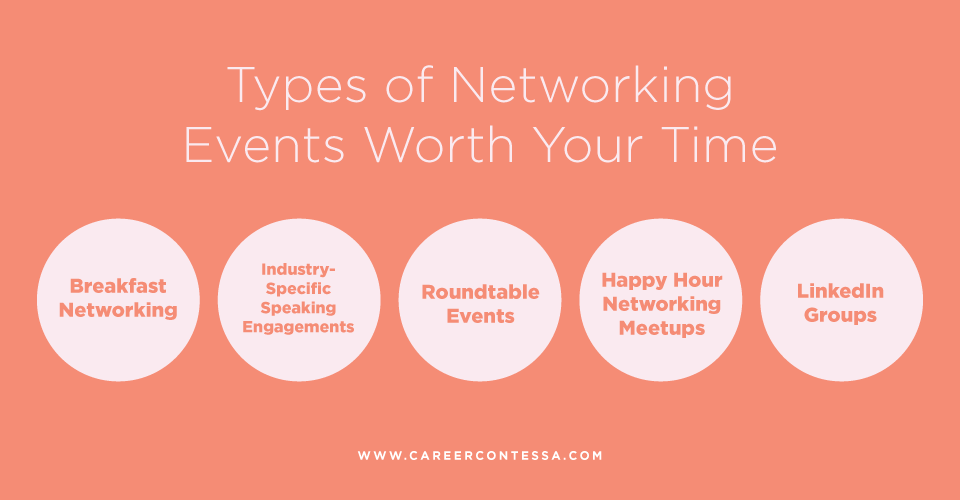
TYPES OF NETWORKING EVENTS WORTH YOUR TIME

1. Breakfast Networking

If you’re a morning person, this is a great way to start your day. What better scenario to schmooze than over egg-white omelets? Breakfast meetings allow all of the early risers to get ahead. You’re the first pitch of the day, so you get in front of potential employers or clients before they’re inundated with requests and resumes later that day. Unlike happy hours, you also get to interact with influencers before a potentially stressful workday hits (and before the alcohol starts flowing).

2. Industry-Specific Speaking Engagements

Whether you’re in marketing, retail, accounting, or another field, there are always people around to learn from. Take advantage of networking events in your area that have a speaker or speakers on a topic directly related to your position or department. You will learn from the experts themselves and ask questions you might not be able to in a webinar or online Q&A. You’ll also be surrounded by attendees in your field—take advantage of picking their brains! Bonus tip: If you have the confidence, offer to speak at one of these events yourself!

Like this Article ?  Share It !    You now can easily enjoy/follow/share Today our Award Winning Articles/Blogs with Now Over 2.5 Million Growing  Participates Worldwide in our various Social Media formats below:

FSC LinkedIn Network:   www.linkedin.com/in/fscnetwork

Facebook:  http://www.facebook.com/pages/First-Sun-Consulting-LLC-Outplacement-Services/213542315355343?sk=wall

Google+:  https://plus.google.com/115673713231115398101/posts?hl=en

Twitter: Follow us @ firstsunllc

Question: Want the ‘the best/current articles/blogs on the web’ on Job Search, Resume, Advancing/Changing your Career, or simply Managing People?

Answer: Simply go to our FSC Career Blog below & type(#career, #leadership, #life) in Blog Search:  https://www.firstsun.com/fsc-career-blog/

What Skill Sets do You have to be ‘Sharpened’ ?

Continue of article:

3. Roundtable Events

Similar to speaking engagements, roundtables are beneficial to those looking to advance their knowledge by communicating with their peers. Roundtables allow for open forums and discussions that, more often than not, lead to creative ideas and new directions. If you’re stuck on a project, story, or proposal, these are great events to get out of your rut and make some new connections in the meantime.

4. Happy Hour Networking Meetups

If you get the “roller coaster” anxiety about events that I do, happy hour is a tried-and-true tradition in the networking world. It allows for more of a relaxed atmosphere—making small talk and approaching strangers is simpler in a casual environment.
Bonus Tip: Avoid happy hours if you are actively looking for a job—given their usually laid-back nature, it might encourage you to make the wrong impression on a potential boss!

5. LinkedIn Groups

The digital age of networking is a blessing to the introvert in all of us. There are a ton of networking groups and forums on LinkedIn and other networks that allow communication, problem-solving and legitimate relationship-building (both business and personal) on a daily basis. If you’re nervous about jumping into the event pool, this is a great way to dip your toes in.
Even this list will leave you with a mind-spinning number of networking event options. So how do you decide which of them are worth your time?
Networking Events

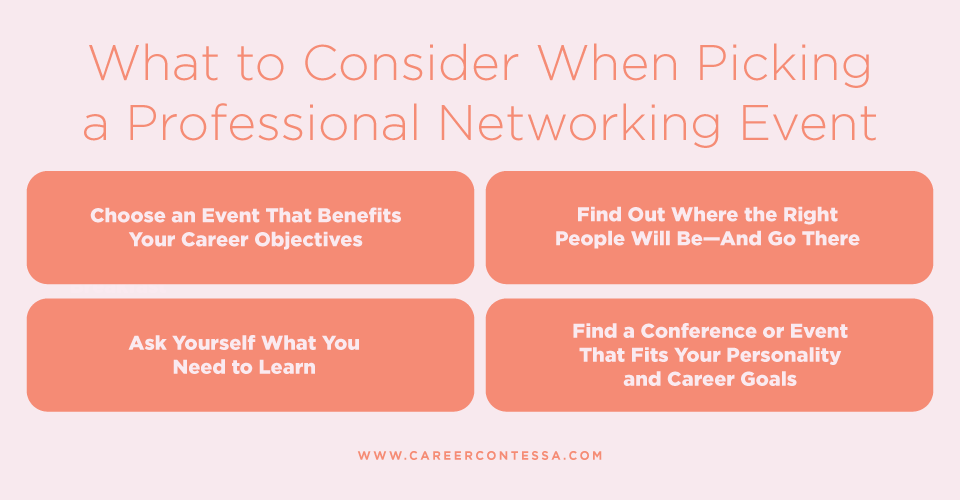
WHAT TO CONSIDER WHEN PICKING A PROFESSIONAL NETWORKING EVENT

1. Choose an Event That Benefits Your Career Objectives

Are you looking for a jobNew clientsStart-up capital? Either way, different events (especially the worthwhile ones!) are tailored to specific goals. Choose one that aligns with yours!

2. Find Out Where the Right People Will Be—And Go There

If you’re looking for a financial backer, you might want to avoid networking events that are lacking the decision-makers. If you’re looking for a job, try to find events attended by hiring managers or HR representatives. Research your favorite companies or industries, and see if there are any opportunities soon that are sponsored or managed by your dream company, or that feature your “dream role” people as keynote speakers or panelists.

3. Ask Yourself What You Need to Learn

Are you looking to attend a meetup or event in your field to escalate your growth? Check out the hosts, the speakers, and the topics being covered. If it’s something you’re already an expert on, look for a more advanced session. These are skill-specific opportunities for you to advance your career through developing and honing in on your strengths—or hey, your weaknesses!

4. Find a Conference or Event That Fits Your Personality and Career Goals

Once your objective is clear, choose an event that will give you a chance to shine. If you’re uncomfortable in big groups, look for events in more intimate settings. The last “rule” is important in our networking-cluttered world. Because the options are vast, you can—and should—attend events that will suit your needs and your A-game! If you hate ice breakers and small talk—maybe a roundtable isn’t for you. Maybe you prefer to listen to panelists, and then break into small groups to workshop specific skills. Maybe you prefer happy hours, because chit chat is your favorite thing to do.

HOW TO FIND NETWORKING EVENTS IN YOUR AREA

Okay so we’ve covered what events you should try to attend, and how to decide which ones you want to make time for—but how do you even know where to find these networking events to choose from? A quick google search of, “networking events [fusion_builder_container hundred_percent=”yes” overflow=”visible”][fusion_builder_row][fusion_builder_column type=”1_1″ background_position=”left top” background_color=”” border_size=”” border_color=”” border_style=”solid” spacing=”yes” background_image=”” background_repeat=”no-repeat” padding=”” margin_top=”0px” margin_bottom=”0px” class=”” id=”” animation_type=”” animation_speed=”0.3″ animation_direction=”left” hide_on_mobile=”no” center_content=”no” min_height=”none”][insert city here]” is a great way to start—but it can also be overwhelming with the amount of results you’ll likely get.

1. Your City Event Calendar

Your city likely has some sort of online event calendar—even if your “city” is more like a “farm” and your networking opportunities are limited to the weekly bingo competitions at one of the local churches. It’s still something, right? Your city calendar is a great starting point, because the list of events is already curated based on an important factor: distance.

2. Eventbrite

It’s an event calendar that’s super collaborative. Other people post events, and you get to search through them (you can even RSVP through the site.) Navigate to different events by date, category, event type, or price. You’ll find what you’re looking for in no time.
Pro tip: There are many websites like Eventbrite that showcase events in your area. Try Meetup and Facebook if you want more options.

3. Utilize Your Existing Network

That’s right—ask around at work! Maybe your coworkers are in industry-specific professional networks, or are secretly genius copywriters who teach multiple creative writing classes each week. Your boss might know of some local groups or meetings that you can attend.
Reach out to connections in your existing network, and see what events they’ve found helpful or exciting. You can also ask friends (especially if they’re in an industry you’re interested in) if they have any upcoming events on their radar. Even if you don’t get any recommendations right away, you’re letting everyone know you’re interested—and you’ll be the first person they call when they hear of something.
CareerContessa.com | July 31, 2018 | BY KELLY AYRES 

[/fusion_builder_column][/fusion_builder_row][/fusion_builder_container]

#CareerAdvice : #CareerChange – 9 Tips from People Who Made Dramatic #CareerChanges …It is Estimated that 40 Percent of Current US Employees are Disengaged at Work. Are you One of Them?

Some don’t like the company or their boss, but other times the frustrations run a lot deeper — maybe you realize your career doesn’t give you satisfaction, let alone a sense of purpose or happiness. So how do you know what you should be doing instead? And even if you do know, how do you get there?

This is why I founded Repurpose Your Purpose: to help people who feel stuck change their careers. Recently, I invited Anthony Barcelo, VFX (Visual Effects) Supervisor and Senior Compositor for TV, commercials and feature films; Darren Marble, CEO of CrowdfundX (CfX); Ronnie Mok, Sr. Technical Program Manager of Product Design at Hulu; and Nicki Klein, Co-Founder and CEO of Betagig, to join me on a panel discussion on their successes and failures in changing careers at WeWork Constellation in Century City.

These are some of my favorite lessons from our talk:

1. Finding “the One” Takes Time

There’s a persistent myth that you can just read a book, do some self-help exercises, choose a career and voilà! You can go out and find “the one.” Don’t buy into this narrative.

Every one of my panelists changed careers at least once before landing at their current gig. Some changed multiple times. Barcelo, for example, didn’t think of visual effects as his ideal career right away. It grew on him organically until it became his career, and a very successful one at that!

Like this Article ?  Share It !    You now can easily enjoy/follow/share Today our Award Winning Articles/Blogs with Now Over 2.5 Million Growing  Participates Worldwide in our various Social Media formats below:

FSC LinkedIn Network:   www.linkedin.com/in/fscnetwork

Facebook:  http://www.facebook.com/pages/First-Sun-Consulting-LLC-Outplacement-Services/213542315355343?sk=wall

Google+:  https://plus.google.com/115673713231115398101/posts?hl=en

Twitter: Follow us @ firstsunllc

Question: Want the ‘the best/current articles/blogs on the web’ on Job Search, Resume, Advancing/Changing your Career, or simply Managing People?

Answer: Simply go to our FSC Career Blog below & type(#career, #leadership, #life) in Blog Search:  https://www.firstsun.com/fsc-career-blog/

What Skill Sets do You have to be ‘Sharpened’ ?

Continue of article:

2. Don’t Sit Back and Wait

Too often we have a feeling something is not working in our career, but we keep waiting for the perfect opportunity to show up before we do something about it. We want to know what to do next, and we want to see a safe path to it. And so we wait, day after day, for that “aha” moment when we finally just figure it all out.

It may be disappointing to hear, but you probably won’t know what to do and how to be successful at it until you do it. Most likely, you will have to follow that hunch that you should be doing something else and then try to do something different, fail, pivot and try again until you find your calling.

3. When It’s Right, You’ll Know

You might not experience an epiphany before quitting your current job, but when you finally find the right career, you will know for sure. Mok used to work as a designer supporting marketing in an agency setting. And she couldn’t shake the feeling that her career, and all that she was creating, were disposable. It was only when she switched to a Program Manager role in the Product Design department at Hulu that everything clicked. Now she has great work/life balance, loves the people she works with and feels that everything has fallen into place.

4. Figure Out Who You Like to Work With

We spend way too much time thinking about what we want to do and not enough about who we want to do it with. One powerful way to assess whether a certain profession is right for you is to hang out with people who are doing it, then ask yourself: Do you feel you would get along? If a career is a good fit, you will find you have a certain affinity with others in that same career. So next time you go to a networking event or meet new people, see if you notice a trend.

5. Find a Job That Fits Your Life

Mok found happiness in her career once she stopped crafting her identity around her job and found work that allowed her to live her life. Now, work is part of her life, but it doesn’t define it.  She teaches yoga, climbs and has a lot of other hobbies. Are you unable to choose your next career because you are too wrapped up in how it defines you a person? Try taking a holistic view of what makes you happy besides work, and how your ideal job would help accommodate that.

6. Dust Yourself Off and Try Again

I invited Klein to join me on the panel months ago. She is an amazing entrepreneur, changed careers multiple times, won the Launch Hackathon 2016 with an all-woman team, and went on to get VC funding for her startup Betagig. Amazing, right? But a week before the panel, she announced that Betagig folded. I have to confess, for a moment I wondered whether to cancel her appearance. And then I realized I had just fallen into the very real trap of people who only tell stories of hardships when there is a happy ending. What a bunch of BS! With Repurpose Your Purpose, I want to have real and authentic discussions about changing careers.

As soon as I checked in with Nicki, I realized she was ready to move onto her next project. As someone who had changed careers before, she recognized that failure is part of the process — each time you put yourself out there, you learn new skills, overcome your own limitations, learn about yourself and the world and ultimately, get closer to whatever it is you’re meant to do. Nicki’s story turned out to be among the most valuable of the evening, as people felt inspired and encouraged to take risks.

By the way, this story ends up having a great happy ending after all… just recently, Nicki announced she landed the role of Sr. Technical Product Manager at Amazon Web Services. You might fail in one career or project you embarked on, but have faith that all you learn in the process will lead you to a new and often unexpected path.

7. Failure Builds Confidence

It seems counterintuitive, but each panelist mentioned that failing gave them the courage to continue. The more they failed and learned from it, the less scared they were the next time around, and the more they learned how to handle new challenges while building confidence. So if you are afraid of failure, remember that there is no way around it — only through it!

8. You Can Go Back to School… or Not

Barcelo went back to school to sharpen his film skills and found a lot of confidence and success in doing so. He described it as “building a new toolset to handle new challenges.” Marble did the exact opposite — he dropped out of college early on and learned by doing. The choice is yours, and a lot will depend on the career you pursue and your personality.

9. Anyone Can Change Careers

You don’t have to be young, childless, wealthy and single to change careers. Barcelo shared how having a wife and children to support motivated him to push forward and finally make better choices. Marble started on his journey as an entrepreneur with a wife, two kids, a mortgage and no savings. It took him five years to build a financially successful business, and he kept working at his day job until the income from the business was 85 percent of his salary. When he finally quit his job, he reminded himself that “if you have a career right now, you are likely employable” — and worst case scenario, he could always get another job within his same field.

About the Author: Aurora Meneghello is a Los Angeles-based career coach and the founder of Repurpose Your Purpose. You can find details and reserve your spot for her next panel discussion on changing careers here.


GlassDoor.com | January 3, 2018

#CareerAdvice : #ChangeManagement – How to Deal with These 4 Types of #ChangesAtWork …From Getting a #Promotion, #CompanyRestructure, #Layoffs, to Working with a New Boss.

When it comes to your career (or life, really) very few things are certain. There is one thing you can count on for sure though. Throughout your professional life, you’ll continue to encounter change, big or small, positive and negative, voluntary and involuntary.

When you experience these changes–you have two choices. You can either actively resist it, or you can accept it and figure out what you can learn from, and how to, leverage the situation. In most cases, the latter is usually the smart option. As Jennifer Harvey Berger previously wrote for Fast Company, in a world that’s only going to become more complex, “shifting your mindset is the only way to not only cope but also make the journey more fun and successful.”

Here are five of the most common changes you can expect to see at work, and how to deal with it so you can continue to thrive in the workplace.

GETTING A PROMOTION

Congratulations! After over-delivering on project after project, and exceeding all your goals that you set with your manager when you started your job, your employer is finally rewarding you with a change in title and an increase in compensation. You’re exhilarated, but you’re also a little confused. What do you do now?

First off, start with figuring out what you will no longer take on, time coach Elizabeth Grace Saunders wrote in a previous Fast Company article. Assuming that your promotion comes with more responsibilities, you will probably need to learn how to master your new tasks, and you won’t be able to do that efficiently if you have to do that on top of your old job. This requires trusting other people, which can be difficult if you have controlling tendencies. But as Saunders pointed out, the higher you move up, the more you have to depend on others. So start to learn to let go of your micro-managing tendencies, and trust that you’re not the only one who knows how to do everything.

It might be counterintuitive to prioritize personal well-being like sleep and exercise. But as Saunders noted, when you are required to perform at a high level, you need to be stricter about making these things a priority. After all, they have a major impact on your productivity. That’s not something you can compromise when you’re required to perform at the next level, Saunders said.


Related: Should you ever accept a promotion without a raise? 


Like this Article ?  Share It !    You now can easily enjoy/follow/share Today our Award Winning Articles/Blogs with Now Over 2.5 Million Growing  Participates Worldwide in our various Social Media formats below:

FSC LinkedIn Network:   www.linkedin.com/in/fscnetwork

Facebook:  http://www.facebook.com/pages/First-Sun-Consulting-LLC-Outplacement-Services/213542315355343?sk=wall

Google+:  https://plus.google.com/115673713231115398101/posts?hl=en

Twitter: Follow us @ firstsunllc

Question: Want the ‘the best/current articles/blogs on the web’ on Job Search, Resume, Advancing/Changing your Career, or simply Managing People?

Answer: Simply go to our FSC Career Blog below & type(#career, #leadership, #life) in Blog Search:  https://www.firstsun.com/fsc-career-blog/

What Skill Sets do You have to be ‘Sharpened’ ?

Continue of article:

COMPANY RESTRUCTURING

Very few things make employees as anxious as a company reorganization. Regardless of whether or not you survive the re-org, you’re sure to face some big changes. The first step, whatever the outcome, is to acknowledge what you went through, Neil Lewis, co-founder of Working Transitions, told Gwen Moran in a 2017 Fast Company article. If you survived the re-org and felt “survivor guilt,” give yourself permission to feel them. Then slowly rebuild your confidence by assessing what kind of opportunities you can take on to grow, and whether there are any gaps in your skills that you can fill. Lewis also urged that you shouldn’t be afraid of reaching out to your colleagues who have left the organization. After all, they’re a crucial part of your professional network.

If the re-org results in a layoff, The Muse’s Jenni Maier recommends that as soon as you’ve had time to process the news, let your network know you’re looking. When Maier was laid off from her role, she desperately wanted to keep it quiet, but because she was unhappy with (and wanted to change) her situation, she decided to be open about the fact that she was back in the job market. She wrote, “The majority of the interviews I went on after being laid off came from friends-of-friend leads. Leads I never got before I lost my job because no one knew I wanted them. And the position I ended up getting at The Muse? That “in” came from a former manager’s friend.”


Related: Take these steps to boost morale after layoffs


GETTING A NEW BOSS

Your happiness and success in your job has a lot to do with the relationship that you have with your boss. You might spend a long time building this relationship, but people move on, and one day, they might leave. You find yourself reporting to someone new, and you want to establish their trust and respect, quickly.

How do you do it in a way that doesn’t come off as bragging? As Gwen Moran previously wrote in Fast Company, the first step you should take is to build in some “networking” time with your boss–whether it’s coffee, or scheduling some time in a calendar for focused discussion. This way, you can start to learn their goals, working styles and any new ideas they might have, and work to amend your priorities where appropriate. Be proactive in terms of identifying where they might need help–that’s an easy way for you to secure some quick wins to help them shine, which builds goodwill quickly.

A CHANGE IN COMPANY CULTURE AND PROCESSES

Sometimes what the company looks like when you joined looks nothing like the company you’re still working at 2 years later. This especially common in a startup–which tends to start without structures and systems in place. As the company scales, those things become necessary, and sometimes, it can change the company culture, entrepreneur Matt Barba previously wrote for Fast Company.

The first step is acknowledging that structure isn’t necessarily a bad thing, and simply accept the fact that it comes with company growth. If you feel like there are some cultures that the company used to have that you want to reinstate–there are ways you can do that without needing approvals from the higher-ups. As SYPartners’ principal Joshua-Michéle Ross said at the 2017 Fast Company Innovation Festival, you can create deep transformations with tiny steps. He went on to say that one of the ways to do this is to create “rituals that solve a problem.” In the case of Airbnb, for example, the home-sharing company found itself with far too many internal meeting as the company grew. Their solution? they started filming the meetings and editing them into digestible content–which solved a problem and got rid of unnecessary bureaucracy.

Your brain might be averse to change, but with time and a shift in perspective, you can learn to accept it. And if you train yourself to be comfortable with uncertainty, you might just see opportunities as a result of those changes that you might not have had otherwise.


FastCompany.com | August 6, 2018


#CareerAdvice : #JobSearch – What #Recruiters Look at When Stalking Your #SocialMedia … You probably Already Know Recruiters are Looking at your #LinkedIn Page, but What About your Other Social Media Platforms?

You know, the ones where you post pictures of your latest vacation, share what you had for dinner and occasionally tag your friends in memes. Why, you might wonder, would a recruiter possibly be interested in viewing things like that?

As it turns out, those personal details are precisely why recruiters and hiring managers keep tabs on applicants’ social media accounts, says career coach Hallie Crawford. “It can help them get a more accurate idea about who you are outside of your resume — a more personal view into your life,” she explains. “A resume can tell them your qualifications, but your social media profile can help them determine your personality type and if you would be a good fit for company culture.”

Plus, recruiters are looking for red flags — risqué photos, bad language, signs of drugs use — that would show them you’d be a less than ideal man or woman to have in their offices.

So now that you know why they’re looking, how about knowing what they’re looking at?

Facebook

According to Crawford, recruiters and hiring managers are concentrating their efforts on two sections of your Facebook page — your “about me” section, and your photo albums.

About Me: “They will want to see how you describe yourself and if it matches up [fusion_builder_container hundred_percent=”yes” overflow=”visible”][fusion_builder_row][fusion_builder_column type=”1_1″ background_position=”left top” background_color=”” border_size=”” border_color=”” border_style=”solid” spacing=”yes” background_image=”” background_repeat=”no-repeat” padding=”” margin_top=”0px” margin_bottom=”0px” class=”” id=”” animation_type=”” animation_speed=”0.3″ animation_direction=”left” hide_on_mobile=”no” center_content=”no” min_height=”none”][with] how you have described yourself in your cover letter and resume,” Crawford says. Any discrepancies could cost you points pre-interview. What’s more, Crawford says, “they will also be looking for proper spelling and grammar” in this section, to see how seriously you take those skills.

Photos: When it comes to your photos albums, “a hiring manager will be checking not only your photos but also your descriptions,” Crawford warns. “A hiring manager wants to see if you represent yourself in a professional way.” To come off in the most positive pre-meeting light, “you will want to avoid using profanity, sexual or drug references,” Crawford says.

Like this Article ?  Share It !    You now can easily enjoy/follow/share Today our Award Winning Articles/Blogs with Now Over 2.5 Million Growing  Participates Worldwide in our various Social Media formats below:

FSC LinkedIn Network:   www.linkedin.com/in/fscnetwork

Facebook:  http://www.facebook.com/pages/First-Sun-Consulting-LLC-Outplacement-Services/213542315355343?sk=wall

Google+:  https://plus.google.com/115673713231115398101/posts?hl=en

Twitter: Follow us @ firstsunllc

Question: Want the ‘the best/current articles/blogs on the web’ on Job Search, Resume, Advancing/Changing your Career, or simply Managing People?

Answer: Simply go to our FSC Career Blog below & type(#career, #leadership, #life) in Blog Search:  https://www.firstsun.com/fsc-career-blog/

What Skill Sets do You have to be ‘Sharpened’ ?

Continue of article:

Twitter

Who You’re Following: “Recruiters like to see if you have any mutual connections and if you are connected with others in your industry,” Crawford explains. Following others in your industry is a smart thing to do no matter what — watching their feeds can give you a scoop on a new job opening, company announcements, the latest tech and much more.

Tweets: “Recruiters will be checking to see if you share useful information, if you share information relevant to your trade or if you just use tweets to fight with others,” Crawford says. If you’re applying for a job, take a look at your tweeting history and consider deleting anything that won’t show your best — and most thoughtful — self to a potential employer.

Instagram

Followers: Recruiters will check out the kind of followers you attract, Crawford says. Plus, they’ll want to see “how friendly and social you seem to be with your followers,” she says. What you say to them and what you say back, she explains, “can also give them insight [into] your personal relationships and if you would be a good cultural fit for the company.”

Pictures: You probably figured this, right? But recruiters are looking to see more than your photography skills (or lack thereof). “They will want to see how you represent yourself,” Crawford says. For example, “if you are at a party, do you represent yourself in a dignified way?” Crawford asks, or, “do you post things that others would consider inappropriate?”

GlassDoor.com | 

[/fusion_builder_column][/fusion_builder_row][/fusion_builder_container]

#CareerAdvice : #Unemployed – How to Handle the Tumultuous Days of #Unemployment …Being #Unemployed Can be Tough, But it’s Also an Opportunity to Find Work you Truly Love.

Picture this: you’re on a hike, almost at the top of the mountain. It’s so close. You’re ready. You know that feeling? The feeling of accomplishment and that burst of adrenaline that pushes you that much further? Of course, when you get to the top of the mountain, it seems like the hard part is over. You realize you still have to hike all the way down, but that’s easy enough, right?
Wrong. It never is. You still have to get down the mountain. This picture, this hike, this mountain—this is the reality of unemployment. I know because I’m living it. Much like the hike, some parts of it are tough, some are exhilarating, and some are even exciting!
I’ve had days where I wake up feeling like I want to conquer the world. And then, there are some when I wake up feeling like the world is conquering me. Though it’s easy to get down on myself during this process, I’ve trained my mind to think of this period as a positive learning experience, and an opportunity to find the work that’s perfect for me.
For you too, there will undoubtedly be many ups and downs on your unemployment journey—but it’s important to think of the experience as the stepping stone to your next big venture. And honestly, unemployment is a full-time job in and of itself, requiring a lot of effort poured into job searching, applyinginterviewingnetworking, and more.
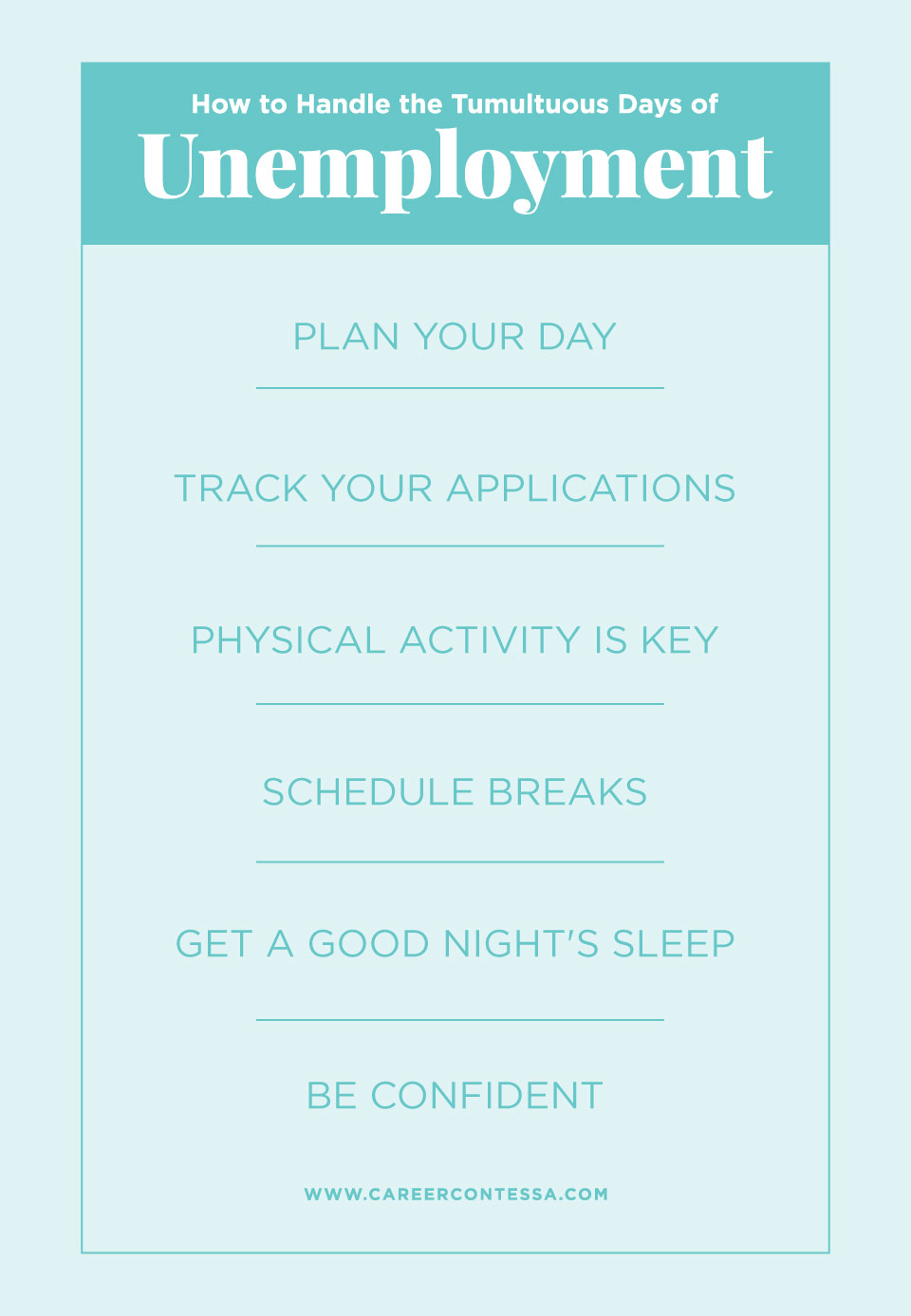
Here are my favorite tips for staying positive and  using your “in-between-jobs” time wisely:

PLAN YOUR DAY

Pretend you’re at work. Whether it’s writing out a to-do list or making a list of goals for the week, having something in writing will take away that sense of scatteredness you may feel when wading through your job hunt.

Like this Article ?  Share It !    You now can easily enjoy/follow/share Today our Award Winning Articles/Blogs with Now Over 2.5 Million Growing  Participates Worldwide in our various Social Media formats below:

FSC LinkedIn Network:   www.linkedin.com/in/fscnetwork

Facebook:  http://www.facebook.com/pages/First-Sun-Consulting-LLC-Outplacement-Services/213542315355343?sk=wall

Google+:  https://plus.google.com/115673713231115398101/posts?hl=en

Twitter: Follow us @ firstsunllc

Question: Want the ‘the best/current articles/blogs on the web’ on Job Search, Resume, Advancing/Changing your Career, or simply Managing People?

Answer: Simply go to our FSC Career Blog below & type(#career, #leadership, #life) in Blog Search:  https://www.firstsun.com/fsc-career-blog/

What Skill Sets do You have to be ‘Sharpened’ ?

Continue of article:

TRACK YOUR APPLICATIONS

Keep an Excel sheet of all the jobs you have applied to—maybe even the ones you want to apply to. Beyond tracking just the title of the jobs, make sure to record what date you applied, so you know when to follow up. You could even include the contact information of the person you’re  reaching out to, for optimal organization.

PHYSICAL ACTIVITY IS KEY

Exercise for at least 30 minutes a day. You will feel so much better you did. Exercising can clear your mind and help you really focus on what needs to get done. Even if it’s just a walk around your block, that small amount of exercise can make a huge difference.

SCHEDULE BREAKS

It’s important to take small breaks from the job hunt throughout the day so you don’t get too overwhelmed. By allowing your brain to focus on something that isn’t job-related for even just a small chunk of time, you’ll be able to recharge and return to it with more clarity and stamina.

GET A GOOD NIGHT’S SLEEP

It can be very easy to sleep in and go to bed late when you are unemployed. Remember that job hunting is a full-time job—you have to get adequate rest to achieve your goals. Develop a sleep routine that works for you so you can get the most done throughout the day.

PRACTICE CONFIDENCE

The worst thing you can do when you are unemployed is to lose your self-esteem. Just remember that you will find another job—it may just take some time. Having a positive mentality throughout this time is essential to achieving your goals!
On any given day, you will be going up and down that mountain. You will have days where you doubt your ability to find your next paycheck. And then there will be days where you feel like you will take over the world with your job-hunting abilities. Whatever kind of day you’re having, remember that this is a stage of your life that will change you for the better—if you let it—and transform into an unforgettable experience later on. Use this time wisely to focus on building your skills and reflect on what you really want in work and life.
Although there are many hurdles that accompany unemployment, finding work that you truly love is well worth it in the end.
How to Handle the Tumultuous Days of Unemployment
What’s your journey been like? Have you climbed the “unemployment mountain”?
 CareerContessa.com | Photos Marie McGrory | February 22, 2018

#Leadership : #StressManagement – 5 Ways #NewManagers can Protect Themselves from Burning Out….Don’t Try to Do it All–That’s a Recipe for Disaster.

Your company just promoted you, and you’re a newly minted manager. After a well-deserved celebration and many congratulatory messages, you come face-to-face with one harsh truth that comes with your new role–the lack of empty time slots in your calendar.

In my experience, new managers tend to make one crucial mistaketrying to do it all. They attempt to keep up with their own workload while making themselves constantly available to their team. As noble as those intentions may be, working 15-hour days won’t make you a better leader. After all, no one does their best work when they’re overly stressed.

I learned this the hard way. As soon as I realized that my round-the-clock hours were neither conducive to my work nor my growing family, I made time management a priority. To prevent burnout, I implemented the following five strategies. It’s something that I still live by today, and as a manager, I can attest that they go a long way in keeping you productive (and sane).

LEARN HOW TO SAY NO

I get it, saying no to a colleague feels terrible. But if you keep saying yes to requests, you’ll end up with an ever-growing to-do list of work that isn’t mission-critical for you or your team.

You’ll feel better about saying “no” when you realize that as a result, you’ll have more time to do work that’s highly important, but not urgent. Sure, it might feel good to send those emails and cross those “simple” requests off your list–but are those tasks really going to have a meaningful impact on your team or business? Probably not. So the next time a project, request, or opportunity comes your way, picture where it would land in the table below. If it’s of low urgency and low importance, say “no.” It’s not worth your time.


Like this Article ?  Share It !    You now can easily enjoy/follow/share Today our Award Winning Articles/Blogs with Now Over 2.5 Million Growing  Participates Worldwide in our various Social Media formats below:

FSC LinkedIn Network:   www.linkedin.com/in/fscnetwork

Facebook:  http://www.facebook.com/pages/First-Sun-Consulting-LLC-Outplacement-Services/213542315355343?sk=wall

Google+:  https://plus.google.com/115673713231115398101/posts?hl=en

Twitter: Follow us @ firstsunllc

Question: Want the ‘the best/current articles/blogs on the web’ on Job Search, Resume, Advancing/Changing your Career, or simply Managing People?

Answer: Simply go to our FSC Career Blog below & type(#career, #leadership, #life) in Blog Search:  https://www.firstsun.com/fsc-career-blog/

What Skill Sets do You have to be ‘Sharpened’ ?

Continue of article:

BE SUPER SELECTIVE WITH MEETINGS

You know that too many meetings can kill your productivity, but earlier in your career, you probably felt obliged to say yes to all of them. As a manager, you can’t afford to do this if you want to get any work done.

Before RSVPing, ask yourself–is there a clear agenda of what this meeting needs to accomplish? Are you the best person to add value in this meeting? Is this something you can’t resolve quickly via email or messenger? If the answer is no, then the meeting is probably not the best use of your time. If the answer is yes, focus the conversation by setting the meeting objective ahead of time. This way, you’ll avoid going into pointless tangents. If you need to decide on something in the meeting, make that clear in the agenda.


Related: 3 creative meeting formats to make your whole team more effective


DO A REGULAR CALENDAR AUDIT

Every now and then, it can be helpful to push the reset button on your schedule. There may be standing meetings that are no longer relevant or nonessential “check-ins” that take up your day-to-day. Do a bird’s eye view analysis to figure out which one of those activities are truly the best use of your time, and whether they’re something others in your team can handle.

You should also think about blocking out time for certain projects that don’t require a meeting–whether that be recruitment or catching up on company updates. Without scheduling those tasks in your calendar, you might find it difficult to make progress.

DON’T USE YOUR INBOX AS YOUR TO-DO LIST

Chances are, you’ll get more emails, not less, when you become a manager. So if you’ve been using your inbox as your to-do list, now is the time to put a stop to that practice. Organizing your “priorities” trains your brain to be “always on” and look for the next task to knock off the list. It does not train you to think about how those lists relate to your big-picture goals and responsibilities.

I use Trello and have separate horizontal lists for “People,” “Culture,” “Product,” “Sales,” and “Performance.” The lists are side-by-side, which allows me to think holistically about my output in a given day or week without the urge to cross off what’s at the “top” of the list.


Related: These to-do list methods will help you finally get organized 


DELEGATE OBJECTIVES, NOT TASKS

Delegating work should save you time, but you can waste a ton of it if you don’t do it right. For starters, delegating to-dos without providing full context results in a lot of hand holding, and as a result, employees don’t feel ownership over the work. This makes them more likely to check in with you and ask unnecessary questions like whether they are doing it “right.”

On the other hand, if you delegate an objective or mission (and provide a few guardrails), they won’t expect a step-by-step instruction manual from you along the way. They’ll write their own, and might even come up with creative solutions as a result. You’ll probably get a better output, and you’ll find yourself with more time to tackle essential items.

Time is our most coveted resource, and that becomes even more of a reality when you move into a management role. By following these methods, you’ll be able to succeed in your new job while maintaining a healthy personal life at the same time.


Christian Kinnear is the managing director and VP of sales at HubSpot.


FastCompany.com | August 3, 2018 | BY CHRISTIAN KINNEAR 4 MINUTE READ