Picture this:you’re on a hike, almost at the top of the mountain. It’s so close. You’re ready. You know that feeling? The feeling of accomplishment and that burst of adrenaline that pushes you that much further? Of course, when you get to the top of the mountain, it seems like the hard part is over. You realize you still have to hike all the way down, but that’s easy enough, right?
Wrong.It never is. You still have to get down the mountain. This picture, this hike, this mountain—this is the reality of unemployment. I know because I’m living it. Much like the hike, some parts of it are tough, some are exhilarating, and some are even exciting!
I’ve had days where I wake up feeling like I want to conquer the world. And then, there are some when I wake up feeling like the world is conquering me. Though it’s easy to get down on myself during this process, I’ve trained my mind to think of this period as a positive learning experience, and an opportunity to find the work that’s perfect for me.
For you too, there will undoubtedly be many ups and downs on your unemployment journey—but it’s important to think of the experience as the stepping stone to your next big venture. And honestly, unemployment is a full-time job in and of itself, requiring a lot of effort poured into job searching, applying, interviewing, networking, and more.
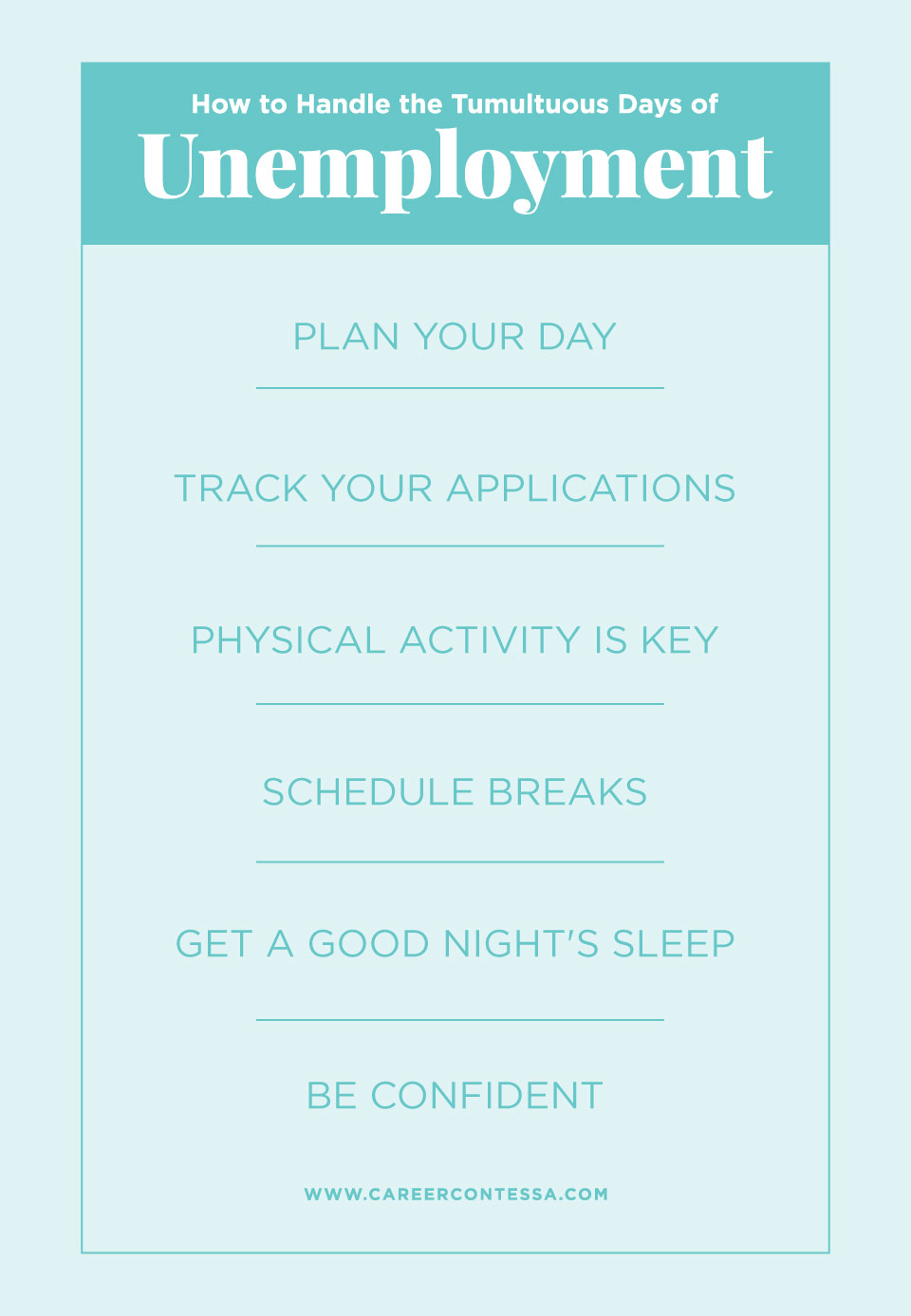
Here are my favorite tips for staying positive and using your “in-between-jobs” time wisely:
PLAN YOUR DAY
Pretend you’re at work. Whether it’s writing out a to-do list or making a list of goals for the week, having something in writing will take away that sense of scatteredness you may feel when wading through your job hunt.
Like this Article? Share It !You now can easily enjoy/follow/share Today our Award Winning Articles/Blogs with Now Over 2.5 Million Growing Participates Worldwidein our various Social Media formats below:
Keep an Excel sheet of all the jobs you have applied to—maybe even the ones you want to apply to. Beyond tracking just the title of the jobs, make sure to record what date you applied, so you know when to follow up. You could even include the contact information of the person you’re reaching out to, for optimal organization.
PHYSICAL ACTIVITY IS KEY
Exercise for at least 30 minutes a day. You will feel so much better you did. Exercising can clear your mind and help you really focus on what needs to get done. Even if it’s just a walk around your block, that small amount of exercise can make a huge difference.
SCHEDULE BREAKS
It’s important to take small breaks from the job hunt throughout the day so you don’t get too overwhelmed. By allowing your brain to focus on something that isn’t job-related for even just a small chunk of time, you’ll be able to recharge and return to it with more clarity and stamina.
GET A GOOD NIGHT’S SLEEP
It can be very easy to sleep in and go to bed late when you are unemployed. Remember that job hunting is a full-time job—you have to get adequate rest to achieve your goals. Develop a sleep routine that works for you so you can get the most done throughout the day.
PRACTICE CONFIDENCE
The worst thing you can do when you are unemployed is to lose your self-esteem. Just remember that you will find another job—it may just take some time. Having a positive mentality throughout this time is essential to achieving your goals!
On any given day, you will be going up and down that mountain. You will have days where you doubt your ability to find your next paycheck. And then there will be days where you feel like you will take over the world with your job-hunting abilities. Whatever kind of day you’re having, remember that this is a stage of your life that will change you for the better—if you let it—and transform into an unforgettable experience later on. Use this time wisely to focus on building your skills and reflect on what you really want in work and life.
Although there are many hurdles that accompany unemployment, finding work that you truly love is well worth it in the end.
What’s your journey been like? Have you climbed the “unemployment mountain”?
CareerContessa.com | PhotosMarie McGrory| February 22, 2018
https://www.firstsun.com/wp-content/uploads/2015/10/0x600-2.jpg600857First Sun Teamhttps://www.firstsun.com/wp-content/uploads/2018/05/logo-min-300x123.jpgFirst Sun Team2018-08-04 13:08:262020-09-30 20:46:17#CareerAdvice : #Unemployed – How to Handle the Tumultuous Days of #Unemployment …Being #Unemployed Can be Tough, But it’s Also an Opportunity to Find Work you Truly Love.
My professional network has never led directly to a job opportunity. I’ve had people on the inside graciously pass along my resume and extend referrals, but while I’ve landed interviews this way, they’ve never crystallized into an offer. In fact, every job offer I’ve ever received has come about the old-fashioned way: by applying to a job posting.
Which is odd. Isn’t it those “weak connections”–not the people you know but the people they know–who are supposed to be such effective job-hunting resources? It’s possible that my personal track record is a reflection of my network, my networking abilities, my resume-writing skills, some weird quirk of probability, or none of the above. In any case, it does remind me of some other ways–short of landing job offers–that networking can come in handy throughout the job-search process. Here are a few of them.
NETWORKING LETS YOU PRACTICE TALKING ABOUT YOUR WORK
If it’s been at least a year since your last job search, there’s a good chance you’re out of practice describing your work to people outside your organization. There’s actually an art to answering the familiar question, “So what do you do?” and since most interviews kick off with, “Tell me a little about yourself,” networking conversations can actually double as interview prep.
Networking with people while you’re job hunting forces you to get beyond those boring one-line summaries of your current job description. As you start telling folks in your network what you’re looking to do next, you’ll also have to characterize your strengths and interests, drum up examples of recent projects you’re proud of, and make connections between your current role and your ambitions for the next stage in your career.
Articulating all of this takes practice. Plus, in addition to helping you refine your pitch to hiring managers and recruiters, this also gives your network a clearer sense of what opportunities to keep a lookout for on your behalf.
Here’s what to ask your contacts:
“Does the experience I’ve just described make sense? And does it sound interesting?
“Based on what I’ve told you, what sounds like my top strength? What about my biggest weakness?”
Like this Article? Share It !You now can easily enjoy/follow/share Today our Award Winning Articles/Blogs with Now Over 2.5 Million Growing Participates Worldwidein our various Social Media formats below:
TALKING TO YOUR NETWORK HELPS YOU FOCUS (OR EXPAND) YOUR SEARCH
You may never have had a professional mentor, but as soon as you mention you’re job searching, just about everyone snaps into mentorship mode. They’re quick to ask questions about your current job and what you’re hoping for in the next one. They grill you about where you’re looking and whether you’ve landed any interviews yet. They wrack their brains for people they know that you might want to talk to.
This knee-jerk generosity can be helpful, or not. (Your friend’s new roommate might not know a damn thing about your industry even though he’s really excited to help.) But these discussions can be clarifying even when they don’t cough up job leads. Sometimes you’ll notice somebody interpreting your work history in a different light than you see it, which could cue you to reframe your experience in future career conversations. Other times someone may suggest a company or a type of role that you hadn’t considered before. And once in a while, a contact with deeper experience in your field might brush away worries about your competitive weaknesses and put their finger on something completely different that you should really focus on.
These networking interactions can lead you to shift your strategy, sometimes in small ways and sometimes much more radically. The best part is that even people who are relatively ignorant about your field or career ambitions can still help you adjust your game plan, whether it’s to find focus or think more broadly.
Here’s what to ask your contacts:
For people who are less knowledgable about your field: “Hypothetically, If I were to leave my field, what types of other roles do you think I’d be qualified for?”
For those who know a lot about your field: “What types of candidates do you think I’m most likely to be competing with for this role? Should I consider different types of positions?”
In my experience, a professional network is most effective at helping you size up job opportunities. Sometimes the hardest part of the hiring process isn’t crafting a great resume or preparing for an interview, it’s deciding whether to take the job once it’s finally offered.
The folks in your network might not know the hiring manager or an HR rep inside the company, but they’re much more likely to know someone who works there and can speak generally about their experiences on the inside. This is often the real benefit of those “weak connections”; the people who know the people you know, even though they’ve never met you, probably won’t give you an endorsement. But many are happy to jump on a 20-minute call with you and share their thoughts on the position you’re applying to, plus any words of caution or advice.
All of this is underappreciated intel. If you can land these conversations before going on a job interview or even before applying, they’ll help you tailor the way you position your candidacy. These second-degree contacts can also clue you into potential drawbacks and suggest good questions to ask about the team, the work culture, and the demands of the role. And if someone has already agreed to chat with you about a job opportunity, they probably won’t blink when you ask if there are any other insiders they might be willing to introduce you to. Before you know it, you’ll have tapped into a brain trust of in-the-know contacts who can share critical insight to guide your strategy and decision making.
Here’s what to ask your contacts:
When you’re looking for company insiders: “Do you know any current or former employees at X company who might be willing to chat with me about their experience there?”
After speaking with company insiders: “Thanks for chatting with me! If you can think of anyone else you work with who may have some insight into the role I’m pursuing, I’d love to be connected.”
So no, your immediate network might not be much help in connecting you with the top decision makers for the specific job opportunities that appeal to you. But if you give them a chance, your professional contacts can probably help you out much more–and in many more ways–than you think.
FastCompany.com | July 31, 2018 | BY RICH BELLIS 5 MINUTE READ
https://www.firstsun.com/wp-content/uploads/2015/10/Networking-Diverse-Group.jpg450970First Sun Teamhttps://www.firstsun.com/wp-content/uploads/2018/05/logo-min-300x123.jpgFirst Sun Team2018-07-31 16:44:182020-09-30 20:46:20#CareerAdvice : #CareerNetworking – Three Surprising Ways your #Network can Help your #JobSearch … #Networking Doesn’t Always Lead to #Referrals or #Introductions to #HiringManagers . But Sometimes your Contacts can Prove Helpful in Ways you Hadn’t Expected.
Enter:the thank you note. The thank you note should be a no-brainer. It is a perfect way for a candidate to give herself the final edge over other candidates in the interview process.
Writing the thank you note does not have to be an exhaustive process. However, a candidate can (and should!) use it as an opportunity to edge out the other candidates.
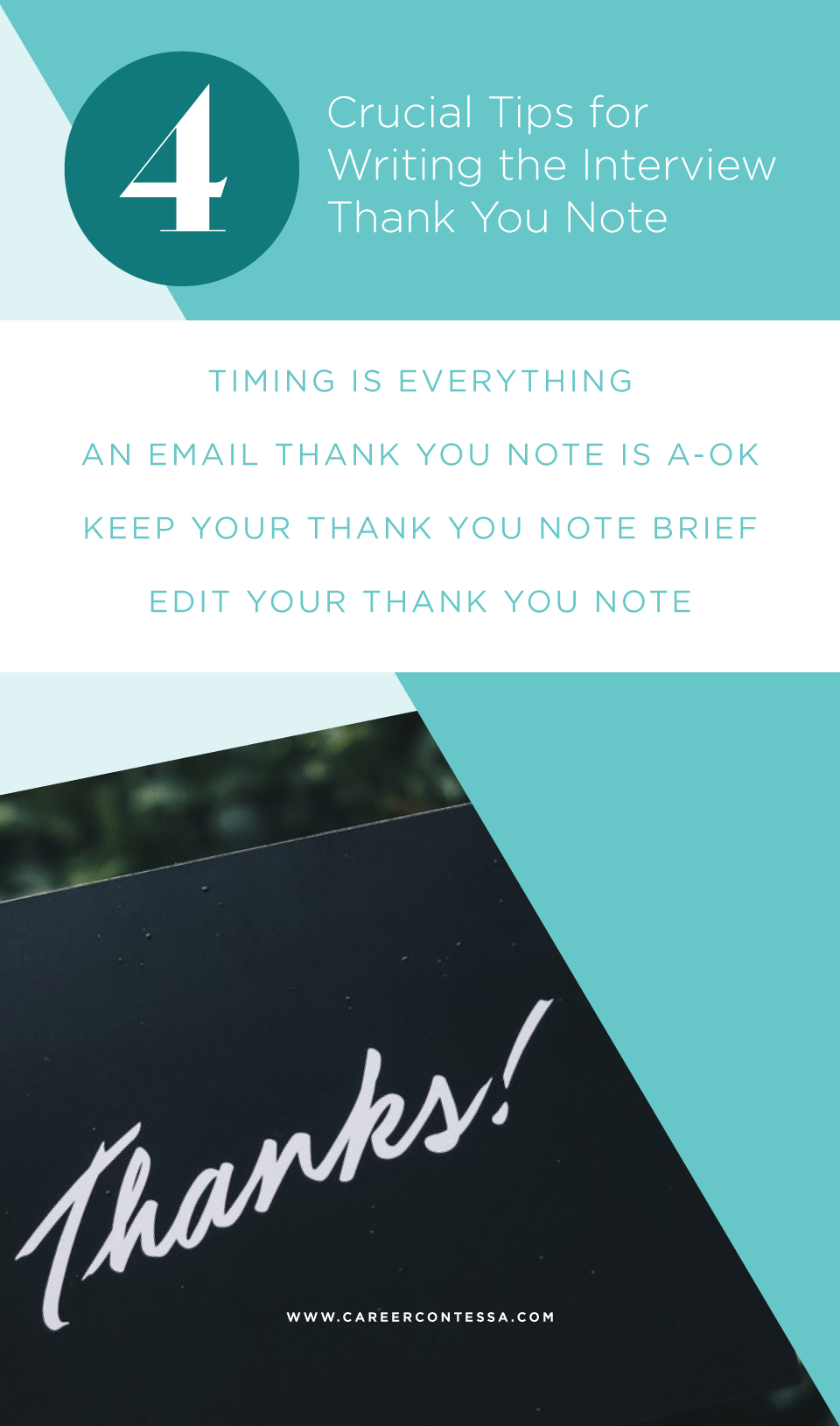
TIMING IS EVERYTHING
Interviewing is an arduous process for any job candidate. In much the same way, it can be a stressful time for the hiring manager. My number one piece of advice in writing a thank you note for a job you really want?
Do it right away. Even if you killed the interview and expect a call saying “You’re hired!” by the end of the day, write the note. Express your gratitude and keep your candidacy fresh in the hiring manager’s mind. DO NOT wait until a week later when you haven’t heard anything to shoot off a “by the way, thanks” email.
A well-timed thank you note after an interview is a perfect way to reiterate your excitement to join the team. Aim to send your thank you note no within 24 hours of the end of the interview.
Like this Article? Share It !You now can easily enjoy/follow/share Today our Award Winning Articles/Blogs with Now Over 2.5 Million Growing Participates Worldwidein our various Social Media formats below:
We know you still have that Laura Ashley stationery your grandma gave you for your high school graduation. We know it’s embossed with your initials.
However, 87 percent of hiring managers view email as a perfectly acceptable means of delivering your thank you note. Since we have already established that timing is everything, email is going to be your best bet.
KEEP YOUR THANK YOU NOTE BRIEF
By this point in the interview process, your hiring manager has likely learned a ton about you. Do not use the thank you note to reiterate the play-by-play.
You can (and should) use it as a means to communicate one point you may have neglected to make, to expand on an idea or simply to express feelings of excitement for the job itself. Since the hiring manager is also busy interviewing, reading resumes, and communicating with other stakeholders, keep your note on point.
EDIT YOUR THANK YOU NOTE
So far, we have focused heavily on the speed and brevity of this note. But that doesn’t mean it’s informal! Make sure to use a formal greeting, write clear (and concise!) sentences, and sign off formally. This is not a one-liner to say “Thanks, Dude!”
Just as easily as a thank you note can impress a hiring manager, it can also detract from the whole process. A spelling error or flippant manner of writing can undo your progress. Write your thank you note, read it over a few times aloud, spell check it, and get a second pair of eyeballs on it if you can.
https://www.firstsun.com/wp-content/uploads/2017/12/Woman-on-laptop.jpg9311242First Sun Teamhttps://www.firstsun.com/wp-content/uploads/2018/05/logo-min-300x123.jpgFirst Sun Team2018-07-30 12:19:312021-02-24 20:43:34#BestofFSCBlog : #JobSearch – Four(4) Crucial Tips for Writing the Interview Thank You Note. So you Really Want this Job?
For many resume writers, the “skills section” presents a unique quagmire. On the one hand, you want to showcase as many skills as you can to show your competence. On the other hand, you don’t want to make it look like you’re padding your resume, and you definitely don’t want to list skills that you’re only half-competent at.
Resume writer Anish Majumdar recommends building your skills section by writing out the skills you need at your current job, and then reviewing your list and circling skills that correlate with your target position. “Finally, underline those circled skills which can be proven on your resume. These are the ones you need to focus on,” writesMajumdar.
Once you’ve done that, here are a few more tips on how to make the skills section on your resume truly shine:
1. Give it all you’ve got
Don’t be shy about layering on your skills – both hard and soft skills. Just because you’re a software engineer doesn’t mean you don’t need to showcase your communication, cross-sector collaboration, and time management abilities. In fact, listing those skills alongside your competency with Java and Python will make you stand out from the crowd. Layering your resume with skills can serve to give recruiters a well-rounded, multi-faceted image of you.
That being said, you need to make sure you’re not putting skills on your resume merely to bulk it up. Certain skills, like knowing how to use Microsoft Word or email, are too basic to distinguish you from other candidates. These competencies are obvious to recruiters, and should not be placed on your resume. If the answer to the question “can every other applicant to the job write that they have this skill?” is yes, you might want to reconsider taking up precious resume real estate with the skill.
Like this Article? Share It !You now can easily enjoy/follow/share Today our Award Winning Articles/Blogs with Now Over 2.5 Million Growing Participates Worldwidein our various Social Media formats below:
No, this doesn’t mean by padding your resume with skills you don’t have! If there are certain skills that you find would be helpful to have for the jobs you’re applying to, but you don’t currently have, it might be time to take a class or do a training on these skills. It also might be a question of brushing up certain skills, so that you can show them off, like upgrading your “intermediate proficiency” in Spanish to “professional working proficiency”. Investing time and money in these skills now can have big payoffs in the future.
The skills section of your resume is not the place to sugarcoat. What you see as a rose-colored picture of a certain skill might simply be seen as a fib by a recruiter. Let’s take the Spanish example again. Suppose you say you have “professional working proficiency”, when you really just spent a semester abroad in Spain when you were in college 10 years ago, and haven’t practiced the language since. A portion of your job interview is conducted in Spanish – yikes! Or even worse, you get the job, and your first assignment is to interface with an Argentinian client – completely in Spanish. Chances are you won’t be at the job for much longer. Even little resume fibs can cause big trouble.
5. Showcase your transferable skills
Especially if you’re transitioning careers, showing off your transferable skills is critical to fleshing out the skills section of your resume. Transferable skillsinclude things like leadership, analytics, communication through writing, public speaking, mathematical reasoning, or organizing meetings. These type of skills can give you the boost you need in showcasing your experience.
Soft skills like “coordination with sub-contractors” can sound intangible and airy – which is why you shouldn’t be afraid to back yourself up with a few examples and numbers. “Coordinated weekly with 12 subcontractors to drive a project slated to take 6 months to a 3-month completion time” packs more of a punch, and lets whoever’s reading your resume visualize better your abilities.
https://www.firstsun.com/wp-content/uploads/2013/09/0218_land-interview-resume_650x4551-300x210-1.jpg210300First Sun Teamhttps://www.firstsun.com/wp-content/uploads/2018/05/logo-min-300x123.jpgFirst Sun Team2018-07-28 15:58:352020-09-30 20:46:22#CareerAdvice : #ResumeWriting – 6 Ways to Make the Skills Section Shine on a #Resume …Here are a Few More Tips on How to Make the #SkillsSection on your Resume Truly Shine.
It can be tough to realize that the role or field you’ve dedicated years of your life to isn’t working out. So tough that you start wondering how you’ll ever make a change and maybe even develop the discouraging sense that you can’t make the change yourself — that if you’re going to have any chance at all, it’s up to someone else to give you a lucky break.
If you find yourself feeling insecure about your prospects for a new job and starting to think you need a hiring manager or recruiter to “take a chance on you,” it’s time to check your attitude. Wanting a lucky break might seem like an innocent enough idea, but in reality, it does a great disservice to you, your prospective employer and your job hunt. Here’s why:
Where Does This Idea Come From?
The origin of this idea could be that grandparent’s story we’ve all heard about showing up in the office and being so persistent that, despite a lack of work experience and a naive approach to business, they got the job. Another source might be the despair that comes with a career change — we doubt ourselves, our decisions and our ability to do something new, so we put the pressure on someone else to make it happen.
Like this Article? Share It !You now can easily enjoy/follow/share Today our Award Winning Articles/Blogs with Now Over 2.5 Million Growing Participates Worldwidein our various Social Media formats below:
First, this attitude dismisses all of your skills and qualifications and removes your power from the situation. Instead of being a smart, talented candidate, you’re acting as if you’re unqualified, desperate and in need of a favor. Not only is that a damaging way to think about your own career, but — outside of a lot of pressure from mutual connections — no hiring manager in their right mind would consider you a front-runner for the job.
Second, and most important to your case, this attitude kicks off a professional relationship by expecting someone else to put their necks on the line for you. It sets up hiring managers as cruel gatekeepers to your dreams who just need to have mercy on you; and if they don’t, it’s not your fault — they’re just mean.
In reality, hiring managers are honest people trying to do their jobs. When they read your resume, they’re thinking, “Does it make sense for me to hire this person for this job?” and “Am I reasonably certain they can perform this job with the regular amount of training?” If the answer isn’t an obvious yes, they could get in trouble for hiring you, and it could have serious consequences for them!
Wherever we get the idea that “we just need someone to give us a chance,” it’s important to understand that job-hunting has changed over the past 10 years. It’s no longer difficult for employers to find candidates with bachelor’s degrees and industry intern experience, so they rarely need to resort to hiring an unknown entity or sit poring over a resume trying to figure out how your skills can work for them.
What Should You Think About Instead?
Remove the idea of getting a lucky break or a once-in-a-lifetime chance from your mind. Turn your attention towards things that you actually have control over: a compelling cover letter that explains the passion and careful thought behind your career change and a resume highlighting the transferable skills that make you a good fit for the job you want. Make it your goal to show hiring managers and recruiters that they aren’t taking a chance on you; they’re making a hiring decision that will bring new insights, skills and talents to the role they’re looking to fill.
When you find yourself standing at the beginning of a career change journey, it’s natural to feel intimidated. But keep in mind that you’re not alone. While this might be your first career change, others have gone before you and made the leap with great success and still more have made significant pivots in their career that add up to big changes, too. Surround yourself with a support network, tap into the resources here on Glassdoor, and take a chance on yourself!
GlassDoor.com | May 3, 2018 | Posted by Sarah Greesonbach
https://www.firstsun.com/wp-content/uploads/2017/11/woman-stressed-on-Laptop.jpeg650434First Sun Teamhttps://www.firstsun.com/wp-content/uploads/2018/05/logo-min-300x123.jpgFirst Sun Team2018-07-24 12:38:012020-09-30 20:46:26#CareerAdvice : #JobSearch – Why Most Hiring Managers Can’t Just “Take A Chance On You” …Are you Considering a #CareerChange ? We feel for you! This will Help & Get your Head Together.
Did you know that–on average–recruiters and hiring managers spend only seven seconds reading your resume before signing you up for an interview–or tossing that precious piece of paper in the trash?
That’s not a lot of time to impress a potential employer. But the slush pile doesn’t have to be your job-search fate. Dawn Rasmussen, certified resume writer and founder of Pathfinder Writing and Career Services, along with Glassdoor’s own tips from its Ultimate Guide to Resumes, will help you craft a resume that’ll grab a recruiter’s attention.
1. CLEAR AND CONCISE FORMATTING
You may think that adding graphics or other infographic elements will make your resume stand out. But before your resume makes it to a recruiter, it will most likely have to pass through a computer scanning program, and those fancy shapes and symbols can confuse a computer. “If you’re sending your resume as an online submission,” Rasmussen explains, “those sexy graphics won’t make it through the software system that is set to scan through your document. In that case, it is important to have a graphic-less document so you can get through the software.” Another tip to get your resume into the right hands, literally? Scan the job description for keywords you can add to your resume, our guide instructs. If the job calls for a “self-starter,” a “leader,” or someone “eager to learn,” be sure to add those in.
Like this Article? Share It !You now can easily enjoy/follow/share Today our Award Winning Articles/Blogs with Now Over 2.5 Million Growing Participates Worldwidein our various Social Media formats below:
According to Rasmussen, “ask any recruiter or someone tasked with looking at resumes day after day, and they’d say that most people do a horrible job organizing information.” By organizing your resume in a clear way, you’ll already be steps ahead of the competition.
There are many ways to organize a resume, but two good formats suggested by our guide are the chronological resume and the functional resume. In a chronological resume, you focus on “your recent work history above all,” our guide instructs. “List your positions in reverse chronological order, with the most recent positions at the top and the oldest ones at the bottom.” In a functional resume, your aim is to “emphasize the relevance of your experience,” according to our guide. “To create a functional resume, you’ll prominently feature your professional summary, your skills, and a work experience section organized by how closely the positions relate to the one you’re applying to. This format is best for those who want to minimize resume gaps, or are transitioning into a new industry.” You can also do a mixture of these styles, which is called–surprise!–a combination resume.
3. DEFINED SECTIONS
No matter what kind of resume you decide to create, whether a chronological or functional resume, you will want to make sure each section is defined. “Guiding the reader through what you are going to discuss next is key,” Rasmussen explains. “They don’t want to be left guessing what you are discussing.” Mark each section of your resume in bold, she suggests.
Don’t just say you increased your company’s sales–show how much you increased those sales with numbers, our guide instructs. “Use your resume to explain concrete accomplishments,” it says. “Make sure your statistics are consistent, percentages are properly placed and business jargon is used appropriately based on the industry.”
What’s more, you may want to bold those numbers and accomplishments. “Bold and front-load your notable accomplishment stories underneath each employment record,” Rasmussen suggests. “Want to get to the point even more? When you are talking about your on-the-job wins underneath each employer, bold the numbers and outcomes from each story. That makes them pop–especially when recruiters are doing the quick once-through on their initial review of your document. Numbers and results bolded at the front of each sentence make it easy for them to see to what degree you are getting stuff done.”
5. EFFICIENCY
If you go on and on and on in your resume, you may lose your reader–and the opportunity for an interview. “Being efficient in how you move the reader through the document makes it cleaner and easier to understand,” Rasmussen says. “We are now in a skimming economy, so getting right to the point cleanly is critical. So, try this tip: If you have held multiple positions at the same company, stack your job titles and dates worked, starting with your most recent and going down to the oldest, instead of having a separate job entry for each position. This stacking maneuver attracts hiring manager attention because by putting the positions underneath each other, it demonstrates that you were progressively promoted.”
One way to keep your resume short and to-the-point is to “only include the skills that truly make an impact–not ones that are basic requirements [fusion_builder_container hundred_percent=”yes” overflow=”visible”][fusion_builder_row][fusion_builder_column type=”1_1″ background_position=”left top” background_color=”” border_size=”” border_color=”” border_style=”solid” spacing=”yes” background_image=”” background_repeat=”no-repeat” padding=”” margin_top=”0px” margin_bottom=”0px” class=”” id=”” animation_type=”” animation_speed=”0.3″ animation_direction=”left” hide_on_mobile=”no” center_content=”no” min_height=”none”][such as Microsoft Word or an ability to use email] or irrelevant to the job you’re applying to,” according to our guide.
6. WELL-CRAFTED DESCRIPTORS
Guess what? Everyone is a hard worker on their resume. So our guide advises you to ditch the generic and vague descriptors you might be apt to use, such as “hard-working” and “self-motivated,” which are a dime a dozen, and use more specific phrases. “Focus on the skills and accomplishments that set you apart from the competition,” the guide advises.
One thing every recruiter will want to see on your resume is reliability. “If you frequently change companies without changing levels or positions, it can be a red flag to recruiters that you are unsure or unreliable,” our guide warns. So that you’re not flagged as a flaky employee, “consider only listing the companies that best align with your desired industry.” If you do that, our guide adds, “you can always add a footnote [that reads like] ‘prior work experience in a different field, more information available upon request.’ ”
FastCompany.com | July 23, 2018 | BY JILLIAN KRAMER—GLASSDOOR 4 MINUTE READ
https://www.firstsun.com/wp-content/uploads/2016/01/ResumeInHole.jpg600857First Sun Teamhttps://www.firstsun.com/wp-content/uploads/2018/05/logo-min-300x123.jpgFirst Sun Team2018-07-23 21:23:402020-09-30 20:46:26#CareerAdvice : Include These Things in your #Resume to Get the #Recruiter’s Attention…Don’t Give Them a Reason to Say No. Instead, Wow Them with Reasons to Advance your Application.
What if I run into traffic on my way to the interview and get there late? What if I mess up one of my answers? What if I draw a total blank when my interviewer asks me if I have any questions for them?
If you’ve ever been up for a position you really wanted before, then questions like these have probably raced through your head in the hours — or worse, throughout the night — before your big interview.
Many people think of overwhelming anxiety as an inevitable part of the interview process. But the truth is, your nerves can be greatly eased once you learn how to properly prepare for an interview. Not only will this make you feel a whole lot better going in — odds are, with a clear head, you’ll actually do a better job.
Ready to learn how to walk into an interview with confidence, and knock it out of the park?Follow these five steps.
1. Research the Company
Recruiters and hiring managers don’t just want to know about your skills and experience — they also want to know how knowledgeable you are about the company. In fact, questions like “What is the name of our CEO?” and “Who are our competitors?” are both among the most commonly asked interview questions. But even if you don’t encounter a question like this, looking up the basics of the company is still worthwhile.
Use Glassdoor and online searches to learn about the company’s industry, products, mission, names of leaders, competitors, recent news and more. Then, you can drop these tidbits of newfound knowledge throughout your responses — e.g., when asked “Why do you want to work here?” a candidate might say, “The reason I decided to apply to this job was because of how much your mission resonates with me. I truly believe that making affordable, high-speed internet widely accessible will help bring the world closer together.” This proves a few things: a) you’re passionate about the opportunity, b) you’re a proactive self-starter with good critical thinking skills and c) you’re a good culture fit for the company.
You can also use this info to ask more informed questions of the interviewers themselves — more on that later.
Like this Article? Share It !You now can easily enjoy/follow/share Today our Award Winning Articles/Blogs with Now Over 2.5 Million Growing Participates Worldwidein our various Social Media formats below:
A lot of candidates stress out over not knowing what a recruiter or hiring manager is going to ask them. But in reality, you’ll get a lot of the same questions from one person to another. There are a few basic questions that you’ll almost certainly be asked — these include staples like “Tell me about yourself,” “Why do you want to leave your current job?” and “What are your biggest strengths and weaknesses?” If you’re a data-driven job seeker, you’ll appreciate the list of the 50 Most Common Interview Questions that Glassdoor identified after sifting through tens of thousands of interview reviews.
You can also use Glassdoor’s interview reviews to find out which questions they specifically ask at the company you’re applying to, as well as which questions are common for your job title. Sure, you might be thrown an oddball interview question every now and then, but you’ll likely find that the vast majority of questions you’re asked are ones that you can identify in advance.
3. Rehearse Your Answers
Now that you have an idea of which questions you could be asked, it’s time to think about how you will respond to them. Keep in mind that in general, interviewers want responses that are specific, positive, impactful and genuine. If you want to know what kind of answers recruiters and hiring managers are looking for from specific questions, check out Glassdoor’s How to Answer the 50 Most Common Interview Questions.
Don’t just think about what your response should entail — go ahead and write it down. You probably shouldn’t write out full answers — that can result in you memorizing the responses verbatim, which can come across as too rehearsed — but making a bulleted list of key points you want to hit is a great idea. Try using the worksheet at the bottom of this blog post to sketch out your answers.
After you’ve written down the key points you want to hit in common interview questions, it’s a good idea to hold a mock interview aloud with a friend or family member. Some people might feel a little shy about doing this, but brush these feelings aside as best you can — in my experience, this is the number one way to improve your odds of succeeding in an interview. Doing a dry run will allow you to get any mistakes you might make out of the way before it counts against you, and also helps you get valuable feedback, so don’t skip this essential step.
4. Come Up With Your Own Questions
One of the questions you’ll almost always be asked by an interviewer is “Do you have any questions for me?” It might seem innocuous, but believe it or not, this is a very common area in which candidates trip up. Interviewers aren’t just asking this question to be nice — it serves as somewhat of a litmus test for whether or not you’ve done your research, are a good culture fit and demonstrate strong critical thinking skills.
Use the research you gathered in step two to help you craft intelligent, informed questions about the role and company that will give you a fuller picture of what it’s like to work there and what it takes to be successful. For example, if you learned that the company you’re applying to is launching a new mobile app, you might say “I read that your company is launching a new mobile experience soon. Can you tell me more about that, and how it relates to this position?” You can also use this opportunity to dig into anything that hasn’t been brought up yet or covered in sufficient detail, like company culture, how the company defines success and what drew your interviewer to the company.
Congrats — if you’ve gotten through the previous four steps, you’ve already gotten the hard part out of the way! Now, all you have to do is think through all the little logistical details of your interview. These can vary depending on what kind of interview it is — phone, video, in-person, etc. Here are a few things to keep in mind for some of the most common types of interviews:
Phone Interviews
Pick a quiet place with good service to take the call
Confirm the day and time, accounting for differences in time zone
Confirm how you’re getting in touch with the hiring manager (Are they calling you? Are you calling them? Will you call their cell, or a conference number?)
Review the job description and company information 30 minutes before the call
Breathe — try to stay relaxed and focused!
Video Interviews
Pick a quiet place with good lighting and a simple background to take the interview
Do a test run to try out the video software
Restart your computer before the interview to help avoid technical difficulties
Plan on arriving 30 minutes early, but wait in your car or at a coffee shop nearby until 5 minutes before
Brush your teeth or chew some gum before walking in
Run through your cheat sheet of responses, and a list of questions to ask each interviewer
Preparing for an interview the right way does take some work on your part, but believe us — it’s worth the effort. Who knows? You might just find that interviews aren’t as scary as you thought after all. Now go out there and get ‘em!
https://www.firstsun.com/wp-content/uploads/2018/06/woman-worried.jpg751500First Sun Teamhttps://www.firstsun.com/wp-content/uploads/2018/05/logo-min-300x123.jpgFirst Sun Team2018-07-18 13:40:222020-09-30 20:46:32#CareerAdvice : #JobInterview – How to Practice for an #Interview in 5 Steps…Ready to Learn How to Walk into an Interview with Confidence, and Knock It Out of the Park? Follow these Five Steps.
No matter how desperate you are for a job, or how annoyed you may be at your current gig, there are some companies you’re better off not working for. Even if the money is good, the role seems irresistible, and even your friends say it’s worth a shot, accepting a role at a crappy company can set your career back and even jeopardize your future success.
So how do you know which companies to steer clear of? Here at Glassdoor, we don’t like to point fingers because all companies have the tools to change. Nevertheless, here are 7 types of companies that might as well have “Do not apply” flashing on a neonsign in the window.
1. The High Turnover Outfit
Red flags: Key roles pop up consistently on a company’s job site.
How bad is it: A company should not be on the hunt for the same important roles in management or leadership every six months, and if they are that means that they have fallen into a hire-and-fire cycle. This can indicate a few things. One, leadership may be very fickle; unable to land on the specific qualities they want in a candidate. Two, the company may have a bad internal culture which makes retention nearly impossible, no matter how talented the new hires may be. Three, top level goals may be as fleeting as the talent.
What to do: Companies with high turnover won’t deliver on their promises and may just be a waste of time.
Like this Article? Share It !You now can easily enjoy/follow/share Today our Award Winning Articles/Blogs with Now Over 2.5 Million Growing Participates Worldwidein our various Social Media formats below:
Red flags: Negative employee reviews, lack of focus on a true employee experience, recruiters evading your questions.
How bad is it: A poor company culture may not seem like a deal breaker, but it should be. Recently, we’ve seen a handful of examples where company culture has significantly handicapped public perception. Even if a company’s poor culture hasn’t played out publicly, it can be bad for your career. It’s well known that a positive company culture can drive financial performance and a productive workforce. Therefore, a negative culture can do the exact opposite.
What to do: Avoid companies who tout their ping-pong tournament but won’t allow you speak to existing employees about their experiences. Consider ending interview discussions with companies that evade questions about culture. And just say no to places who define “hard work” as 15-hour days and long weekend email threads.
Red flags: Pristine and ideal image in marketing materials and publicity, however, the day-to-day operation is far from glamorous. Only the leaders have what can pass as offices, staff is dispersed amongst shoddy cubicles, lighting is awful, technology is from the ’90s, and let’s not get started on the break room.
How bad is it: We’ve all seen them: the amazingly beautiful house on the block with the pristine lawn and the paint job that always manages to look fresh, even in the winter. These are the homes with curb appeal. They are the envy of every neighbor and look like a million bucks. But, have you ever been inside a home with massive curb appeal? Unless you’re in a really impressive neighborhood, they can have less-than-ideal interiors. The same can go for companies that are featured in all the top publications, have the coolest website, the most cutting-edge ad campaigns, and marketing materials. However, inside might tell another story.
What to do: Do your due diligence before you apply to a company to look inside its offices, get a sense of the digs and see if it’s a place you want to spend 40+ hours a week.
4. The Top Heavy Business
Red flags: Too many executives brainstorming, too few employees tasked with executing.
How bad is it: The three leading drivers of long-term employee satisfactioninclude culture and values, career opportunities, and trust in senior leadership. That does not mean, however, that all of the emphasis should be placed on attracting top executives to a company. Sure, it’s important to have phenomenal leadership, but when you read reviews of a company be sure to note how much emphasis is placed on rank & file employees. All team members are important and you should see that reflected in employee reviews of the company and in their hiring practices.
What to do: Ask yourself: Who’s getting promoted internally? Or are outsiders filling key positions? Why are there 10 SVPs, but only 100 employees? If the answers to these questions puzzle you, then you may be looking at a top-heavy company.
Red flags: Unfulfilled corporate expectations, employees report a lack of trust in CEO, inability to live up to brand promises.
How bad is it: In the era of transparency, most companies are fully aware that they must attract the best talent with full, robust and competitive packages. In order to do this, they make promises. Companies make promises around the job, the compensation package, the culture and the brand. Furthermore, companies have a brand promise that is a manifestation of its core business strategy. The problem with promises, however, they can be broken. Beware of companies that make promise after promise after promise.
Let’s boil this down to something tangible: a promotion. Your boss at XYZ company promises you a promotion based on your hard work and value to the company. You start to get excited about the new role and, of course, the increased pay. However, a month goes by and no one has mentioned anything. You follow up, and your boss routes you to HR. All you get from HR is blank stares and shrugged shoulders. Finally, weeks later you’ve been sent an email stating that your promotion has been delayed. Sigh. Broken promise.
What to do: Consider leaving. A company is only as good as its brand promise and the trust of its employees. Without these two things, it is doomed to fail.
6. The “Stagnator”
Red flags: Lack of learning opportunities, fails to promote mentorship, offers little more than the role you’ve applied for.
How bad is it: You’ve got the offer from the firm or company of your dreams. The money is right, the role is perfect and your future coworkers are people you’d absolutely grab a beer with after work. So what, there’s no learning-and-development offerings. So what, the hiring manager evaded your questions about your future goals. No big deal, right? Hardly. The stagnant company is one to stay away from as well because it places little to no emphasis on helping you meet your long-term career goals. While this type of company may work for some job seekers looking for a very particular type of job, for many it presents a dead-end.
What to do: Working at a “stagnator” means that you’ll likely be back on the job hunt in 12 to 18 months. Remember, to stagnate is a verb that means, “to cease developing; become inactive or dull.” This is not what you want for your career.
Red flags: No clear plan for the future, employees don’t know long-term goals, senior leadership fails to adequately communicate.
How bad is it: Beware of the Titanic companies that tout all the bells and whistles, but lack a clear direction. It’s these companies that inevitably hit the icebergs or big challenges over time and can become in danger of sinking. Companies should be forthright about where they stand financially, where they see themselves going, and should be willing to talk about any major challenges. If the hiring team is unable to discuss openly what direction the company hoping to go, it may be a clue that they lack a plan for growth and that the foundation may be shaky.
What to do: No matter how promising a company looks to the media or how much buzz surrounds the company’s latest product, if the value proposition and forecast are unclear, the company does not have a winning strategy.
https://www.firstsun.com/wp-content/uploads/2013/10/Interview.jpg600904First Sun Teamhttps://www.firstsun.com/wp-content/uploads/2018/05/logo-min-300x123.jpgFirst Sun Team2018-07-17 20:49:032020-09-30 20:46:33#CareerAdvice : #JobSearch – 7 Types of Companies You Should Never Work For…No Matter How Desperate you Are for a Job ,there are 7 Types of Companies that Might as Well have “Do Not Apply” Flashing on a Neon Sign in the Window.
Remember back when you were a new grad and applying for every job mentioning your degree, only to be told you didn’t have enough experience? Now, you’ve got years of experience under your belt and the skill set and experience to get any of those jobs you applied for years ago, but you’re faced with one critical problem. You’re now overqualified.
Hiring managers tend to overlook candidates with too much experience. Often they’re worried that the applicant will jump ship as soon as something comes along that they’re better suited for, or that they’ll expect a salary that’s greater than their budget.
Hiring managers tend to overlook candidates with too much experience. Often they’re worried that the applicant will jump ship as soon as something comes along that they’re better suited for, or that they’ll expect a salary that’s greater than their budget.
“We tend to think of lower-level jobs as a way to pay our dues in order to advance,” says Kim Stiens, hiring consultant and founder and CEO of career advice site Ranavain. When reviewing resumes of individuals who seem to have already put in those dues, employers may be skeptical of why they want to take a step back. They worry the candidate won’t be engaged enough in the position. “Employers want to hire the best candidate, and often, that actually means hiring someone for whom the position is a stretch; they’re perhaps a bit underqualified, but hungry and eager to do the work.” says Stiens. It might be hard to see an overqualified candidate as ambitious.
While there are many good arguments around not hiring someone too qualified for the position, that doesn’t mean you can’t still land that job.
CLARIFY WHY YOU WANT THE JOB
Are you looking for greater work-life balance or a less stressful and less time-consuming job than your existing role? Are you entering a new industry and feel the need to start in an entry-level position? Or are you simply looking to move away from your current company, regardless of whether it’s an upward, lateral, or downward move? Understanding your own motives is the first step to landing the gig.
Like this Article? Share It !You now can easily enjoy/follow/share Today our Award Winning Articles/Blogs with Now Over 2.5 Million Growing Participates Worldwidein our various Social Media formats below:
Hiring managers want to know that the job is a good fit for you. The last thing you want them thinking is that it doesn’t make sense why you are applying. Tell the hiring manager what aspects of the job are appealing to you and show how the position fits into your career goals. Perhaps you’ve been performing a similar role in nonprofits for a few years, and you want to apply to a big company doing something similar or at a lower level.
DISCUSS YOUR INTEREST IN THE COMPANY
Sometimes individuals are willing to accept a lower-level job because it’s at their dream company. Employers are more likely to want to take a chance on you if they believe that you are truly passionate about the company and are willing to do any position, even if it’s a lower level, because you truly want to work there in whatever capacity, even if it’s a lower position than you’re used to.
FOCUS ON THE EMPLOYER’S NEEDS
Show the employer that you understand their pain points and outline what you can bring to the organization to help solve their problem. Do your research on the company before applying. Employers know getting someone with more experience means the learning curve will be shorter, and that someone with more experience at a lower price can be good for them, but that doesn’t mean you still don’t have to convince them based on what you can do for them. “You have to be able to build a constructive case for your hire,” says Stiens. “The hiring manager has to believe that you’re applying for their job because you think you’ll thrive in it, or else they won’t hire you, no matter how great a bargain you might be.”
ARE YOU REALLY OVERQUALIFIED OR JUST DIFFERENTLY QUALIFIED?
If you’re trying to change careers, you may feel that you’re overqualified for an entry-level position because you have 10 years of unrelated experience. “A company might prefer to hire someone with 1.5 years of exactly applicable experience over someone with 10 years of vaguely applicable experience,” says Stiens. In this case, be explicit in how your skills are transferrable to the new field. “The hiring manager isn’t going to hunt down those details and make the case for you,” says Stiens.
Whether applying for a position you’re overqualified or underqualified for, demonstrating to the prospective employer that you are the best choice will help you land the gig.
ABOUT THE AUTHOR
FastCompany.com | July 13, 2018 | BY LISA EVANS 3 MINUTE READ
https://www.firstsun.com/wp-content/uploads/2018/06/older-worker-on-cellphone-in-resturant.jpg750500First Sun Teamhttps://www.firstsun.com/wp-content/uploads/2018/05/logo-min-300x123.jpgFirst Sun Team2018-07-13 15:57:292020-09-30 20:46:36#CareerAdvice : #JobSearch – How to Get a Job that you’re #Overqualified For…It Can be Hard for a #HiringManager to see an overQualified Candidate as Ambitious. So If you Want to Change Direction, Here’s What you Need to Do.
You send in a stellar resume. You blow the recruiter away in the phone screen. And you wow everyone you speak with during your in-person interview. And yet, you still don’t get the job. Worst of all, you don’t know why you didn’t get it — you either didn’t hear back at all, or received feedback so vague that it’s virtually useless (e.g. “We decided to go with another candidate who was a better fit.”) Is there anything worse?
It’s incredibly frustrating when a recruiter or hiring manager doesn’t share a concrete reason why you were passed over, but if it happens to you, don’t worry. Often, there’s still a way to figure out what went wrong — here’s how.
1. Reach Out to the Decision Maker
If you have the contact info of the hiring manager, it’s best to chat with them rather than a recruiter or HR representative, says Ren Burgett, career coach and owner of 3R Coach.
“An HR manager or recruiter is more likely to give you a programmed HR response such as, ‘We found a candidate that was a better fit for our needs.’ The hiring manager is more likely to give you a candid response,” she explains.
If you haven’t already been in touch with the hiring manager, though, you may want to reach out to someone who can point them in your direction.
“If you don’t have their contact details, you need to get in touch with whoever your point of contact was throughout the recruitment process. Even if they can’t provide feedback themselves, they will be able to pass your query onto someone who can,” says Steve Pritchard, HR Manager at Cuuver.com.
When you haven’t been given the hiring manager’s contact information, it can be tempting to bypass your point of contact and look them up on LinkedIn or Google their email address, but this is a mistake, Pritchard says: “They may not feel too comfortable with you contacting them using a number/email they didn’t provide you with.”
Nobody wants to engage with a candidate who sounds demanding or presumptuous, so make sure to open your message with a note of thanks.
“Thanking someone for [fusion_builder_container hundred_percent=”yes” overflow=”visible”][fusion_builder_row][fusion_builder_column type=”1_1″ background_position=”left top” background_color=”” border_size=”” border_color=”” border_style=”solid” spacing=”yes” background_image=”” background_repeat=”no-repeat” padding=”” margin_top=”0px” margin_bottom=”0px” class=”” id=”” animation_type=”” animation_speed=”0.3″ animation_direction=”left” hide_on_mobile=”no” center_content=”no” min_height=”none”][taking the] time to interview you and provide the opportunity can always start the conversation in a positive manner,” says Shanalee Sharboneau, President/Technical Recruiter at Staffing Science, LLC.
In particular, you should express gratitude for the fact that they are going out of their way to read your note. After all, they don’t have to share feedback with you.
“Show in your request for feedback that you appreciate the recruiter/hiring manager is likely to be busy. This way, you don’t sound too pushy or demanding,” Pritchard adds.
Like this Article? Share It !You now can easily enjoy/follow/share Today our Award Winning Articles/Blogs with Now Over 2.5 Million Growing Participates Worldwidein our various Social Media formats below:
You may be upset that you didn’t get the job, but remember: you catch more flies with honey than with vinegar. It’s okay to acknowledge that you’re disappointed with the outcome, but don’t express resentment or aggression.
Show “that you are understanding of their decision not to hire you, otherwise, you may sound bitter about not getting the job rather than someone looking for honest feedback to help them with their job search,” Pritchard continues.
And instead of taking a self-deprecating approach like “How did I screw up” or “Where did I go wrong”, frame the conversation as a quest for personal growth.
“Don’t make your question about ‘why’ you didn’t get the job, make your question about ‘how’ you can improve. People are more likely to respond to someone that seeks out growth as opposed to someone that just wants answers,” Burgett says.
When reaching out for feedback, “make your email no more than one paragraph,” Burgett recommends. After all, they are probably plenty busy with their day-to-day tasks, so you want to make sure to honor their time.
You can save them even more time by avoiding general questions like “Why didn’t I get the job?” and instead drilling down into a few precise issues. Burgett recommends including “two to three specific questions [that] you would like feedback on from the interview process.”
One questions that Laura Handrick, Career Analyst at FitSmallBusiness.com, recommends asking is “what might you have done, said or provided differently that would have made the company choose YOU instead of the other candidate.”
5. Open the Door for Future Opportunities
Just because you were rejected from a job doesn’t always mean that you can never apply there again — you may have been a close second. At the end of your message, reiterate your interest in the company (if you are truly interested) and consider adding something like “if anything changes, I’d love to connect regarding future opportunities.”
“That will go far, and many times, new hires fail in the first few months. They’ll remember your graciousness,” Handrick says.
You can also see if they might be willing to refer you to another opportunity.
“Always end the email by asking if they know of anyone else you can reach out to as you continue your job search. If you didn’t get the job, perhaps you can get a lead [for] another job. Use this as an opportunity to network,” Burgett says.
If the person you reach out to fails to respond, don’t ping them every day until they do.
“Giving feedback, particularly constructive feedback, is hard, so allowing time for preparing will likely get you more thoughtful responses,” points out Dr. Dawn Graham, Career Management Director at the Wharton School and host of Career Talk.
Even if they never respond, you shouldn’t pester them, Graham adds.
“Companies tend to avoid giving candidates feedback to avoid opening themselves up to risk,” she explains. “In addition, many hirers have trouble putting their fingers on a clear definition of ‘fit’ or likability, which are two powerful aspects of hiring decisions that can be challenging to put into words. Therefore, they may pass on giving feedback to a rejected job seeker for the sheer reason that even they are unable to verbalize their final decision in a way that will be meaningful to the overlooked applicant.”
Sample Message
Want an example of what exactly you could say to a hiring manager? Burgett recommends the following:
Hi (Hiring Manager),
I wanted to thank you for the amazing opportunity to interview for the position of (job title) with your company. I really enjoyed learning about (company name) and getting to know you and your team during the interview process. I understand you have decided to move forward with another candidate that better fits your current needs.
As I continue my job search, I would love to get your feedback on how I can improve as a candidate. When you have a minute, could you provide insight into what I can improve upon to help me stand out and progress in my career? Specifically, I would appreciate feedback on the following:
1. What is the one skill I can improve upon to help advance my career that may be holding me back?
2. If I had the opportunity to redo my interview, what is the one thing I should have done differently?
I appreciate any candid feedback you can offer as it will help me understand the areas I need to improve. Additionally, if you know of any companies that may be hiring for similar positions or anyone else I should reach out to as I continue my job search, please let me know.
Again, thank you for the opportunity to interview for the position. I wish you and your team continued success.
Sincerely,
Your Name
There’s no doubt that getting rejected from a job you were interested in is upsetting, and it can be doubly so if you don’t hear actionable feedback from the hiring team. But odds are, it’s nothing personal, so try not to take it that way. And remember — the right job is out there. It’s only a matter of time until you find it.
https://www.firstsun.com/wp-content/uploads/2016/04/free-man-thinking.jpg24563680First Sun Teamhttps://www.firstsun.com/wp-content/uploads/2018/05/logo-min-300x123.jpgFirst Sun Team2018-07-12 21:21:532020-09-30 20:46:37#CareerAdvice : #JobSearch – How to Find Out Why You Didn’t Get the #Job …Want an Example of What Exactly you could Say to a #HiringManager ? We’ve got it.