Posts

#BestofFSCBlog : #InterviewingQuestions -How to Answer: What Are Your Strengths and Weaknesses? Bonus: Complete List of Other Questions Asked! A Must Read!

Job interviews can get surprisingly intimate. You’ve only met the interviewer 10 minutes ago, and all of a sudden they’re hitting you with a very deep set of questions: What are your greatest strengths? What are your weaknesses? These questions can take enormous powers of self-reflection to give an honest answer to. Rather than making your interviewer sit silently while you parse out what your greatest weakness is and how it’s impacted your career, it’s better to think of answers to these types of questions beforehand.

In this guide, we’ll show you how to identify your strengths and weaknesses, how to frame them in a clear, compelling narrative and what common pitfalls to avoid. You may even learn some new things about yourself along the way!


GUIDE OVERVIEW

  1. What Is the “Strengths and Weaknesses” Question?
  2. Determining Your Strengths
  3. Determining Your Weaknesses
  4. How to Weave a Story
  5. What to Avoid
  6. Learn More!

What Is the “Strengths and Weaknesses” Question?

You’ll almost always hear these questions in one form or another during a job interview.

Employers want to hear in your own words why you’re a good fit for the job and for the company. They might want to assess what potential issues there could be, too. It’s a chance for them to assess your capacity to be self-reflective.

Whether the question you’re asked is “what attributes will make you shine in this role?” or “what areas of your approach to work are you looking to improve?”, taking a hard look at your strengths and weaknesses — and learning how to communicate them effectively in a professional setting — will be invaluable for your next interview.


Like this Article ?  Share It !    You now can easily enjoy/follow/share Today our Award Winning Articles/Blogs with Now Over 2.5 Million Growing  Participates Worldwide in our various Social Media formats below:

FSC LinkedIn Network:   www.linkedin.com/in/fscnetwork

Facebook:  http://www.facebook.com/pages/First-Sun-Consulting-LLC-Outplacement-Services/213542315355343?sk=wall

Google+:  https://plus.google.com/115673713231115398101/posts?hl=en

Twitter: Follow us @ firstsunllc

Question: Want the ‘the best/current articles/blogs on the web’ on Job Search, Resume, Advancing/Changing your Career, or simply Managing People?

Answer: Simply go to our FSC Career Blog below & type(#career, #leadership, #life) in Blog Search:  https://www.firstsun.com/fsc-career-blog/

What Skill Sets do You have to be ‘Sharpened’ ?

Continue of article:

Determining Your Strengths

Generally, you’ll focus on your soft skills as strengths — there are other ways for interviewers and recruiters to glean hard skills, whether it’s through take-home assignments, a coding interview or examples of your past work. But with soft skills, you have to tell them the story.

“Don’t feel that your response needs to match what you said your manager and colleagues think of you,” said Sharlyn Lauby, president of consulting firm ITM Group Inc and founder of HR Bartender, to Glassdoor. “It’s perfectly natural to say, ‘One skill I haven’t been able to use much in my current role is [fusion_builder_container hundred_percent=”yes” overflow=”visible”][fusion_builder_row][fusion_builder_column type=”1_1″ background_position=”left top” background_color=”” border_size=”” border_color=”” border_style=”solid” spacing=”yes” background_image=”” background_repeat=”no-repeat” padding=”” margin_top=”0px” margin_bottom=”0px” class=”” id=”” animation_type=”” animation_speed=”0.3″ animation_direction=”left” hide_on_mobile=”no” center_content=”no” min_height=”none”][insert skill]. I hope to use it more in the role we’re discussing.’”

Here are some examples of strengths. Which ones do you identify with? Can you think of more that have helped you shine in your career?

  • Good communicator
  • Team player
  • Time management abilities
  • Conflict resolution
  • Ability to perform under pressure

Depending on the job, you might also choose to include hard skills in your strengths, citing your ability to code in a variety of languages, your knowledge of a foreign language or your experience as a copy editor as examples of why you would be a strong candidate for the job.

Determining Your Weaknesses

Determining our strengths is generally easier; it’s fun to reflect on and celebrate our successes. But what about the areas where we struggle? Do you ever set aside the time to take a look in the mirror to see where you are letting others — and yourself — down, and how you can improve?

“Employers expect candidates to have weaknesses… so you are better served by answering the question frankly.  A candid answer will show your prospective employer your growth-mindset and will demonstrate a sense of self-awareness and honesty,” writes Jeevan Balani, Founder and CEO of Rocket Interview and frequent Glassdoor contributor.

Here are some examples of common career weaknesses. Can you identify with any of them? If so, what have you done to improve these weaknesses?

  • Wanting to control too many aspects of a situation
  • Procrastination
  • Inability to self-regulate, leading to burnout
  • Disorganized
  • Impatient

Again, you might choose to highlight some hard skills that are a weakness for you too, for example not being good with math, not being versed in a particular type of software or having trouble spelling — but only if it’s non-essential to the role.

How to Weave a Story

Now that you’ve got a solid list of your strengths and weaknesses, is it enough just to list them out when you’re asked during a job interview? Absolutely not! Backing up each strength or weakness with a relevant anecdote is critical to giving the interviewer the full picture of why you excel in one area, or what areas you’re working to get better in.

As an exercise to prepare, for every strength on your list, write down a story that showcases how you effectively used that strength to accomplish something in your career. For every weakness, write down a story about how that weakness had (or could have had) a negative repercussion in your career — then write what you learned from it, and what you’re actively doing to improve it.

Especially when answering about your weaknesses, framing is critical. You don’t want to make it seem like your flaws are immutable, or worse, incriminate yourself. You also don’t want to turn your weakness into a humblebrag, like “it’s hard for others to keep up with me because I think so fast.” So striking a reflective tone is key, which you can do by highlighting what you have learned about your weakness, and what you are doing to improve it.

On a more general note, try to match your strengths to the job description. It’s great if you’re a pro at skill X, but the job requires skills A, B and C, then your expertise in skill X might not be relevant. Similarly, keep the job description in mind when you share your weaknesses. If you’re applying for a job in copy editing, it’s probably not a good idea to say that your weakness is spelling.

Also, research on the company’s culture can help you decide which strengths and weaknesses to highlight, and how. If the company is known to be fast-paced and dynamic, you might want to highlight your strength in juggling many projects at once or your ability to pivot quickly to new tasks. But also be honest — if you find during your research that the company culture doesn’t seem like a good fit for you, then you might want to take a step back and reconsider, rather than trying to squeeze yourself into a mold that doesn’t quite fit.

Here are some example anecdotes for the strengths and weakness we defined above:

Strengths

  • I work well in teams. When my division reorganized and I was put on a team with people from different backgrounds and experience levels without a clear hierarchy, there was a lot of friction. I organized regular bonding sessions for our team that helped break down some boundaries in the office. I also took it upon myself to take some of the more cumbersome tasks that others didn’t want to do. When I left, a number of people on the team thanked me for the diplomacy and harmony I fostered in our work environment.
  • I’m good at time management. When I worked as a marketing manager, I had to schedule the release of promotional materials, get materials ready for a launch date and time when to stoke interest in my company’s products before their release. I would make detailed calendars with every step of a campaign before embarking, which included estimating time and making due dates for even the smallest of tasks. It was this ability that led to the success of the XYZ product launch, the most intensive project I worked on while at the company.
  • I perform well under pressure. When I worked as a consultant, I often had to give presentations to high-level executives at the company we were consulting at a day’s notice or less. I had to quickly learn how to speak confidently and fluently about material I had only drawn up the day before. Sometimes I would be interrupted and challenged, and I had to stand my ground, explain myself clearly and keep my cool. I believe that skill will make me a good fit in this role as a spokesperson.

Weaknesses

  • I have a tendency to procrastinate. This really came to a head when I was working on a big project, and overestimated the amount of work I could do at the last second. I ended up narrowly making the deadline, but it caused my team and my manager a lot of stress. After that, I started learning more about time management from my mentors at work, and I’ve started making detailed schedules weeks — and even months — ahead. I’m still working to create accurate timelines that I can easily follow, but I am heartened because I’ve found that it actually puts me at ease to work with a schedule.
  • I can be impatient, and this has caused me to sometimes micromanage my employees. I used to hound employees in advances of deadlines, because I was afraid if I didn’t, they wouldn’t turn in the work on time. I now see it cause a lot of stress for my employees, and I’m working to trust that they will get things in on time. So far, not a single deadline has been missed!
  • I have had a tendency to work until I reach burnout. After a while, I started noticing a pattern in my career that I would work very hard on projects, staying up all night to finish them in advance of deadlines, and making it a goal for myself to be the first one in the office every morning and the last one to leave. Ultimately, this was unsustainable, and after a big project I would often crash, and either become sick and have to miss work, or be lethargic while I was there. I’m now learning how to impose healthy limits on myself and to stick to a doable schedule so that I don’t risk burning out like that again.

What to Avoid

Told right, your answer to this question can inspire the interviewer and give them an intimate picture into how you work. It can help them assess whether your strengths and weakness will make you the right fit for your job, if your disposition will be a good fit with the team you’re working on and if you’ll fit into the company culture as a whole. But there’s a few things you need to keep in mind when delivering your answer, so that it doesn’t come off as bragging, overly humble or other common pitfalls.

  • Don’t brag.
  • Don’t minimize yourself by dwelling on your weaknesses
  • Don’t give examples that are too unrelated to work
  • Don’t ramble
  • Don’t give an example that will set off a red flag in the interviewer’s mind

“HR pros see through the, ‘I’m a perfectionist,’ response,” Lauby says. It’s still possible to keep it positive, though. For example, an answer Lauby gave: “I recently attended a customer service training program and I was reminded of some problem-solving skills that I need to start using again,” will certainly get the job done.

This interview question can be tricky, but don’t stress too much — with proper preparation, you’ve got it in the bag!

Learn More

How to Master the Art of Bragging Like a Pro

How to Answer “What Is Your Greatest Weakness?”

8 Words or Phrases to Avoid When You’re Trying to Project Confidence

How to Answer “Tell Me About Yourself”

The Dos and Don’ts of Showing Passion in an Interview

The Surprising Reason You’re Not Hearing Back After Job Interview

How to Answer the 50 Most Common Interview Questions

Learn More!


GlassDoor.com | May 21, 2019 

[/fusion_builder_column][/fusion_builder_row][/fusion_builder_container]

#CareerAdvice : #JobInterview -#Recruiter -Approved Answers to “Where Do You See Yourself in 5 Years?” … Great Read!

When I was job hunting and in the process of interviewing, one of the scariest questions I came across was this one — “So, Caroline, where do you see yourself in five years?”

At the time, I was a month out of graduation. I barely had an inkling of an idea what I wanted to do in six months, never mind five years.

I struggled to find the line between honesty, genuine confusion and fantasy.

I wondered if I should say, “I hope to be at your company, perhaps leading the marketing team!” to suggest my steadfast loyalty to the company for which I was interviewing.

Alternatively, perhaps I should let them know my biggest fantasy: “In five years, I hope to be traveling and writing a book.”

Sometimes, I simply settled for the truth: “In five years … huh. I have no idea.”

However, none of these responses are answers you’ll want to copy for yourself. Here, we’re going to explore what interviewers actually want to know when they ask you that question, and how you can answer it to demonstrate your value as a candidate.

Why Interviewers Want to Know “Where You See Yourself in Five Years”

When an interviewer asks you, “Where do you see yourself in five years?”, they want to know one thing: whether your goals align well with the potential career path of the role for which you’re applying.

Ultimately, they want to hire a candidate who they can hire and train for the long-haul. They’re asking this question to gauge whether you’ll likely want to stay with the company for a long time, and whether the company can fulfill some of your long-term needs.

You might be thinking — “Okay, but so what if I quit after a year or two? I still put in my hard work during that time.”

Unfortunately, it’s more expensive to replace an employee, and bring a new hire up-to-speed, than you might think. In fact, the average company loses anywhere between 1% and 2.5% of their total revenue on the time and effort it takes to train a new hire.

Additionally, companies don’t want high turnover rates, which can decrease team morale and productivity.

For instance, let’s say you’re applying for a customer service position but tell the interviewer, “In a few years, I’d like to get more involved in SEO and marketing analytics.”

This can be a great answer, if the company has a department for that.

But if the company outsources their SEO tasks, then the recruiter just learned you’ll likely become frustrated by the lack of opportunities internally, and leave the company within the next few years.

Of course, if this is the case, they’ll choose to hire a candidate whose long-term growth plan aligns well with the opportunities their company can offer.

Now that we’ve clarified that, let’s take a look at how you should answer, “Where do you see yourself in five years?”

Like this Article ?  Share It !    You now can easily enjoy/follow/share Today our Award Winning Articles/Blogs with Now Over 2.5 Million Growing  Participates Worldwide in our various Social Media formats below:

FSC LinkedIn Network:   www.linkedin.com/in/fscnetwork

Facebook:  http://www.facebook.com/pages/First-Sun-Consulting-LLC-Outplacement-Services/213542315355343?sk=wall

Google+:  https://plus.google.com/115673713231115398101/posts?hl=en

Twitter: Follow us @ firstsunllc

Question: Want the ‘the best/current articles/blogs on the web’ on Job Search, Resume, Advancing/Changing your Career, or simply Managing People?

Answer: Simply go to our FSC Career Blog below & type(#career, #leadership, #life) in Blog Search:  https://www.firstsun.com/fsc-career-blog/

What Skill Sets do You have to be ‘Sharpened’ ?

Continue of article:

How to Answer, “Where do you see yourself in five years?”

To ensure accuracy, I spoke with internal HubSpot recruiters to find out what type of answer they deem most appropriate for this question.

Holly Peterson, a Senior Recruiter at HubSpot, told me, “A good answer to this question is an honest one. If you don’t know where you see yourself in five years, that’s okay, but you should have something prepared, to at least share your thoughts surrounding the question.”

Peterson further noted, “Responding ‘I have no idea’, isn’t ideal, but saying something like ‘I’m not sure the exact role I want to be in, but I want to continue on a growth trajectory in X field — whether that develops into a people management role, or functional expert, it’s hard to say at this point in time. Overall, I want to make sure no matter what position I’m in, I’m constantly seeking growth opportunities in and outside my role.’ That way, whether you have a concrete goal or not, you set yourself up as someone who has a growth mindset, i.e. you’re a continual learner. All employers want to hire this type of person.”

HubSpot Recruiter Rich Lapham also advises candidates to avoid making a statement if they can’t back it up. He told me, “Whatever your answer, think through the follow-up question, ‘Why?’. When candidates can’t articulate their why, it often feels as though they aren’t presenting their authentic self, and to me, that’s a red flag. For instance, if I ask a candidate and they respond with ‘I want to be a manager’ and I ask ‘Why?’, you can usually tell the difference between people who are really interested in management versus people who say it because they think it is the right thing to say.”

Additionally, Olivia Chin, a Technology Recruiter at HubSpot, said, “I like to hear tangible, measurable answers that show candidates have done their research and also have personal drive, i.e. ‘I noticed a lot of Tech Leads at HubSpot started as Software Engineers. I am interested in people management and it’d be great to develop those skills on the job.’”

Chin, who recruits for both entry-level and senior positions, also mentioned, “I always appreciate honesty. If a candidate doesn’t have a set plan or timeline, a good answer might be, ‘As a junior-level candidate, I want to learn as much as I can, and in a year or two I’ll have a better idea of what I want next’.”

Finally, Glory Montes, a HubSpot Associate Campus Recruiter, told me, “Before answering this question, think about the size and culture of the company you’re interviewing for. Are they a fast-paced startup? If so, make sure your answer aims high! If they are slower-paced, make sure you are staying realistic about what kind of progress you can make in that organization. Also, the focus doesn’t always have to be on job titles. You can also focus on hard or soft skills you want to develop, relationships you want to make or even personal goals to give the recruiter a better idea of your priorities.”

Sample Answers to “Where do you see yourself in five years?”

1. “As a social media manager, I’d like to focus short-term on developing my skill set to become incredibly proficient on the job. Then, in five years’ time, I’d like to have become adept at design and know how to use programs like Photoshop — ideally, I’d take online or evening courses to help with this. I have an interest in video marketing, and I think there’s a compelling alignment between social media and video, and it could be interesting to figure out how to intersect those passions long-term to help grow your social media audience.”

2. “In five years, I’d like to have completed your leadership training course. I read about it on your website and think it’s a phenomenal program. Once I’ve completed that course, I’d like to develop my skill set to eventually become a project manager for my team.”

3. “My goal is to find a company where I can grow my career and develop new professional skills. In five years, I imagine I’d like to be in a leadership position — additionally, I’m interested in learning more about the content strategy side of the business. However, I find it most important to find a company that encourages continuous learning, as yours does.”

4. “Right now I’d like to continue to develop my writing skills, which is why I’m excited about the opportunity to be a blogger at your company. In five years, I would be delighted to see this role turn into a bit more of an editorial position, where I also help edit other writers’ work, and offer ideas for the editorial strategy of the team.”

5. “In five years I’d like to have developed a deep expertise of video strategy and how to use video to promote brands, which is why I’m excited about this position. I know my role will require me to become a master at video, which aligns well with my long-term goals. Additionally, in a few years, I could see myself enjoying the project management aspect of video strategy, as well.”


GlassDoor.com |  |

#CareerAdvice – #JobInterview – How to Answer #InterviewQuestions to make #HiringManagers like You…By the Time you Reach the Interview Phase, your Prospective #Employer already Knows a Lot About you. They Know your Previous Experience. What they Don’t Know is Whether they Want to Work with You.

After you interview for a position, you may obsess over whether you gave the interviewer the “right” answers to the questions. But rather than worrying about what you said, you might want to spend more time thinking about how you say it.

By the time you reach the interview phase, your prospective employer already knows a lot about you. They know your previous experience. They might even have recommendations that attest to your knowledge, skills, abilities, and effectiveness. They know enough about you to think that you are a good match to the position they are filling.

What they don’t know is whether they want to work with you.

That means that a lot of what your interviewer is evaluating is whether they think you will fit into the organization and people will enjoy having you around. They are trying to envision what it will be like to have you as a part of the community.


Related: These 5 interview questions reveal the most about job candidates

There are several things you can do to make them think more favorably about you.

LEAN IN — LITERALLY

You want to leave an impression that you are going to be an interested, upbeat, and engaged person to work with. That means you want your interviewer to feel good about the interaction with you.

A great way to help that along is to take advantage of the natural coordination that happens when you talk with someone else. You automatically tune yourself to what a conversation partner is doing when you converse. You match how fast they are talking. You match the pitch of their voice. You mirror their gestures. You take on their level of energy.

At your interview, lean in. Literally. Lean forward. Talk with energy. Smile. Not only does this posture convey your interest to the interviewer, it will cause your interviewer to mirror your movements. That will increase your interviewer’s enthusiasm for you when the interview is over.


Related: Be careful about answering these 5 job interview questions


BE QUICK

Lots of research suggests that fast thinking makes people feel good. That is why listening to fast music is a positive experience. It is why people often enjoy the last stages of solving a problem when the ideas are flowing. And it is why people enjoy a really good conversation.

At your interview, try to keep the conversation moving along. Prepare your responses to typical interview questions so that you have vocabulary at your disposal to talk about your qualifications, interests, and goals. That way, you can respond quickly to the questions you are asked. Those fast responses will make your interviewer feel positively about you.

Like this Article ?  Share It !    You now can easily enjoy/follow/share Today our Award Winning Articles/Blogs with Now Over 2.5 Million Growing  Participates Worldwide in our various Social Media formats below:

FSC LinkedIn Network:   www.linkedin.com/in/fscnetwork

Facebook:  http://www.facebook.com/pages/First-Sun-Consulting-LLC-Outplacement-Services/213542315355343?sk=wall

Google+:  https://plus.google.com/115673713231115398101/posts?hl=en

Twitter: Follow us @ firstsunllc

Question: Want the ‘the best/current articles/blogs on the web’ on Job Search, Resume, Advancing/Changing your Career, or simply Managing People?

Answer: Simply go to our FSC Career Blog below & type(#career, #leadership, #life) in Blog Search:  https://www.firstsun.com/fsc-career-blog/

What Skill Sets do You have to be ‘Sharpened’ ?

Continue of article:

BE POSITIVE

The word you want on your interviewer’s mind at the end of the conversation is “yes.” And that means that you want to make it as easy for your interviewer to be thinking about good things rather than bad ones.


Related: Here’s how you can prepare for these common interview questions


The best way to do that is to focus on positive elements throughout your interview. Find reasons why you can do things rather than not do them. If you interviewer asks you about problems you have encountered, find ways to turn those problems into benefits and focus on good outcomes and what you have learned.

Research on mood and memory suggests that it is easier for people to remember information that is consistent with their current mood. If you stay focused on the positive throughout your interview, you make it easy for your interviewer to think about the positive elements of your interview than the negative ones.

Obviously, throughout your interview, you also want to actually answer the specific questions you are asked. You certainly don’t want to be seen as someone who is not paying attention or won’t answer a question. But, to the extent that you can also convey how nice it would be to have you as a colleague, you will increase the chance that the next question you are asked is “When can you start?”


FastCompany.com | 9.17.18

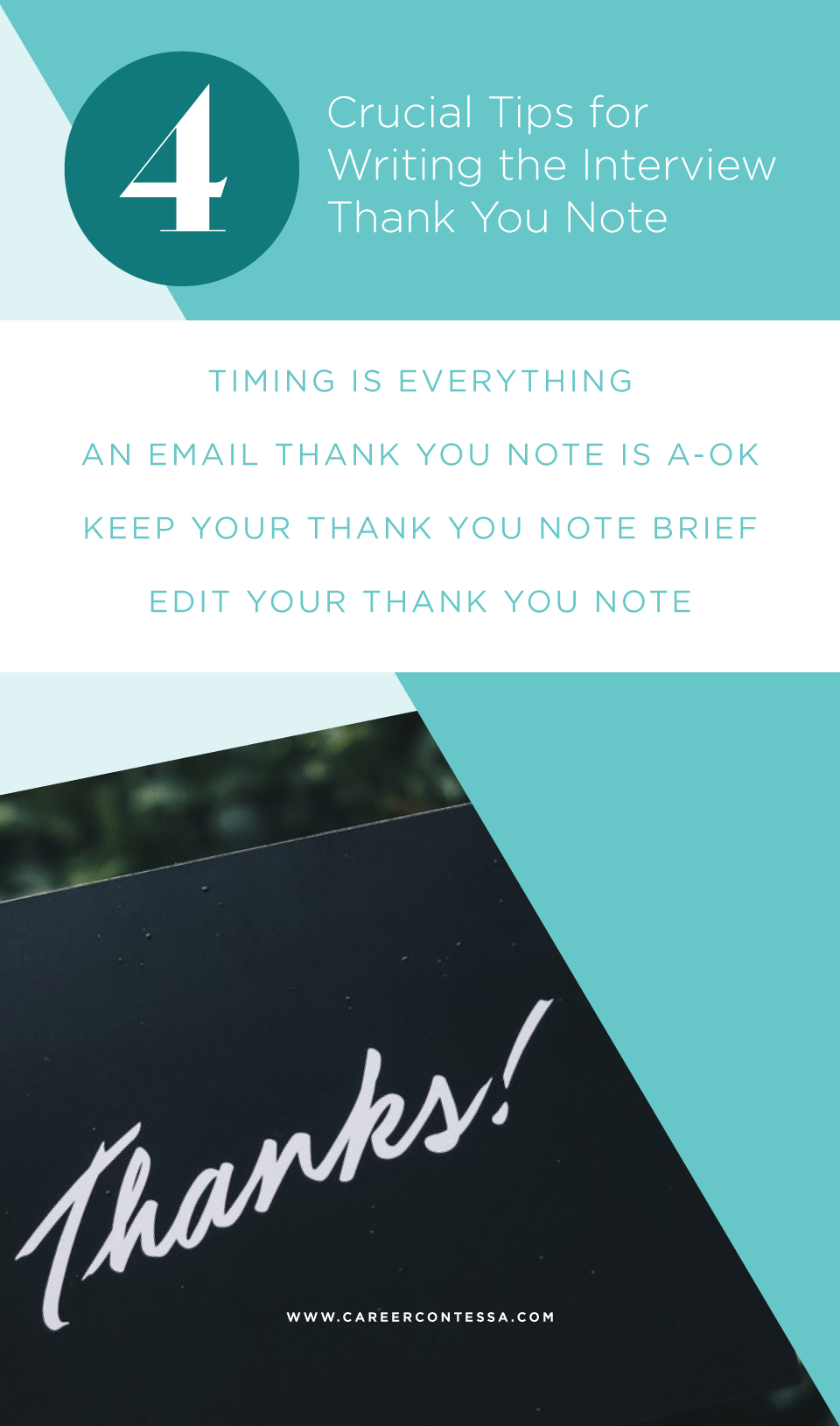
#BestofFSCBlog : #JobSearch – Four(4) Crucial Tips for Writing the Interview Thank You Note. So you Really Want this Job?  

So you really want this job?  You have likely already written a captivating cover letterundergone a brief phone interview and finally, were invited into the office for an interview. The interview went swimmingly (because you prepped for it like a pro)? Awesome! Now that you’re exiting the office building of your (hopeful) future job, it’s time for your next step.
Enter: the thank you note. The thank you note should be a no-brainer. It is a perfect way for a candidate to give herself the final edge over other candidates in the interview process.
Writing the thank you note does not have to be an exhaustive process. However, a candidate can (and should!) use it as an opportunity to edge out the other candidates.

TIMING IS EVERYTHING

Interviewing is an arduous process for any job candidate. In much the same way, it can be a stressful time for the hiring manager. My number one piece of advice in writing a thank you note for a job you really want?
Do it right away. Even if you killed the interview and expect a call saying “You’re hired!” by the end of the day, write the note. Express your gratitude and keep your candidacy fresh in the hiring manager’s mind. DO NOT wait until a week later when you haven’t heard anything to shoot off a “by the way, thanks” email.
A well-timed thank you note after an interview is a perfect way to reiterate your excitement to join the team. Aim to send your thank you note no within 24 hours of the end of the interview.

Like this Article ?  Share It !You now can easily enjoy/follow/share Today our Award Winning Articles/Blogs with Now Over 2.5 Million Growing  Participates Worldwidein our various Social Media formats below:

FSC LinkedIn Network:   www.linkedin.com/in/fscnetwork

Facebook:  http://www.facebook.com/pages/First-Sun-Consulting-LLC-Outplacement-Services/213542315355343?sk=wall

Google+:  https://plus.google.com/115673713231115398101/posts?hl=en

Twitter: Follow us @ firstsunllc

Question: Want the ‘the best/current articles/blogs on the web’ on Job Search, Resume, Advancing/Changing your Career, or simply Managing People?

Answer: Simply go to our FSC Career Blog below & type(#career, #leadership, #life) in Blog Search:  https://www.firstsun.com/fsc-career-blog/

What Skill Sets do You have to be ‘Sharpened’ ?

Continue of article:

AN EMAIL THANK YOU NOTE IS A-OK

We know you still have that Laura Ashley stationery your grandma gave you for your high school graduation. We know it’s embossed with your initials.
However, 87 percent of hiring managers view email as a perfectly acceptable means of delivering your thank you note. Since we have already established that timing is everything, email is going to be your best bet.

KEEP YOUR THANK YOU NOTE BRIEF

By this point in the interview process, your hiring manager has likely learned a ton about you. Do not use the thank you note to reiterate the play-by-play.
You can (and should) use it as a means to communicate one point you may have neglected to make, to expand on an idea or simply to express feelings of excitement for the job itself. Since the hiring manager is also busy interviewing, reading resumes, and communicating with other stakeholders, keep your note on point.

EDIT YOUR THANK YOU NOTE

So far, we have focused heavily on the speed and brevity of this note. But that doesn’t mean it’s informal! Make sure to use a formal greeting, write clear (and concise!) sentences, and sign off formally. This is not a one-liner to say “Thanks, Dude!”
Just as easily as a thank you note can impress a hiring manager, it can also detract from the whole process. A spelling error or flippant manner of writing can undo your progress. Write your thank you note, read it over a few times aloud, spell check it, and get a second pair of eyeballs on it if you can.
Crucial Tips Interview Thank You
CareerContessa.com | BY CAILEEN KEHAYAS  |  July 25, 2018

#CareerAdvice : Use this 15-Minute Checklist to Prepare for a #JobInterview …In Just a Few Minutes you can Make Sure that you’ll Nail your First Impression.

Your job interview is just days away and you’re feeling unprepared. You’ve reread the job posting about 67 times and you’re pretty clear on the role itself–but you can’t really think of much else to do to brush up.

Don’t sweat it. In fact, you may only need another 15 minutes or so in order to prep, so here’s what to do.

1. CONFIRM EVERYONE YOU’LL BE MEETING WITH

One minute. If the hiring manager or an HR officer set up your interview and didn’t explicitly tell you whom you’re going to be chatting with, don’t just assume it’s them and only them. It’s not at all uncommon for hiring managers to shuttle you off to someone else on their team who’s become available to meet you at the last minute. Firing off a quick email like this puts them on the hook to plan ahead rather than surprise you:

Hi Kamala, I’m really excited to come in on Tuesday. Just wanted to confirm that I’ll be speaking with you and Jarrod. Could you please let me know if there’s anyone else I should look forward to meeting? Thanks so much!

Hit send and move on.


Like this Article ?  Share It !    You now can easily enjoy/follow/share Today our Award Winning Articles/Blogs with Now Over 2.5 Million Growing  Participates Worldwide in our various Social Media formats below:

FSC LinkedIn Network:   www.linkedin.com/in/fscnetwork

Facebook:  http://www.facebook.com/pages/First-Sun-Consulting-LLC-Outplacement-Services/213542315355343?sk=wall

Google+:  https://plus.google.com/115673713231115398101/posts?hl=en

Twitter: Follow us @ firstsunllc

Question: Want the ‘the best/current articles/blogs on the web’ on Job Search, Resume, Advancing/Changing your Career, or simply Managing People?

Answer: Simply go to our FSC Career Blog below & type(#career, #leadership, #life) in Blog Search:  https://www.firstsun.com/fsc-career-blog/

What Skill Sets do You have to be ‘Sharpened’ ?

Continue of article:

2. CHECK OUT THE INTERVIEWER’S LINKEDIN AND TWITTER

Five minutes. Chances are you’re more familiar with the job description than with the roles and backgrounds of your interviewer. Once you’ve nailed down which people you’ll be talking to, it’s time to do some digging on each of them.

LinkedIn is the obvious great place to start. Skim their previous roles (including at other employers), take note of how long they’ve been with the organization, and then head way down to the bottom: If there are endorsements and recommendations, these can give you a feel for what a prospective boss might be especially good at. Any common themes in the praise their colleagues are sharing? Obviously, you’ll only find positive feedback in these sections, but that can still help you hone better questions about their management style.

Twitter is a handy guide, too: What articles is your interviewer sharing? Are their tweets opinionated and casual, or do they sound serious and formal? It’s certainly an imperfect measure, but this can still help you guess at an interviewer’s personality, interests, and values.

3. LINE UP YOUR “ABOUT ME” ANSWER

Seven minutes. Chances are your interview will open with some form of “Tell me a little about yourself” or the longer variant, “Tell me a little about yourself and what interests you about this role.” So plan your answer using a few quick bullet points in order to keep things short and concise.

As Glassdoor’s Isabel Thottam pointed out recently, it’s all about first impressions, so you’ll want to avoid sharing a lengthy backstory. “Skip your personal history and give about two to three sentences about your career path and how you ended up in this interview, applying for this job,” she explains. “You don’t need to be too detailed, there are plenty more questions coming. You just want to leave enough curiosity that the interviewer becomes excited to learn more about you throughout the interview.”

Take a few minutes to sketch out this capsule narrative and commit it (loosely, not word-for-word) to memory.

4. BRAINSTORM ONE GREAT QUESTION TO ASK

Two minutes. Get one really sharp question lined up that you can pose to the hiring manager. Sure, you can brainstorm three or five if you have time, but interviews ted to get truncated more often than they drag on longer than expected–so think about the No. 1 thing you really want to know.

Not sure what that is? Here are a few good questions you might want to pose depending on your career-stage. These are a bunch of all-around sharp questions that help you probe deeper about how performance is measured, expectations for the role, career advancement, and more, and these are a few more that can help you really dig into the company culture.

But when in doubt, just ask a question that shows off your curiosity. According to psychologist and talent expert Tomas Chamorro-Premuzic, “just being curious is a marketable job skill.” It’s “the precursor to learning faster and better, and thereby adapting to change rather than succumbing to it,” he explained in a recent Fast Company column. He suggests asking qualitative questions like, Why do you see X as important?” or “How do you see Y changing in the future?”

This can help interviewers see that you’re thinking ahead and considering how the role fits into the bigger organizational picture, but it does something much more fundamental, too: Continued curiosity is a sign that you’re actually interested in the job and giving it some serious thought. At a minimum, you want to walk out of your interview having convinced them of that.


FastCompany.com | July 23, 2018

#CareerAdvice : #JobInterview – How to Practice for an #Interview in 5 Steps…Ready to Learn How to Walk into an Interview with Confidence, and Knock It Out of the Park? Follow these Five Steps.

What if I run into traffic on my way to the interview and get there late? What if I mess up one of my answers? What if I draw a total blank when my interviewer asks me if I have any questions for them?

If you’ve ever been up for a position you really wanted before, then questions like these have probably raced through your head in the hours — or worse, throughout the night — before your big interview.

Many people think of overwhelming anxiety as an inevitable part of the interview process. But the truth is, your nerves can be greatly eased once you learn how to properly prepare for an interview. Not only will this make you feel a whole lot better going in — odds are, with a clear head, you’ll actually do a better job.

Ready to learn how to walk into an interview with confidence, and knock it out of the park?  Follow these five steps.

1. Research the Company

Recruiters and hiring managers don’t just want to know about your skills and experience — they also want to know how knowledgeable you are about the company. In fact, questions like “What is the name of our CEO?” and “Who are our competitors?” are both among the most commonly asked interview questions. But even if you don’t encounter a question like this, looking up the basics of the company is still worthwhile.

Use Glassdoor and online searches to learn about the company’s industry, products, mission, names of leaders, competitors, recent news and more. Then, you can drop these tidbits of newfound knowledge throughout your responses — e.g., when asked “Why do you want to work here?” a candidate might say, “The reason I decided to apply to this job was because of how much your mission resonates with me. I truly believe that making affordable, high-speed internet widely accessible will help bring the world closer together.” This proves a few things: a) you’re passionate about the opportunity, b) you’re a proactive self-starter with good critical thinking skills and c) you’re a good culture fit for the company.

You can also use this info to ask more informed questions of the interviewers themselves — more on that later.

Like this Article ?  Share It !    You now can easily enjoy/follow/share Today our Award Winning Articles/Blogs with Now Over 2.5 Million Growing  Participates Worldwide in our various Social Media formats below:

FSC LinkedIn Network:   www.linkedin.com/in/fscnetwork

Facebook:  http://www.facebook.com/pages/First-Sun-Consulting-LLC-Outplacement-Services/213542315355343?sk=wall

Google+:  https://plus.google.com/115673713231115398101/posts?hl=en

Twitter: Follow us @ firstsunllc

Question: Want the ‘the best/current articles/blogs on the web’ on Job Search, Resume, Advancing/Changing your Career, or simply Managing People?

Answer: Simply go to our FSC Career Blog below & type(#career, #leadership, #life) in Blog Search:  https://www.firstsun.com/fsc-career-blog/

What Skill Sets do You have to be ‘Sharpened’ ?

Continue of article:

2. Look Up Common Interview Questions

A lot of candidates stress out over not knowing what a recruiter or hiring manager is going to ask them. But in reality, you’ll get a lot of the same questions from one person to another. There are a few basic questions that you’ll almost certainly be asked — these include staples like “Tell me about yourself,” “Why do you want to leave your current job?” and “What are your biggest strengths and weaknesses?” If you’re a data-driven job seeker, you’ll appreciate the list of the 50 Most Common Interview Questions that Glassdoor identified after sifting through tens of thousands of interview reviews.

You can also use Glassdoor’s interview reviews to find out which questions they specifically ask at the company you’re applying to, as well as which questions are common for your job title. Sure, you might be thrown an oddball interview question every now and then, but you’ll likely find that the vast majority of questions you’re asked are ones that you can identify in advance.

3. Rehearse Your Answers

Now that you have an idea of which questions you could be asked, it’s time to think about how you will respond to them. Keep in mind that in general, interviewers want responses that are specific, positive, impactful and genuine. If you want to know what kind of answers recruiters and hiring managers are looking for from specific questions, check out Glassdoor’s How to Answer the 50 Most Common Interview Questions.

Don’t just think about what your response should entail — go ahead and write it down. You probably shouldn’t write out full answers — that can result in you memorizing the responses verbatim, which can come across as too rehearsed — but making a bulleted list of key points you want to hit is a great idea. Try using the worksheet at the bottom of this blog post to sketch out your answers.

After you’ve written down the key points you want to hit in common interview questions, it’s a good idea to hold a mock interview aloud with a friend or family member. Some people might feel a little shy about doing this, but brush these feelings aside as best you can — in my experience, this is the number one way to improve your odds of succeeding in an interview. Doing a dry run will allow you to get any mistakes you might make out of the way before it counts against you, and also helps you get valuable feedback, so don’t skip this essential step.

4. Come Up With Your Own Questions

One of the questions you’ll almost always be asked by an interviewer is “Do you have any questions for me?” It might seem innocuous, but believe it or not, this is a very common area in which candidates trip up. Interviewers aren’t just asking this question to be nice — it serves as somewhat of a litmus test for whether or not you’ve done your research, are a good culture fit and demonstrate strong critical thinking skills.

Use the research you gathered in step two to help you craft intelligent, informed questions about the role and company that will give you a fuller picture of what it’s like to work there and what it takes to be successful. For example, if you learned that the company you’re applying to is launching a new mobile app, you might say “I read that your company is launching a new mobile experience soon. Can you tell me more about that, and how it relates to this position?” You can also use this opportunity to dig into anything that hasn’t been brought up yet or covered in sufficient detail, like company culture, how the company defines success and what drew your interviewer to the company.

5. Hammer Out the Logistics

Congrats — if you’ve gotten through the previous four steps, you’ve already gotten the hard part out of the way! Now, all you have to do is think through all the little logistical details of your interview. These can vary depending on what kind of interview it is — phone, video, in-person, etc. Here are a few things to keep in mind for some of the most common types of interviews:

Phone Interviews

  • Pick a quiet place with good service to take the call
  • Confirm the day and time, accounting for differences in time zone
  • Confirm how you’re getting in touch with the hiring manager (Are they calling you? Are you calling them? Will you call their cell, or a conference number?)
  • Review the job description and company information 30 minutes before the call
  • Breathe — try to stay relaxed and focused!

Video Interviews

  • Pick a quiet place with good lighting and a simple background to take the interview
  • Do a test run to try out the video software
  • Restart your computer before the interview to help avoid technical difficulties
  • Dress like you are going to an in-person interview

In-Person Interviews:

  • Research standard company attire and dress one step above that
  • Have directions to where you’re going
  • Print multiple copies of your resume
  • Plan on arriving 30 minutes early, but wait in your car or at a coffee shop nearby until 5 minutes before
  • Brush your teeth or chew some gum before walking in
  • Run through your cheat sheet of responses, and a list of questions to ask each interviewer

Preparing for an interview the right way does take some work on your part, but believe us — it’s worth the effort. Who knows? You might just find that interviews aren’t as scary as you thought after all. Now go out there and get ‘em!

Screen Shot 2018 05 25 at 12.59.18 PMScreen Shot 2018 05 25 at 12.59.32 PM


GlassDoor.com |  |

Your #Career : #Interviews -How to Practice for an #Interview in 5 Steps (Bonus: Great Checklists)…Ready to Learn How to Walk into an #Interview with Confidence, and Knock It Out of the Park? Follow these Five Steps

What if I run into traffic on my way to the interview and get there late? What if I mess up one of my answers? What if I draw a total blank when my interviewer asks me if I have any questions for them?

If you’ve ever been up for a position you really wanted before, then questions like these have probably raced through your head in the hours — or worse, throughout the night — before your big interview.

Many people think of overwhelming anxiety as an inevitable part of the interview process. But the truth is, your nerves can be greatly eased once you learn how to properly prepare for an interview. Not only will this make you feel a whole lot better going in — odds are, with a clear head, you’ll actually do a better job.

Ready to learn how to walk into an interview with confidence, and knock it out of the park? Follow these five steps.

1. Research the Company

Recruiters and hiring managers don’t just want to know about your skills and experience — they also want to know how knowledgeable you are about the company. In fact, questions like “What is the name of our CEO?” and “Who are our competitors?” are both among the most commonly asked interview questions. But even if you don’t encounter a question like this, looking up the basics of the company is still worthwhile.

Use Glassdoor and online searches to learn about the company’s industry, products, mission, names of leaders, competitors, recent news and more. Then, you can drop these tidbits of newfound knowledge throughout your responses — e.g., when asked “Why do you want to work here?” a candidate might say, “The reason I decided to apply to this job was because of how much your mission resonates with me. I truly believe that making affordable, high-speed internet widely accessible will help bring the world closer together.” This proves a few things: a) you’re passionate about the opportunity, b) you’re a proactive self-starter with good critical thinking skills and c) you’re a good culture fit for the company.

You can also use this info to ask more informed questions of the interviewers themselves — more on that later.

Like this Article ?  Share It !    You now can easily enjoy/follow/share Today our Award Winning Articles/Blogs with Now Over 2.5 Million Growing  Participates Worldwide in our various Social Media formats below:

FSC LinkedIn Network:   www.linkedin.com/in/fscnetwork

Facebook:  http://www.facebook.com/pages/First-Sun-Consulting-LLC-Outplacement-Services/213542315355343?sk=wall

Google+:  https://plus.google.com/115673713231115398101/posts?hl=en

Twitter: Follow us @ firstsunllc

Question: Want the ‘the best/current articles/blogs on the web’ on Job Search, Resume, Advancing/Changing your Career, or simply Managing People?

Answer: Simply go to our FSC Career Blog below & type(#career, #leadership, #life) in Blog Search:  https://www.firstsun.com/fsc-career-blog/

What Skill Sets do You have to be ‘Sharpened’ ?

Continue of article:

2. Look Up Common Interview Questions

A lot of candidates stress out over not knowing what a recruiter or hiring manager is going to ask them. But in reality, you’ll get a lot of the same questions from one person to another. There are a few basic questions that you’ll almost certainly be asked — these include staples like “Tell me about yourself,” “Why do you want to leave your current job?” and “What are your biggest strengths and weaknesses?” If you’re a data-driven job seeker, you’ll appreciate the list of the 50 Most Common Interview Questions that Glassdoor identified after sifting through tens of thousands of interview reviews.

You can also use Glassdoor’s interview reviews to find out which questions they specifically ask at the company you’re applying to, as well as which questions are common for your job title. Sure, you might be thrown an oddball interview question every now and then, but you’ll likely find that the vast majority of questions you’re asked are ones that you can identify in advance.

3. Rehearse Your Answers

Now that you have an idea of which questions you could be asked, it’s time to think about how you will respond to them. Keep in mind that in general, interviewers want responses that are specific, positive, impactful and genuine. If you want to know what kind of answers recruiters and hiring managers are looking for from specific questions, check out Glassdoor’s How to Answer the 50 Most Common Interview Questions.

Don’t just think about what your response should entail — go ahead and write it down. You probably shouldn’t write out full answers — that can result in you memorizing the responses verbatim, which can come across as too rehearsed — but making a bulleted list of key points you want to hit is a great idea. Try using the worksheet at the bottom of this blog post to sketch out your answers.

After you’ve written down the key points you want to hit in common interview questions, it’s a good idea to hold a mock interview aloud with a friend or family member. Some people might feel a little shy about doing this, but brush these feelings aside as best you can — in my experience, this is the number one way to improve your odds of succeeding in an interview. Doing a dry run will allow you to get any mistakes you might make out of the way before it counts against you, and also helps you get valuable feedback, so don’t skip this essential step.

4. Come Up With Your Own Questions

One of the questions you’ll almost always be asked by an interviewer is “Do you have any questions for me?” It might seem innocuous, but believe it or not, this is a very common area in which candidates trip up. Interviewers aren’t just asking this question to be nice — it serves as somewhat of a litmus test for whether or not you’ve done your research, are a good culture fit and demonstrate strong critical thinking skills.

Use the research you gathered in step two to help you craft intelligent, informed questions about the role and company that will give you a fuller picture of what it’s like to work there and what it takes to be successful. For example, if you learned that the company you’re applying to is launching a new mobile app, you might say “I read that your company is launching a new mobile experience soon. Can you tell me more about that, and how it relates to this position?” You can also use this opportunity to dig into anything that hasn’t been brought up yet or covered in sufficient detail, like company culture, how the company defines success and what drew your interviewer to the company.

5. Hammer Out the Logistics

Congrats — if you’ve gotten through the previous four steps, you’ve already gotten the hard part out of the way! Now, all you have to do is think through all the little logistical details of your interview. These can vary depending on what kind of interview it is — phone, video, in-person, etc. Here are a few things to keep in mind for some of the most common types of interviews:

Phone Interviews

  • Pick a quiet place with good service to take the call
  • Confirm the day and time, accounting for differences in time zone
  • Confirm how you’re getting in touch with the hiring manager (Are they calling you? Are you calling them? Will you call their cell, or a conference number?)
  • Review the job description and company information 30 minutes before the call
  • Breathe — try to stay relaxed and focused!

Video Interviews

  • Pick a quiet place with good lighting and a simple background to take the interview
  • Do a test run to try out the video software
  • Restart your computer before the interview to help avoid technical difficulties
  • Dress like you are going to an in-person interview

In-Person Interviews:

  • Research standard company attire and dress one step above that
  • Have directions to where you’re going
  • Print multiple copies of your resume
  • Plan on arriving 30 minutes early, but wait in your car or at a coffee shop nearby until 5 minutes before
  • Brush your teeth or chew some gum before walking in
  • Run through your cheat sheet of responses, and a list of questions to ask each interviewer

Preparing for an interview the right way does take some work on your part, but believe us — it’s worth the effort. Who knows? You might just find that interviews aren’t as scary as you thought after all. Now go out there and get ‘em!

Screen Shot 2018 05 25 at 12.59.18 PMScreen Shot 2018 05 25 at 12.59.32 PM

GlassDoor.com |  | 

Your #Career : #CareerAdvice, #Interviews -How to Sell Yourself to a #HiringManager …You Quickly Get a Couple of Calls to Set Up Interviews, Talk to a Couple of #HiringManagers , and…you Don’t Hear Back. What’s Going On?

You’re ready to make a change, so you throw your hat in the ring for a few opportunities that look interesting. You quickly get a couple of calls to set up interviews, talk to a couple of hiring managers, and…you don’t hear back.

This is frustrating because the company wouldn’t interview you if you didn’t look like a reasonable candidate on paper or if you didn’t come with a recommendation from your professional network.

So your resume and recommendations are strong enough to get interviews, but then the opportunities just sort of dry up.

What’s going on?

This is almost always a sign that you need better positioning.

“What is positioning?”

Your job interviews are a part of your negotiation. The better you perform, the better your offer will be and the better you’ll be able make your case when you begin the formal salary negotiation.

Every question you’re asked is a chance to move them in this direction. Imagine you have a power meter that fills up a little more every time you give a great answer to an interview question. The more full that power meter is when they make you an offer, the better the offer will be.

Once you get into your interviews your job is to change the company’s thinking from “What’s the minimum we can offer this candidate to get them into this role?” to “What’s it going to take to convince this candidate to take this job?”

See the difference? You want to shift their thinking from “What’s the minimum salary we can offer?” to “What’s it going to take?”

Positioning is how you describe yourself as the hero this company needs, turning your skillset and experience into superpowers by matching them with the outcomes the business wants.

Let’s illustrate this with an example you may have experienced: Let’s say you’ve applied for a job as a software developer and you’re being interviewed by someone on the team you might work with.

Suddenly, you’re asked a common interview question that scares most people:

“Why should we hire you?”

You’re definitely qualified for the job, but this question catches you off guard, so you freeze up and say something like this:

“I’m a software developer.”

Maybe you elaborate a bit and mention the school you went to or the programming languages you’re familiar with. But in the end, your answer doesn’t really tell the interviewer anything new or compelling.

You’re not alone—that’s what most people would say! They might use more words, but their answer boils down to “I read the job description and I think I can do that job.”

Here’s what your answer might sound like when you leveraging strong positioning to stand out as the candidate for the job:

“You’re transitioning your application to Ruby on Rails, and I’ve been using Ruby on Rails for production client projects for two years. I can save your team a lot of time because I can start writing production code right away.”

Well, hello there! That’s a compelling answer that will impress your interviewer and significantly increase your chances of getting another interview and ultimately getting a high-quality job offer. And there’s a straightforward process you can follow to consistently give strong answers like the second one.

Like this Article ?  Share It !    You now can easily enjoy/follow/share Today our Award Winning Articles/Blogs with Now Over 2.5 Million Growing  Participates Worldwide in our various Social Media formats below:

FSC LinkedIn Network:   www.linkedin.com/in/fscnetwork

Facebook:  http://www.facebook.com/pages/First-Sun-Consulting-LLC-Outplacement-Services/213542315355343?sk=wall

Google+:  https://plus.google.com/115673713231115398101/posts?hl=en

Twitter: Follow us @ firstsunllc

Question: Want the ‘the best/current articles/blogs on the web’ on Job Search, Resume, Advancing/Changing your Career, or simply Managing People?

Answer: Simply go to our FSC Career Blog below & type(#career, #leadership, #life) in Blog Search:  https://www.firstsun.com/fsc-career-blog/

What Skill Sets do You have to be ‘Sharpened’ ?

Continue of article:

Learning about the job and company

In a nutshell, positioning is how you show a company that you’re the person they need for a specific job.

But how do you do that? How did the Software Developer know the company was transitioning their application to Ruby on Rails?

Research!

Basic research you should do for each opportunity

You’ll start with basic research and careful preparation for your interviews. Your goal is to learn enough about the company and job you’re pursuing so that you understand exactly what they need. Once you have that information, will tell them why you are exactly what they need.

Here’s a short list of things you should look for as you discover exactly what the company needs:

  • Company name
  • Company size
  • Mission statement
  • Company goals
  • Company challenges/struggles
  • Company website and jobs page (a link to the specific job listing would be great, plus a link to their generic jobs page)
  • What types of other jobs are they trying to fill right now? How many of each type?
  • A summary of what your know about the company from blog posts, news, experience with their products, etc.
  • Are they growing? How quickly?

Knowing that information before you go into an interview will help you be prepared to talk about the specific company and job you’re considering. And, more importantly, you’ll be able to tell a more detailed story about how their company will be better if you’re a part of it.

Where to find that information

So where do you start? There are three main places where you’ll find pretty much everything you need: their company website, Google and Glassdoor.

This doesn’t need to be complicated—you’re simply doing the work that others won’t do. Here are the types of information you’re looking for:

  • Company website—You’re particularly interested in their “Careers” or “Jobs” page, their home page, their About page.
  • News and articles about them—Are other people talking about this company? What are they saying?
  • Blogs—If they have a corporate blog, read a few entries to see what they’re talking about right now; if there are other blogs written about the company, see what others are saying about the company.
  • Financial statements—If the company is publicly traded, then they’re required to file 10-Q (quarterly) and 10-K (annual) financial statements. You don’t have to read the entire thing, but the first page is usually pretty enlightening.

In general, bigger companies will have more information available than smaller companies. That’s ok. For now, all you’re doing is building a list of data sources you can use.

Using your research to answer interview questions

Use the short list of above to discover exactly what the company needs. Most of the information is publicly available, and some companies will have more information than others. But that’s ok because you just need basic information to get through the first interview or two.

How can you help them achieve their goals and address their pain points?

This is the key question you want to answer before your interviews. When you can tell the hiring manager how you’ll help the company or team achieve its goals and address its challenges, they will want to hire you.

Remember, they’re interviewing you because they need to fill an open position. That position is open because the company has needs or challenges that the person who does that job will help address. So when you tell them that you’ll help them address those needs and challenges, and you tell them how you’ll do it, you’re saying, “I am the candidate you opened this job for.”

Why would they look anywhere else?

Here’s the formula:

  1. Identify needs and challenges the company or team has.
  2. Identify specific ways you can help them address those needs and challenges.
  3. Answer interview questions by telling them how you’ll help them address their needs and challenges.

Let’s go back to the very beginning. The question we’re considering is:

“Why should we hire you?”

Most people are intimidated by this question because it’s so vague and open-ended. Usually, they’ll say something like, “Because I’m a software developer.”

A more experienced interviewer might say something like:

“I’ve been in this industry for 10 years, and I worked on a major project for ACME Corp and carried a lot of responsibility there. I also have experience managing teams and I have published five white papers on various topics.”

But look at who this candidate is talking about: I’ve, I, I, I.

That’s not good enough.

Don’t just talk about yourself. Talk about how you can help the company achieve its goals or address its pain points. You’ll still say “I”, but you’ll say it in the context of “you”.

This is a softball question, the perfect setup for you to tell them how you’ll help them meet one of their goals or resolve a challenge they’re having! Take advantage of it!

If you’ve done your research before the interview, then the first thing you’ll do when confronted with this question is think, “What is their most urgent need or challenge?” It will probably be pretty obvious since you’ve spent time reading about their company, but it’s ok to just pick something from your list if there isn’t any particular outstanding one.

Now that you’ve identified their most urgent need, ask yourself, “How can I help them address that need?” You’ve already been thinking about this before the interview, so it’s a slam dunk.

Then you put them together into a nice, short answer that tells them how you’ll help them address their most urgent need with your skillset and experience.

When companies hire people, they have a range they’re able to pay to fill the position, and they’re more inclined to pay at the higher end of that range if they find the right candidate. You want to be that candidate.

Another look at our Software Developer example from earlier

Before we wrap up, let’s jump back to the software developer example we saw earlier. Now that you know how to use positioning to answer interview questions, see if you can spot the need and how the developer describes the solution when asked “Why should we hire you?”

“You’re transitioning your application to Ruby on Rails, and I’ve been using Ruby on Rails for production client projects for two years. I can save your team a lot of time because I can start writing production code right away.”

You’re, your, I’ve, I, your, I.

Do you see it now? This answer is much more focused on the company and their needs.

The most urgent need this developer identified was a big transition to a new technology. The developer could directly help address that need because he had a few years’ experience with that specific technology.

All he had to do was tell the interviewer how he could help meet that need.

That’s an excellent use of positioning to answer a tricky interview question.

Use this process for every new opportunity

Let’s go back to our Positioning definition from the beginning of this series:

Positioning is how you describe yourself as the hero this company needs, turning your skillset and experience into superpowers by matching them with the outcomes the business wants.

For each opportunity you pursue, do the research described above, and consider the company’s goals and challenges. Then think about how you can use your skillset and experience to help the company address those goals and challenges.

Do that for every opportunity and you’ll stand out from other candidates and get more high-quality job offers.


Glassdoor.com | May 28, 2018 | Posted by 


Your #Career : Behind the Scenes: Uncovering the Myths and Mysteries of #Recruiting …For many #Jobseekers , it Can be Confusing & Downright Frustrating to Try to Understand what a Recruiter is Thinking when He/She Reviews a #Resume or is Evaluating a Candidate Post-Interview.

For many jobseekers, it can be confusing and downright frustrating to try to understand what a recruiter is thinking when he or she reviews a resume or is evaluating a candidate post-interview. Most recruiters would like to speak with everyone personally, but some of their job postings have so many people applying, that they often have to rely on form letters.

Here are some insights into all those questions you would love to ask the person on the other side of the “Apply” button.  

Scenario #1: I just clicked Apply and submitted my application. What happens now?

After a job is posted, recruiters will spend time reviewing applicants and setting up interviews for the most qualified people. They also do some proactive searching for skilled candidates if they’ve got a really tough job to fill. After interviews wrap up, recruiters spend a lot of time comparing notes with the hiring teams. During those discussions, they will offer expertise to influence hiring decisions and help determine the best person for the job.

Scenario #2: I thought the interview went well, then I got a form letter. What happened?

Don’t take a form letter as a sign of not doing well; it’s possible that you did a great job, someone else just did slightly better. Recruiters truly wish they could respond to everyone personally, but some of their open jobs have literally hundreds of people applying.

Scenario #3: Is it a bad idea for me to apply to the same role multiple times?

It’s not unheard of to apply multiple times before being hired, especially at well-known companies or in competitive industries. The key is to show the recruiter you have something new to offer the next time you interview. Start by doing an honest self-assessment of your interview performance:

  • Did you struggle to provide strong answers? 
  • Did the recruiter have to ask follow-up questions to understand your responses? 
  • Did you make it to the interview step or were you declined during the apply phase? 

Whatever you uncover, know that you don’t necessarily have to offer something drastically different the next time, sometimes just improving your interview performance is enough. But if you were declined early in the process, take some time to consider whether you met all the criteria for the role. You may want to take a few months to obtain new skills or experiences before trying again.

Another best practice is to take some reflection time immediately following an interview. Write down everything you can remember – questions you were asked, your answers, what you did well, and what you would improve.

Scenario #4: Why didn’t the recruiter offer me feedback after the interview?

Recruiters and the hiring team collaborate before deciding where strengths and opportunity areas exist, so immediate feedback wouldn’t be helpful to the applicant. Another reason is time – offering feedback to a large volume of applicants isn’t very efficient. Even if only a few people applied, many recruiters are hesitant to give feedback due to legal reasons.

Scenario #5: How can I stand out during the interview process?

Believe it or not, simple things like professionalism, manners, and a polished presence make a huge difference. Display your enthusiasm for the job and practice articulating your qualifications so they’ll sound natural, not rehearsed. Make sure to research the hiring company so you’ll sound informed, and avoid gimmicks. And don’t forget to send a personalized “thank you” note – you’d be surprised how many people forget.

Scenario #6: I was originally scheduled for a phone interview in two days, now it’s pushed out two weeks. Is this a bad sign?

Not necessarily. Many industries (banking, finance, PR, to name a few) have frequent emergencies that need addressing right away. If your interview is rescheduled once or twice, that may be a normal course of business. Five or six times? It could be a sign that the business or person is a bit disorganized. Chat with a trusted contact in your industry to uncover if this is normal.

Scenario #7: During an interview, I was only asked two or three questions. Should I be concerned?

There are many reasons for short interviews, so don’t worry too much about the length. Sometimes, recruiters identify something early on that tells them they want to move a candidate to the next step in the process; they then save deeper questions for that stage. Many phone screens, for example, only take about 15 minutes. It could also be that your interviewer isn’t prepared for the conversation or is newer at interviewing. Always make sure to ask your own questions to demonstrate your interest in the role. Asking solid questions can make a more memorable – and more positive – impression.

Scenario #8: I get so nervous during interviews! Will this affect my ability to get a job?

While it’s true that you are being assessed on your ability to stay composed in a tough situation, how much you are measured will depend on the role. For example, if you are applying for a senior leader position, recruiters will expect you to appear confident and relaxed.

In other roles, many recruiters will overlook slight nervousness, but if your emotions get out of control (crying, gasping for air, being unable to speak) it can negatively affect the impression you make. There are little tricks to look less nervous than you feel – smile a few times, avoid conversations fillers (such as “um” and “uh”) and don’t be afraid to pause if you need a moment to compose your thoughts. Above all, realize that recruiters empathize that interviewing is hard. Remember that they brought you in for a reason – they want you to do well and get hired.

Devon Miller, Talent Branding and Recruitment Marketing at Vanguard, is a writer specializing in branding and marketing topics that create authenticity and engagement via social media channels. Vanguard is one of the world’s largest investment companies, offering a large selection of high-quality low-cost mutual funds, ETFs, advice, and related services.

GlassDoor.com |  

#BestofFSCBlog : Sixteen(16) #InterviewQuestions that are Designed to Trick You. Here are a Few Particularly Thorny Questions — and Some Suggestions on How to Answer Them.

Savvy hiring managers know exactly what to ask candidates. Sometimes, that means asking prospective employees seemingly simple questions.

These questions may seem innocuous at first, but they’re actually trying to get you to reveal information you may have been trying to conceal.

Hiring managers often love these queries. Used correctly, they break through the traditional interview noise and clutter to get to the raw you.

So it’s important to learn how to answer questions designed to trick you.

Here are a few particularly thorny questions — and some suggestions on how to answer them:

1- ‘Can you tell me about yourself?’

“The employer wants to hear that the candidate did their homework,” Tina Nicolai, executive career coach and founder of Resume Writers’ Ink, told Business Insider. “The interviewer is also listening for a level of confidence in how well the candidate portrays herself through the information that is communicated.”

So, how can such a straightforward question be a trap? Nicolai said that it’s important not to use this question as an opportunity to chat about your personal life. You need to focus on your potential value to the organization.

“The employer wants to hear about your achievements broken down into two or three succinct bullet answers that will set the tone of the interview,” Nicolai said.

Remember, what we tell people about us is what they hear. So stay sharp and convey your top strengths when answering this question.

Like this Article?  Share It !    You now can easily enjoy/follow/share Today our Award Winning Articles/Blogs with Now Over 2.5 Million Growing  Participates Worldwide in our various Social Media formats below:

FSC LinkedIn Network:   www.linkedin.com/in/fscnetwork

Facebook:  http://www.facebook.com/pages/First-Sun-Consulting-LLC-Outplacement-Services/213542315355343?sk=wall

Google+:  https://plus.google.com/115673713231115398101/posts?hl=en

Twitter: Follow us @ firstsunllc

Question: Want the ‘the best/current articles/blogs on the web’ on Job Search, Resume, Advancing/Changing your Career, or simply Managing People?

Answer: Simply go to our FSC Career Blog below & type(#career, #leadership, #life) in Blog Search:https://www.firstsun.com/fsc-career-blog/

What Skill Sets do You have to be ‘Sharpened’ ?

Continue of article:

2- ‘How would you describe yourself in one word?’

With this question, interviewers are likely hoping to elicit several data points.

They want to know about your personality type, how confident you are in your self perception, and whether your work style is a good fit for the job, explained Lynn Taylor, a national workplace expert and the author of “Tame Your Terrible Office Tyrant: How to Manage Childish Boss Behavior and Thrive in Your Job

This question can be a challenge, particularly early on in the interview, because you don’t really know what personality type the manager is seeking.

“There is a fine line between sounding self-congratulatory versus confident, and humble versus timid,” Taylor told Business Insider. “And people are multifaceted, so putting a short label on oneself can seem nearly impossible.”

When in doubt, opt for the conservative route. For example, if your coworkers find you both hilarious and reliable, Taylor said to stay on the safe side and emphasize the latter trait.

But most of all, try to tailor your response to the role or organization in question.

“Most employers today are seeking team players that are levelheaded under pressure, upbeat, honest, reliable, and dedicated,” she added. “However, it would be a mistake to rattle off adjectives that you think will be well received. This is your opportunity to describe how your best attributes are a great match for the job as you see it.”

3- ‘How does this position compare to others you are applying for?’

They’re basically asking: “Are you applying for other jobs?”

“The hiring manager is first trying to figure out how active you are in your job search,” Nicolai said. The interviewer wants to see how you speak about other companies or positions that hold your interest — and how honest you are.

If you say, “This is the only job I’m applying for,” that’ll send up a red flag. Very few job applicants apply to only one job — so they may assume you’re being dishonest.

If you openly speak about other positions you’re pursuing, however, and you speak favorably about them, the hiring manager may see you as unattainable and pass.

“Speaking negatively about other jobs or employers isn’t good either,” she said.

It is appropriate to say, “There are several organizations with whom I am interviewing, however, I’ve not yet decided the best fit for my next career move.”

“This is positive and protects the competitors,” Nicolai said. “No reason to pit companies or to brag.”

4- ‘Can you name three of your strengths and weaknesses?’

The interviewer is looking for red flags and deal-breakers, such as an inability to work well with coworkers or an inability to meet deadlines.

“Each job has its unique requirements, so your answers should showcase applicable strengths, and your weaknesses should have a silver lining,” Taylor said. “At the very least, you should indicate that negative attributes have diminished because of positive actions you’ve taken.”

Exposing your weaknesses can hurt you if not ultimately turned into positives, she said.

“Your strengths may not align with the skill set or work style required for the job. It’s best to prepare for this question in advance, or risk landing in a minefield,” Taylor said.

And, as for strengths, Hiring managers want to know that they will be a direct asset to the new position.

But the most important thing is to be able to show the interviewer that you’re capable of well-thought-out self-reflection.

“They are also looking for your ability to self-assess with maturity and confidence,” Taylor said.

5- ‘Why do you want to work here?’

Interviewers ask this because they want to know what drives you the most, how well you’ve researched them, and how much you want the job.

“Clearly you want to work for the firm for several reasons,” Taylor said. “But just how you prioritize them reveals a lot about what is important to you.”

You may be thinking to yourself, “I’m not getting paid what I’m worth,” or, “I have a terrible boss,” or, “All things being equal, this commute is incredibly short” — none of which endears you to the hiring manager.

“You’re also being tested on your level of interest for the job,” she said.

Hiring managers want to see that you’ve taken the time to research the company and understand the industry.

They also want to know that you actually want this job (and not just any job); that you have a can-do attitude; that you are high energy; that you can make a significant contribution; that you understand their mission and goals; and that you want to be part of that mission.

6- ‘Why do you want to leave your current job?’

“Your prospective boss is looking for patterns or anything negative, especially if your positions are many and short-term,” Taylor said.

The interviewer may try to determine whether you have had issues working with others leading to termination, if you get bored quickly in a job, or other red flags.

So tread with caution. If you’re not diplomatic, your answer could raise further questions and doubts or sink your chances entirely.

The hiring manager is likely hoping you are seeking a more challenging position that is a better fit for your skill set, according to Taylor.

“Know that hiring managers don’t mind hearing that you’re particularly excited about the growth opportunity at their company,” Taylor said.

7- ‘What are you most proud of in your career?’

Interviewers want to understand what you’re passionate about, what you feel you excel at, and whether you take pride in your work.

“How you describe your favorite project, for example, is almost as important as the project itself,” Taylor said. “It’s assumed that if you can speak with conviction and pride about your past work, you can do the same during important presentations at the new employer.”

Managers may assume that this type of work is what you really want to do most or focus on in the future.

It can make you sound one-dimensional if you don’t put it in the context of a larger range of skills and interests.

Hiring managers want to see your ability to articulate well and foster enthusiasm in others, as well as your positive energy.

“But one note of caution: In all your zeal to share your successes, remain concise,” Taylor said. “You want to showcase your ability to present well once on the job.”

8- ‘What kind of boss and coworkers have you had the most and least success with, and why?’

The key to answering this question is staying cool.

You run the risk of appearing difficult by admitting to unsuccessful interactions with others, unless you keep emotions out of it.

Interviewers are trying to ascertain if you generally have conflicts with people and/or personality types.

“Secondarily, they want to know how you can work at your best,” Taylor said.

You may also inadvertently describe some of the attributes of your prospective boss.

“They want to hear more good than bad news,” Taylor said. “It’s always best to start out with the positive and downplay the negatives.”

You don’t want to be evasive, but this is not the time to outline all your personality shortcomings either.

This is an opportunity to speak generally about traits that you admire in others yet appear flexible enough to work with a variety of personality types.

For example: “I think I work well with a wide gamut of personalities. Some of my most successful relationships have been where both people communicated very well and set mutual expectations up front.”

9- ‘Have you ever considered being an entrepreneur?’

In most cases, this question gets at whether or not you’re planning to abandon ship and found your own company, Taylor said.

“No firm wants to sense this, as they will begin to ponder whether their valuable training time and money could vanish,” Taylor said.

Don’t get lured into talking about your one-time desire to be your own boss with too much perceived enthusiasm. An employer may fear that you still hope to eventually go out on your own and consider you a flight risk.

It’s okay to tell a prospective manager that you once considered entrepreneurship or have worked as an independent contractor.

Turn the experience into a positive by saying that you’ve already experienced it or thought about it, and it’s not for you.

That might be more convincing than saying, “No, I’ve never considered that.”

This is an opportunity to discuss why working in a corporate environment as part of a team is most fulfilling to you.

You may also enjoy the specialized work in your field more than the operational, financial, or administrative aspects of entrepreneurship.

You can further allay their fears by explaining exactly why their company appeals to you.

10- ‘If you could work for any company, where would you work?’

Hiring managers want to ascertain how serious you are about working for them in particular, versus the competition, as well as your level of loyalty, Taylor said.

“It also helps them weed out candidates who may veer from the core career,” Taylor said. “You may have heard that Google is a great place to work, but that off-road strategy would spell doom, as you’re being given the opportunity to theoretically work at your ‘dream job.'”

Basically, stay focused on the job at hand. Don’t get caught up in the casual flow of the discussion and inadvertently leak out your preference for a well-known firm.

“Your interviewer wants to know that you’re interviewing at your first company of choice,” Taylor said.

A response to this might be, “Actually, I’ve been heavily researching target firms, and [fusion_builder_container hundred_percent=”yes” overflow=”visible”][fusion_builder_row][fusion_builder_column type=”1_1″ background_position=”left top” background_color=”” border_size=”” border_color=”” border_style=”solid” spacing=”yes” background_image=”” background_repeat=”no-repeat” padding=”” margin_top=”0px” margin_bottom=”0px” class=”” id=”” animation_type=”” animation_speed=”0.3″ animation_direction=”left” hide_on_mobile=”no” center_content=”no” min_height=”none”][your company] seems like the ideal fit for my credentials,” Taylor said. “It’s exciting to me that [your company] is doing XYZ in the industry, for example, and I’d like to contribute my part.”

11- ‘Why were you laid off?’

“Employers want to know how you hold up under pressure and less fortunate circumstances such as job loss,” Nicolai said. “They want to hear that you are positive and ready to get back to work with a great attitude. They also want to hear a level of confidence — not defeat or anger.”

For starters, you may be bitter or angry about the layoff, and this question may prompt you to bad-mouth your former employer, which you never want to do in a job interview.

“Stay away from finger pointing, desperation, or portraying a victim,” she added.

Instead, talk about the business decision behind the layoff and keep your own feelings about the situation in check.

“Be sure to not cast blame or any discontent,” Nicolai said. “Stay on track with the facts as you know them.”

12- ‘What would you do if you won $5 million tomorrow?’

What’s the goal of this out-of-left-field question? The interviewer probably wants to know whether you would still work if you did not need the money.

They want to hear that you would continue working because you’re passionate about what you do — and they want to know you would make smart financial decisions.

If you would do something irresponsible with your own money, they’ll worry you’ll be careless with theirs.

Your response to this question tells the employer about your motivation and work ethic.

Your interviewer also might be testing your ability to handle a somewhat random question.

“They have nothing to do with the job at hand, and you may wonder if there is any significance to them,” Taylor said. “Whether there is or not, the fact remains that you can easily lose your cool if you don’t pause and gather your thoughts before you respond to a question like this.”

13- ‘Have you ever been asked to compromise your integrity by your supervisor or colleague? Tell us about it.’

Your prospective boss is evaluating your moral compass by asking how you handled a delicate situation that put your integrity to the test, Taylor said.

“They may also dig too deeply to test your level of discretion,” she said.

Essentially they want to know: Did you use diplomacy? Did you publicly blow the whistle? Did a backlash ensue? What was your thought process?

Interviewers want to know how you manage sensitive matters and are also wary of those who bad-mouth former employers, no matter how serious the misdeed.

“They will be concerned if you share too much proprietary information with the interviewer,” she said. “So it is tricky because you must carefully choose your words, using the utmost diplomacy.”

It’s wise to be clear, concise, and professional in your answer, without revealing any internal practices of prior employers.

“You have nothing to gain by divulging private corporation information,” Taylor said.

14- ‘Can you give us a reason someone may not like working with you?’

Prospective bosses want to know if there are any glaring personality issues, and what better way than to go direct to the source?

“They figure that the worst that can happen is you will lie, and they may feel they’re still adept at detecting mis-truths,” Taylor said. “The negative tone of the question is bound to test the mettle of even the most seasoned business professionals.”

But be careful. You can easily shoot yourself in the foot with this question.

If you flip and say, “I can’t think of a reason anyone wouldn’t like working with me,” you’re subtly insulting the interviewer by trivializing the question.

So you have to frame the question in a way that gets at the intent without being self-effacing. “Hiring managers are not seeking job candidates who have self-pity,” she said.

Taylor suggested leading with the positive: “‘Generally I’ve been fortunate to have great relationships at all my jobs.'”

“‘The only times I have been disliked — and it was temporary — was when I needed to challenge my staff to perform better,'” Taylor added. “‘Sometimes I feel we must make unpopular decisions that are for the larger good of the company.'”

15- ‘How did you make time for this interview? Where does your boss think you are right now?’

Hiring managers want to find out if your priorities are in the right place: current job first, interviews second.

“They know that the habits you follow now speak to your integrity and how you will treat your job at their company should you undertake a future job search,” Taylor said. “They also want to know how you handle awkward situations where you cannot be truthful to your boss. Ideally your interview is during a break that is your time, which is important to point out.”

The implication is, “How is it searching for a job behind your boss’ back?” For most employed job seekers, it’s uncomfortable to lie about their whereabouts.

So they’re vague and treat it like any other personal matter they handle on their time.

It’s wise to explain that you always put your job first, and schedule interviews before or after work, at lunchtime, during weekends if appropriate, and during personal time off.

If asked pointedly, “Where does your boss think you are right now?” be vague.

Don’t say: “I took a sick day.” Instead, Taylor suggested you try something like: “My boss understands that I have certain break periods and personal time — he doesn’t ask for details. He’s most interested in my results.”

16- ‘Tell me about a time you disagreed with a company policy’

The hiring manager is attempting to determine a number of things with this query.

Namely, your decision-making ability, ease of working with others, and most importantly, whether you will speak up after identifying an area in need of improvement.

“To say, ‘I’ve never disagreed with a company policy’ is tough to believe from even the most amenable employee,” Nicolai said. “This also sends a message that you may just accept anything that you are told to do without thinking through all possible outcomes.”

While companies want leaders and employees to follow the rules, they also want people who are going to review potential outdated policies and have the courage to push back and propose changes to maintain a current, competitive edge and productive workplace.

So offer up a real situation that points out a logical and business reason that you were in opposition of a policy, she suggested.

“Focus on how your idea to rework the policy was beneficial to the company as a whole,” Nicolai said. “Speak up on the research that you conducted, the facts that you presented, and the outcome of your attempts to have the policy rewritten.”

Jacquelyn Smith contributed to a previous version of this article.


Businessinsider.com | March 27, 2018 |  

[/fusion_builder_column][/fusion_builder_row][/fusion_builder_container]