Posts

#CareerAdvice : #ResumeWriting – How to Write a #Resume That Will Impress a Bot ( #AI )…Great REad!

Getting hired used to mean writing a resume that stood out to the HR manager or recruiter assigned to thumb through them. Today, the gatekeeper is a machine as AI revolutionizes the hiring process. That means the way you write your resume has changed, too.

“AI is handling processes that used to take an enormous amount of time away from engaging with the talent pool,” says Jon Christiansen, PhD, chief intelligence officer of the marketing research firm Sparks Research. “HR managers don’t have to sift through hundreds of resumes, and they can get into their real expertise of recruiting and placing the right talent.”

While this is good news for the HR department, it adds a new challenge for candidates, says Arran Stewart chief visionary officer and co-founder of Job.com, a recruiting platform.

“AI has made the resume writing process far more competitive as it now requires emphasis on personalizing the document for the job in question rather than submitting a generic resume for a myriad of vacancies,” he says. “Where recruiters and hiring managers are able to read between the lines and find the relevance of any skill or accomplishment on your resume to the open positions they have, AI is only concerned with how closely your resume matches with the skills it’s been asked to look for in the job you applied to.”

Get past the bot and in front of the HR manager by doing these six things:

1. WRITE A NEW RESUME FOR EVERY JOB

The ability to blast out one version of a resume and get nibbles is over. Now you have to write a resume that speaks to the job description.

“The job description contains several clues about what the machine is looking for,” says Christiansen. “It’s saying, ‘Here are the knowledge skills I’m looking for, and here’s background I’m looking for.’ Look at the tags, keywords, and streams of text; that’s where you should get started.”

Apply the language to the resume you submit to the job in question, says Stewart. “AI is looking for singular relevance to the role they’re searching for, so including job-specific language is a must if you want to make it to the shortlist,” he says. “It might be slightly more work, but no different than say having different cover letters ready for each position.”


Like this Article ?  Share It !    You now can easily enjoy/follow/share Today our Award Winning Articles/Blogs with Now Over 2.5 Million Growing  Participates Worldwide in our various Social Media formats below:

FSC LinkedIn Network:   www.linkedin.com/in/fscnetwork

Facebook:  http://www.facebook.com/pages/First-Sun-Consulting-LLC-Outplacement-Services/213542315355343?sk=wall

Google+:  https://plus.google.com/115673713231115398101/posts?hl=en

Twitter: Follow us @ firstsunllc

Question: Want the ‘the best/current articles/blogs on the web’ on Job Search, Resume, Advancing/Changing your Career, or simply Managing People?

Answer: Simply go to our FSC Career Blog below & type(#career, #leadership, #life) in Blog Search:  https://www.firstsun.com/fsc-career-blog/

What Skill Sets do You have to be ‘Sharpened’ ?

Continue of article:

2. USE EASY TO UNDERSTAND JOB TITLES

Some companies like to assign creative job titles, like Branding Guru or Planning Expert, but including them on your resume might get you passed over by the machine.

“It’s cool for culture, but that’s not the tags the machine is looking for,” says Christiansen. “If the job description says they’re looking for a marketing manager or product manger, that’s the tag it’s going to look for.”

Christiansen suggests going to the Bureau of Labor Statistics or O-NETand searching standard job titles. “If you can’t find your job title, it’s probably not going to be picked up and tagged during the machine screening,” he says.

Also consider the job progression, adds Stewart. “AI isn’t at the point of a mass scale predictive, so if you’re applying for a job that is senior to your current role as a logical next step in your career, AI won’t make the connection that it is the logical next step,” he says. “If your experience and skills make you seem underqualified, you should write in aspirational terms about your skills and accomplishments. That way the system views you as ready to take on the added challenge.”

3. RESIST THE URGE TO BE CREATIVE

Machines don’t judge you by the font you choose. If you have a font that can’t be read by most word processors, you might get spit out.

“Any font that isn’t within the Microsoft Word platform might not be able to be read,” says Christiansen. “Sometimes using a PDF format might work, but it’s not worth the risk.”

And don’t add graphics. Tables or images might look good, but again, the bot might not be able to recognize it.

“It might look like wasted space to a machine,” says Christiansen.

4. BE PRECISE

Including a long history of experience is no longer necessary, so try to keep your list of experience within the last five years, says Stewart.

“A full 20 years of work history dilutes the experience concentration weighing your resume, which will result in you being removed from shortlists,” he says. “When writing your resume remember the two Rs: keep it relevant and recent.”

5. CHECK YOUR SPELLING

You never want your resume to include spelling or grammatical errors, but a human might have been more forgiving than a machine.

“AI not only sorts through irrelevant applicants, in some cases it highlights the lazy ones as well,” says Stewart. “It’s still important to be sure your information is still meeting the usual standards of excellence expected for professional documents.”

6. INCLUDE A COVER LETTER

While a resume should be written to match the job and advance you past the bot, the cover letter is your chance to shine, says Christiansen.

“It’s an opportunity to speak like a human,” he says. “You can speak directly to the hiring manager, make yourself sound like a human and talk uniquely about the experiences you mentioned that spoke to the job description.”

Christiansen recommends writing three or four paragraphs about how you could fit that team, company and job. “Get into the why,” he says. “A cover letter may be an old practice, but I don’t see them go away. A good hiring manager wants to hear you in that.”

Taking these six steps involve more work on the part of the candidate, but skipping them might be a bigger risk.

“If you send out a generalized resume, it’s a case of garbage in/garbage out,” he says. “You want to get a match because you fit the job. If you’re getting calls from a generalized resume it’s because those companies want warm bodies, whether or not they fit the job. Is that where you want to work?”


FastCompany.com |April 1, 2019 | BY STEPHANIE VOZZA  4 MINUTE READ

#CareerAdvice : #CoverLetter – 5 Strong Ways to Close a Cover Letter. Must REad!

Writing a cover letter isn’t an easy task for many job seekers. There’s a lot of pressure because, sometimes, the cover letter is the only piece the recruiter will read. Therefore, your cover letter must be a piece of writing that describes your achievements, and how you will help the company succeed.

Additionally, you want your cover letter to illustrate how you are the best fit for the company, and for the reader to believe you have the qualifications they seek. If you want to land an interview with your cover letter, you don’t want to sound vague or wishy-washy. Your cover letter should illustrate why you are the best fit, and how you will help the company or organization reach success.

However, when writing the closing paragraph of your cover letter, it’s easy to have a passive voice because you don’t want to appear overconfident. For example, if you say, “I look forward to hearing from you,” that’s great –but that alone doesn’t seal the deal. The closing paragraph of your cover letter must be one of the strongest elements because it is the last impression you leave in the reader’s mind.

Here are five phrases to include in the final paragraph of your cover letter that will help you seal the deal for your next interview:

1. “I AM VERY EXCITED TO LEARN MORE ABOUT THIS OPPORTUNITY AND SHARE HOW I WILL BE A GREAT FIT FOR XYZ CORPORATION.”

Strong cover letter closings are enthusiastic and confident. You want the reader to have the impression you are truly passionate about the position and working for their company. This statement will also illustrate your ability to fit into the company culture, and how your personality and work ethic is exactly what they’re looking for.

2. “I BELIEVE THIS IS A POSITION WHERE MY PASSION FOR THIS INDUSTRY WILL GROW BECAUSE OF THE XYZ OPPORTUNITIES YOU PROVIDE FOR YOUR EMPLOYEES.”

It’s always a good idea to explain what you find attractive about working for the company, and how you want to bring your passions to the table. By doing this, you can illustrate how much thought you dedicated to applying for the position, and how much you care about becoming a part of the company.

Like this Article ?  Share It !    You now can easily enjoy/follow/share Today our Award Winning Articles/Blogs with Now Over 2.5 Million Growing  Participates Worldwide in our various Social Media formats below:

FSC LinkedIn Network:   www.linkedin.com/in/fscnetwork

Facebook:  http://www.facebook.com/pages/First-Sun-Consulting-LLC-Outplacement-Services/213542315355343?sk=wall

Google+:  https://plus.google.com/115673713231115398101/posts?hl=en

Twitter: Follow us @ firstsunllc

Question: Want the ‘the best/current articles/blogs on the web’ on Job Search, Resume, Advancing/Changing your Career, or simply Managing People?

Answer: Simply go to our FSC Career Blog below & type(#career, #leadership, #life) in Blog Search:  https://www.firstsun.com/fsc-career-blog/

What Skill Sets do You have to be ‘Sharpened’ ?

Continue of article:

3. “IF I AM OFFERED THIS POSITION, I WILL BE READY TO HIT THE GROUND RUNNING AND HELP XYZ COMPANY EXCEED ITS OWN EXPECTATIONS FOR SUCCESS.”

By adding this piece to your conclusion, you will be able to add some flare and excitement to your cover letter. The reader will become intrigued by your enthusiasm to “hit the ground running.” Employers look for candidates who are prepared for the position and are easy to train. Therefore, this phrase will definitely raise some curiosity, and the reader will want to discover what you have to offer for their company.

4. “I WOULD APPRECIATE THE OPPORTUNITY TO MEET WITH YOU TO DISCUSS HOW MY QUALIFICATIONS WILL BE BENEFICIAL TO YOUR ORGANIZATION’S SUCCESS.”

Remember, you want to make it clear in your cover letter how the employer will benefit from your experience and qualifications. You want to also express how your goal is to help the organization succeed, not how the position will contribute to your personal success.

5. “I WILL CALL YOU NEXT TUESDAY TO FOLLOW UP ON MY APPLICATION AND ARRANGE FOR AN INTERVIEW.”

The most essential part of your closing is your “call to action” statement. Remember, the purpose of your cover letter is to land an interview. Don’t end your cover letter saying you’ll hope to get in touch. Explain to the reader the exact day and how you will be contacting them. When you state you will be following up with the employer, make sure you do it!

Remember, the closing of your cover letter is the most important element that will help you land your next interview. By crafting a strong, confident, and enthusiastic closing paragraph, you will leave the reader feeling like you could be the best candidate for the position.

You Might Also Like:

FastCompany.com | January 27, 2019 | BY HEATHER HUHMAN—GLASSDOOR 3 MINUTE READ

#CareerAdvice : #ResumeWriting – How to Give Your Resume a Makeover for 2019.

Whether you’re a new grad poised to take on your first professional role, or a seasoned pro primed for new challenges, strut your savvy in 2019.


Step one is to ensure that the cornerstone of your personal brand, your resumeand LinkedIn profile, reflect your experience, skills and enthusiasm.  

It can be intimidating to put yourself out there; minimize that anxiety by strategically formulating materials that turn heads.

Flex that structure

How you order the section headers on your resume can look different depending on where you are in your career. “New grads are likely to put education first-that’s their main experience and they are going for an entry-level position. But for executives, their education is going to be less important to feature prominently. They’ve already proven themselves. They’re going to have a stronger summary about their careers,” explains Nick Francioso, Army Veteran, mentor to career transitioning veterans and founder of resume optimization tool SkillSyncer.  

Francioso points out that while there’s some wiggle room for ordering resume sections, it’s important to adhere to standard headers such as education, experience, summary and skills. He explains: “These are what the ATS (applicant tracking system) looks for. No matter what kind of resume you’re creating.”

Like this Article ?  Share It !    You now can easily enjoy/follow/share Today our Award Winning Articles/Blogs with Now Over 2.5 Million Growing  Participates Worldwide in our various Social Media formats below:

FSC LinkedIn Network:   www.linkedin.com/in/fscnetwork

Facebook:  http://www.facebook.com/pages/First-Sun-Consulting-LLC-Outplacement-Services/213542315355343?sk=wall

Google+:  https://plus.google.com/115673713231115398101/posts?hl=en

Twitter: Follow us @ firstsunllc

Question: Want the ‘the best/current articles/blogs on the web’ on Job Search, Resume, Advancing/Changing your Career, or simply Managing People?

Answer: Simply go to our FSC Career Blog below & type(#career, #leadership, #life) in Blog Search:  https://www.firstsun.com/fsc-career-blog/

What Skill Sets do You have to be ‘Sharpened’ ?

Continue of article:

Busting resume myths

Your resume isn’t a comprehensive professional history; it only needs to capture your last ten years of professional experience. Francioso explains, “Your resume is what gets you the interview. Then you can talk about all the other positions you’ve had.” Of course, if you’ve worked for your most recent employer for longer than ten years, you want to include those details.  

Francioso points out another myth: you don’t have to limit your resume to a single page. His rule of thumb: “If you’re doing two pages, fill two pages.” Francioso recommends that job seekers refrain from leaving excess white space, which can make the resume looks weak or incomplete.    

Show me the data

Keep your content concise and avoid over-used buzzwords like “action-oriented” or “hardworking.” A reader can’t tell the difference between a candidate whom such words truly describe and one who’s just making that claim. This is where data comes in; it makes your case.    

Offer data that demonstrates your success and productivity. Francioso explains: “If you have a good employer, they tend to help you create bullet points for your resume because they share performance data with you-sometimes at year-end or quarterly reviews…They are tracking performance data to calculate raises and evaluate performance.” Francioso notes that you can also track data yourself by noting reports you run or moves you make that have a measurable impact.

Metrics are concrete indicators of performance. Use them to tell your story.  

Befriend the bots

Francioso explains that job seekers have two audiences to keep in mind: “Write your resume for an ATS. If it makes it through that, a human is going to read it.” You reach each audience by speaking its language.

It’s also important to create multiple resumes, each tailored to various job descriptions. Francioso’s recommended approach for getting a high match score from ATS is to “Mention those things that they really emphasize in the job description more than once in your resume- take the hard skills and word them the same way.” If the job description uses an acronym to describe a hard skill that you have, for example, use that same acronym in your skills section.

When it comes to addressing human resume readers, Francioso explains: “You don’t want to show what you’re responsible for, you want to show what you accomplished.” Use meaningful action words to tell that story.  

Francioso explains that while pictures, charts, graphs may look impressive, reserve those on a separate version of your resume that you only share with contacts for whom you have personal email addresses.  These are not likely to parse well in ATS.


Thinking differently about LinkedIn

Francioso sees LinkedIn as “a database of resumes,” and he recognizes users’ goal on the platform as optimizing their LinkedIn profiles to ensure maximum exposure. Francioso points out that the way you write your headline, the more active you are on the platform, the more connections and endorsements you have, all impact where your profile appears in search results.

His advice: “Make sure that you have the newest tech terms. If you’re a Java programmer, for example, you want to make sure that’s in your headline. I’ve noticed that when you search in LI, it goes to the headline first and then to the summary . . .  So if you’re targeting a specific job title or industry, that’s what you want in your headline.”

Francioso points out that your headline is valuable space. If you’re searching for a new opportunity, you can signify that in settings, leaving your headline clear for SEO terms. Francioso explains: “Effective LinkedIn profiles should have headlines that take advantage of the 120-character limit and are roughly 7 – 12 words in length. Add important keywords to your headline since these can be used to rank you higher in search results. . . the most important keywords should go in your header as those are the first to return in search results.”

Another great tip: Francioso recommends creating a customized URL via LinkedIn. This way, it’s easily sharable. Plus, it looks neat, tidy and professional. Francioso recommends adding it to your resume-positioned after your email address.  

Remember, refining your personal brand gives you the chance to take stock of your professional goals and accomplishments. That’s a great way to kick off 2019!   

GlassDoor.com | January 3, 2019 

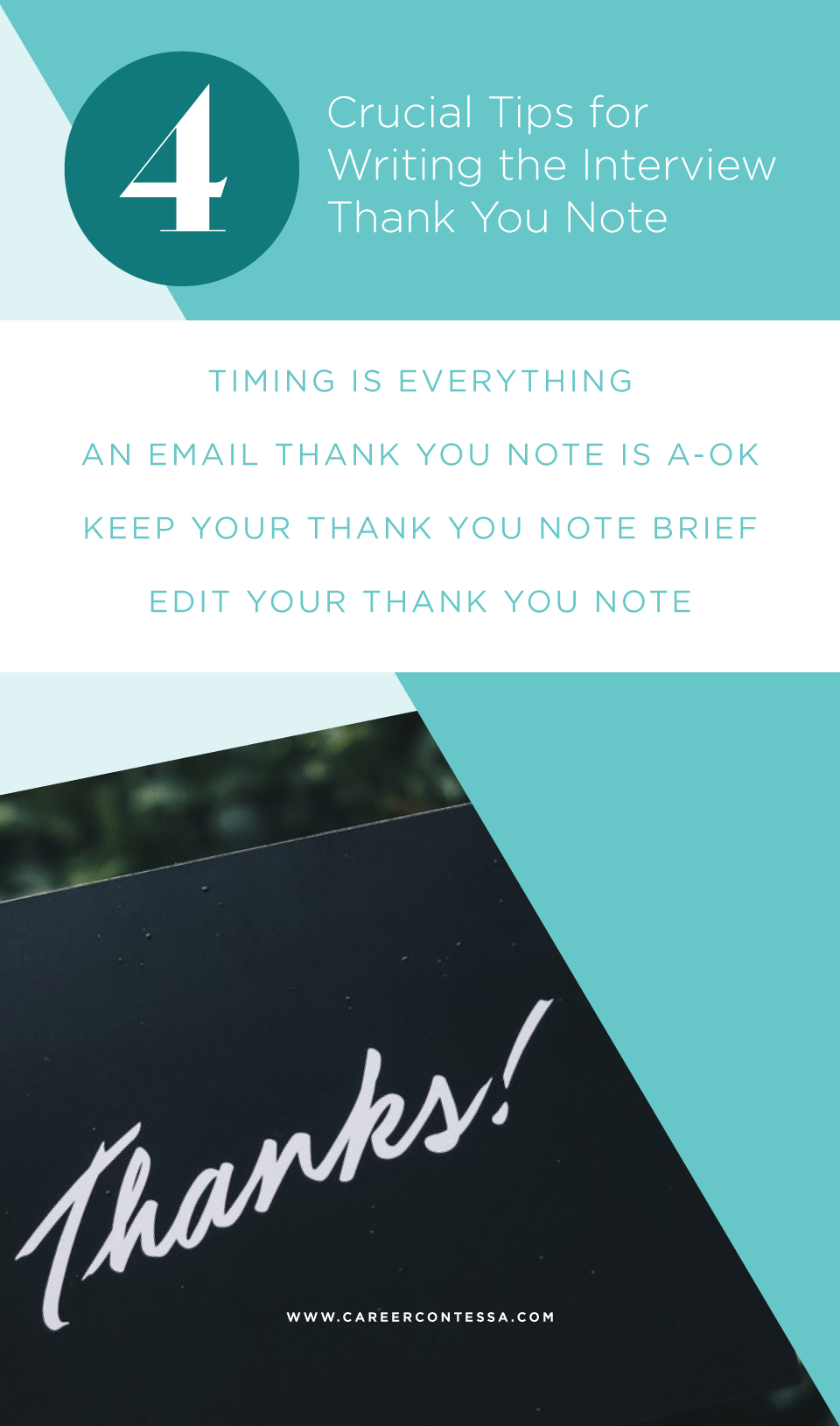
#BestofFSCBlog : #JobSearch – Four(4) Crucial Tips for Writing the Interview Thank You Note. So you Really Want this Job?  

So you really want this job?  You have likely already written a captivating cover letterundergone a brief phone interview and finally, were invited into the office for an interview. The interview went swimmingly (because you prepped for it like a pro)? Awesome! Now that you’re exiting the office building of your (hopeful) future job, it’s time for your next step.
Enter: the thank you note. The thank you note should be a no-brainer. It is a perfect way for a candidate to give herself the final edge over other candidates in the interview process.
Writing the thank you note does not have to be an exhaustive process. However, a candidate can (and should!) use it as an opportunity to edge out the other candidates.

TIMING IS EVERYTHING

Interviewing is an arduous process for any job candidate. In much the same way, it can be a stressful time for the hiring manager. My number one piece of advice in writing a thank you note for a job you really want?
Do it right away. Even if you killed the interview and expect a call saying “You’re hired!” by the end of the day, write the note. Express your gratitude and keep your candidacy fresh in the hiring manager’s mind. DO NOT wait until a week later when you haven’t heard anything to shoot off a “by the way, thanks” email.
A well-timed thank you note after an interview is a perfect way to reiterate your excitement to join the team. Aim to send your thank you note no within 24 hours of the end of the interview.

Like this Article ?  Share It !You now can easily enjoy/follow/share Today our Award Winning Articles/Blogs with Now Over 2.5 Million Growing  Participates Worldwidein our various Social Media formats below:

FSC LinkedIn Network:   www.linkedin.com/in/fscnetwork

Facebook:  http://www.facebook.com/pages/First-Sun-Consulting-LLC-Outplacement-Services/213542315355343?sk=wall

Google+:  https://plus.google.com/115673713231115398101/posts?hl=en

Twitter: Follow us @ firstsunllc

Question: Want the ‘the best/current articles/blogs on the web’ on Job Search, Resume, Advancing/Changing your Career, or simply Managing People?

Answer: Simply go to our FSC Career Blog below & type(#career, #leadership, #life) in Blog Search:  https://www.firstsun.com/fsc-career-blog/

What Skill Sets do You have to be ‘Sharpened’ ?

Continue of article:

AN EMAIL THANK YOU NOTE IS A-OK

We know you still have that Laura Ashley stationery your grandma gave you for your high school graduation. We know it’s embossed with your initials.
However, 87 percent of hiring managers view email as a perfectly acceptable means of delivering your thank you note. Since we have already established that timing is everything, email is going to be your best bet.

KEEP YOUR THANK YOU NOTE BRIEF

By this point in the interview process, your hiring manager has likely learned a ton about you. Do not use the thank you note to reiterate the play-by-play.
You can (and should) use it as a means to communicate one point you may have neglected to make, to expand on an idea or simply to express feelings of excitement for the job itself. Since the hiring manager is also busy interviewing, reading resumes, and communicating with other stakeholders, keep your note on point.

EDIT YOUR THANK YOU NOTE

So far, we have focused heavily on the speed and brevity of this note. But that doesn’t mean it’s informal! Make sure to use a formal greeting, write clear (and concise!) sentences, and sign off formally. This is not a one-liner to say “Thanks, Dude!”
Just as easily as a thank you note can impress a hiring manager, it can also detract from the whole process. A spelling error or flippant manner of writing can undo your progress. Write your thank you note, read it over a few times aloud, spell check it, and get a second pair of eyeballs on it if you can.
Crucial Tips Interview Thank You
CareerContessa.com | BY CAILEEN KEHAYAS  |  July 25, 2018

Your #Career : 8 Expert-Approved Tips for How to Find a Job Today (Bonus: Live Stream Podcasts)… The #JobHunt : It’s Something We All Go Through in our Lives, Yet there’s Still a Surprising Amount of Mystery Around It.

The job hunt: it’s something we all go through in our lives, yet there’s still a surprising amount of mystery around it. Do I need to write a cover letter? What’s the best way to prepare for an interview? And why do I never hear back, even after sending dozens of applications?

We know that many different aspects of the job search process can be confusing — and as a company whose mission is to help people everywhere find jobs and companies they love, we wanted to provide some clarity. That’s why we hosted How to Get a Job Live!, a livestream dedicated to helping people beat the competition and get hired. In it, we heard from job search experts, recruiters and even Glassdoor’s Chief Economist about what it takes to find the right company for you, stand out from the crowd, write an excellent resume and more.

Couldn’t make it? No problem! Register here for access to the livestream recordings, and read on to learn a few of the top tips from our panel of experts.

1. The Time to Apply Is Now

Good news for anyone thinking about moving onto a new opportunity — we’re undoubtedly in a job seeker’s market, according to Glassdoor Chief Economist Dr. Andrew Chamberlain. The U.S. has seen nine years of continuous economic expansion, allowing businesses to add jobs at a steady clip. Some particularly hot industries, like healthcare and tech, are hiring even more. With so many opportunities available, companies are working hard to attract the best and the brightest to their companies, which can result in improved benefits packages, higher salaries and other perks that entice candidates.

It’s important to remember, though, that these favorable conditions won’t last forever — after all, what goes up must eventually come down. Chamberlain’s advice: Take advantage of the job seeker’s market while it lasts. If you’ve been thinking about finding a new job, there’s no time to apply like the present.

Like this Article ?  Share It !    You now can easily enjoy/follow/share Today our Award Winning Articles/Blogs with Now Over 2.5 Million Growing  Participates Worldwide in our various Social Media formats below:

FSC LinkedIn Network:   www.linkedin.com/in/fscnetwork

Facebook:  http://www.facebook.com/pages/First-Sun-Consulting-LLC-Outplacement-Services/213542315355343?sk=wall

Google+:  https://plus.google.com/115673713231115398101/posts?hl=en

Twitter: Follow us @ firstsunllc

Question: Want the ‘the best/current articles/blogs on the web’ on Job Search, Resume, Advancing/Changing your Career, or simply Managing People?

Answer: Simply go to our FSC Career Blog below & type(#career, #leadership, #life) in Blog Search:  https://www.firstsun.com/fsc-career-blog/

What Skill Sets do You have to be ‘Sharpened’ ?

Continue of article:

2. Bolster Your Skills

Just because there are tons of open positions, though, it doesn’t mean that recruiters are lowering their standards — you’ll still be competing amongst other talented candidates. And as technology has advanced, employers expect potential employees to have more specialized, technical skills. One of the best ways for you to stand out from the crowd is to show employers that you’ve mastered hard skills like these. In particular, Chamberlain recommended familiarizing yourself with data analysis, as nearly all roles work with data in some form and can benefit from deriving insight from it. If data analysis isn’t your strong suit, consider taking an online course.

3. Include the Most Important Resume Info Up Top

Your resume is the first impression recruiters and hiring managers have of you — and if you don’t grab their attention, it will likely also be the last. The average recruiter only spends about six to seven seconds on a resume, so make sure it’s easy for the reader to gather all of the most important information with just a quick scan. One way to do that, suggested job search expert Scott Dobroski, is to include a professional summary up top that doesn’t just state who you are and what job you’re looking for, but the unique value you bring to the table and your most valuable skills.

4. When in Doubt, Write a Cover Letter

On most job listings, you’ll see “cover letter optional” — something that causes a lot of confusion for job seekers. Is it truly optional, or is it just a test to weed out less committed candidates? Most of the time, cover letters aren’t required, Dobroski said, but attaching a well-written one can only help your application. For one, it shows strong communication skills, which are a necessity for nearly any role, Chamberlain pointed out. For another, it gives you an extra chance to sell yourself. Cover letters should be quick, one-page documents that provide added color on why you’re interested in the opportunity, what you’ve achieved in your career, how you did it and why you’re a good fit for the job.

5. Research, Research, Research

The single biggest mistake you can make in an interview is not preparing for it beforehand. This means looking up the basics of the company (industry, products/services, recent articles), common interview questions (making sure to practice the responses aloud with a friend), information about your interviewers and more. This will help you come across as a more informed, passionate candidate.

6. Always Negotiate

One of the biggest misconceptions job seekers have about negotiating salary is that their job offer will be rescinded if they ask for a higher salary. But this is virtually unheard of — as Dobroski said, “I’ve never seen that to be the case.” So be comfortable asking for more, but make sure it’s based on hard data around what your market value is. Use Glassdoor’s Know Your Worth tool to help inform the range you ask for, although you should make sure not to start with your lowest acceptable salary in a negotiation! Finally, don’t forget to see if you can negotiate additional benefits — companies are often willing to accommodate requests for additional vacation days, workplace flexibility and more in order to seal the deal with a strong candidate.

7. Don’t Judge a Company By Its Industry

In the second half of the livestream, recruiters from FacebookSalesforce and Kaiser Permanente shared insight about their company cultures, how candidates can stand out and what they look for in interviews. One of their main pieces of advice for job seekers: Don’t assume you can’t apply to a company because of the industry they’re in! Claire Arnold, recruiter at Kaiser Permanente, shared that you don’t need to be a doctor or nurse to work at her company. While about 70 percent of Kaiser’s positions are healthcare related, they still have tons of open jobs in fields like administration, marketing, IT and more. Similarly, you don’t need to be a software engineer to work at tech companies Facebook and Salesforce. While yes, they do have many open technical positions, they also need talented folks in roles like sales, recruiting, finance, HR… the list goes on.

8. Ask Questions in an Interview

Even if you feel like you’ve gotten sufficient information already, you should always take an interviewer up on their offer to answer any questions you might have. In this situation, interviewers aren’t just trying to help you out — they also want to see if you can ask questions that demonstrate that you’ve done your research and have critical thinking skills. One question that Ashley Core of Salesforce loves to hear is “How have you given back to the community?” At Salesforce, community service is huge, so this proves that candidates did their due diligence in the research stage.

9. Don’t Take It Personally

Near the end of the livestream, recruiters were asked what the best piece of career advice they had ever received was. According to Facebook Recruiting Director Liz Wamai, it was “Don’t take it personally.” This is especially applicable in the job search. When you get rejected, it’s easy to get down on yourself, and think “What’s wrong with me?” But oftentimes, recruiters will pass on a candidate not because they don’t like them, but simply because they don’t have the right role for them at the moment or they need a little more experience under their belt first. If this happens to you, don’t get discouraged — if you keep applying thoughtfully and bringing your best self to the interview, it’s only a matter of time before you get an offer.


GlassDoor.com |  |

Your #Career : 5 Methods To Make Your #CoverLetter Irresistible To #HiringManagers …Writing #CoverLetters is a Boring but Necessary Part of #JobHunting . Here’s are Some Tips on How to Craft One that Catches the Hiring Manager’s Attention (in a Good Way).

You’ve probably heard that many recruiters don’t always read cover letters when they review applications. Unfortunately, despite some grumblings about it being an antiquated practice, many companies still include it as part of their application process. Sure, sometimes they make it optional, but do you really want to risk getting put in the “no” pile because most of the applicants included a cover letter?

They’re not the most fun to write, but you can make your cover letter more interesting to read for hiring managers. Here are a few tips to turn your boring cover letter into something that the person on the other side actually wants to read.

1. START YOUR COVER-LETTER WITH AN INTERESTING ANECDOTE

Whatever you do, don’t start your letter with “I’m writing to express my interest in x position.” Hopefully, you’ve applied to the right listing or made that obvious in your subject line if you are sending the application by email.

A much more interesting way to grab the hiring manager’s attention is to start with a specific anecdote highlighting why you are a great candidate. In The New Rules Of Work: The Modern Playbook For Navigating Your Career, the cofounders of career site The Muse shared examples of engaging cover letter introductions. Here is one:

While you won’t find the title “Community Manager” listed on my resume, I’ve actually been bringing people together online and off for three years while running my own blog and series of meet-ups.


Like this Article ?  Share It !    You now can easily enjoy/follow/share Today our Award Winning Articles/Blogs with Now Over 2.5 Million Growing  Participates Worldwide in our various Social Media formats below:

FSC LinkedIn Network:   www.linkedin.com/in/fscnetwork

Facebook:  http://www.facebook.com/pages/First-Sun-Consulting-LLC-Outplacement-Services/213542315355343?sk=wall

Google+:  https://plus.google.com/115673713231115398101/posts?hl=en

Twitter: Follow us @ firstsunllc

Question: Want the ‘the best/current articles/blogs on the web’ on Job Search, Resume, Advancing/Changing your Career, or simply Managing People?

Answer: Simply go to our FSC Career Blog below & type(#career, #leadership, #life) in Blog Search:  https://www.firstsun.com/fsc-career-blog/

What Skill Sets do You have to be ‘Sharpened’ ?

Continue of article:

2. WRITE IT LIKE A STORY, WITH A BEGINNING, MIDDLE, AND END

You want to brag about your impressive achievements and experience in your cover letter, but you don’t just want to restate what is on your resume. Otherwise, what’s the point of sending two separate documents? Fast Company associate editor Rich Bellis made this mistake in one application he sent for his second job out of college, and unsurprisingly never heard back from the hiring manager. Dana-Leavy Detrick, the founder/creative scribe at Brooklyn Resume Studio told Bellis that creating a compelling and unique narrative around yourself is something anyone can do at every level.

She went on to say, “Companies don’t just hire on requirements and qualifications–they also make hiring decisions based on culture fit and potential.” You can easily show this in a story that incorporates specific details on how your experiences can benefit the company.

3. TELL A COMPANY HOW YOU WOULD SOLVE A PROBLEM THEY’RE HAVING

Many candidates (especially those starting their careers) make the mistake of focusing too much on how the job will benefit them, rather than how they can benefit the company. As Drake Baer wrote in a 2013 Fast Company article, one of the best ways to show your value to the company is to understand their pain points and troubles, and then identify how you, as a candidate can help them. Beyond reading the news, you can try to organize an informational interviewwith people in the company (who aren’t your hiring manager) to find out more about their issues.

4. BUT DON’T GUESS WHAT THEIR CHALLENGES ARE IF IT’S NOT CLEAR

That being said, when you’re not inside a company, it’s easy to misidentify their problems. If it’s sensitive, current employees might not be entirely frank with you about what’s really going on. You can try to mitigate this by talking to more than one person, as well as former employees.

If it’s still not clear, articulate what you would do as a candidate if you were hired. Recruiter and professional resume writer Donna Svei called this an “opportunity letter.” Svei suggested writing about a time that you over-delivered on a project, and based on those experiences, how you’d bring that level of excellence to the role you’re applying for.

5. TAILOR YOUR COVER LETTER TO THE JOB DESCRIPTION, NOT THE COMPANY

It might seem obvious to you to link your experiences to the specific role, but you’d be surprised how many people fall into the trap of pitching to the company in general. As Buzzfeed’s recruiting operating manager Dan Geiger previously told Fast Company, a lot of entry-level hires spend their time talking about how great Buzzfeed is (something he already knows, because he works there.) According to Geiger, it’s better to show your enthusiasm “for the specifics of the role,” rather than the organization. After all, if you just wrote your cover letter with the company in mind, you’re making the recruiter and hiring manager do all the work. By tailoring your pitch to the role, you’re also demonstrating one key skill that many positions require–your ability to pay attention to details.


FastCompany.com | April 25, 2018 | BY ANISA PURBASARI HORTON 3 MINUTE READ