
Posts

Your #Career : These Are 4 Types Of #Bosses You’ll Have, And How To Deal With Them…Most Bosses you’ll have Fit into One of These Categories. Here’s How to #Manage Each–and When to Jump Ship.

Many types of people become managers, and they employ many different leadership styles once they do. And considering the wide spectrum of personality traits there are out there, you’d think that would lead to a multitude of managerial types. But according to Ximena Vengoechea, you’d be wrong.

A design researcher at Pinterest as well as a Fast Company contributor who writes prolifically about management, work culture, and mentorship, Vengoechea believes most bosses basically fit into four categories:

  1. Hands on, and in it for themselves
  2. Hands on, and it it for you
  3. Hands off, and in it for themselves
  4. Hands off, and in it for you

“Obviously,” she adds, “the ones where they are in it for themselves are less effective for the individual.” Also a talented illustrator, Vengoechea maps out this framework like so:
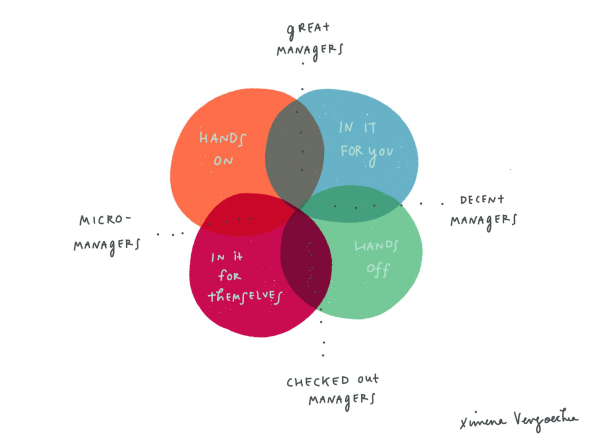
[fusion_builder_container hundred_percent=”yes” overflow=”visible”][fusion_builder_row][fusion_builder_column type=”1_1″ background_position=”left top” background_color=”” border_size=”” border_color=”” border_style=”solid” spacing=”yes” background_image=”” background_repeat=”no-repeat” padding=”” margin_top=”0px” margin_bottom=”0px” class=”” id=”” animation_type=”” animation_speed=”0.3″ animation_direction=”left” hide_on_mobile=”no” center_content=”no” min_height=”none”][Illustration: Ximena Vengoechea]

Here’s her take on what employees need to know in order to deal with each type of boss.

1. HANDS ON, IN IT FOR THEMSELVES

Vengoechea doesn’t mince words: “Get a new manager!” Bosses who hover and nitpick, either because they’re on a power trip or they just assume you’ll screw it all up, are bad at the fundamentals of supervising other people. “It’s hard to grow when you’re being micromanaged and your manager is taking all the credit,” she points out. You can’t work for someone who doesn’t trust you and only looks out for their own interests.


Related:This Is How To Handle A Boss Who Overcommunicates


Of course, bad bosses who fall into this category can be broken down a bit further by their other quirks and habits. Some, for example, may be highly indecisive; others might set habitually unrealistic expectations. There are a few ways you can try to adapt to each of these habits, but that’s really just in order to make work livable while you finagle a transfer to another team internally or look for a new job altogether.

Like this Article?  Share It !    You now can easily enjoy/follow/share Today our Award Winning Articles/Blogs with Now Over 2.5 Million Growing  Participates Worldwide in our various Social Media formats below:

FSC LinkedIn Network:   www.linkedin.com/in/fscnetwork

Facebook:  http://www.facebook.com/pages/First-Sun-Consulting-LLC-Outplacement-Services/213542315355343?sk=wall

Google+:  https://plus.google.com/115673713231115398101/posts?hl=en

Twitter: Follow us @ firstsunllc

Question: Want the ‘the best/current articles/blogs on the web’ on Job Search, Resume, Advancing/Changing your Career, or simply Managing People?

Answer: Simply go to our FSC Career Blog below & type(#career, #leadership, #life) in Blog Search:https://www.firstsun.com/fsc-career-blog/

What Skill Sets do You have to be ‘Sharpened’ ?

Continue of article:

2. HANDS ON, IN IT FOR YOU

Yes, this type of boss may have some micromanaging tendencies, but as Vengoechea cautions, “Don’t assume the worst from ad hoc check-ins. Your manager may just be proactive about helping you grow.”

Give this type of boss the benefit of the doubt (sometimes micromanaging is a symptom of work-related stress, by the way) and use it as an opportunity to improve how you communicate. “Let them know where you need their help and brainpower,” Vengoechea advises. That includes sharing when you don’t need it.

But as long as you can tell that your boss has your best interests at heart, try to see their hands-on approach as an opportunity for mentorship. As Vengoechea explained previously in Fast Company, “If a manager checks in outside of your normally scheduled one-on-one meeting, relax. Don’t automatically assume the worst and put your guard up. Consider the possibility that rather than trying to micromanage, your new boss may be trying to find ways to help, so be more receptive.”


Related:These Are The 3 Traits Of Bosses That Everyone Wants To Work For


3. HANDS OFF, IN IT FOR THEMSELVES

If your boss seems mostly concerned about their own status and advancement and uninterested in yours, that’s of course not an ideal situation. But it doesn’t necessarily mean you should run for the hills.

Vengoechea suggests first trying to test your theory about why your boss is keeping their distance–and, as she explained in a separate Fast Company story, it’s usually due to one of two reasons: “They’re either checked out at work in general, or they totally trust you.” She breaks down the best strategies for both scenarios here, but claims that in general, it’s smart to “be proactive about following up, show that one-on-ones matter, [and] widen their window onto your work.”

These efforts can all help build a bridge to a distant manager. But if you don’t make progress at deepening your rapport, Vengoechea says it’s time to look for a different boss. “It’s hard to grow if your manager doesn’t have your best interests at heart.”

4. HANDS OFF, IN IT FOR YOU

It’s not the worst thing in the world to have a boss who keeps their distance simply because they trust you to get the job done.

Here, too, the onus is on you to communicate what you need. Vengoechea suggests expressing gratitude for their trust and “share when you want more input, check in on their goals and how you can help, [and] ask for feedback.” As she put it in her previous article, it’s all about “acknowledg[ing] that you feel empowered to make decisions and run with ideas autonomously, thanks to their support. But don’t be afraid to spell out scenarios where their perspective might be helpful and productive for you.” Typically, a manager who cares about your professional development will make a greater effort to get more involved when you need that.


Related:The Management Formula Every Leader Should Know (In One Easy Chart)


Researchers have found that employees’ relationships with managers is one of the most decisive factors in the decision to look for another job versus stay put,” Vengoechea points out, “which means that the type of manager you have matters a lot–it’s going to determine your growth in a role or in a company, as well as your happiness and fulfillment day-to-day.”

So no matter what type of manager you have, Vengoechea says, “make sure you are following the key tenets of ‘managing up’ : Understand their goals, and how you can help; learn what communication style works for them (and you!), give feedback on them, and on what you need; [and] share your wins.” Not all boss-employee relationships are win-wins, but for those who keep these basic rules in mind, more of them can be.

FastCompany.com | April 23, 2018 | BY RICH BELLIS 4 MINUTE READ

[/fusion_builder_column][/fusion_builder_row][/fusion_builder_container]

#Leadership : 9 No-Fail Tips for Giving #ConstructiveCriticism at Work (Infographic) ….Learning How to Give Honest, Constructive Feedback to All Types of Colleagues will Help you Be a #BetterManager and Will Help your #Employees Develop.

Though criticism is an inevitable part of any workplace, most people find it difficult to give negative feedback to direct reports. Whether you are offering real-time observations or engaging in a formal review discussion, it can be stressful to critique the work of your colleagues.

Don’t let yourself be intimidated by difficult feedback conversations! Honest evaluations are essential to employee development, engagement, and retention. Most employees understand the value of constructive feedback for their company and for their own personal development. A Zenger/Folkman surveyfound that 93% of people agree that when negative feedback is delivered correctly it can be an effective way to improve performance.

Learning how to give honest, constructive feedback to all types of colleagues will help you be a better manager and will help your employees develop. By providing specific direction based on employees’ actions, you can provide criticism in a way that will help people develop, without making them feel attacked.

Check out this infographic for tips on how to criticize constructively:


Fundera.com | March 23, 2018 | Meredith Wood

Original Post: https://www.fundera.com/blog/how-to-criticize

Your #Career : Don’t Let Your Boss’s Poor #CommunicationSkills Hold You Back….If your #Boss is Terrible at #Communicating , you Don’t have to Deal With the Fallout. These Strategies will Help you Get the Information you Need.

Poor communication is costing you in more ways than you probably realize. But it might not be your poor communication that’s the problem.

A recent Economist Intelligence Unit study found that communication barriers like lack of clarity, pointless meetings, and even differences in communication styles are wreaking havoc on productivity and efficiency. Forty-four percent of respondents said such issues delay or derail projects, while nearly a third said they cause low morale. A quarter attributed poor communication to missed performance goals, and 18% said a failure to communicate caused lost sales, sometimes totaling well into the six figures.


Related:How To Communicate With People Who Disagree With You


It’s one thing if the finger is pointed at you—there are plenty of ways you can shore up your own ability to ensure others hear and understand what you say. But, what if the perpetrator of murky directives is your boss?

Of course, you can ask questions, but you must know what to ask, business leadership coach Cheri Torres, PhD, author of Conversations Worth Having: Using Appreciative Inquiry to Fuel Productive and Meaningful Engagement. Try to clarify directives and expectations without unduly challenging your boss or making them feel threatened or inadequate, which can make it even tougher to get direction, she says.

“Don’t throw the boss into further panic and fear, but instead seek clarity and information from that person, and putting it in the context of, ‘I really want to do a good job for you and for the department, so I need this information in order to do that,’” she says. And to help get the information you need to succeed use these tactics.

IDENTIFY THE DISCONNECT

Identifying the root of the disconnect can make a world of difference in how you communicate with your boss on a regular basis, says Brian Kelley, vice president of employee experience at McLean, Virginia-based Sage Communications. Take note of your boss’s interactions with others. Do they have a tough time communicating with everyone? Are there traits that get in the way of clear communication? Understanding different communication styles, especially those typical of introverts, extroverts, and various personality types, can also be helpful to understand where the gap is.

“Anytime you have a poor communicator in a senior position, it’s a great opportunity to manage up and really work with your superior to make sure that they understand your needs for solid communication and the specific ways that you can really communicate with each other better,” he says. Kelley urges his direct reports to tell him what they need from him to better do their jobs. If your boss is open to that kind of frank communication, it could be enormously helpful, he says.


Related:How To Avoid The 5 Most Common Misunderstandings At Work


Like this Article ?  Share It !    You now can easily enjoy/follow/share Today our Award Winning Articles/Blogs with Now Over 2.5 Million Growing  Participates Worldwide in our various Social Media formats below:

FSC LinkedIn Network:   www.linkedin.com/in/fscnetwork

Facebook:  http://www.facebook.com/pages/First-Sun-Consulting-LLC-Outplacement-Services/213542315355343?sk=wall

Google+:  https://plus.google.com/115673713231115398101/posts?hl=en

Twitter: Follow us @ firstsunllc

Question: Want the ‘the best/current articles/blogs on the web’ on Job Search, Resume, Advancing/Changing your Career, or simply Managing People?

Answer: Simply go to our FSC Career Blog below & type(#career, #leadership, #life) in Blog Search:  https://www.firstsun.com/fsc-career-blog/

What Skill Sets do You have to be ‘Sharpened’ ?

Continue of article:

DOUBLE-CLICK

Understanding the thought process that led to this project or request can help you better understand what is being asked, says executive coach Judith E. Glaser, and author of Conversational Intelligence: How Great Leaders Build Trust and Get Extraordinary Results. One way to do that is to “double-click” when your boss gives you direction.

Let’s say your supervisor tells you to take on a project. They’ve obviously thought through why they want you to do so, and they’re in a state of conclusion, Glaser says. But you may not agree with the directive and may need help understanding why you’re being asked to take on the project, as well as what the point of it is. Asking about what led up to the decision to execute this project or take on this task can get you more clarity about the context and expectations, she says. That’s double-clicking, Glaser says.

“A lot of times we don’t get context from CEOs, we get conclusions. With conclusions, you miss out on a lot of the pre-thought, where the [fusion_builder_container hundred_percent=”yes” overflow=”visible”][fusion_builder_row][fusion_builder_column type=”1_1″ background_position=”left top” background_color=”” border_size=”” border_color=”” border_style=”solid” spacing=”yes” background_image=”” background_repeat=”no-repeat” padding=”” margin_top=”0px” margin_bottom=”0px” class=”” id=”” animation_type=”” animation_speed=”0.3″ animation_direction=”left” hide_on_mobile=”no” center_content=”no” min_height=”none”][employee] might be able to get in and make some adjustments to make it even better. That’s what they want to do, get into the conversation, into the thought process,” she says.

REFRAME, REFOCUS, REDIRECT

When you’re having conversations with your boss and don’t feel like you’re getting what you need, try stating the question in a different way or sharing your understanding of what’s being said, Glaser says. Respond with, “So, what I understand you’re asking me to do is . . . ” or, “What I hear you saying is that you want me to . . . ” and fill in the blank with your perspective. That will allow your supervisor to understand what you’re hearing in the conversation, she says.


Related:6 Ways To Communicate With More Authority


“When you’re not getting what you want, try to reframe it, say it in a different way, or connect it to something, a new word that might activate the opening of a conversation,” she says.

GET CLEAR ABOUT PRIORITIES

If you’re still having trouble getting detailed instructions, context, or feedback, try to focus on priorities, Kelley says. What matters about the project? What is the purpose? What will a successful outcome look like?

If you can get a clearer picture of the desired outcome, you may be able to figure out how to make that happen, Torres adds. Some bosses may try to test your problem-solving ability and resourcefulness by giving you the broad strokes of a project and allowing you to figure out how to get it done.

“Some bosses don’t give real clear instructions because they are anticipating or expecting or hoping the person will make decisions about how to do things on their own, but they assume that, rather than say that,” she says.

And if you’re feeling lost on a project or not sure you’re moving in the right direction, arranging check-ins along the way can help ensure you don’t get too far off track, Kelley adds.

FIND OTHER STAKEHOLDERS

Finding coworkers, colleagues, and even other senior-level people who can help you get the direction you need is another good strategy, Torres says. If your boss isn’t clear about direction, they may also not be clear about who else is involved in the project. Ask around and work on gathering information from people who can provide it, she says. You may also get valuable feedback about how other people have found ways to communicate effectively with your supervisor, she says.

FastCompany.com | April 12, 2018 | Gwen Moran

[/fusion_builder_column][/fusion_builder_row][/fusion_builder_container]

#Leadership : How to Gain your #Employees Trust, take Care When #Changes Need to be Made…One of the Greatest Threats to #EmployeeEngagement is UnCeremonious or UnDignified Dismissals.

I was at a conference last month and had the chance to hear from several people who had read my book, “Fired:  How to Manage Your Career in the Age of Job Uncertainty.” One of them told me their organization was having to do a reduction in force. It was going to be a very difficult–the organization’s leaders truly cared about their employees. She then shared that  and her boss used the book to make sure as they planned the layoffs, they did everything they could to help the employees affected transition successfully.

Another person at the same conference told me that she too is having to look at organizational changes and that the book is helping her think more intentionally about those affected.

I am glad to see that my book is having an impact with leaders who truly care about their employees and their organization’s culture.  I had hoped it would help leaders with tough decisions as well as people at the other end of them.

Like this Article ?  Share It !    You now can easily enjoy/follow/share Today our Award Winning Articles/Blogs with Now Over 2.5 Million Growing  Participates Worldwide in our various Social Media formats below:

FSC LinkedIn Network:   www.linkedin.com/in/fscnetwork

Facebook:  http://www.facebook.com/pages/First-Sun-Consulting-LLC-Outplacement-Services/213542315355343?sk=wall

Google+:  https://plus.google.com/115673713231115398101/posts?hl=en

Twitter: Follow us @ firstsunllc

Question: Want the ‘the best/current articles/blogs on the web’ on Job Search, Resume, Advancing/Changing your Career, or simply Managing People?

Answer: Simply go to our FSC Career Blog below & type(#career, #leadership, #life) in Blog Search:  https://www.firstsun.com/fsc-career-blog/

What Skill Sets do You have to be ‘Sharpened’ ?

Continue of article:

One of the greatest threats to employee engagement is unceremonious or undignified dismissals.  We’ve seen them in the news.  You may have witnessed them at work.  Someone is perp walked out the door.  Or at 4:55 pm there is an email saying someone “…is no longer with XYZ Company.” Or maybe you’ve heard managers blame or scape goat the person who was let go.  The remaining employees who see their friends treated poorly in a termination wonder, “Am I next?”   or “Is this company worth my loyalty?”

It is so difficult to let someone go, whether they “deserve” it or not.  Handling these gut wrenching decisions with grace and dignity helps leaders keep the trust with their employees.

As one of my book reviewers, John Franklin wrote,

“This is a must read for everyone, whether you have been fired or not, and in doing so, will expand our understanding of others and will make each of us more compassionate human beings.”

I am grateful that these leaders took the lessons learned in the book to heart.  Please share your stories with me as well on my web site www.jobuncertainty.com

Dr. Nancy Koury King is a contributing author on the FSC Career Blog (https://www.firstsun.com/fsc-career-blog/) & is a participating member of the FSC LinkedIn Network ( www.linkedin.com/in/fscnetwork ) . 

As mentioned above, her publication of the book, “Fired:  How to Manage Your Career in the Age of Job Uncertainty”  & is available on Amazon below.

https://www.amazon.com/Fired-manage-your-career-uncertainty/dp/1978407130


First Sun Career Blog | April 10, 2018

Your #Career : 3 Signs It’s Time To Ask Your #Boss For That #Promotion …The Timing of your Ask is as Important as How you Ask. Here’s a Checklist to Know if the Moment is Ripe.

You already know why you want a promotion: It will confirm what you’ve already accomplished in your role, validate your work and work ethic, and open paths for bigger and better projects. Ideally, it’ll also mean more pay.

But there’s a difference between wanting a promotion and being ready for it. In order to put your best foot forward with your manager, you need to be confident that the time is right. How can you ensure you’re not jumping the gun?

This three-part checklist can help you identify when you’re ready to make the most compelling pitch you possibly can.

1. YOU’VE BEEN DOING THE JOB YOU WANT TO BE PROMOTED TO FOR SIX MONTHS

This means you’ve been taking on more than what’s expected of your current role or level and performing well in that new scope. If you’re not sure where you stand, it’s a good time to have a check-in with your manager about her expectations for the level you’re hoping to reach, and the types of projects and impact you eventually want to make in a more senior role.

Like this Article ?  Share It !    You now can easily enjoy/follow/share Today our Award Winning Articles/Blogs with Now Over 2.5 Million Growing  Participates Worldwide in our various Social Media formats below:

FSC LinkedIn Network:   www.linkedin.com/in/fscnetwork

Facebook:  http://www.facebook.com/pages/First-Sun-Consulting-LLC-Outplacement-Services/213542315355343?sk=wall

Google+:  https://plus.google.com/115673713231115398101/posts?hl=en

Twitter: Follow us @ firstsunllc

Question: Want the ‘the best/current articles/blogs on the web’ on Job Search, Resume, Advancing/Changing your Career, or simply Managing People?

Answer: Simply go to our FSC Career Blog below & type(#career, #leadership, #life) in Blog Search:  https://www.firstsun.com/fsc-career-blog/

What Skill Sets do You have to be ‘Sharpened’ ?

Continue of article:

2. YOUR WORK HAS HAD A VISIBLE IMPACT ON THE BUSINESS

It goes without saying that you should be making an impact at the team level, that’s part and parcel of your job. But the strongest cases for moving up a level at work rest on the contributions you make to projects that have a measurable impact on the business.

Looking at the work you’ve done in the past six months, identify the impact you’ve made for your team as well as for the business. That impact can be measurable (think revenue impact) or fuzzier (strategic impact)–so long as it’s visible and provable. For example, what part did you play to make sure that your team (and the company) met their sales target for the year? Did you propose a new idea to the higher-ups that they turned into company policy? To make your case, outline not just the business impact your work has driven, but also the alternate paths the team or company might have gone down without your work.

If you’re struggling to identify how your work fits into big-picture company goals, you might need to postpone your promotion request and instead work with your manager on a strategy to make your work more impactful.

3. YOU’VE MADE PROGRESS ON PREVIOUSLY IDENTIFIED DEVELOPMENT AREAS

If you’ve been in your role for at least six months, you should have gotten feedback by now on what you can to do improve. (If you haven’t, you should drop everything and ask for feedback now.) Have you made progress in the development areas your manager raised to you? Are some of these areas prerequisites for getting to the next level? If you’re excelling in them, it’s a great sign that now’s the time to make your case for a promotion.

Nodded your head to all these scenarios? You’re almost ready. Before approaching your manager, make sure you’ve gathered comprehensive documentation of your progress and performance. This should include specifics. Come armed with plenty of examples of how you’ve exceeded expectations, the measurable impact you’ve had on the business, and the progress you’ve made in the last six months.

At the same time, you’ll want to keep an open mind: Your manager will inevitably have a different perspective on your performance, impact, and progress. So take the time to compare notes in good faith and respectfully advocate for yourself. If you disagree, don’t be afraid to push back politely with concrete examples of your progress. By the end of the conversation, you and your boss should be able to arrive at a game plan you both feel comfortable with.

And yes, that may mean accepting a “not yet” to your promotion request. But you’ve at least laid out a reasonable timetable for getting to the next level.

ABOUT THE AUTHOR

Ximena Vengoechea is a design researcher, writer, and illustrator whose work on personal and professional development has been published in Inc.Newsweek, and HuffPost. She currently manages a team of researchers at Pinterest, in addition to leading a company-wide mentorship program.

More

FastCompany.com | March 16, 2018 | BY XIMENA VENGOECHEA 3 MINUTE READ

Your #Career : How To Update Your #LinkedIn Without Making Your Boss Suspicious…Updating your #LinkedInProfile is something you should be doing regularly. Here’s how you can do it without raising alarm bells at work.

Updating your LinkedIn profile can be a major stress point if you feel like it could alarm your boss or cause tension at work. However, the truth of the matter is that you should never feel guilty about updating your professional profile.

It’s common to feel like your boss might know or think that you’re looking for a new job, but there are simple ways to get around that issue. Here are some tips to help you update your LinkedIn profile without alarming your boss or sending out the wrong message.

UPDATING YOUR PROFILE DOESN’T MEAN YOU’RE UNHAPPY AT YOUR JOB

The first thing to realize is that updating your LinkedIn profile or revamping your resume doesn’t automatically mean you’re unhappy in your current role. You might have recently taken on a big project that you want to acknowledge, or maybe it’s just been a while since you’ve freshened things up. Regardless of your reasoning, you have every right to update your professional documents and LinkedIn profile without feeling guilty or scared that a manager or boss might be unhappy.

If your boss gets that upset over a LinkedIn update (updating your LinkedIn can be considered professional development), you probably aren’t working for someone who wants to see you succeed. If anything, your manager or boss should be thrilled that you want to highlight all that you’ve accomplished while working for them. Your success can reflect well on them and their leadership techniques.


Like this Article ?  Share It !    You now can easily enjoy/follow/share Today our Award Winning Articles/Blogs with Now Over 2.5 Million Growing  Participates Worldwide in our various Social Media formats below:

FSC LinkedIn Network:   www.linkedin.com/in/fscnetwork

Facebook:  http://www.facebook.com/pages/First-Sun-Consulting-LLC-Outplacement-Services/213542315355343?sk=wall

Google+:  https://plus.google.com/115673713231115398101/posts?hl=en

Twitter: Follow us @ firstsunllc

Question: Want the ‘the best/current articles/blogs on the web’ on Job Search, Resume, Advancing/Changing your Career, or simply Managing People?

Answer: Simply go to our FSC Career Blog below & type(#career, #leadership, #life) in Blog Search:  https://www.firstsun.com/fsc-career-blog/

What Skill Sets do You have to be ‘Sharpened’ ?

Continue of article:

BE TRANSPARENT AND ACKNOWLEDGE THE UPDATE

If you’re concerned that a manager or boss might feel like you’re going behind their back, let them know that you’re updating your profile. By coming out and telling them that you’re planning on doing an update or revamp, there’s no way for them to feel like you were being dishonest or trying to hide it.

Swing by your boss’s desk or shoot them an email saying something along the lines of, “I was looking at my LinkedIn profile, and I noticed that there are a lot of projects and responsibilities that I haven’t included, so I’m going to be adding some additional information in the next few days. I wanted to let you know, because I don’t want any updates or changes to catch you by surprise.” This shows that you’re open and respecting your boss by giving them a head’s up for what they can expect.

You can even add something in about how they’ve made great opportunities available to you, and you want to reflect that on your LinkedIn profile.


Related: Your LinkedIn Profile Lists Too Many Skills 


IF ALL ELSE FAILS

If you still feel like the update might raise red flags to your boss, put it into perspective for them. A great way to phrase it is, “I always want our clients/candidates/partners to have the most updated information on their LinkedIn profiles so I can learn more about them, therefore I feel like I need to do the same in order to reflect that standard.”

Another great way to frame the LinkedIn update is this: “I’ve been afforded so many great opportunities in this role, and I want others to see that and be aware of the great opportunities that this company provides.”


Related: Exactly What To Put In Your LinkedIn Profile To Get A Promotion


Both of these statements articulate that you want to hold yourself to the same standard that you hold others to, and that you want to highlight the benefits of working for the company. This highlights how it will benefit you as well as benefit your clients/candidates/partners, which will in turn benefit your boss/company.

At the end of the day, you have control of the information you put out there, and you shouldn’t feel guilty or scared about updating your LinkedIn profile. If your superior is that upset about it, you may want to look into a new role where your boss/manager wants to actually see you succeed. If you are trying to update your LinkedIn profile without alarming your boss, be transparent about it, and frame it in a way that will benefit everyone. At that point you’ve made a conscious effort to be respectful of your peers and authority figures, and if they’re still upset, that’s on them.


You Might Also Like:

#Leadership : How To Avoid The 5 Most Common Misunderstandings At #Work …From Long Email Chains to Group Projects without Clear roles, here are the Most Common Ways #Communication at Work Goes Off the Rails, & How to Fix It.

If you’ve ever had to clear up a situation at work because you were misquoted or misinterpreted, you know how easy it is for actions and words to be misconstrued. Misunderstandings are rooted in communication, and we often wind up getting derailed because we were too busy to get clarification, says Janel Anderson, owner of the communication consulting firm Working Conversations and author of Head On: How to Approach Difficult Conversations Directly.

“We want others to agree with us, and in our current culture of too much to do and not enough time to do it,” she says. “We often jump to conclusions when, in fact, we haven’t asked enough questions and engaged them effectively to find out if they agree or not.”

Here are five of the most common situations that lead to misunderstandings, and how you can get everyone back on the same page.

1. WHEN DIVIDING RESPONSIBILITIES

When people work together on a team, everyone’s role needs to be clear. Any ambiguity can lead to misunderstandings. At the beginning of a project, put responsibilities and expectations in writing, and have regular check-ins to make sure everyone is clear about their part.

“It’s important for everyone to see their peers contributing, all working toward a goal, and ensuring that everyone’s roles are defined so that you can avoid confusion, or discontent because others aren’t doing their fair share,” says Brian Kelley, vice president of public relations and employee engagement at Sage Communications, a marketing and public relations firm. “What is that fair share? Make sure you define it at the outset so there are no questions.”


Like this Article ?  Share It !    You now can easily enjoy/follow/share Today our Award Winning Articles/Blogs with Now Over 2.5 Million Growing  Participates Worldwide in our various Social Media formats below:

FSC LinkedIn Network:   www.linkedin.com/in/fscnetwork

Facebook:  http://www.facebook.com/pages/First-Sun-Consulting-LLC-Outplacement-Services/213542315355343?sk=wall

Google+:  https://plus.google.com/115673713231115398101/posts?hl=en

Twitter: Follow us @ firstsunllc

Question: Want the ‘the best/current articles/blogs on the web’ on Job Search, Resume, Advancing/Changing your Career, or simply Managing People?

Answer: Simply go to our FSC Career Blog below & type(#career, #leadership, #life) in Blog Search:  https://www.firstsun.com/fsc-career-blog/

What Skill Sets do You have to be ‘Sharpened’ ?

Continue of article:

2. WHEN COMMUNICATING COMPANY GOALS

Most leaders believe they communicate big-picture information, such as goals, strategies, issues, and projects. They may be communicating, but it’s often not with the entire team, says Heidi Pozzo, founder of Pozzo Consulting, a strategy consulting firm.

“There is typically a lot of discussion within the leadership team so it feels like everyone should understand,” she says. “The challenge is the group that needs to hear about it may have only heard from leaders once or twice.”

A leader needs to clearly define not only the starting point, but the pathway and critical touch points to the desired state, says Brad Deutser, CEO of the leadership consulting firm Deutser and author of Leading Clarity: A Breakthrough Strategy to Unleash People, Profit, and Performance. “Defining the pathway is fundamental to achieving the desired end state,” he says. “A purposeful leader works to carefully define the pathway, eliminating any potential diversions and ensuring clarity.”

3. WHEN COMMUNICATING VIA EMAIL

Email frequently leads to misunderstandings because it eliminates social cues, like tone of voice, eye contact, or facial expression that aid our comprehension of the message, says Anderson.

“When email misunderstandings occur, people feel threatened and get defensive,” she says. “To avoid this misunderstanding I suggest following the rule of three: If there have been three emails exchanged and you haven’t understood each other, pick up the phone and speak to them in person.”

4. WHEN DISCUSSING PROFESSIONAL GOALS

Disconnects can often happen during feedback or performance reviews, says Kelley. “It’s easy to relay information in a negative connotation when you are in effect asking for something completely different,” he says.

For example, if someone says, “I’ve worked too hard and too long for this pay,” they probably mean they feel undervalued or that their work/life balance is out of order.

“Instead of jumping to a conclusion, always assume the other party is coming from a position of positive intent,” says Kelley, adding that it’s important to take what you know about the employee and read between the lines. “Ensure you properly accept and respond to their message from this positive intent and coach them on how to better communicate their misunderstanding more effectively in the future.”

Be sure to get clear on employees’ long-term personal and professional goals, adds Ed McNamara, senior director of marketing and communications for SHI International, a software firm. “Some employees are very good at being proactive in asking for what they want; others might wait to be asked, but that doesn’t mean they want it any less,” he says.

5. WHEN YOU’RE HEARING THIRD-PERSON INFORMATION

The old saying is that too many cooks spoil the broth, and too many voices can spoil the message. “A lot of misunderstandings at work happen when information is relayed between people,” says Jessica Schaeffer, chief of staff and director of marketing and communications for the LaSalle Network, a staffing firm. “Someone says something, tells another person, and that person talks to you,” she says. “It could be business-related or company politics, but usually, it leads to a misunderstanding.”

It’s important to not jump to conclusions and get defensive, says Schaeffer. “Go back to the original person, and ask for clarification,” she says. “Eliminate the middleman and get the information firsthand. Sometimes the middleman misinterprets excitement as frustration or anger, or worse yet, doesn’t know the person well enough to pick up on important context or nonverbal cues, and relays the message incorrectly.”

WHY MISUNDERSTANDINGS ARE COMMON

The human brain is a sense-making machine and it wants to know why someone did or didn’t do something, says Anderson. “In the absence of information, we make up a motive, and we are usually wrong,” she says.

In all of these situations, the best way to mitigate is to stop and check in with yourself when you think someone has intentionally wronged you. “Ask yourself how much hard evidence you have to support your conclusion that the other person has acted maliciously,” says Anderson. “If you don’t have much—or any—evidence, get curious and ask the person some questions about why they did what they did. Assume positive intent until you have hard evidence to the contrary.”


FastCompany.com | March 1, 2018 | BY STEPHANIE VOZZA 4 MINUTE READ