• About WordPress
    • WordPress.org
    • Documentation
    • Learn WordPress
    • Support
    • Feedback
  • Log In
  • LinkedIn
  • Facebook
  • X
p: 866.311.2514
First Sun Consulting, LLC | Outplacement Services and Career Transition Firm
  • Home
  • About
  • Services
    • Outplacement Services
    • Executive Coaching
    • Career Transition
  • Locations
  • Blog
    • Best of FSC Career Blog
    • FSC Career Blog
  • Members
    • FSC Career Modules
    • FSC LinkedIn Network
    • New! FSC AI Tools – Latest Technology for Resumes & Search
  • Our Clients
  • Contact Us
  • Menu Menu

Archive for category: First Sun Blog

You are here: Home1 / FSC Career Blog – Voted ‘Most Read’ by LinkedIn.2 / First Sun Blog

Your #Career : 7 New Year’s Resolutions for Career Success in 2016… With the new year quickly approaching, many of us are starting to reevaluate some life and career choices. New Years resolutions are a perfect way for us to focus on certain areas that we would like to improve on for the upcoming year.

December 29, 2015/in First Sun Blog/by First Sun Team

Each year resolutions come around, and when thinking about career resolutions specifically, some of the same items make the list over and over again. Whether you still have some of the same goals as you did last year or are looking for new resolutions to add to your list, being able to put these ideas to paper and get organized before the New Year hits is crucial to success.

Free- Holiday Dinner

Below are 7 New Years resolutions that focus on career success and are realistic for most professionals. Sometimes the reason resolutions don’t stick is because they are unclear or too difficult to manage all at once (and consistently), so check out a few ideas below that may help you succeed this New Year:

Make sleep and healthy eating a priority over your workload.

One of the worst things you can do in your career is work so hard that you forget to take care of yourself. In fact, eating healthy and exercise has actually been linked tobetter productivity in the workplace. This means you should make healthy eating and sleep a priority this year. If you feel like you’re behind on work but you’ve run out of time if you want to get 7 hours of sleep, then allow yourself to run out of time. The same can be said for spending time cooking healthy meals. Let those take priority and watch your work get done faster and more efficiently than before.


Like this Article ?  Share It !    You now can easily enjoy/follow/share Today our Award Winning Articles/Blogs with Now Over 800K+ Growing  Participates Worldwide in our various Social Media formats below:

FSC LinkedIn Network: (Over 10K+ Members & Growing !)   www.linkedin.com/in/frankfsc/en

Facebook:   http://www.facebook.com/pages/First-Sun-Consulting-LLC-Outplacement-Services/213542315355343?sk=wall

  • Google+: https://plus.google.com/115673713231115398101/posts?hl=en
  • Twitter: Follow us @ firstsunllc

educate/collaborate/network….Look forward to your Participation !

Continue of article:

Actively network outside of the office.

Even if you’re not looking for a new job, networking is still something you should be actively pursuing. Going to networking events every few months can help keep you active in your industry, help you make valuable connections and learn new things, and help you improve your skills as a professional. Simply networking with those in your office is great, but getting out to networking events is even better. It definitely takes some effort, but after a while you’ll likely start to feel more comfortable and it will become a part of your routine.

Do your own career evaluation.

This means sitting down and thinking about your goals for the year in terms of your own personal career. Write down any responsibilities you want to take on for the year, evaluate what is making you happy and what is making you unhappy in your career so you can make changes, and do some research about salary for your position. Make sure you’re getting treated fairly and you’re happy, and if not, come up with a plan to make changes.

Get certified in one new skill.

Whatever the skill, make sure it is something that interests you and really make time for it this year as part of your personal development. This will help keep you motivated and hopefully learn something that will make you more valuable in the years to come.

Organize personal social accounts for business.

Even if you’re not the social media expert in your office, that doesn’t mean you can’t use social media to your advantage. Make it a goal to utilize social media to help promote your business and even more importantly, help improve your personal brand.

Clean out your inbox and keep it clean.

This is probably the easiest resolution to master on the list. Take one weekend day before January and clean out your entire inbox so you can start fresh at 0 emails. This not only means deleting the emails you don’t want, but actually unsubscribing from them as you go so that they don’t keep bothering you. It’s also important to keep it up throughout the year, which involves creating email folders for organization, turning off notifications, and more.

Read industry news every morning.

Before work everyday, read the news that’s happening in your industry. Find the blog that really focuses on industry specifics so that you do not have to sift through other distracting news, and give it a quick read every single morning. If you keep up with it, you should only have three or four new headlines to read each day, and for most, only about one or two stories per week even deserves a click and a read. Regardless, it’s important to have a feel for what is going on so that you don’t miss a beat.

The opinions expressed here by Inc.com columnists are their own, not those of Inc.com.
PUBLISHED ON: DEC 29, 2015
Inc.om | 

BY ADAM HEITZMAN

Co-founder, HigherVisibility@HigherVis
https://www.firstsun.com/wp-content/uploads/2018/05/logo-min-300x123.jpg 0 0 First Sun Team https://www.firstsun.com/wp-content/uploads/2018/05/logo-min-300x123.jpg First Sun Team2015-12-29 15:50:002020-09-30 20:54:18Your #Career : 7 New Year’s Resolutions for Career Success in 2016… With the new year quickly approaching, many of us are starting to reevaluate some life and career choices. New Years resolutions are a perfect way for us to focus on certain areas that we would like to improve on for the upcoming year.

#Leadership : 5 Surefire Signs That You’re #Promotable … When it Comes to Getting #Promoted, you Want to Present yourself in a Way that Feeds into the Biases that #Bosses ’ have about What Makes someone Promotable.

December 28, 2015/in First Sun Blog/by First Sun Team

It’s the end of the year already, and it isn’t too late to show your boss that you’re worthy of a promotion. Maybe you’ve been holding down the same position for a few years and are ready to move up. Maybe your company is going through some internal shuffling and you’re expecting your dream job to open up. Or, maybe you’ve been disappointed a few too many times by other people getting promoted ahead of you.

Free- NYC Skycraper

Whatever the reason, you want to make certain now that you’re ready to move up. In other words, you need to make certain that your boss sees it that way.

“Be so good they can’t ignore you.” –Steve Martin

Anthony Greenwald at the University of Washington has studied bias more than just about anyone, and his research findings have major implications for your ability to get promoted. His recent studies showed that unconscious workplace biases tend to stay constant, and bosses follow these biases, whether they are aware of them or not.

“People are claiming that they can train away biases,” Greenwald says, “[fusion_builder_container hundred_percent=”yes” overflow=”visible”][fusion_builder_row][fusion_builder_column type=”1_1″ background_position=”left top” background_color=”” border_size=”” border_color=”” border_style=”solid” spacing=”yes” background_image=”” background_repeat=”no-repeat” padding=”” margin_top=”0px” margin_bottom=”0px” class=”” id=”” animation_type=”” animation_speed=”0.3″ animation_direction=”left” hide_on_mobile=”no” center_content=”no” min_height=”none”][They’re] making those claims without evidence.”

When it comes to getting promoted, you want to present yourself in a way that feeds into the biases that bosses’ have about what makes someone promotable. You’re already doing the hard work, so why not frame your effort in such a way that it increases your chances of obtaining the position you want?

While this probably sounds a bit manipulative, there are several straightforward things that you can do to showcase your work and make certain that you’re promotable. The following five actions will appeal to your boss’s inherent biases about promotability, without you being disingenuous.

1. You stretch your boundaries

Anybody (well, almost anybody) can do what they’re told. To get promoted, you have to go above and beyond. Taking on additional responsibilities without being asked is not only a great way to demonstrate your work ethic, energy, and skills, but it also lets your boss know that you’re ready (and able) to expand your scope. When you take on more than the norm, your boss can’t help but think that you’re capable of a bigger role. This includes showing that you’re willing to take risks by making innovative suggestions.


Like this Article ?  Share It !    You now can easily enjoy/follow/share Today our Award Winning Articles/Blogs with Now Over 800K+ Growing  Participates Worldwide in our various Social Media formats below:

FSC LinkedIn Network: (Over 10K+ Members & Growing !)   www.linkedin.com/in/frankfsc/en

Facebook:   http://www.facebook.com/pages/First-Sun-Consulting-LLC-Outplacement-Services/213542315355343?sk=wall

  • Google+: https://plus.google.com/115673713231115398101/posts?hl=en
  • Twitter: Follow us @ firstsunllc

educate/collaborate/network….Look forward to your Participation !

Continue of article:

2. You aren’t too irreplaceable

Most people fail at this. Of course, performing at your highest level regardless of the position you’re in is always the best idea. The key here is not to be seen as the onlyperson capable of performing the necessary duties in the position that you want to move on from. If you do, your boss will conclude that promoting you isn’t worth the trouble (and risk) of finding someone to replace you.

The best way to find a balance between doing your best and showing that you’re ready for more is by developing other people. As tempting as it is to hoard knowledge, don’t. Instead, make certain that there are others who know how to do important aspects of your job. Plus, teaching is a critical leadership skill. So, in addition to alleviating concerns about finding your replacement, you’ll demonstrate that you can handle the responsibility that comes with a more advanced position.

3. You demonstrate emotional intelligence (EQ)

You might be able to get away with being a temperamental genius in entry-level positions, but you’ll never move past that without emotional intelligence. If you’re the type who’s prone to temper tantrums when things don’t go your way; losing your cool when people cross you; storming out of rooms, yelling; or going silent during conflict, you’re signaling to your boss that you don’t want a promotion.

No boss wants to be known as the guy or gal who promoted a short-fused person. Once you’re promoted, your behavior is a reflection of the judgment of the person who promoted you. Show your boss that you have enough self-awareness to acknowledge your weaknesses and to work to improve them. This will prove you’re capable. Emotional self-control is the result of hard work, not an inherent skill.

4. You speak the company’s language

Bosses appreciate vision more than anything. They love it when you see what could be useful to the company over the long term and tell them about it in language they understand. As you move up in any company, your choice of language becomes increasingly important. It’s no longer enough to simply be an expert at what you do; you have to demonstrate that you understand how the work you do serves the business.

That means learning the vocabulary of the executive team and your boss. Whether that’s KPIs, EBITA, profit margin, market share, failure rate, or what have you, know what the terms mean and why they’re important so that you can use them correctly when speaking with upper management. Speaking the right language will not only show that you’re interested in more than your current role, but it will also demonstrate your intelligence and fit within the company.

5. You aren’t afraid to ask for it

Not everybody wants to be promoted; some people are perfectly happy doing the same job for years on end. If you don’t tell your boss otherwise, he or she may assume that you’re one of them. When the time comes to show up in your boss’s office and say, “I’m interested in a promotion,” it’s important that you have something specific in mind—if not a specific job title, then at least a clear idea of what the responsibilities might include and how this ties in to your career goals. And, if the job requires skills you don’t have yet, outline your plan for acquiring them.

Bringing It All Together

You may not get the promotion you’re aiming for. If that happens, ask for feedback, but stay away from sour-grapes questions like “Why did you pick him and not me?” In fact, don’t speak about the person who got the promotion at all. Instead, ask which of the critical skills you lack and what you need to do to be ready for the next opportunity. Don’t argue; just listen, and ask thoughtful follow-up questions. Just make certain you follow through on the suggestions you’re given. If your boss suggests some things you can do to become more promotable and you don’t follow through, don’t expect to be considered the next time around.

Promotions don’t just happen, and they’re not a guaranteed result of high performance. That’s because you don’t get promoted as a reward for what you’ve already done. You get promoted because your boss thinks you have the potential to add more value in a larger role.


Forbes.com | December 28, 2015 | Travis Bradberry 

[/fusion_builder_column][/fusion_builder_row][/fusion_builder_container]

https://www.firstsun.com/wp-content/uploads/2018/05/logo-min-300x123.jpg 0 0 First Sun Team https://www.firstsun.com/wp-content/uploads/2018/05/logo-min-300x123.jpg First Sun Team2015-12-28 20:59:562020-09-30 20:54:18#Leadership : 5 Surefire Signs That You’re #Promotable … When it Comes to Getting #Promoted, you Want to Present yourself in a Way that Feeds into the Biases that #Bosses ’ have about What Makes someone Promotable.

Your #Career : Beyond #LinkedIn — Using Social Media For Your Job Search…It’s no Secret that LinkedIn is a Powerful Job Search Tool. It Can Help you Expand your #Network, gain Job Prospects, Grab the Attention of #Recruiters & More.

December 27, 2015/in First Sun Blog/by First Sun Team

It’s no secret that LinkedIn is a powerful job search tool. It can help you expand your network, gain job prospects, grab the attention of recruiters and more. There are many other ways to leverage social media to give your job hunt a boost, though. Try these tips during your job search in 2016, to get a leg up on the competition.

Free- Business Desk

Scope out Instagram. If a potential employer has a company Instagram account, the photos can offer some serious intel into the day-to-day happenings of its office. The No. 1 question an Instagram account will answer: What is the dress code really like? This helps get rid of any confusion or anxiety over an appropriate interview outfit. Additionally, you might also find that the company is hosting an event, supporting a charity or partaking in fun team-building exercises. These are all great for giving you a better understanding of the culture and helping you make genuine conversation during an interview.

Like this Article ?  Share It !    You now can easily enjoy/follow/share Today our Award Winning Articles/Blogs with Now Over 800K+ Growing  Participates Worldwide in our various Social Media formats below:

FSC LinkedIn Network: (Over 10K+ Members & Growing !)   www.linkedin.com/in/frankfsc/en

Facebook:   http://www.facebook.com/pages/First-Sun-Consulting-LLC-Outplacement-Services/213542315355343?sk=wall

  • Google+: https://plus.google.com/115673713231115398101/posts?hl=en
  • Twitter: Follow us @ firstsunllc

educate/collaborate/network….Look forward to your Participation !

Continue of article:

Read the blog of an insider. Find a list of employees who work within your desired department via LinkedIn to see if any promote themselves as bloggers or keynote speakers. If yes, reading an employee’s industry blog can provide insight into how the people at a potential employer think and work. And if your hiring manager is the one with a blog, it will offer a wealth of information and ideas to discuss during your interview, making you look incredibly smart and tuned in to the company.

Follow on Twitter. A Twitter account can provide an up-to-date feed of important news, trends and even job opportunities. Plus, if the company is small, interacting on Twitter could help provide you with name recognition for when you submit a resume. However, make sure that your Twitter page is squeaky clean and reflects your professional goals before connecting.

Take LinkedIn even further. Many people use LinkedIn as only a digital version of their resume, but there are so many other ways to showcase your skills and experience on the social platform. For example: Ensure you’re getting the most out your LinkedIn recommendations. Upload portfolio examples. Join industry groups. Follow prospective employers and influential people in your industry.

And my final piece of advice: Social media is a quick and easy way to gain information and make connections, but don’t take it too far. You shouldn’t be hounding a hiring manager via Twitter after an interview, sending messages on LinkedIn when it’s not appropriate or stalking employees through Instagram.

Lisa Quast, author of the book, Secrets of a Hiring Manager Turned Career Coach: A Foolproof Guide to Getting the Job You Want. Every Time. Join me on Twitter @careerwomaninc

Forbes.com | December 27, 2015 | Lisa Quast

https://www.firstsun.com/wp-content/uploads/2018/05/logo-min-300x123.jpg 0 0 First Sun Team https://www.firstsun.com/wp-content/uploads/2018/05/logo-min-300x123.jpg First Sun Team2015-12-27 13:13:482020-09-30 20:54:19Your #Career : Beyond #LinkedIn — Using Social Media For Your Job Search…It’s no Secret that LinkedIn is a Powerful Job Search Tool. It Can Help you Expand your #Network, gain Job Prospects, Grab the Attention of #Recruiters & More.

Your #Career : 6 Ways To Make Your New Year’s Resolutions Stick In 2016… No One Wants to Attempt a Positive Change in His or Her Life, Only to Dump His or Her Goal in a few Short Weeks. But 24% of People Fail to Keep their Resolutions every Year

December 26, 2015/in First Sun Blog/by First Sun Team

As a new year approaches and you contemplate becoming part of the 45% of Americans who usually set New Year’s resolutions, you can either set yourself up for success or failure. No one wants to attempt a positive change in his or her life, only to dump his or her goal in a few short weeks. But 24% of people fail to keep their resolutions every year.

Free- Fireworks

I don’t know about you, but I don’t want to join the ranks of people who celebrate January 17 as “Dump Your Resolutions Day.”

It doesn’t have to be that way. You can actually use the start of a new year to make significant changes that can make a lasting impact on your life.

Here are six ways to achieve your New Year’s resolutions in 2016:

Set short-term goals.

Maybe we should choose “New Month’s Resolutions” every 30 or 31 days instead of New Year’s resolutions once a year. Try breaking down a larger goal into shorter periods of time.

Why not shorten the timing of your resolution to what suits your particular goal rather than something that fits neatly on the calendar?

Write down your goals and share them with a friend (or two)

In a study on goal-setting at the Dominican University of California, one group of study participants wrote their goals down, broke them into action steps, and shared them with friends.

This group’s success rate was high — 62% had achieved their goals or were halfway there, compared to the 43% who only thought deeply about the goals and rated their difficulty and importance. Taking it a step further, of the goal-setters who did all of the above but also sent weekly updates to a friend, 76% were at least halfway to achieving their goals.

Consider keeping a journal with your goals for 2016 and reviewing them weekly. Enlist the support of friends or colleagues, share your plans with them, get feedback and meet at regular intervals to share your progress.


Like this Article ?  Share It !    You now can easily enjoy/follow/share Today our Award Winning Articles/Blogs with Now Over 800K+ Growing  Participates Worldwide in our various Social Media formats below:

FSC LinkedIn Network: (Over 10K+ Members & Growing !)   www.linkedin.com/in/frankfsc/en

Facebook:   http://www.facebook.com/pages/First-Sun-Consulting-LLC-Outplacement-Services/213542315355343?sk=wall

  • Google+: https://plus.google.com/115673713231115398101/posts?hl=en
  • Twitter: Follow us @ firstsunllc

educate/collaborate/network….Look forward to your Participation !

Continue of article:

Create momentum.

Knock off a few important steps early in the process.

For example, say your resolution is to get on track for retirement. If you have a pretty good idea that you are behind in your savings, don’t wait until you have completed an exhaustive and thorough analysis. Bump up your contributions right away — even if it’s only a little bit.

Pick your game-changer.

What is the most important action you can take this month to meet your goal?What’s one thing you could accomplish that would make or break a successful outcome? Focus your time and energy on this aspect of your goal.

For example, some friends of mine who are in their mid-30s live in California, and their careers (and incomes) are taking off. Their tax bill is following suit, so they called me to ask for help in finding ways to reduce their taxes. A game-changing New Year’s resolution for them would be to become tax savvy in order to reduce their income taxes this year and going forward.

Some steps they might take:

Meet with a financial advisor early in the year.

Hire an accountant instead of doing their taxes themselves.

Defer the maximum they can in their retirement plans.

Set up a receipt file and save every receipt related to taxes.

Determine a charitable giving strategy to maximize their deductions.

What action can you take in 2016 that would be a game-changer?

Get some skin in the game.

Sometimes changing behavior can be challenging. It’s simple in theory, but when the rubber hits the road, we can easily fall back on old bad habits. Light a fire under your goals to make yourself accountable for what you really want to accomplish.

Consider using negative consequences when you don’t complete the action steps you’ve committed to.

For example, a few years ago my friend Dianne and I set fitness goals that we simply weren’t reaching, even though we tried month after month to complete them. So we decided to put some skin in the game in a creative way.

We each wrote checks to causes we abhor, post-dated at the end of the month, and handed them to each other. If we didn’t complete the promised actions, the partner would mail the check to the cause we detested!

Guess what? I always seemed to find the time to complete the action steps. I even did it with a smile, because I sure didn’t want my hard-earned money going to that particular cause! Be sure to only sign up for a goal you are truly committed to, or you might have to write that check! This exercise can be a great test of commitment.

Nudge yourself.

A little reminder can go a long way — especially when you remind yourself why you want to accomplish this goal . Skip “Dump Your Resolutions Day” and simply set up reminders to encourage yourself to stick with it.

Use the calendar on your smartphone or work computer. Set a recurring reminder or appointment to review your progress toward your goal.

Ask others to remind you to check in and do the same for them. Set up a private group on Facebook, use a group Google Docs goal sheet, or sign up for an app like MyFitnessPal that is meant for group interaction and reminders. Encourage each other to stick with your promises to yourselves.

A financial planning colleague of mine in Florida and I set up a monthly call to review our goals, share ideas, and support each other. This works because of the collaborative element as well as having a recurring appointment on the calendar that I prioritize and prepare for. Sometimes it’s just that simple.

The New Year is a time to hope and dream and to make those dreams a reality, but it takes work. You can set yourself up for success by starting early, setting up realistic action steps, and engaging supportive people so 2016 becomes a year of great accomplishments for you.

Nancy L. Anderson, CFP is a financial planner in Park City, Utah. You can find her on Facebook and Twitter as well on the Official blog of Deer Valley Ski Resort.


Forbes.com | December 26, 2015 | Nancy Anderson

https://www.firstsun.com/wp-content/uploads/2018/05/logo-min-300x123.jpg 0 0 First Sun Team https://www.firstsun.com/wp-content/uploads/2018/05/logo-min-300x123.jpg First Sun Team2015-12-26 18:45:522020-09-30 20:54:20Your #Career : 6 Ways To Make Your New Year’s Resolutions Stick In 2016… No One Wants to Attempt a Positive Change in His or Her Life, Only to Dump His or Her Goal in a few Short Weeks. But 24% of People Fail to Keep their Resolutions every Year

Your #Career : This One Skill Can Get Your #Résumé to the Top of the Pile… #Networking is One of the Most Valuable Skills that an Individual can Have these Days, in Terms of Getting Where you Want to Go, Be it a Selective School, or Landing a Competitive Job.

December 23, 2015/in First Sun Blog/by First Sun Team

If you’re looking for a job, or simply re-evaluating your current career trajectory, having a coherent and clear strategy is essential. That can include a number of things — getting the perfect résumé put together, knowing the right people, and even having at least some grasp as to what industries are growing or shrinking, or what cities and states are seeing the most economic growth.

Free- Door to Building

But more than anything, you’ll want to have a solid set of skills and competencies that will win over hiring managers, and show businesses that you can and will be an asset to their growth and long-term strategy. 

Your résumé should include all of the traditional core competencies that businesses are looking for, including punctuality, solid industry experience, and maybe even a college degree. It’s all going to depend on what you’re looking for, of course, but there’s some new insight that is giving job-seekers — that may mean you — a bit of insider information that may put you in the upper echelon of applicants.

Businesses want employees with social skills.

This is the conclusion of a slew of new research into labor economics. The New York Times’ Upshot recently did a story covering the phenomenon, which included diving into a new study from David Deming, associate professor of education and economics at Harvard University. Deming’s paper, The Growing Importance of Social Skills in the Labor Market, says that social skills and an ability to bring a “human touch” to the workplace is becoming more important as automation and technology render many positions obsolete.


Like this Article ?  Share It !    You now can easily enjoy/follow/share Today our Award Winning Articles/Blogs with Now Over 800K+ Growing  Participates Worldwide in our various Social Media formats below:

FSC LinkedIn Network: (Over 10K+ Members & Growing !)   www.linkedin.com/in/frankfsc/en

Facebook:   http://www.facebook.com/pages/First-Sun-Consulting-LLC-Outplacement-Services/213542315355343?sk=wall

  • Google+: https://plus.google.com/115673713231115398101/posts?hl=en
  • Twitter: Follow us @ firstsunllc

educate/collaborate/network….Look forward to your Participation !

Continue of article:

“While computers perform cognitive tasks of rapidly increasing complexity, simple human interaction has proven difficult to automate,” his paper reads. “Since 1980, jobs with high social skill requirements have experienced greater relative growth throughout the wage distribution. Moreover, employment and wage growth has been strongest in jobs that require high levels of both cognitive skill and social skill.”

Networking is one of the most valuable skills that an individual can have these days, in terms of getting where you want to go, be it a selective school, or landing a competitive job.

It’s an interesting development and hypothesis, and the data seems to support Deming’s findings.

As we know, automation is rapidly encroaching on many industries. Over the next few decades, the economy is going to be going through some drastic changes as a good deal of the labor needed across many industries is taken out of human hands, and put into the hands of robots and artificial intelligences. It’s happening at fast food restaurants, and it’s happening in the finance industry. There’s really no stopping it.

That’s what makes social skills so important. We’re going to need people — actual flesh, blood, and the ability to empathize and understand — to work in concert with the metal and circuits doing the heavy lifting. So, all that time you spent screwing around with your buddies instead of paying attention during math class? You may have been polishing the skills that will actually find you work in a rapidly changing economy.

Think about it — one of the most foolproof ways to actually get a job is to have a connection through some sort of social networking. In fact, networking is one of the most valuable skills that an individual can have these days, in terms of getting where you want to go, be it a selective school, or landing a competitive job.

And those networking and social skills are the ones we have learned from an early age. As The New York Times puts it, “what you learned at preschool.”

So, if you were more apt to screw around during your formative years, rather than be a serious student, this might be some good news. Albeit it was hard to see this coming, but still, it’s a silver lining. The bad news is that you’ll still have to couple those social skills with some sort of training or education. The jobs that are disappearing are the ones that require little training or skill, or that can be easily automated. You may be a chatterbox at your jobat the local Taco Bell drive-thru, but that doesn’t mean your position isn’t going to be automated in the near future.

For job seekers — which all of us either are, or will be at some point in the future — don’t forget to take stock of your social skills as an asset. What if you’re not a social person? Make it a point to work on those skills, as they may be more valuable in the future than anyone would’ve imagined a decade or two ago.

Follow Sam on Twitter @SliceOfGinger


CheatSheet.com | December 22, 2015 | Sam Becker

https://www.firstsun.com/wp-content/uploads/2018/05/logo-min-300x123.jpg 0 0 First Sun Team https://www.firstsun.com/wp-content/uploads/2018/05/logo-min-300x123.jpg First Sun Team2015-12-23 12:54:002020-09-30 20:54:21Your #Career : This One Skill Can Get Your #Résumé to the Top of the Pile… #Networking is One of the Most Valuable Skills that an Individual can Have these Days, in Terms of Getting Where you Want to Go, Be it a Selective School, or Landing a Competitive Job.

#Leadership : How Successful People Overcome Toxic Bosses … Research Suggests that Roughly 50% of Workers are Currently Working for a Bad Boss.

December 21, 2015/in First Sun Blog/by First Sun Team

Bad bosses contaminate the workplace. Some do so obliviously, while others smugly manipulate their employees, using them as instruments of their own success. Regardless of their methods, bad bosses cause irrevocable damage to their companies and employees by hindering performance and creating unnecessary stress.

Free- Rusted Tanker

The stress your boss causes is bad for your health. Multiple studies have found that working for a bad boss increases your chance of having a heart attack by as much as 50%.

Even more troubling is the number of bad bosses out there. Gallup research found that 60% of government workers are miserable because of bad bosses. In another study 69% of US workers compared bosses with too much power to toddlers with too much power.

Related: How Successful People Stay Productive and In Control

The comparisons don’t stop there. Significant percentages of US workers describe their bosses as follows:

  • Self-oriented (60%)
  • Stubborn (49%)
  • Overly demanding (43%)
  • Impulsive (41%)
  • Interruptive (39%)

Most bosses aren’t surprised by these statistics. A DDI study found that 64% of managers admit that they need to work on their management skills. When asked where they should focus their efforts, managers overwhelmingly say, “Bringing in the numbers”; yet, they are most often fired for poor people skills.

TalentSmart has conducted research with more than a million people, and we’ve found that 90% of top performers are skilled at managing their emotions in times of stress in order to remain calm and in control. One of their greatest gifts is the ability to neutralize toxic people—even those they report to. This is no easy task. It requires a great deal of emotional intelligence, a skill that top performers rely on.

While the best option when you have a bad boss is to seek other employment, this isn’t always possible. Successful people know how to make the most of a bad situation. A bad boss doesn’t deter them because they understand that success is simply the product of how well you can play the hand you’ve been dealt. When that “hand” is a bad boss, successful people identify the type of bad boss they are working for and then use this information to neutralize their boss’ behavior. What follows are six of the most common types of bad bosses and the strategies that successful people employ to work effectively with them.

The Inappropriate Buddy

This is the boss who’s too friendly, and not in the fun, team-building sort of way. He is constantly inviting you to hang out outside of work and engages in unnecessary office gossip. He uses his influence to make friends at the expense of his work. He chooses favorites and creates divisions among employees, who become frustrated by the imbalance in attention and respect. He can’t make tough decisions involving employees or even fire those who need to be fired (unless he doesn’t like them). His office quickly becomesThe Office.

How to neutralize an inappropriate buddy: The most important thing to do with this type of boss is to learn to set firm boundaries. Don’t allow his position to intimidate you. By consciously and proactively establishing a boundary, you can take control of the situation. For example, you can remain friendly with your boss throughout the day but still not be afraid to say no to drinks after work. The difficult part here is maintaining consistency with your boundaries, even if your boss is persistent. By distancing yourself from his behaviors that you deem inappropriate, you will still be able to succeed and even have a healthy relationship with your boss.

It’s important you don’t put up unnecessary boundaries that stop you from being seen as friendly (ideally, a friend). Instead of trying to change the crowd-pleaser and force him to be something he’s not, having him see you as an ally will put you in a stronger position than you could have anticipated.


Like this Article ?  Share It !    You now can easily enjoy/follow/share Today our Award Winning Articles/Blogs with Now Over 800K+ Growing  Participates Worldwide in our various Social Media formats below:

FSC LinkedIn Network: (Over 10K+ Members & Growing !)   www.linkedin.com/in/frankfsc/en

Facebook:   http://www.facebook.com/pages/First-Sun-Consulting-LLC-Outplacement-Services/213542315355343?sk=wall

  • Google+: https://plus.google.com/115673713231115398101/posts?hl=en
  • Twitter: Follow us @ firstsunllc

educate/collaborate/network….Look forward to your Participation !

Continue of article:

The Micromanager

This is the boss who makes you feel as if you are under constant surveillance. She thought your handwriting could use improvement, so she waited until you left work at 7:00 p.m. to throw away your pencils and replace them with the .9 lead mechanical pencils that have the “proper grip.” She has even handed back your 20-page report because you used a binder clip instead of a staple. The micromanager pays too much attention to small details, and her constant hovering makes employees feel discouraged, frustrated, and even uncomfortable.

Related: 15 Secrets of Really Persuasive People

How to neutralize a micromanager: Successful people appeal to micromanagers by proving themselves to be flexible, competent, and disciplined while staying in constant communication. A micromanager is naturally drawn to the employee who produces work the way she envisions. The challenge with the micromanager is grasping the “envisioned way.” To do this, try asking specific questions about your project, check in frequently, and look for trends in the micromanager’s feedback.

Of course, this will not always work. Some micromanagers will never stop searching for something to over-analyze and micromanage. When this is the case, you must learn to derive your sense of satisfaction from within. Don’t allow your boss’ obsession with details to create feelings of inadequacy as this will only lead to further stress and underperformance. Remember, a good report without a staple is still a good report. Despite your boss’ fixation on detail, she appreciates your work; she just doesn’t know how to show it.

The Tyrant

The tyrant resorts to Machiavellian tactics and constantly makes decisions that feed his ego. His primary concern is maintaining power, and he will coerce and intimidate others to do so. The tyrant thinks of his employees as a criminal gang aboard his ship. He classifies people in his mind and treats them accordingly: High achievers who challenge his thinking are treated as mutinous. Those who support their achievements with gestures of loyalty find themselves in the position of first mate. Those who perform poorly are stuck cleaning the latrines and swabbing the decks.

How to neutralize a tyrant: A painful but effective strategy with the tyrant is to present your ideas in a way that allows him to take partial credit. The tyrant can then maintain his ego without having to shut down your idea. Always be quick to give him some credit, even though he is unlikely to reciprocate, because this will inevitably put you on his good side. Also, to survive a tyrant, you must choose your battles wisely. If you practice self-awareness and manage your emotions, you can rationally choose which battles are worth fighting and which ones you should just let go. This way, you won’t find yourself on latrine duty.

The Incompetent

This boss was promoted hastily or hired haphazardly and holds a position that is beyond her capabilities. Most likely, she is not completely incompetent, but she has people who report to her that have been at the company a lot longer and have information and skills that she lacks.

How to neutralize an incompetent: If you find yourself frustrated with this type of boss, it is likely because you have experience that she lacks. It is important to swallow your pride and share your experience and knowledge, without rubbing it in her face. Share the information that this boss needs to grow into her role, and you’ll become her ally and confidant.

The Robot

In the mind of the robot, you are employee number 72 with a production yield of 84 percent and experience level 91. This boss makes decisions based on the numbers, and when he’s forced to reach a conclusion without the proper data, he self-destructs. He makes little or no effort to connect with his employees, and instead, looks solely to the numbers to decide who is invaluable and who needs to go.

How to neutralize a robot: To succeed with a robot, you need to speak his language. When you have an idea, make certain you have the data to back it up. The same goes with your performance—you need to know what he values and be able to show it to him if you want to prove your worth. Once you’ve accomplished this, you can begin trying to nudge him out of his antisocial comfort zone. The trick is to find ways to connect with him directly, without being pushy or rude. Schedule face-to-face meetings and respond to some of his e-mails by knocking on his door. Forcing him to connect with you as a person, however so slightly, will make you more than a list of numbers and put a face to your name. Just because he’s all about the numbers, it doesn’t mean you can’t make yourself the exception. Do so in small doses, however, because he’s unlikely to respond well to the overbearing social type.

The Visionary

Her strength lies in her ideas and innovations. However, this entrepreneurial approach becomes dangerous when a plan or solution needs to be implemented, and she can’t bring herself to focus on the task at hand. When the time comes to execute her vision, she’s already off onto the next idea, and you’re left to figure things out on your own.

How to neutralize a visionary: To best deal with this type, reverse her train of thought. She naturally takes a broad perspective, so be quick to funnel things down into something smaller and more practical. To do so, ask a lot of specific questions that force her to rationally approach the issue and to consider potential obstacles to executing her broad ideas. Don’t refute her ideas directly, or she will feel criticized; instead, focus her attention on what it will take to realistically implement her plan. Oftentimes, your questions will diffuse her plan, and when they don’t, they’ll get her to understand—and commit to—the effort it’s going to take on her part to help make it happen.

The Seagull

We’ve all been there—sitting in the shadow of a seagull manager who decided it was time to roll up his sleeves, swoop in, and squawk up a storm. Instead of taking the time to get the facts straight and work alongside the team to realize a viable solution, the seagull deposits steaming piles of formulaic advice and then abruptly takes off, leaving everyone else behind to clean up the mess. Seagulls interact with their employees only when there’s a fire to put out. Even then, they move in and out so hastily—and put so little thought into their approach—that they make bad situations worse by frustrating and alienating those who need them the most.

Related: Why Leaders Lack Emotional Intelligence

How to neutralize a seagull: A group approach works best with seagulls. If you can get the entire team to sit down with him and explain that his abrupt approach to solving problems makes it extremely difficult for everyone to perform at their best, this message is likely to be heard. If the entire group bands together and provides constructive, non-threatening feedback, the seagull will more often than not find a better way to work with his team. It’s easy to spot a seagull when you’re on the receiving end of their airborne dumps, but the manager doing the squawking is often unaware of the negative impact of his behavior. Have the group give him a little nudge, and things are bound to change for the better.

Bringing It All Together

If you think these strategies might help others, please share this article with your network. Research suggests that roughly half of them are currently working for a bad boss.

<b>Get Your Valuation</b>

Travis Bradberry – Author

https://www.firstsun.com/wp-content/uploads/2018/05/logo-min-300x123.jpg 0 0 First Sun Team https://www.firstsun.com/wp-content/uploads/2018/05/logo-min-300x123.jpg First Sun Team2015-12-21 16:44:182020-09-30 20:54:22#Leadership : How Successful People Overcome Toxic Bosses … Research Suggests that Roughly 50% of Workers are Currently Working for a Bad Boss.

#Leadership : 11 Ways Successful People Overcome Uncertainty…The Ability to Strategically Manage Ambiguity is One of the Most Important Skills You can Cultivate in an Increasingly Uncertain Business Environment.

December 21, 2015/in First Sun Blog/by First Sun Team

Our brains are hardwired to make much of modern life difficult. This is especially true when it comes to dealing with uncertainty. On the bright side, if you know the right tricks, you can override your brain’s irrational tendencies and handle uncertainty effectively.

Free- Lonely Foggy Road

Our brains give us fits when facing uncertainty because they’re wired to react to it with fear. In a recent study, a Caltech neuroeconomist imaged subjects’ brains as they were forced to make increasingly uncertain bets—the same kind of bets we’re forced to make on a regular basis in business.

The less information the subjects had to go on, the more irrational and erratic their decisions became. You might think the opposite would be true—the less information we have, the more careful and rational we are in evaluating the validity of that information. Not so. As the uncertainty of the scenarios increased, the subjects’ brains shifted control over to the limbic system, the place where emotions, such as anxiety and fear, are generated.
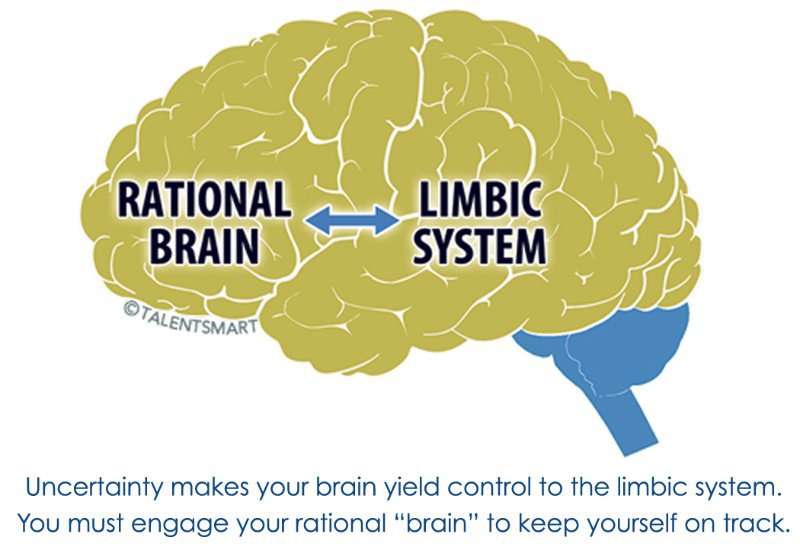
This brain quirk worked great eons ago, when cavemen entered an unfamiliar area and didn’t know who or what might be lurking behind the bushes. Overwhelming caution and fear ensured survival. But that’s not the case today. This mechanism, which hasn’t evolved, is a hindrance in the world of business, where uncertainty rules and important decisions must be made every day with minimal information.

As we face uncertainty, our brains push us to overreact. Successful people are able to override this mechanism and shift their thinking in a rational direction. This requires emotional intelligence (EQ), and it’s no wonder that—among the 1 million-plus people that TalentSmart has tested—90% of top performers have high EQs. They earn an average of $28,000 more per year than their low-EQ counterparts do.

To boost your EQ, you have to get good at making sound decisions in the face of uncertainty, even when your brain fights against this. Fear not! There are proven strategies that you can use to improve the quality of your decisions when your emotions are clouding your judgment. What follows are eleven of the best strategies that successful people use in these moments.

1. They quiet their limbic systems

The limbic system responds to uncertainty with a knee-jerk fear reaction, and fear inhibits good decision-making. People who are good at dealing with uncertainty are wary of this fear and spot it as soon as it begins to surface. In this way, they can contain it before it gets out of control. Once they are aware of the fear, they label all the irrational thoughts that try to intensify it as irrational fears—not reality—and the fear subsides. Then they can focus more accurately and rationally on the information they have to go on. Throughout the process, they remind themselves that a primitive part of their brain is trying to take over and that the logical part needs to be the one in charge. In other words, they tell their limbic system to settle down and be quiet until a hungry tiger shows up.


Like this Article ?  Share It !    You now can easily enjoy/follow/share Today our Award Winning Articles/Blogs with Now Over 800K+ Growing  Participates Worldwide in our various Social Media formats below:

FSC LinkedIn Network: (Over 10K+ Members & Growing !)   www.linkedin.com/in/frankfsc/en

Facebook:   http://www.facebook.com/pages/First-Sun-Consulting-LLC-Outplacement-Services/213542315355343?sk=wall

  • Google+: https://plus.google.com/115673713231115398101/posts?hl=en
  • Twitter: Follow us @ firstsunllc

educate/collaborate/network….Look forward to your Participation !

Continue of article:

2. They stay positive

Positive thoughts quiet fear and irrational thinking by focusing your brain’s attention on something that is completely stress-free. You have to give your wandering brain a little help by consciously selecting something positive to think about. Any positive thought will do to refocus your attention. When things are going well and your mood is good, this is relatively easy. When you’re stressing over a tough decision and your mind is flooded with negative thoughts, this can be a challenge. In these moments, think about your day, and identify one positive thing that happened, no matter how small. If you can’t think of anything from the current day, reflect on the previous day or days or even the previous week, or perhaps you’re looking forward to an exciting event. The point here is that you must have something positive that you’re ready to shift your attention to when your thoughts turn negative due to the stress of uncertainty.

3. They know what they know—and what they don’t

When uncertainty makes a decision difficult, it’s easy to feel as if everything is uncertain, but that’s hardly ever the case. People who excel at managing uncertainty start by taking stock of what they know and what they don’t know and assigning a factor of importance to each. They gather all the facts they have, and they take their best shot at compiling a list of things they don’t know, for example, what a country’s currency is going to do or what strategy a competitor will employ. They actually try to identify as many of these things as possible because this takes away their power.

4. They embrace that which they can’t control

We all like to be in control. After all, people who feel like they’re at the mercy of their surroundings never get anywhere in life. But this desire for control can backfire when you see everything that you can’t control or don’t know as a personal failure. People who excel at managing uncertainty aren’t afraid to acknowledge what’s causing it. In other words, successful people live in the real world. They don’t paint any situation as better or worse than it actually is, and they analyze the facts for what they are. They know that the only thing they really control is the process through which they reach their decisions. That’s the only rational way to handle the unknown, and the best way to keep your head on level ground. Don’t be afraid to step up and say, “Here’s what we don’t know, but we’re going forward based on what we do know. We may make mistakes, but that’s a lot better than standing still.”


Bringing It All Together: The ability to strategically manage ambiguity is one of the most important skills you can cultivate in an increasingly uncertain business environment. Try the strategies and your ability to handle uncertainty will take a huge step in the right direction.

5. They focus only on what matters

Some decisions can make or break your company. Most just aren’t thatimportant. The people who are the best at making decisions in the face of uncertainty don’t waste their time getting stuck on decisions where the biggest risk is looking foolish in front of their co-workers. When it comes down to it, almost every decision contains at least a small factor of uncertainty—it’s an inevitable part of doing business. Learning to properly balance the many decisions on your plate, however, allows you to focus your energy on the things that matter and to make more informed choices. It also removes the unnecessary pressure and distraction caused by a flurry of small worries.

6. They don’t seek perfection

Emotionally intelligent people don’t set perfection as their target because they know there’s no such thing as a perfect decision in an uncertain situation. Think about it: human beings, by our very nature, are fallible. When perfection is your goal, you’re always left with a nagging sense of failure, and you end up spending your time lamenting what you failed to accomplish and what you should have done differently, instead of enjoying what you were able to achieve.

7. They don’t dwell on problems

Where you focus your attention determines your emotional state. When you fixate on the problems that you’re facing, you create and prolong negative emotions and stress, which hinders performance. When you focus on actions to better yourself and your circumstances, you create a sense of personal efficacy that produces positive emotions and improves performance. Emotionally intelligent people don’t allow themselves to become preoccupied with the uncertainties they face. Instead, they focus all their attention and effort on what they can do, in spite of the uncertainty, to better their situation.

8. They know when to trust their gut

Our ancestors relied on their intuition—their gut instinct—for survival. Since most of us don’t face life-or-death decisions every day, we have to learn how to use this instinct to our benefit. Often we make the mistake of talking ourselves out of listening to our gut instinct, or we go too far in the other direction and impulsively dive into a situation, mistaking our assumptions for instincts. People who successfully deal with uncertainty recognize and embrace the power of their gut instincts, and they rely on some tried-and-true strategies to do so successfully:

They recognize their own filters. They’re able to identify when they’re being overly influenced by their assumptions and emotions or by another person’s opinion, for example. Their ability to filter out the feelings that aren’t coming from their intuition helps them focus on what is.

They give their intuition some space. Gut instincts can’t be forced. Our intuition works best when we’re not pressuring it to come up with a solution. Albert Einstein said he got his best ideas while sailing, and when Steve Jobs was faced with a tough problem, he’d head out for a walk.

They build a track record. People who deal well with uncertainty take the time to practice their intuition. They start by listening to their gut on small things and seeing how it goes so that they’ll know whether they can trust it when something big comes around.

9. They have contingency plans . . .

Staying on top of uncertainty is as much about planning for failure as it is about hoping for the best. Experts at handling uncertainty aren’t afraid to admit that they could be wrong, and that frees them up to make detailed, rational, and transparent contingency plans before taking action. Successful people know they aren’t always going to make the right decision. They know how to absorb and understand mistakes so that they can make better decisions in the future. And they never let mistakes get them down for too long.

10. . . . but they don’t ask, “What if?”

“What if?” statements throw fuel on the fire of stress and worry, and there’s no place for them in your thinking once you have good contingency plans in place. Things can go in a million different directions, and the more time you spend worrying about the possibilities, the less time you’ll spend focusing on taking action that will calm you down and keep your stress under control. Successful people know that asking “what if?” will only take them to a place they don’t want, or need, to go to.

11. When all else fails, they breathe

You have to remain calm to make good decisions in the face of uncertainty. An easy way to do this lies in something that you have to do every day anyway—breathing. The practice of being in the moment with your breathing trains your brain to focus solely on the task at hand and quiets distracting thoughts. When you’re feeling overwhelmed, take a couple of minutes to focus on your breathing. Close the door, put away all other distractions, and just sit in a chair and breathe. The goal is to spend the entire time focused only on your breathing, which will prevent your mind from wandering. Think about how it feels to breathe in and out. This sounds simple, but it’s hard to do for more than a minute or two. It’s all right if you get sidetracked by another thought—this is sure to happen at the beginning—and you just need to bring your focus back to your breathing. If staying focused on your breathing proves to be a real struggle, try counting each breath in and out until you get to twenty, and then start again from one. Don’t worry if you lose count; you can always just start over. This task may seem too easy or even a little silly, but you’ll be surprised by how calm you feel afterward and how much easier it is to let go of distracting thoughts that otherwise seem to lodge permanently inside your brain.

 Bringing It All Together

The ability to strategically manage ambiguity is one of the most important skills you can cultivate in an increasingly uncertain business environment. Try the strategies above, and your ability to handle uncertainty will take a huge step in the right direction.

How do your skills measure up? What do you do when faced with uncertainty? Please share your thoughts in the comments section below as I learn just as much from you as you do from me.

Travis co-wrote the bestselling book Emotional Intelligence 2.0 and co-foundedTalentSmart, the world’s #1 provider of emotional intelligence tests and training, serving 75% of Fortune 500 Companies.


Forbes.com | December 21, 2015 | Travis Bradberry 

https://www.firstsun.com/wp-content/uploads/2018/05/logo-min-300x123.jpg 0 0 First Sun Team https://www.firstsun.com/wp-content/uploads/2018/05/logo-min-300x123.jpg First Sun Team2015-12-21 13:57:512020-09-30 20:54:22#Leadership : 11 Ways Successful People Overcome Uncertainty…The Ability to Strategically Manage Ambiguity is One of the Most Important Skills You can Cultivate in an Increasingly Uncertain Business Environment.

#Leadership : How to Train your Brain to Make Better Decisions…Researchers have Shown this Growth-Mindset #Strategy of Changing How you Interpret an Event will Change Negative Response Patterns.

December 20, 2015/in First Sun Blog/by First Sun Team

Overcoming obstacles is synonymous with entrepreneurship. The ability to engage with difficulties and stress in an empowering way is described as the biggest factor for success in life — more significant than your IQ, social networks, physical health, or socio-economic background.

Free- Big Photo Lense

When you encounter stressful situations, there are two basic ways your brain will respond: fight or flight. Whether you fight or flee can be boiled down to how you’ve been conditioned from past experiences. This negative pattern of responses is known as “learned helplessness.” If you’ve given a terrible presentation at a business meeting, you’ll have a stress-induced flight response in similar future scenarios.

To create a pattern of empowering “fight” responses when you encounter a stressful or difficult situation, adjust your explanatory style from pessimistic to optimistic, at three key points: the cause (internal vs. external); the timeframe (stable vs. unstable); and the context (global vs. specific).

If left unchecked, this pattern of “learned” avoidance behaviors will lead to passive and poor decisions. You cannot dominate in entrepreneurship and leadership if you have a pattern of unhealthy risk-averse decisions — always fleeing from challenges.

The good news is, researchers have found that learned helplessness can be short-circuited depending your “explanatory style” or “attribution style.” After encountering a stressful situation, before a passive behavior is “learned,” you first have to interpret the experience, and that interpretation can be changed. Your fight-or-flight respond is visceral, until you learn to stop and ask, “Why?”

These explanatory or attributional styles can be categorized in three ways:

1. Internal vs. external.

This is how you explain the cause of an event, where you attach the “responsibility.” Making it internal means you see yourself as the cause, rather than an external factor. Example: “I’m terrible at giving presentations” (internal), as opposed to “the material was challenging to explain” (external).

2. Stable vs. unstable.

This is how you explain the lifespan an event; whether an experience has permanent effects, or is transient. Example: “I always forget names, I was born with a terrible memory” (stable), as opposed to “I didn’t get enough sleep last night, my memory is a little off this morning” (unstable).


Like this Article ?  Share It !    You now can easily enjoy/follow/share Today our Award Winning Articles/Blogs with Now Over 800K+ Growing  Participates Worldwide in our various Social Media formats below:

FSC LinkedIn Network: (Over 10K+ Members & Growing !)   www.linkedin.com/in/frankfsc/en

Facebook:   http://www.facebook.com/pages/First-Sun-Consulting-LLC-Outplacement-Services/213542315355343?sk=wall

  • Google+: https://plus.google.com/115673713231115398101/posts?hl=en
  • Twitter: Follow us @ firstsunllc

educate/collaborate/network….Look forward to your Participation !

Continue of article:

3. Global vs. specific 

This is how you explain the context of an event; whether the situation is universal across all environments or unique to one environment. Example: “I don’t enjoy meeting people at conferences” (global), as opposed to “I didn’t enjoy meeting the people at that last conference” (specific).

What’s the best explanatory style?

Explanatory styles can be divided simply into optimistic and pessimistic. So, a person who responds to challenges with pessimistic attributions will believe they were born “dumb;” that their lack of intelligence is permanent; and will never succeed in any job. This person responds with a “flight-response.”

Reframing the cause, the lifespan, and the context with an optimistic lens means this person believes they were born with great resilience; that their struggles are temporary and change happens over time; and they have the ability to succeed in any career, regardless of past failures. This person responds with a “fight-response.”

These reframing techniques can sound like wishful thinking or making excuses, but researchers have shown this growth-mindset strategy of changing how you interpret an event will change negative response patterns.

To create a pattern of empowering “fight” responses when you encounter a stressful or difficult situation, adjust your explanatory style from pessimistic to optimistic, at three key points: the cause (internal vs. external); the timeframe (stable vs. unstable); and the context (global vs. specific).

Read the original article on Entrepreneur. Copyright 2015. Follow Entrepreneur on Twitter.

December 19, 2015 | Thai Nguyen, Entrepreneur

https://www.firstsun.com/wp-content/uploads/2018/05/logo-min-300x123.jpg 0 0 First Sun Team https://www.firstsun.com/wp-content/uploads/2018/05/logo-min-300x123.jpg First Sun Team2015-12-20 14:27:122020-09-30 20:54:23#Leadership : How to Train your Brain to Make Better Decisions…Researchers have Shown this Growth-Mindset #Strategy of Changing How you Interpret an Event will Change Negative Response Patterns.

Your #Career : 5 Strategies to get Constant #Promotions …What’s the Secret to Getting to the #C-Suite? Being Self-Critical, Self-Aware, & Keeping your Ego in Check.

December 20, 2015/in First Sun Blog/by First Sun Team

Climbing the career ladder doesn’t happen though hard work alone. But the skills it takes to reach the C-suite might not always be that clear.

Free- Bridge in Fog


Krisi Rossi O’Donnell, chief recruiting officer for the staffing and recruiting firm LaSalle Network, has cracked the code. She started at LaSalle 11 years ago as a temporary office assistant and has been promoted 10 times.

Over the course of her momentous climb to the C-Suite, she has developed five strategies, including self-criticism and self-awareness, that have worked well for her and that she now shares with fellow employees (she currently manages about 60 people across multiple offices) as well as with job candidates who use the Network’s career counseling services.

1. ELIMINATE MICROMANAGEMENT THROUGH SELF-CRITICISM

O’Donnell explains that “in order to make sure you are doing your job as best you can, without being constantly supervised, you need to have some checks and balances to ensure you are not only doing your best at the moment, but that you continue moving forward and do it better the next time.”

Ask yourself how you can contribute. “What do you know?” O’Donnell asks. “How can you position yourself to have value? It is not how can I be important.” An offshoot of consistent self-criticism—in addition to helping to enhance your capabilities over time—is that you will experience less micromanagement from your boss(es).


Like this Article ?  Share It !    You now can easily enjoy/follow/share Today our Award Winning Articles/Blogs with Now Over 800K+ Growing  Participates Worldwide in our various Social Media formats below:

FSC LinkedIn Network: (Over 10K+ Members & Growing !)   www.linkedin.com/in/frankfsc/en

Facebook:   http://www.facebook.com/pages/First-Sun-Consulting-LLC-Outplacement-Services/213542315355343?sk=wall

  • Google+: https://plus.google.com/115673713231115398101/posts?hl=en
  • Twitter: Follow us @ firstsunllc

educate/collaborate/network….Look forward to your Participation !

Continue of article:

2. BE SELF-AWARE

Knowing where you need to improve is vitally important to continued growth and further steps up the career ladder. In other words, being self-critical does not work unless you are also self-aware. Being self-aware is a process, she adds.

THE MINUTE PEOPLE THINK THEY NO LONGER NEED DIRECTION OR FEEDBACK BECAUSE THEY DO THEIR JOB PERFECTLY IS THE MINUTE THEY SLIP AND FALL BEHIND.

“It is not a single moment in time. You have to think through things entirely by looking at the beginning, middle, end, outcomes, relationships, and interactions. People who are more self-aware, who can read across the table and know when somebody is not paying attention, or when what they are saying is not hitting the right spot, these people are more capable and take full advantage of being self-aware and self-critical.”

3. SEEK NEGATIVE FEEDBACK

How do you know more precisely where you need to improve when you are already fully cognizant and dedicated to high levels of work fortitude through self-criticism and self-awareness? “Encourage and gather feedback,” O’Donnell says. This means, in addition to frequently evaluating yourself, actively seek out ways to improve through other peoples’ suggestions.

For example, if you make a presentation at a meeting, don’t wait for one of your colleagues to offer a reaction to how well you did. “People intuitively want to be nice to each other, so when you are in a meeting in which you messed up, the person you are with may not tell you. They may tell other people,” however. So don’t be afraid to sincerely ask for substantial feedback. “You would rather know the truth and be able to overcome it instead of living a lie and never being able to max yourself out.”

4. THINK OF MULTIPLE SOLUTIONS TO EVERYTHING

An outgrowth of being self-critical and self-aware is that you start paying closer attention and gain a better understanding of how to be prepared for any given situation. “Even when you win, look back and say is this the only way I could have played it, are there other ways that I may be less comfortable with that I could have played,” O’Donnell explains.

YOUR FIRST INCLINATION TO DO A JOB RIGHT IS MORE THAN LIKELY COMING FROM YOUR COMFORT ZONE.

Understand that perhaps your first inclination to do a job right is more than likely coming from your comfort zone, says O’Donnell. But, simply executing instead of thinking a bit more out of the box and even taking some risks to come up with alternative (and possibly more creative and interesting) solutions, can hold you back. “Speak to your manager about multiple options,” she says. “Your career will change if you are bringing in solutions as opposed to just executing.”

5. KEEP YOUR EGO IN CHECK

“The minute people think they no longer need direction or feedback because they do their job perfectly is the minute they slip and fall behind,” O’Donnell says. “Continuously questioning your process keeps you from developing an ego.” Always be receptive, and if you don’t agree with what some of your colleagues might have to say, “learn from it and recognize that, while you don’t agree, somebody else in the room felt that way and perception matters.”


FastCompany.com | December 11, 2015 |  GEORGE LORENZO

https://www.firstsun.com/wp-content/uploads/2018/05/logo-min-300x123.jpg 0 0 First Sun Team https://www.firstsun.com/wp-content/uploads/2018/05/logo-min-300x123.jpg First Sun Team2015-12-20 13:34:322020-09-30 20:54:23Your #Career : 5 Strategies to get Constant #Promotions …What’s the Secret to Getting to the #C-Suite? Being Self-Critical, Self-Aware, & Keeping your Ego in Check.

Your #Career : The 10 most Popular Free Online Courses for #Professionals …. Your #Education Shouldn’t Stop When you Leave the Classroom. Learning New Skills is a Great Way to Expand your Mind & Get Ahead in your Career

December 19, 2015/in First Sun Blog/by First Sun Team

Your education shouldn’t stop when you leave the classroom.  Learning new skills is a great way to expand your mind and get ahead in your career — and it’s easier than ever with a plethora of online classes just a click away.

Free- Business Desk


A good place to start is with this year’s most popular Courseracourses from top universities. They range from an introduction to the programming language Python to mastering the art of negotiating. All are free, but some have paid versions that offer more extensive experiences.

Read on to see this year’s top 10, courtesy of Coursera.

10. Introduction to Financial Accounting — University of Pennsylvania

Wharton professor Brian J. Bushee teaches the basics of accounting in this course. By the end, you’ll know how to confidently read an income statement, balance sheet, and statement of cash flows.

It’s one of four courses in Wharton’s business foundation Coursera package, which costs you $595 for the classes and a capstone project, all graded. If you don’t care about a certificate or being part of a cohort that can interact with each other and the professors, you can work through each course for free.

Next session: December 28 — February 1

Find it here >>


Like this Article ?  Share It !    You now can easily enjoy/follow/share Today our Award Winning Articles/Blogs with Now Over 800K+ Growing  Participates Worldwide in our various Social Media formats below:

FSC LinkedIn Network: (Over 10K+ Members & Growing !)   www.linkedin.com/in/frankfsc/en

Facebook:   http://www.facebook.com/pages/First-Sun-Consulting-LLC-Outplacement-Services/213542315355343?sk=wall

  • Google+: https://plus.google.com/115673713231115398101/posts?hl=en
  • Twitter: Follow us @ firstsunllc

educate/collaborate/network….Look forward to your Participation !

Continue of article:

9. Successful Negotiation: Essential Strategies and Skills — University of Michigan

Ross School of Business professor George Siedel has taught negotiation classes around the world and says his research-based class is useful whether you’re trying to secure a million-dollar investment in your business or to lower the cost of your cable bill.

Next session:Always available

Find it here


8. An Introduction to Interactive Programming in Python (Part 1) — Rice University

Python is one of the world’s top five programming languages and is used at organizations like Google, Yahoo, and NASA. It’s a high-level language, but a novice can learn the basics relatively easily.

Rice professors Joe Warren, Scott Rixner, John Greiner, and Stephen Wong keep the course interesting by having students use Python to build simple games like Pong and Asteroids.

Next session: January 9 — February 2

Find it here >>

7. Tibetan Buddhist Meditation and the Modern World — University of Virginia

This course from University of Virginia professors David Francis Germano and Kurt R. Schaeffer takes a look at multiple Tibetan Buddhist meditation traditions from historical, religious, scientific, and practical purposes.

It’s a multilayered introduction to the roots of an increasingly secularized practice.

Upcoming session:Always available

Find it here >>


6. The Data Scientist’s Toolbox — Johns Hopkins University

Johns Hopkins professors Jeff Leek, Roger D. Peng, and Brian Caffo use this two-part course to give an overview of what exactly data scientists do, as well as to introduce students to some of their tools: version control, markdown, git, GitHub, R, and RStudio.

It’s one of nine courses in the data-science introductory package, which costs $470 for full participation and a certificate of completion.

Next session: Current session still open, ends January 2

Find it here >>

5. R Programming — Johns Hopkins University

This is another class in the Johns Hopkins data-science package. It introduces students to the R programming language, which is the world’s most popular language for data analysis.

Next session:Current session still open, ends January 2

Find it here >>


4. Machine Learning — Stanford University

If you’ve been wanting to learn more about artificial intelligence, this is a great place to start. Stanford associate professor and Coursera cofounder Andrew Ng uses case studies and programming exercises to illustrate some of the ways machines learn.

Next session: December 28 — March 21

Find it here >>

3. Programming for Everybody (Getting Started with Python) — University of Michigan

This is another Python course, from Michigan professor Charles Severance.

It’s part one of five, so consider this one if you’re looking for a more thorough foundation.

Next session:Current session still open, enrollment ends December 21

Find it here >>


2. Mastering Data Analysis in Excel — Duke University

Duke post-doctoral fellow Jana Schaich Borg and director of the Center for Quantitative Modeling Daniel Egger teach students how to use Excel to understand the concepts behind uncertainty-reduction and information-gain predictive models that data scientists use.

It’s one of four courses in Duke’s data science package, which costs $395 for full participation.

Next session: December 14 — February 1

Find it here >>

1. Learning How to Learn: Powerful mental tools to help you master tough subjects — University of California at San Diego

Oakland University professor Barbara Oakley and Salk Institute professor Terrence Sejnowski use studies of brain chemistry to determine the best ways to approach a new subject, memorize facts, and deal with procrastination.

The instructors make a bold claim: “If you’ve ever wanted to become better at anything, this course will help serve as your guide.”

Next session: January 4 — February 7

Find it here >>


Businessinsider.com | December 13, 2015 | Richard Feloni

https://www.firstsun.com/wp-content/uploads/2018/05/logo-min-300x123.jpg 0 0 First Sun Team https://www.firstsun.com/wp-content/uploads/2018/05/logo-min-300x123.jpg First Sun Team2015-12-19 16:34:382020-09-30 20:54:24Your #Career : The 10 most Popular Free Online Courses for #Professionals …. Your #Education Shouldn’t Stop When you Leave the Classroom. Learning New Skills is a Great Way to Expand your Mind & Get Ahead in your Career
Page 185 of 235«‹183184185186187›»

Blog Search

Login/Register

  • Log in
  • Entries feed
  • Comments feed
  • WordPress.org

FSC Career Videos

  • Job Search Techniques | Start Here
  • Resume/Cover Letter
  • Interviewing
  • Additional Career Videos
  • FSC Career Blog – #1 Career Library LinkedIn

Recent Posts

  • #Resume : How To Start A Resume To Secure Interviews For $100,000+ Jobs. A MUst REad! March 12, 2026
  • #JobOpenings : 3 Fully Remote Jobs Just Doubled Hiring And Pay Up To $100,000+. Curious About Which Roles have Doubled in Remote Hiring?  Great Read! March 10, 2026
  • #YourCareer : AI Won’t Decide Your Career. Your Habits Will. Four AI Practices Worth Considering Now! MUst REad! February 24, 2026
© Copyright - First Sun Consultation - Website Maintained by BsnTech Networks - Enfold WordPress Theme by Kriesi
Scroll to top