• About WordPress
    • WordPress.org
    • Documentation
    • Learn WordPress
    • Support
    • Feedback
  • Log In
  • LinkedIn
  • Facebook
  • X
p: 866.311.2514
First Sun Consulting, LLC | Outplacement Services and Career Transition Firm
  • Home
  • About
  • Services
    • Outplacement Services
    • Executive Coaching
    • Career Transition
  • Locations
  • Blog
    • Best of FSC Career Blog
    • FSC Career Blog
  • Members
    • FSC Career Modules
    • FSC LinkedIn Network
    • New! FSC AI Tools – Latest Technology for Resumes & Search
  • Our Clients
  • Contact Us
  • Menu Menu

Archive for category: First Sun Blog

You are here: Home1 / FSC Career Blog – Voted ‘Most Read’ by LinkedIn.2 / First Sun Blog

Your #Career : I’m A CEO—Here’s How I Decide Whether To Give You A Raise Or Lay You Off… This Exec Reveals the Arithmetic Companies Typically Use to Assess Employees’ Value.

October 12, 2016/in First Sun Blog/by First Sun Team
 Employee compensation can be an emotional subject, especially if you’re the employee. It is often daintily tiptoed around in interviews and loudly complained about in bars. Personally, I’m a firm believer that compensation is a reflection of an employee’s value to a company. As value goes up, so does pay.
ceo-scroll

When I express these opinions, however, I often get disgruntled rebuttals like, “Yeah, right. Corporations have no concept of loyalty”; “Layoffs are completely arbitrary—it doesn’t matter what you’re worth”; and, “The only way to get a raise is to change jobs!”

Since these complaints are made to me—the CEO of a company that clearly isn’t so callous—it’s obvious that these stereotypes cannot be universal. Putting aside this irony, though, even if every company in the world were as ruthless and coldblooded as some believe, value and compensation would still be inextricably connected. Let’s take a look at why this is the case and how you can increase your value as an employee to get paid what you deserve.

WHAT HAPPENS BEHIND CLOSED DOORS

Let’s be a fly on the wall in that dim, coffin-shaped room where lanky, black-suited business misers drum their spindly fingers together and cackle over that most evil of subjects: layoffs.

When they discuss the customer support floor, they decide they need to lay off one person, and gradually narrow the options down to two employees:

For every dollar that you hope to get in increased pay, you need to bring in three to five dollars to the business for your raise to make sense.

Option 1: “Bill” is an old-and-true company standby. He’s worked at the company for 20 years and has been completely faithful to his job expectations. He clocks in and out on time and delivers his customer support perfectly on script. As a result, he’s accumulated a number of raises over the years and now makes $20 an hour.

Option 2: “Shelly” has only worked in customer support for five years but has obtained advanced technical certifications, has an excellent interpersonal manner, and routinely turns upset customers into loyal patrons. Clients who get support from her are 30% more likely to purchase additional services and to refer friends.

She talks off script a fair amount but keeps track of what she says and how customers react. As a result, she has submitted many helpful modifications to the basic IT script, resulting in a 10% increase in customer satisfaction for the whole floor. Due to her high performance, Shelly also makes $20 per hour.

Which one gets the boot? It’s Bill without question.

The company is actually losing money on Bill. If they fired him, a new employee would work for only $12/hour and could read the script just as skillfully as Bill does within two weeks.

If Shelly were fired, however, the company would lose out on a major source of sales, referrals, customer satisfaction, and an internal system for improving the whole department—they can’t afford to lose her!


Like this Article ?  Share It !    You now can easily enjoy/follow/share Today our Award Winning Articles/Blogs with Now Over 2.5 Million Growing  Participates Worldwide in our various Social Media formats below:

FSC LinkedIn Network: (Over 15K+ Members & Growing !)   www.linkedin.com/in/frankfsc/en

Facebook: (over 12K)   http://www.facebook.com/pages/First-Sun-Consulting-LLC-Outplacement-Services/213542315355343?sk=wall

  • Google+: (over 800K)https://plus.google.com/115673713231115398101/posts?hl=en
  • Twitter: Follow us @ firstsunllc

educate/collaborate/network….Look forward to your Participation !

Continue of article:


VALUE IS NOT THE SAME THING AS YEARS ON THE JOB

But what about faithful old Bill? It would be so mean to fire him! Bill’s problem is that he hasn’t really done anything to justify his increased wages. Small raises have accumulated on his paycheck like moss on an old river rock, but his real value is still around $12 an hour.

However, since Bill has been working at the company for so many years, he probably “feels” like he’s worth $20 an hour. Never mind the fact that he couldn’t get paid $20 an hour at a different company, he’s “put in his time,” so he’s worth $20 an hour, right?

Now, I’m not trying to understate the value of experience and wisdom. Good employees learn and grow over time, so they provide more value for their employer. As a reward, they get raises. The problem is, those raises are often based on meeting minimum standards for specified periods of time—not the value an employee brings to the table. As a result, when push comes to shove and a company needs to actually evaluate the worth of an employee, “years on the job” means far less to the business than added value.

Related: How To Ask For A Raise

BUSINESSES PAY FOR VALUE, AND EMPLOYEES ARE THEIR ASSETS

Many employees are confused about what their salaries pay for. When people first enter the workforce as teenagers, they usually start with an hourly wage. The equation is simple: The more you work, the more money you get. Unfortunately, after a couple of years, many people begin to translate time into money and begin to think, “I’ve put in a lot of time at this job, so it stands to reason that I should be making a lot of money! I need a raise!”

Value isn’t a function of time . . . An employee is a company asset and compensation is an investment in that asset.

Allow me to burst that bubble. Value isn’t a function of time. There are 24 hours in a day whether a company pays for them or not—it’s what you do with those hours that counts. Even for hourly employees, businesses aren’t paying for time—they’re paying for value. To put it simply, an employee is a company asset, and compensation is an investment in that asset.

Let me explain what I mean: If I were to invest $5,000 in a new asset for my business—say an online marketing account—you might think that I would have to make $5,000 in sales to justify the expense. Unfortunately, it doesn’t quite work that way. I won’t get too deep into the math of contribution margin, but in short, since my business expenses aren’t just limited to what I spend on marketing, it turns out that the account would have to make me at least three times my investment ($15,000) just to break even.

If the asset started producing four or five times more money than I put into it, then it would really be profitable. In fact, I’d be willing to invest more if I knew my payoff would be that good.

The same goes for employees: If I’m going to invest in people, I need to know that having them around will make my company at least three times what I’m paying them. The more revenue an employee drives for my business, the greater their value and the more I’m happy to pay to have them as an asset. An employee who produces less value, however, loses me money and—unless they can become more productive—I can’t afford to keep them in the long run.

Related: The 10 Highest-Paying Finance Companies In America

HOW TO INCREASE YOUR VALUE

Now, I think we’ve looked at things like a ruthless businessman for long enough to show why companies care about the value their employees bring to the table.

In most real businesses with real, warm-hearted people (like I try to be), the same principles are still at play, but the focus is more on encouraging employees to become more valuable than on eliminating dead weight. In general, this encouragement comes in the form of salary. The more value an employee brings to the table, the more they deserve to be paid. The question then becomes, how do employees increase their value?

There are three basic steps:

  1. Ensure that you’re meeting the basic expectations of your job.
  2. Identify areas where you can add more value.
  3. Create and execute a plan to exceed expectations.

Step 1: Meet expectations. Before you start trying to expand your horizons, it’s a good idea to make sure that you’re at least fulfilling the minimum requirements of your role.

Of course, it can sometimes be hard to figure out what those requirements are. A recent Gallup poll revealed that up to half of employees don’t really understand what is expected of them at work. Many companies have very little in the way of formal job descriptions. Others have long lists of tasks and expectations around hiring time, but when you start the job you find that half the stuff on the list you never do and half the stuff you do isn’t on the list.

Ask how your position adds value to the company. This gives you a target for increasing your value later on.

So if you’re not sure what your job expectations really are, the easiest way to get that question answered is to talk to your manager. Havea discussion about what workplace success looks like. You might even ask how your position adds value to the company. This gives you a target for increasing your value later on.

If, in this discussion, you discover work expectations that you weren’t aware of or that you haven’t been meeting, your first priority should be to start meeting those expectations. You may also find that, as Gallup’s poll also suggests, somemanagers are just as confused about your role as you are. If this describes your supervisors, then a sit-down conversation is especially important. Defining together what your core responsibilities are will help them to know when you are exceeding expectations.

[fusion_builder_container hundred_percent=”yes” overflow=”visible”][fusion_builder_row][fusion_builder_column type=”1_1″ background_position=”left top” background_color=”” border_size=”” border_color=”” border_style=”solid” spacing=”yes” background_image=”” background_repeat=”no-repeat” padding=”” margin_top=”0px” margin_bottom=”0px” class=”” id=”” animation_type=”” animation_speed=”0.3″ animation_direction=”left” hide_on_mobile=”no” center_content=”no” min_height=”none”][Related: 5 Ways To Get The Most Out Of Your Annual Performance Review]

Step 2: Find areas in which to excel. As part of your conversation, you should also determine a list of projects that could add extra value to the company that fall within the scope of your job.

It’s important to choose these projects in conjunction with your manager because you need to be sure that when you go above and beyond, it’s in areas that your company finds important. What’s more, you want your extra efforts to be recognized for what they are.

It’s helpful at this stage to come up with a way to document your performance. Remember Shelly—how she increased customer satisfaction by 10% and got 30% more referrals than average? These numbers make her value pretty undeniable, but they wouldn’t exist if she or her managers weren’t keeping track of them.

If you work in an area like sales, it’s pretty easy to document your performance with hard figures, but for many other jobs performance is less easy to quantify. Documentation is still important in these cases, but it may look a little different. For example, this is a scorecard my marketing director and I use to measure his performance each month (shared with his permission):
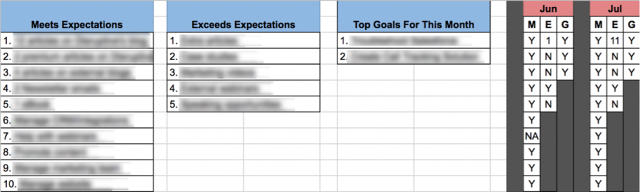
The first column contains a list of his basic job expectations. If he meets all of these he’s producing enough value to justify his base salary. The other two columns contain things that he can do to go above and beyond his normal duties to provide added value to the company.

This is a very simple documentation system, but it’s surprisingly effective. When it comes time for me to hand out bonuses and raises, I don’t have to wonder whether he’s earned it or not—I just look at the scorecard. If he’s consistently performing above expectations, then he’s adding extra value and he deserves to be rewarded.

Step 3: Make a plan and execute it. Finally, you need to put everything you’ve learned into action. If your goal is to increase your compensation at work, you can start by deciding how much more you would like to be making.

Take your current job expectations and salary as the baseline for what you’re worth to the company. Then realize that for every dollar that you hope to get in increased pay, you need to bring in three to five dollars to the business for your raise to make sense. Pick from your “above and beyond” list some projects that would add this kind of value to the company. Make a plan to complete these goals in addition to your regular tasks and present the plan to your manager.

Trust me, this will go over a lot better than the old, “I’m getting married so I need a raise” conversation. Your manager may not agree with every detail of your plan, but you will definitely come off as a motivated employee who really gets it. And even if your managers don’t buy in right away, it will be a great opportunity to discuss their priorities again and work together to come up with a plan that accomplishes things that really matter.

Don’t skip this important conversation. I’d hate to get a comment on this article saying, “I wasted six months doing what you said only to find out that nobody cared about my contribution.”

If you haven’t figured out by now, communication with your superiors is going to be a critical part of this whole process. Unfortunately, business plans are rarely static and you may have to chase a moving target, but if you’re willing to be flexible, you should be able to keep moving forward toward your goals.

Related: 9 Work Habits That Could Be Killing Your Chances For A Promotion

REACHING YOUR GOALS

Now, I know you’re probably thinking, “This all sounds great, Jacob, but it also sounds a little too idealistic. It would never work at my business.” Maybe not. I can’t predict every circumstance, and there’s a chance that yours is an exception. But isn’t it worth a try? The relationship between employee value and compensation holds just as true in “big ruthless corporations” as it does in more supportive ones.

Business plans are rarely static and you may have to chase a moving target, but if you’re willing to be flexible, you should be able to keep moving forward.

For example, one of my employees recently related to me his experience at a prior company. This was one of those more stingy jobs and had a high turnover rate for entry-level employees. However, he applied the principles I’ve described. He developed a number of specialized skills and got deeply involved in some really important projects.

The miserly company was happy to be getting more out of him for the same pay—until the day he started looking at taking his skills elsewhere. His value was so great by then that the company would be set back months or years if he left, so when he suggested that he would need a 40% pay increase to stay, they felt like it was a worthwhile investment.

Despite the money-grubbing attitude of this company, he was providing so much value that he had become an asset they couldn’t afford to lose. As a result, he was able to negotiate a much better situation for himself. The moral of the story? If you feel that you deserve a raise, don’t get drunk and holler about it every Friday night. Take inventory of your worth, talk with your managers, and start working to become a more valuable asset.


FastCompany.com |  JACOB BAADSGAARD, GLASSDOOR  | 10.11.16 5:00 AM

[/fusion_builder_column][/fusion_builder_row][/fusion_builder_container]

https://www.firstsun.com/wp-content/uploads/2018/05/logo-min-300x123.jpg 0 0 First Sun Team https://www.firstsun.com/wp-content/uploads/2018/05/logo-min-300x123.jpg First Sun Team2016-10-12 12:15:592020-09-30 20:50:30Your #Career : I’m A CEO—Here’s How I Decide Whether To Give You A Raise Or Lay You Off… This Exec Reveals the Arithmetic Companies Typically Use to Assess Employees’ Value.

Your #Career : 6 TED Talks That Will Boost your Career….Let the following TED Talks Inspire You, Challenge your Way of Thinking, and Give You the Push you Need to Take your Career to the Next Level.

October 11, 2016/in First Sun Blog/by First Sun Team
Wherever you are in your professional life, there’s a TED Talk for you. Let the following TED Talks inspire you, challenge your way of thinking, and give you the push you need to take your career to the next level.

TED-Talks-for-career-change

View As: One PageSlides

 When you feel like you’ve missed your calling:

Ashley Stahl: 3 questions to unlock your authentic career

“There’s a difference between doing work we love, and doing work that is who we are,” says Ashley Stahl, a career counselor who left a job she thought she loved years ago to pursue a career that she felt was more aligned with who she was. Stahl provides three questions to ask yourself to find your true calling, and reminds us that it’s never too late — or too early — to ask for guidance.


When you’re feeling career envy:

Alain de Botton: A kinder, gentler philosophy of success

If you ever feel as if your job isn’t good enough or that your career doesn’t measure up, rest assured that you’re not alone. In this revealing TEDTalk, philosopher Alain de Botton tries to pinpoint the reasons so much anxiety exists around our careers and statuses in the world — from career snobbery to materialism to envy — and how these factors skew our idea of success. De Botton makes a compelling case for creating our own definition of success, so that we can let go of anxiety and make room for happiness in our work.

When you’re at a career crossroads:

Barry Schwartz: The paradox of choice

Many people feel stuck in their jobs or careers, but they are afraid to leave for fear that they’ll make the wrong move. This, psychologist Barry Schwartz explains, is called the paradox of choice. In this eye-opening TED Talk, Schwartz discusses the downside of having too many choices and provides some insight into why we can’t seem to move forward — even when nothing stands in our way.


When your dream job feels out of reach:

Bel Pesce: 5 ways to kill your dreams

What holds us back from achieving our dreams? Perhaps it’s believing that success will come overnight. Or maybe it’s believing that achieving that dream is the only thing that matters. In this thought-provoking talk, MIT graduate and entrepreneur Bel Pesce looks at the five commonly held beliefs people having about achieving our dreams that actually stand in the way of us doing so.

When you feel like you’re destined to fail:

Richard St. John: 8 secrets of success

What leads to success? In this short and sweet presentation, analyst Richard St. John provides thoughts from several fellow TED speakers — including Rupert Murdoch, Goldie Hawn and Bill Gates — on the secrets to achieving success. As it turns out, the “secrets” to success aren’t so secret at all.

When you’re just plain unhappy in your job …

Scott Dinsmore: How to find work you love

Not happy in your job? You’re not alone: An estimated 80% of people don’t enjoy their work, Scott Dinsmore asserts. So what sets the other 20% apart? After years of research, and drawing from personal experience, Dinsmore, the founder of Live Your Legend, thinks he has the answer. In this inspirational talk, Dinsmore provides a framework for finding work we love and pursuing our passions.

Read the original article on CareerBuilder. Copyright 2016.

Businessinsider.com |  October 8, 2016 | Mary Lorenz, CareerBuilder

https://www.firstsun.com/wp-content/uploads/2016/05/TED-Talks-for-career-change.png 227 593 First Sun Team https://www.firstsun.com/wp-content/uploads/2018/05/logo-min-300x123.jpg First Sun Team2016-10-11 20:37:562020-09-30 20:50:30Your #Career : 6 TED Talks That Will Boost your Career….Let the following TED Talks Inspire You, Challenge your Way of Thinking, and Give You the Push you Need to Take your Career to the Next Level.

#BestofFSCBlog :Two Simple Tricks For Staying Positive In A Long, Hard Job Search.

October 11, 2016/in First Sun Blog/by First Sun Team

You’ve been applying to jobs for months, and while you’ve gotten an interview or two, nothing has panned out. What’s worse—your annoyance with your current position has reached an all-time high. That, or maybe you’re in between jobs and bills are looming.

resume-mistakes-11

Whatever the reason, you need an actual offer—ASAP.

Lengthy job searches can test even the heartiest of souls, but when you mix a tight internal timeline with slow external results, it’s an even greater challenge. You have all the typical highs and lows of applying (waiting to hear back, facing rejection, dusting yourself off and trying again), and the added pressure to land that new role yesterday.

Here are two powerful perspective shifts to help you make it through.

1. TIE DEADLINES TO YOUR EFFORTS (RATHER THAN RESULTS)

Have you ever said something like: “I’ll have a new job before the end of the month?” It’s sounds helpful, but it’s actually not.

By connecting the deadline to your personal efforts, you give yourself the opportunity to feel successful just by meeting it

That’s because you’re linking your goal to someone else’s behavior (which is outside of your control). When you tie a deadline to something that’s not within your power, you set yourself up to feel defeated if it falls through.

Instead, choose a goal based around something you do control. For example, “I will send out 10 applications by month’s end.” By connecting the deadline to your personal efforts, you give yourself the opportunity to feel successful just by meeting it—and that confidence boost can mean a lot during a tough search.

So, ask yourself, “What measurable action can I take that’ll move me closer to landing a position at my dream company?” Whatever your answer is—stepping up your networking, reaching out to a career coach—tie it to a reasonable deadline. This way, your goals will bring you results and peace of mind.

Like this Article?  Share It!    You now can easily enjoy/follow/share Today our Award-Winning Articles/Blogs with Now Over 2.5 Million Growing  Participates Worldwide in our various Social Media formats below:

LinkedIn: https://www.linkedin.com/in/chris-g-laughter-b46389198/

Facebook:  http://www.facebook.com/pages/First-Sun-Consulting-LLC-Outplacement-Services/213542315355343?sk=wall

Twitter: Follow us @ firstsunllc

Best Daily Choice: Follow the Best of FSC Career Articles/Blogs @

https://twitter.com/search?q=bestoffscblog&src=typeahead_click

Question: Want the ‘the best/current articles/blogs on the web’ on Job Search, Resume, Advancing/Changing your Career, or simply Managing People?

Answer: Simply go to our FSC Career Blog below & type(#career, #leadership, #life) in Blog Search:  https://www.firstsun.com/fsc-career-blog/

What Skill Sets do You have to be ‘Sharpened’ ?

Continue of the article:

Continue of article:

2. CHOOSE TO ERR ON THE SIDE OF POSITIVITY

Our brains have something called a “built-in negativity bias”, which means our first impression of events is likely to skew negatively. For example, if you face one of the following (common) disappointments, your initial reaction might be to get down on yourself:

Situation: You send out several resumes and don’t get any bites.
Thought: “I’m clearly a terrible candidate because no one’s responding.”

Situation: You come in as the second choice candidate for two jobs in a row.
Thought: This is too hard. I’m never going to get picked. I’m going to be stuck here forever.

Situation: Despite leaving early for an interview, you hit mega traffic and wind up arriving five minutes late.
Thought: “I blew this already.”

When you buy into these knee-jerk interpretations, it’s easy to feel down about the way things are going. So take a beat, and recognize that with a little focused attention you can come up with a more helpful perspective.

Here’s how those same situations could look after an effort to find the silver lining.

Situation: You send out several resumes over the course of a few weeks and don’t get any bites.
Thought: “The more ‘at-bats’ I take, the more likely I am to hit something.”

Situation: You come in as the second-choice candidate for two job prospects in a row.
Thought: “I must be doing something right to make it so far in the interview process.”

Situation: Despite leaving early for an interview, you hit mega traffic and wind up arriving five minutes late.
Thought: “Not the best start, but I can still make a great impression.”

Yes, this is very Pollyanna, and you’ll also want to make time to analyze what you could be doing differently to make sure you aren’t getting in your own way; e.g., Are you blowing your final interview by bringing up salary too soon?.

But don’t skip this pep talk and space to focus on the positive: That’s what’ll keep you motivated to keep trying. Can’t find a sunnier angle? You can always ask a supportive friend, family member, or professional for help. Or, at the very least, be aware when you’re jumping to negative conclusions. Just calling yourself out for that habit is a good reminder that often times, you’re choosing to be pessimistic.

I hated my first job. And I remember vividly how I worried I be stuck there for eternity. In reality, I changed things up to a much better work situation in just a few years.

Things will change, both because of your own efforts and because change is a constant in this world. Maybe the change you want isn’t coming as fast as you like, but it’ll come. Keep your focus on the things you can most influence—your actions and your thoughts. You’ll get a new job eventually. For now you just have to stay strong.


This article originally appeared on The Daily Muse and is reprinted with permission.


FastCompany.com | ALISON CARDY, THE MUSE  | 10.10.16 5:00 AM 


https://www.firstsun.com/wp-content/uploads/2014/08/resume-mistakes-11.jpg 360 480 First Sun Team https://www.firstsun.com/wp-content/uploads/2018/05/logo-min-300x123.jpg First Sun Team2016-10-11 20:08:032020-09-30 20:50:30#BestofFSCBlog :Two Simple Tricks For Staying Positive In A Long, Hard Job Search.

#Leadership : Three Ways To Write Shorter, More Effective Emails…Here’s How to Stop Writing Emails that Bury What you’re Asking for Under a Bunch of Inessential Information.

October 10, 2016/in First Sun Blog/by First Sun Team

Inside each of us there’s a little efficiency guru who views every single email within a larger matrix of all the stuff we could be focusing on: the big deadline that needs to be met, the presentation that needs to be prepared, the client conflict that needs to be resolved, the errands that need to be run. I call this the “busy bias,” and it colors how much—or how little—attention we are willing to give any one interaction or piece of information.

Free- Women on Laptop

Get right to the point immediately and do your explaining later.

When everyone is busy, a key part of getting people to pay attention is being respectful of their time. In the context of composing an email this means being clear, concise, and actionable. You can achieve this by sticking to a few simple strategies for structuring the information you need to communicate.

1. LEAD WITH THE ASK

Without being abrupt or pushy, it’s important to put your ask at the top of your email—within the first sentence or two if possible. The goal is to get the reader’s attention and have them understand the action that’s being requested immediately. If you put a lot of rigmarole before your ask, an impatient reader might never get to it. For example, let’s say you’re reaching out to the CEO of a startup you admire to invite her to speak at a conference. You could position the ask like so:

Hi Catherine—This is Mark Holland. I run the popular Firestarters conference, which draws over 5,000 entrepreneurs to the Staples Center in L.A. each year. I’m writing to extend an invitation for you to speak at our event on March 5, 2016.

Catherine may not know what the hell the Firestarters conference is yet, but she does know something important: What this email is about (a speaking invitation). She also now knows the date and location of the event and that it has fairly impressive attendance numbers. Now that the ask is clear and her interest is piqued, Mark can go on to give her some backstory on the event, share more impressive stats, and make his case even stronger.

In a short-attention span world, it’s best to get right to the point immediately and do your explaining later. Think about what will appear in the two-line message preview the recipient will see as she scrolls through her inbox: Will it capture her attention?


Like this Article ?  Share It !    You now can easily enjoy/follow/share Today our Award Winning Articles/Blogs with Now Over 2.5 Million Growing  Participates Worldwide in our various Social Media formats below:

FSC LinkedIn Network: (Over 15K+ Members & Growing !)   www.linkedin.com/in/frankfsc/en

Facebook: (over 12K)   http://www.facebook.com/pages/First-Sun-Consulting-LLC-Outplacement-Services/213542315355343?sk=wall

  • Google+: (over 800K)https://plus.google.com/115673713231115398101/posts?hl=en
  • Twitter: Follow us @ firstsunllc

educate/collaborate/network….Look forward to your Participation !

Continue of article:

2. ESTABLISH YOUR CREDIBILITY

Why should I care? is the tacit question hovering in most people’s minds as they open an email, especially if it’s from someone they don’t know. This is why establishing your credibility early on in the message is crucial. Tell your reader why you are different, why you are accomplished, or why they should pay attention to you.

You’re much more likely to get a response from someone if it’s clear what the next step is. 

If you’re emailing someone you do know—getting in touch with a coworker about an urgent task, for example—you might legitimize your request by indicating that you are under pressure from the boss (assuming that’s true).

Hi Tom—I’m following up to see if you were able to implement the new email signup feature? The CEO wants to see this wrapped up by the end of the week.

But data points and brute authority aren’t your only options, of course. You can also establish credibility by being a keen observer of the person you are contacting: You could tell them how long you’ve followed their work, what you enjoyed about the last blog post they wrote, or how their product might be improved—with tact of course! As long as it’s not fawning, most people appreciate being noticed—and it makes them notice you back.

3. MAKE THE WAY FORWARD CLEAR

You’re much more likely to get a response from someone if it’s clear what the next step is. I frequently receive emails from people who are interested in some sort of knowledge exchange but never clarify how they would like for me to take action. Do they want to have a coffee? Do they want to do a phone call? It’s unclear, which means that instead of saying, “Yes!” I have to respond by asking them what they’re asking me for in the first place—or, more likely, not respond at all. By making the way forward clear, you make it easy for the recipient to say yes to your request.

Let’s say you’re reaching out to a film director you admire for advice. Don’t just email them with:

I’ve been a fan of your work for years, and I’d love to pick your brain. What do you say?

Instead, propose something specific:

I’m a longtime admirer of your work and have the greatest respect for your filmmaking expertise. I would love to ask you a few questions about how you financed your first film. Would you be game for a 15–20 minute phone call next week? My schedule is wide open all day Thursday and Friday if you have availability then. I promise to keep it brief.

The second example clarifies the subject matter at hand and the fact that you just want to do a brief phone call. This means that the recipient knows the time commitment will be minimal and—because you’ve already proposed a calendar date—they know that the email thread can be closed quickly and efficiently. In other words, you’ve respected their time, and they now know that dealing with you won’t be another headache they don’t need.


This article is excerpted from Unsubscribe: How to Kill Email Anxiety, Avoid Distractions, and Get Real Work Done by Jocelyn K. Glei. Copyright © 2016. Available from PublicAffairs, an imprint of Perseus Books, LLC, a subsidiary of Hachette Book Group, Inc. It is reprinted with permission.

FastCompany.com | JOCELYN K. GLEI  | 10.10.16 |  5:00 AM

 
https://www.firstsun.com/wp-content/uploads/2015/11/Free-Women-on-Laptop1.jpg 1100 1650 First Sun Team https://www.firstsun.com/wp-content/uploads/2018/05/logo-min-300x123.jpg First Sun Team2016-10-10 20:28:212020-09-30 20:50:31#Leadership : Three Ways To Write Shorter, More Effective Emails…Here’s How to Stop Writing Emails that Bury What you’re Asking for Under a Bunch of Inessential Information.

#Leadership : 18 Tools That Saved Time and Grew My Business…These Affordable Tools and Apps Helped this Entrepreneur See Marked Growth Throughout 2016.

October 10, 2016/in First Sun Blog/by First Sun Team

We’re getting closer to the end of the year. It’s been a very exciting year for me achieving most of the goals that I’ve set so far. And of course, it wouldn’t have been possible without the help of some tools that have provided great shortcuts.

Free- Biz Man on Cellphone

The tools shared in this post fall under three categories:

  1. Tools that helped me apply a simple productivity system.
  2. Tools that saved me time by paying less money.
  3. Tools that had an impact on my business growth.

Related: 7 Tools to Increase Productivity and Efficiency

Are you ready? Let’s tackle these:

Tools for my productivity system.

There is a system that I’ve been following for more than a year now that has had a great impact on my business. It’s composed of three simple steps:

  1. Plan the right way.
  2. Start the day right.
  3. Take action with focus.


Like this Article ?  Share It !    You now can easily enjoy/follow/share Today our Award Winning Articles/Blogs with Now Over 2.5 Million Growing  Participates Worldwide in our various Social Media formats below:

FSC LinkedIn Network: (Over 15K+ Members & Growing !)   www.linkedin.com/in/frankfsc/en

Facebook: (over 12K)   http://www.facebook.com/pages/First-Sun-Consulting-LLC-Outplacement-Services/213542315355343?sk=wall

  • Google+: (over 800K)https://plus.google.com/115673713231115398101/posts?hl=en
  • Twitter: Follow us @ firstsunllc

educate/collaborate/network….Look forward to your Participation !

Continue of article:

You could check my previous post here to learn more about it, How This 20-Year-Old Built His Business While Studying Dentistry. And if you plan to implement it, check out this checklist.

Here are the tools:

  1. Google Docs: A great tool I use to do all the planning for the tasks I want to accomplish.
  2. Wunderlist: Helps me create to-do lists on the go and great for doing tomorrow’s to-do list.
  3. Accomplish: It helps me easily create my schedule for the day. This is my best calendar app that suits all my needs.
  4. Clear focus: Taking action with focus hasn’t been easier with the help of this great tool.
  5. 7 Min Workout app: Not only does this app have the normal seven minute exercise, but also it have many different variants with different durations
  6. Headspace: A gem tool that changed my focus throughout the day.
  7. Freedom Journal: One of the best journals. I like their app which reminds me to write in the journal in the morning and at the evening.

Tools that saved me time.

Usually, these are resources where I pay a few dollars to save me time or resources where I could save a few minutes by grouping tasks together.

  1. Upwork (formerly known as Odesk): This is not a tool but it is a great way to get low-value tasks done leaving me time to focus on higher value tasks.
  2. 99designs: I’m sure you know how time-consuming design work can be. When redesigning my logo, I spent a ton of time trying to communicate my vision to designers only to receive concepts I wasn’t happy with, which ate into other projects. Using 99designs, I was able to save a lot of time because of the great amount of designs I get. I pick the one I like, ask for reiterations till I like it and then pay.
  3. Thrive content builder: Having a great design that attracts the attention of new readers is very hard. I used to outsource this job, but with this tool, I don’t need to.
  4. Auto Text Expander chrome expansion: Great tool to share common sentences without typing them out completely.
  5. Buffer extension: Publish on all my social networks without entering them one by one.
  6. Pocket: Save important posts that come your way to read them on the weekends.

Related: 3 Productivity Tools to Rev Up Your Business Processes

Tools that helped my business grow.

There are a few tools which help you increase your business growth without much work on your end. These are the tools that helped me do just that this year:

  1. Thrive Leads: This tools helped collect more emails from my website without spending time messing with the code.
  2. SumoMe: It provides you with a great set of tools. I like to use the share, content analytics and heatmap tools. Did I mention it’s free? I’m doing just fine with the free version.
  3. Active Campaign: Creating automation with ease to convert new subscribers and customers has never been easier. Forget infusionsoft with its complexity and the hefty price you pay initially and monthly. You pay a fraction of that with Active Campaign.
  4. Optimizepress: Started using it lately after all the buzz I heard. It deserves every penny of the $97 I paid for it.
  5. Buzzsumo: Great tool to help me identify popular topics and posts in my “industry +” who are sharing it.

Related: 6 Powerful Productivity Tools That Can Supercharge Every Solopreneur’s Workflow

There are many tools out there but these are the ones that had the most impact on my business and my life so far in 2016.


Entrepreneur.com | October 7, 2016 | Ahmed Safwan


https://www.firstsun.com/wp-content/uploads/2015/11/Free-Biz-Man-on-Cellphone1.jpg 2667 4000 First Sun Team https://www.firstsun.com/wp-content/uploads/2018/05/logo-min-300x123.jpg First Sun Team2016-10-10 15:58:032020-09-30 20:50:31#Leadership : 18 Tools That Saved Time and Grew My Business…These Affordable Tools and Apps Helped this Entrepreneur See Marked Growth Throughout 2016.

Your #Career : 9 Books Everyone Looking for a Job Should Read…From Interviewing to Negotiating your Salary, There are a Lot of Factors at Play when Looking for a New Job, and One Mistake Could Put the Kibosh on the Whole Thing.

October 10, 2016/in First Sun Blog/by First Sun Team

Whether you’re just starting out in your career or making a transition, odds are there’s some part of the job search process that’s at least a little mystifying.

free- Man on Laptop looking for job

From interviewing to negotiating your salary, there are a lot of factors at play when looking for a new job, and one mistake could put the kibosh on the whole thing.

To master the art of the job search, here are nine books that can guide you through the process:

View As: One Page Slides


Richard N. Bolles’ ‘What Color is Your Parachute?’

Richard N. Bolles' 'What Color is Your Parachute?'

Amazon

Great book for: getting started

If you’re only going to read one book on the list, you may want to choose this one. Why? It covers a little about everything when it comes to a job search.

The first half of the book talks about how to create an eye-catching résumé and cover letter, as well as how to improve your networking, interviewing, and negotiating skills, while the second half focuses on how to find your ideal career.

Find it here »


Like this Article ?  Share It !    You now can easily enjoy/follow/share Today our Award Winning Articles/Blogs with Now Over 2.5 Million Growing  Participates Worldwide in our various Social Media formats below:

FSC LinkedIn Network: (Over 15K+ Members & Growing !)   www.linkedin.com/in/frankfsc/en

Facebook: (over 12K)   http://www.facebook.com/pages/First-Sun-Consulting-LLC-Outplacement-Services/213542315355343?sk=wall

  • Google+: (over 800K)https://plus.google.com/115673713231115398101/posts?hl=en
  • Twitter: Follow us @ firstsunllc

educate/collaborate/network….Look forward to your Participation !

Continue of article:

David Allen’s ‘Getting Things Done’

David Allen's 'Getting Things Done'

Amazon

Great book for: staying organized in your job search

Considering all the moving parts that come with getting a new job, this book is a must-read because it teaches you the basics of time management and organization.

It can also help you through the transition of finding a new job by teaching you how to reassess goals and stay focused.

Find it here »

Dale Carnegie’s ‘How to Win Friends & Influence People’

Dale Carnegie's 'How to Win Friends & Influence People'

Amazon

Great book for: networking

There are a number of lessons you can learn from Carnegie’s classic that will help you in your personal and professional lives. Importantly, especially when it comes to networking (and also the job interview), you’ll learn how to make people like you and win them over to your side.

Carnegie’s advice focuses on maximizing your interactions with other people, and he instructs readers, for example, to encourage people to talk about themselves, instead of dominating the conversation, emphasizing the things you both agree on.

Find it here »

Danny Rubin’s ‘Wait, How Do I Write This Email?’

Danny Rubin's 'Wait, How Do I Write This Email?'

New To Live By, LLC

Great book for: writing anything career-related

Don’t let the title of this book deceive you — “Wait, How Do I Write This Email?” is not just about writing professional-sounding emails — though, yes, it does include practical tips for that, too.

The book covers just about any job search situation you can think of that involves a written component, from crafting LinkedIn profiles, résumés, and cover letters to soliciting a referral or career guidance. Even if you’d never written a word in your life, this book could help you pass for the most competent professional out there.

Find it here »

William Strunk Jr. and E.B. White’s ‘The Elements of Style’

William Strunk Jr. and E.B. White's 'The Elements of Style'

Amazon

Great book for: editing your cover letter and résumé

One of the biggest faux pas you can make in your job search is sending out a résumé or cover letter rife with grammar, spelling, and punctuation errors.

Strunk and White’s classic grammar book will help anyone drastically improve their mastery of the written word.

From commonly misspelled words to grammar and punctuation, you’ll find all the answers in this concise and entertaining read.

Find it here »

Steve Dalton’s ‘The 2-Hour Job Search: Using Technology to Get the Right Job Faster’

Steve Dalton's 'The 2-Hour Job Search: Using Technology to Get the Right Job Faster'

Amazon

Great book for: getting the first interview

The book offers practical tips for how to wade through the sea of internet job postings.

You’ll learn how to complete three important steps in very little time using Excel, Google, LinkedIn, and alumni databases: Prioritize your target employers, contact them, and recruit people to provide you with internal referrals.

Find it here »

Michael Port’s ‘Steal the Show’

Michael Port's 'Steal the Show'

Amazon

Great book for: interviewing

You may not need a whole book to prepare you for the kinds of questions you might hear in a job interview. You can easily check out Glassdoor or articles about interview questions for that.

What’s more important is figuring out how to convey with maximum impact that you’re the best person for the job. This book can help you with that.

According to the author, every interaction is a performance, including the job interview, and as a job seeker, you have to persuade and motivate people to hire you. This book shares practical advice for shining during even the most nerve-wracking interview.

Find it here »

Roger Fisher, William L. Ury, and Bruce Patton’s ‘Getting to Yes: Negotiating Agreement Without Giving In’

Roger Fisher, William L. Ury, and Bruce Patton's 'Getting to Yes: Negotiating Agreement Without Giving In'

Amazon

Great book for: getting the job

This 30-year-old book is a great primer for going into any negotiation.

Based on the work of the Harvard Negotiation Project, this classic offers practical steps for negotiating, including key takeaways like understanding your counter-party’s interests well.

Find it here »

Lewis Lin and Christine Ko’s ‘Five Minutes to a Higher Salary’

Lewis Lin and Christine Ko's 'Five Minutes to a Higher Salary'

Impact Interview

Great book for: negotiating your salary and benefits

Understanding the theory behind salary negotiationis one thing, but putting it into practice is often easier said than done.

The book’s authors, who are salary negotiation experts, offer scripts with the exact words you can use to phrase your request for more than 60 negotiation scenarios, taking much of the pain out of negotiating.

Find it here »


Businessinsider.com | October 10, 2016 | Rachel Gillett


https://www.firstsun.com/wp-content/uploads/2016/07/free-Man-on-Laptop-looking-for-job.jpeg 350 524 First Sun Team https://www.firstsun.com/wp-content/uploads/2018/05/logo-min-300x123.jpg First Sun Team2016-10-10 15:31:172020-09-30 20:50:31Your #Career : 9 Books Everyone Looking for a Job Should Read…From Interviewing to Negotiating your Salary, There are a Lot of Factors at Play when Looking for a New Job, and One Mistake Could Put the Kibosh on the Whole Thing.

#Leadership : 3 Steps to Get More Done in Less Time…These Simple Tricks will Allow you to Manager your Time Better and Become More Productive.

October 9, 2016/in First Sun Blog/by First Sun Team

Recently a friend of mine held a productivity summit with 20 or more experts. The content shared came to more than 20 hours. When he told me about it my eyes glazed over. He noticed.  “What’s the problem? I’ve put together the greatest minds on productivity. This information is incredibly valuable,” he argued.

Free- Time Mans Watch

“I have no doubt,” I agreed, “but it feels like common core math to me. You’re taking something extremely simple and making it difficult… on purpose.”

My mind was having a hard time with almost twenty-four hours of varying approaches to getting things done. He asked about my approach and quickly discovered why I wasn’t added to the summit. It’s probably too simple.

Getting more done in less time comes down to three things:

1. Obligation scheduling.

You can’t just mentally plan to get things done. You have to calendar what you are going to do and when you are going to do it. You must make an appointment with yourself and keep it as if it were a dinner with your top client.

Related: 3 Ways to Manage Your Time and Boost Productivity

Too often we schedule with the mindset of what we want to accomplish rather than what we must accomplish. If we do that our minds see the events as optional rather than mandatory. By shifting to an obligation frame of mind, you give weight to the tasks and that creates greater necessity.


Like this Article ?  Share It !    You now can easily enjoy/follow/share Today our Award Winning Articles/Blogs with Now Over 2.5 Million Growing  Participates Worldwide in our various Social Media formats below:

FSC LinkedIn Network: (Over 15K+ Members & Growing !)   www.linkedin.com/in/frankfsc/en

Facebook: (over 12K)   http://www.facebook.com/pages/First-Sun-Consulting-LLC-Outplacement-Services/213542315355343?sk=wall

  • Google+: (over 800K)https://plus.google.com/115673713231115398101/posts?hl=en
  • Twitter: Follow us @ firstsunllc

educate/collaborate/network….Look forward to your Participation !

Continue of article:

2 Effective efficiency.

Efficiency means that we do the best job possible in the least amount of time. First, you need to know how long a task will take. Second, you need to determine if you can shrink that time without losing quality.

A colleague of mine, Mike, struggled with servicing current clients and reaching new ones. “I just don’t have enough time to work personally with everyone.”

We did some math. His average client visit was one hour. I asked if he could be just as effective in 45 minutes. He said he could. What about 40 minutes? He said yes to that as well. What about 35 minutes? He didn’t feel that would work. We settled on 40 minutes and he freed 80 minutes each day.

Related: How Getting up at 5 a.m. Has Improved My Health and Productivity

It’s not enough to just schedule, you need to be precise about the amount of time the tasks actually take. Keep track of how long certain actions take and work toward shrinking the time without losing quality.

3. Present focus.

The greatest enemy of productivity is distraction. The ability to stay attentive seems almost impossible in today’s world. You might schedule efficiently and still lose because your mind drifts or call or an email pulls you away. Staying in the “now” and in the present will increase your productivity.

Here are two “tricks” that you’ve heard over and over, but still may not be doing.

First, eliminate anything not related to the task. If your phone, or internet or people are not essential to task completion, then shut them down. Period.

Related: 4 Productivity Tips That Changed My Life This Year

Second, if you have an extra short attention span, then get an egg timer and set it for five or ten minutes as a reminder to stay on point. If you would like to really ramp up your focus by using reminders and timed sessions then consider using The Action Machine.

Personal productivity doesn’t require 20 experts. It just requires that you focus on what you should be doing, when you should be doing it without excuse.


Entrepreneur.com |  October 8, 2016 |  Paul Evans

https://www.firstsun.com/wp-content/uploads/2015/12/Free-Time-Mans-Watch.jpg 1100 1650 First Sun Team https://www.firstsun.com/wp-content/uploads/2018/05/logo-min-300x123.jpg First Sun Team2016-10-09 14:21:462020-09-30 20:50:32#Leadership : 3 Steps to Get More Done in Less Time…These Simple Tricks will Allow you to Manager your Time Better and Become More Productive.

#CareerAdvice : #JobSearch Tactics That Work… A #MustRead !

October 9, 2016/in First Sun Blog/by First Sun Team

In today’s business world, a college degree does not automatically lead to a great job the way it typically did in the past. Today, in addition to that college degree, one has to learn how to find a job — and be good at it. This additional challenge represents a significant barrier to some job seekers and especially to more mature people who have a hard time keeping up with fast-developing technology that requires new skills.

free- Man on Laptop looking for job

So, the following are a few tips regarding both what to do and how to do it.

Online and in-person networking

Beyond LinkedIn, recruiters use Twitter, Facebook and other social media to find, select and qualify talent. Those new tools — which 10 years ago were either nonexistent or in their infancy stage — are absolutely essential for today’s job seekers to be familiar with. A job seeker who does not show up on recruiters’ screens is simply ignored. This is a huge punishment for those who need a job. To be found and deemed qualified, candidates must learn how to use social media — and then use it extensively — beyond the three mentioned here. Social media are not only the venues for finding jobs but also tools that establish a positive reputation and credibility. Just remember that there are many, many applicants for just a few openings.

In-person networking supplements other social media networking. In-person networking should be considered a business transaction and not just social interaction the way many job seekers practice it. When networking in person, ask for opinions, introductions and referrals. Don’t be bashful; be slightly aggressive but still tactful. Most people are willing to help if asked.


Like this Article ?  Share It !    You now can easily enjoy/follow/share Today our Award Winning Articles/Blogs with Now Over 2.5 Million Growing  Participates Worldwide in our various Social Media formats below:

FSC LinkedIn Network: (Over 15K+ Members & Growing !)   www.linkedin.com/in/frankfsc/en

Facebook: (over 12K)   http://www.facebook.com/pages/First-Sun-Consulting-LLC-Outplacement-Services/213542315355343?sk=wall

  • Google+: (over 800K)https://plus.google.com/115673713231115398101/posts?hl=en
  • Twitter: Follow us @ firstsunllc

educate/collaborate/network….Look forward to your Participation !

Continue of article:

Tools for job seekers

Because technology has changed the job search system for both employers and job seekers, the latter group needs to quickly catch up. Employers use technology to source for talent. The majority of medium-size companies use some type of recruiting management system. Companies were forced into using such systems so they could become able to deal with larger and larger volumes of applicants, so they could save money, and so they could speed up the process. Most of the different kinds of applicant-tracking systems (ATSs) have become web-based, which extends access to the system by anyone in the organization who’s involved with the hiring process. This means that job seekers need to appeal to those people in the organization and not exclusively to human resources as in the past.

Related: Stay One Step Ahead of Your Competition

Regardless of which system recruiters use, job seekers need to improve their ranking in order to be found. Think about a Google search. Here are a few tips for improving ranking:

  • Use TagCrowd.com to visually match your résumé and the job description.
  • Match your résumé to the keywords used in the job description.
  • Use Microsoft Word to format your résumé, and avoid textboxes, tables and graphics.
  • Under the heading “Professional Experience,” list first the name of the company where you most recently worked; then, to the right of that, the dates of your tenure there; and then under the company name, the name of the position you held. Add a line or two of responsibilities or job duties, and then a bulleted list of a few specific and preferably quantifiable accomplishments. Then do the same for the job previous to that one.

The new ATSs incorporate social media tool functionality to reach passive candidates, to advertise job opportunities and to build talent communities for specific industries. Therefore, to generate multiple options for themselves, job seekers must at all times deploy diverse approaches to job seeking. Candidates need to learn how various ATSs work in order to get high enough scores to be found by a particular company’s system. A description of familiarizing oneself with the systems is vaster than can be accomplished here and will be the topic of one of my future articles.

Entrepreneur.com  |  October 8, 2016 | Alex Freund

https://www.firstsun.com/wp-content/uploads/2016/07/free-Man-on-Laptop-looking-for-job.jpeg 350 524 First Sun Team https://www.firstsun.com/wp-content/uploads/2018/05/logo-min-300x123.jpg First Sun Team2016-10-09 13:21:362020-09-30 20:50:32#CareerAdvice : #JobSearch Tactics That Work… A #MustRead !

#Leadership : 4 Ways Leaders Kill Productivity…You May be Holding your Business Back Without Even Realizing It.

October 7, 2016/in First Sun Blog/by First Sun Team

Businesses often reflect its leaders, which is why you should work on developing traits that make you a good business leader and killing those that are harming you and your business.

argue-conflict-workplace

“Whenever you see a successful business, someone once made a courageous decision.” – Peter F. Drucker

As a business leader and a blogger, my level of productivity is greatly determined by the skills I possess and the various productivity tools I’ve acquired over the years. The same applies to all entrepreneurs of every stripe and color. It’s important to constantly self-examine your progress. I do this by regularly asking myself the following questions.

  • How far have I come?
  • What got me to where I am today?
  • Am I really delivering as expected?
  • Do I find it difficult to keep up with expectations?

Related: 22 Qualities That Make a Great Leader

Too many business leaders fail to reach their full potential because they have an internal hold-back button and fail to take their fingers off of it. In this post, I’ll identify four common struggles that you may not realize are holding you back and harming your business.

1. You’re afraid to fail.

“Keep your fears to yourself, but share your courage with others” – Robert Louis Stevenson

You will fail and make mistakes a lot, as a business leader. The good news is it’s a necessary part of the path to success because running a business isn’t a hurdle-free process.

When your mind is filled with thoughts of failure coming up with actionable strategies to help boost your business can be difficult, if not impossible.

You may ask yourself: But what if I lose my job or sink my business by making one wrong choice? And I’ll say: Well, if your business dies as a result of inaction, you’ll be in the same boat. By not taking any risks, you’ll never set yourself up for the rewards that success can bring.

According to the founder of iCustomLabel Nick Chachula, great leaders are good at taking risks, because they keep themselves open for the opportunities. They see around the corner, have their homework done and are upfront about taking a shot at the given opportunity.


Like this Article ?  Share It !    You now can easily enjoy/follow/share Today our Award Winning Articles/Blogs with Now Over 2.5 Million Growing  Participates Worldwide in our various Social Media formats below:

FSC LinkedIn Network: (Over 15K+ Members & Growing !)   www.linkedin.com/in/frankfsc/en

Facebook: (over 12K)   http://www.facebook.com/pages/First-Sun-Consulting-LLC-Outplacement-Services/213542315355343?sk=wall

  • Google+: (over 800K)https://plus.google.com/115673713231115398101/posts?hl=en
  • Twitter: Follow us @ firstsunllc

educate/collaborate/network….Look forward to your Participation !

Continue of article:

2. You’re too independent.

Yes, you’re the leader; therefore, you should have the power to single-handedly manage the business all by yourself, right? Wrong. No one has the ability to grow a business and increase all-around productivity without relying on others at times.

The truth is this – in running a successful business, the role of teamwork can’t be neglected. In the words of Ken Blanchard, “None of us is as smart as all of us.”

Getting ideas from various sources will help you make well-informed decisions and take calculated risks. It will also lead to a rise in your productivity because you’ll be able to spend more time on things you do well. To rise above the challenges, you’ll need to kill the one man army mentality before it kills you.

Related: 10 Signs That You Suck As a Leader

3. You’re too scared to make decisions.

“It doesn’t matter which side of the fence you get off on sometimes. What matters most is getting off. You cannot make progress without making decisions.” – Jim Rohn

As a business leader, the decisions you make strongly determine outcome of your business, so I understand the pressure. I really do.

Having the buck stop at your table can get overwhelming. And making good decisions will help boost your productivity, almost as quickly as poor decisions will kill productivity.

According to French Entrepreneur Julien Labrousse, decisions must be made. And guess what: every leader struggles with a fear of making poor decisions at some point. One way to get over this fear is to seek counsel and delve into available data. This will give you the foundation you need in order to trust your gut instinct. It’s never a bad idea to gather information and professional opinions. Just don’t delay unnecessarily.

4. You’re not humble.

“Pride is concerned with who is right. Humility is concerned with what is right.” — Ezra Taft Benson

You just might be a great leader, but don’t forget that your team can always make you better. They may indirectly let you know when you’re taking the wrong steps. But leaders, who lacks humility, will tend to ignore any kind of constructive feedback.

Being a humble leader doesn’t mean accepting everything that your team says, but it does mean having a willingness to listen to the views of others, and give their suggestions fair consideration.

Related: How Thoughtful Leaders Earn Employee Loyalty

It also means giving credit where credit is due. It means recognizing and rewarding the efforts of your team. Acknowledging the contributions of others is a great way to foster humility, and encourage positive results from your team.

Businesses often reflect its leaders, which is why you should work on developing traits that make you a good business leader and killing those that are harming you and your business.

Entrepreneur.com | October 7, 2016 |  Toby Nwazor

https://www.firstsun.com/wp-content/uploads/2014/04/argue-conflict-workplace.jpg 360 480 First Sun Team https://www.firstsun.com/wp-content/uploads/2018/05/logo-min-300x123.jpg First Sun Team2016-10-07 12:57:562020-09-30 20:50:33#Leadership : 4 Ways Leaders Kill Productivity…You May be Holding your Business Back Without Even Realizing It.

Your #Career : The Follow-Up Email Every Job Seeker Needs To Know How To Write…You can Do Much More Than just Get your Name Back at the Top of a Hiring Manager’s Inbox.

October 6, 2016/in First Sun Blog/by First Sun Team

Fact No. 1: After you’ve interviewed for a job, hiring managers don’t always get back to you in the time frame they told you they would.

man-at-computer-sending-email

Consider describing a project you’re working on—one that could apply in some way to the job you’re applying for.

Fact No. 2: You should absolutely follow up with a polite email if you’re expecting to hear back and you haven’t.

Fact No. 3: You can use this message not just to check in, but to give the decision maker even more info that’ll show you’re the right person for the job.

That’s right. Take this traditional “just following up” email:

Hi Damon,

I hope you had a great week. You had mentioned that you’d be in touch with next steps on the hiring process by Wednesday, so I just wanted to check in. Please let me know if there’s anything I can do to help with your decision.

Best,
Adrian

There’s nothing wrong with that note. It’s brief, it’s polite, and it gets your name in front of the hiring manager.

That said, instead of asking if there’s anything you can do to, in essence, boost your candidacy, why not take that next step and provide something that does just that?


Like this Article ?  Share It !    You now can easily enjoy/follow/share Today our Award Winning Articles/Blogs with Now Over 2.5 Million Growing  Participates Worldwide in our various Social Media formats below:

FSC LinkedIn Network: (Over 15K+ Members & Growing !)   www.linkedin.com/in/frankfsc/en

Facebook: (over 12K)   http://www.facebook.com/pages/First-Sun-Consulting-LLC-Outplacement-Services/213542315355343?sk=wall

  • Google+: (over 800K)https://plus.google.com/115673713231115398101/posts?hl=en
  • Twitter: Follow us @ firstsunllc

educate/collaborate/network….Look forward to your Participation !

Continue of article:

Let’s say you’re applying to a social media position with Dolby. You might say something like this instead:

Hi Damon,

I hope you had a great week. You had mentioned that you’d be in touch with next steps on the hiring process by Wednesday, so I just wanted to check in.

In the meantime, I wanted to share a social campaign that I launched this week. It’s already had more than 5,000 shares—the company’s second most successful program ever. I think something similar to this would be very impactful for Dolby, and I’d be excited to jump right in and get started.

Best,
Adrian

In this message, you’ve shared another example of your work, you’ve highlighted a recent success, and you’ve reiterated your enthusiasm for the position. And you’ve done so proactively, which is never a bad thing.

“IN THE MEANTIME . . .”

You can tailor this template pretty easily if your work is online or easily sharable, like writing, marketing, or design.

Or, if your work or goals can be quantified—you’re in sales or account management, say—you might try something like this:

In the meantime, I wanted to share that I finished this month as the No. 1 sales rep in the New York market. It was a big honor, and also a reminder that I’m ready for my next challenge, hopefully as the sales manager at Dolby.

If your work is more behind the scenes, or if you’re working on proprietary information that can’t necessarily be shared externally, you might consider describing a project you’re working on (one that could apply in some way to the job you’re applying for) in broader terms:

In the meantime, I wanted to share that I just put the finishing touches on a crisis communications plan for one of our technology clients—a three-month process that involved collaborating with everyone from the customer success team to the CEO. It was a great experience, and one that made me even more excited about the opportunity to work on the communications team at Dolby.

Still stumped? Here’s something anyone, in any field, can do:

In the meantime, I wanted to share an article that I published last week on LinkedIn, which was inspired by the conversation we had about [fusion_builder_container hundred_percent=”yes” overflow=”visible”][fusion_builder_row][fusion_builder_column type=”1_1″ background_position=”left top” background_color=”” border_size=”” border_color=”” border_style=”solid” spacing=”yes” background_image=”” background_repeat=”no-repeat” padding=”” margin_top=”0px” margin_bottom=”0px” class=”” id=”” animation_type=”” animation_speed=”0.3″ animation_direction=”left” hide_on_mobile=”no” center_content=”no” min_height=”none”][topic you discussed in interview]. It’ll give you a little more on how I think about [subject matter]. Thanks for the inspiration—I hope we have the opportunity to work together and have many more of these conversations.

Assuming you’re not the only candidate in the pipeline, your “just checking in” email will probably be one of many sitting in the hiring manager’s inbox. Use the opportunity not just to follow up, but to show once again why you’re the best candidate for the job.


This article originally appeared on The Daily Muse and is reprinted with permission.

FastCompany.com | ADRIAN GRANZELLA LARSSEN |  THE MUSE |  10.06.16 5:00 AM

[/fusion_builder_column][/fusion_builder_row][/fusion_builder_container]

https://www.firstsun.com/wp-content/uploads/2016/10/Man-at-Computer-sending-Email.jpg 720 1280 First Sun Team https://www.firstsun.com/wp-content/uploads/2018/05/logo-min-300x123.jpg First Sun Team2016-10-06 20:47:442020-09-30 20:50:33Your #Career : The Follow-Up Email Every Job Seeker Needs To Know How To Write…You can Do Much More Than just Get your Name Back at the Top of a Hiring Manager’s Inbox.
Page 151 of 235«‹149150151152153›»

Blog Search

Login/Register

  • Log in
  • Entries feed
  • Comments feed
  • WordPress.org

FSC Career Videos

  • Job Search Techniques | Start Here
  • Resume/Cover Letter
  • Interviewing
  • Additional Career Videos
  • FSC Career Blog – #1 Career Library LinkedIn

Recent Posts

  • #JobSearch : 3 Simple Ways To Make LinkedIn Work For You In 2026. A MUst REad for All! April 29, 2026
  • #JobSearch : A Successful Job Search & Career Needs A Strong Network—Here’s How To Build One. Great Quick Read! March 25, 2026
  • #ResumeWriting : 8 In 10 Hiring Managers Spot AI Resumes-These 3 Mistakes Give It Away. Guide to How To Write Your Resume Using AI. March 20, 2026
© Copyright - First Sun Consultation - Website Maintained by BsnTech Networks - Enfold WordPress Theme by Kriesi
Scroll to top