Picture this:you’re on a hike, almost at the top of the mountain. It’s so close. You’re ready. You know that feeling? The feeling of accomplishment and that burst of adrenaline that pushes you that much further? Of course, when you get to the top of the mountain, it seems like the hard part is over. You realize you still have to hike all the way down, but that’s easy enough, right?
Wrong.It never is. You still have to get down the mountain. This picture, this hike, this mountain—this is the reality of unemployment. I know because I’m living it. Much like the hike, some parts of it are tough, some are exhilarating, and some are even exciting!
I’ve had days where I wake up feeling like I want to conquer the world. And then, there are some when I wake up feeling like the world is conquering me. Though it’s easy to get down on myself during this process, I’ve trained my mind to think of this period as a positive learning experience, and an opportunity to find the work that’s perfect for me.
For you too, there will undoubtedly be many ups and downs on your unemployment journey—but it’s important to think of the experience as the stepping stone to your next big venture. And honestly, unemployment is a full-time job in and of itself, requiring a lot of effort poured into job searching, applying, interviewing, networking, and more.
Here are my favorite tips for staying positive and using your “in-between-jobs” time wisely:
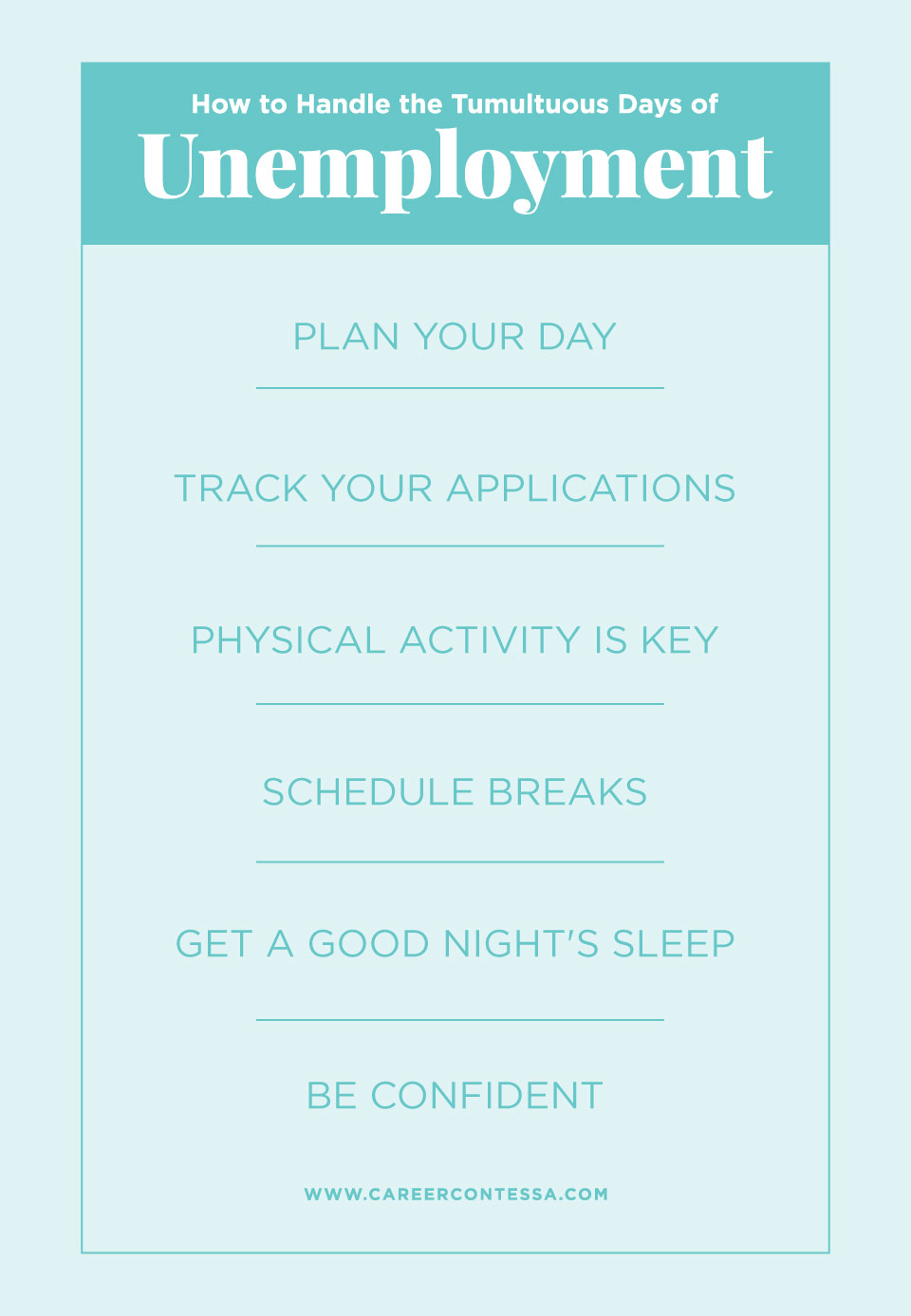
PLAN YOUR DAY
Pretend you’re at work. Whether it’s writing out a to-do list or making a list of goals for the week, having something in writing will take away that sense of scatteredness you may feel when wading through your job hunt.
Like this Article? Share It !You now can easily enjoy/follow/share Today our Award Winning Articles/Blogs with Now Over 2.5 Million Growing Participates Worldwidein our various Social Media formats below:
Keep an Excel sheet of all the jobs you have applied to—maybe even the ones you want to apply to. Beyond tracking just the title of the jobs, make sure to record what date you applied, so you know when to follow up. You could even include the contact information of the person you’re reaching out to, for optimal organization.
PHYSICAL ACTIVITY IS KEY
Exercise for at least 30 minutes a day. You will feel so much better you did. Exercising can clear your mind and help you really focus on what needs to get done. Even if it’s just a walk around your block, that small amount of exercise can make a huge difference.
SCHEDULE BREAKS
It’s important to take small breaks from the job hunt throughout the day so you don’t get too overwhelmed. By allowing your brain to focus on something that isn’t job-related for even just a small chunk of time, you’ll be able to recharge and return to it with more clarity and stamina.
GET A GOOD NIGHT’S SLEEP
It can be very easy to sleep in and go to bed late when you are unemployed. Remember that job hunting is a full-time job—you have to get adequate rest to achieve your goals. Develop a sleep routine that works for you so you can get the most done throughout the day.
PRACTICE CONFIDENCE
The worst thing you can do when you are unemployed is to lose your self-esteem. Just remember that you will find another job—it may just take some time. Having a positive mentality throughout this time is essential to achieving your goals!
On any given day, you will be going up and down that mountain. You will have days where you doubt your ability to find your next paycheck. And then there will be days where you feel like you will take over the world with your job-hunting abilities. Whatever kind of day you’re having, remember that this is a stage of your life that will change you for the better—if you let it—and transform into an unforgettable experience later on. Use this time wisely to focus on building your skills and reflect on what you really want in work and life.
Although there are many hurdles that accompany unemployment, finding work that you truly love is well worth it in the end.
What’s your journey been like? Have you climbed the “unemployment mountain”?
CareerContessa.com | PhotosMarie McGrory| February 22, 2018
https://www.firstsun.com/wp-content/uploads/2015/10/0x600-2.jpg600857First Sun Teamhttps://www.firstsun.com/wp-content/uploads/2018/05/logo-min-300x123.jpgFirst Sun Team2018-08-04 13:08:262020-09-30 20:46:17#CareerAdvice : #Unemployed – How to Handle the Tumultuous Days of #Unemployment …Being #Unemployed Can be Tough, But it’s Also an Opportunity to Find Work you Truly Love.
Did you know that–on average–recruiters and hiring managers spend only seven seconds reading your resume before signing you up for an interview–or tossing that precious piece of paper in the trash?
That’s not a lot of time to impress a potential employer. But the slush pile doesn’t have to be your job-search fate. Dawn Rasmussen, certified resume writer and founder of Pathfinder Writing and Career Services, along with Glassdoor’s own tips from its Ultimate Guide to Resumes, will help you craft a resume that’ll grab a recruiter’s attention.
1. CLEAR AND CONCISE FORMATTING
You may think that adding graphics or other infographic elements will make your resume stand out. But before your resume makes it to a recruiter, it will most likely have to pass through a computer scanning program, and those fancy shapes and symbols can confuse a computer. “If you’re sending your resume as an online submission,” Rasmussen explains, “those sexy graphics won’t make it through the software system that is set to scan through your document. In that case, it is important to have a graphic-less document so you can get through the software.” Another tip to get your resume into the right hands, literally? Scan the job description for keywords you can add to your resume, our guide instructs. If the job calls for a “self-starter,” a “leader,” or someone “eager to learn,” be sure to add those in.
Like this Article? Share It !You now can easily enjoy/follow/share Today our Award Winning Articles/Blogs with Now Over 2.5 Million Growing Participates Worldwidein our various Social Media formats below:
According to Rasmussen, “ask any recruiter or someone tasked with looking at resumes day after day, and they’d say that most people do a horrible job organizing information.” By organizing your resume in a clear way, you’ll already be steps ahead of the competition.
There are many ways to organize a resume, but two good formats suggested by our guide are the chronological resume and the functional resume. In a chronological resume, you focus on “your recent work history above all,” our guide instructs. “List your positions in reverse chronological order, with the most recent positions at the top and the oldest ones at the bottom.” In a functional resume, your aim is to “emphasize the relevance of your experience,” according to our guide. “To create a functional resume, you’ll prominently feature your professional summary, your skills, and a work experience section organized by how closely the positions relate to the one you’re applying to. This format is best for those who want to minimize resume gaps, or are transitioning into a new industry.” You can also do a mixture of these styles, which is called–surprise!–a combination resume.
3. DEFINED SECTIONS
No matter what kind of resume you decide to create, whether a chronological or functional resume, you will want to make sure each section is defined. “Guiding the reader through what you are going to discuss next is key,” Rasmussen explains. “They don’t want to be left guessing what you are discussing.” Mark each section of your resume in bold, she suggests.
Don’t just say you increased your company’s sales–show how much you increased those sales with numbers, our guide instructs. “Use your resume to explain concrete accomplishments,” it says. “Make sure your statistics are consistent, percentages are properly placed and business jargon is used appropriately based on the industry.”
What’s more, you may want to bold those numbers and accomplishments. “Bold and front-load your notable accomplishment stories underneath each employment record,” Rasmussen suggests. “Want to get to the point even more? When you are talking about your on-the-job wins underneath each employer, bold the numbers and outcomes from each story. That makes them pop–especially when recruiters are doing the quick once-through on their initial review of your document. Numbers and results bolded at the front of each sentence make it easy for them to see to what degree you are getting stuff done.”
5. EFFICIENCY
If you go on and on and on in your resume, you may lose your reader–and the opportunity for an interview. “Being efficient in how you move the reader through the document makes it cleaner and easier to understand,” Rasmussen says. “We are now in a skimming economy, so getting right to the point cleanly is critical. So, try this tip: If you have held multiple positions at the same company, stack your job titles and dates worked, starting with your most recent and going down to the oldest, instead of having a separate job entry for each position. This stacking maneuver attracts hiring manager attention because by putting the positions underneath each other, it demonstrates that you were progressively promoted.”
One way to keep your resume short and to-the-point is to “only include the skills that truly make an impact–not ones that are basic requirements [fusion_builder_container hundred_percent=”yes” overflow=”visible”][fusion_builder_row][fusion_builder_column type=”1_1″ background_position=”left top” background_color=”” border_size=”” border_color=”” border_style=”solid” spacing=”yes” background_image=”” background_repeat=”no-repeat” padding=”” margin_top=”0px” margin_bottom=”0px” class=”” id=”” animation_type=”” animation_speed=”0.3″ animation_direction=”left” hide_on_mobile=”no” center_content=”no” min_height=”none”][such as Microsoft Word or an ability to use email] or irrelevant to the job you’re applying to,” according to our guide.
6. WELL-CRAFTED DESCRIPTORS
Guess what? Everyone is a hard worker on their resume. So our guide advises you to ditch the generic and vague descriptors you might be apt to use, such as “hard-working” and “self-motivated,” which are a dime a dozen, and use more specific phrases. “Focus on the skills and accomplishments that set you apart from the competition,” the guide advises.
One thing every recruiter will want to see on your resume is reliability. “If you frequently change companies without changing levels or positions, it can be a red flag to recruiters that you are unsure or unreliable,” our guide warns. So that you’re not flagged as a flaky employee, “consider only listing the companies that best align with your desired industry.” If you do that, our guide adds, “you can always add a footnote [that reads like] ‘prior work experience in a different field, more information available upon request.’ ”
FastCompany.com | July 23, 2018 | BY JILLIAN KRAMER—GLASSDOOR 4 MINUTE READ
https://www.firstsun.com/wp-content/uploads/2016/01/ResumeInHole.jpg600857First Sun Teamhttps://www.firstsun.com/wp-content/uploads/2018/05/logo-min-300x123.jpgFirst Sun Team2018-07-23 21:23:402020-09-30 20:46:26#CareerAdvice : Include These Things in your #Resume to Get the #Recruiter’s Attention…Don’t Give Them a Reason to Say No. Instead, Wow Them with Reasons to Advance your Application.
No matter how desperate you are for a job, or how annoyed you may be at your current gig, there are some companies you’re better off not working for. Even if the money is good, the role seems irresistible, and even your friends say it’s worth a shot, accepting a role at a crappy company can set your career back and even jeopardize your future success.
So how do you know which companies to steer clear of? Here at Glassdoor, we don’t like to point fingers because all companies have the tools to change. Nevertheless, here are 7 types of companies that might as well have “Do not apply” flashing on a neonsign in the window.
1. The High Turnover Outfit
Red flags: Key roles pop up consistently on a company’s job site.
How bad is it: A company should not be on the hunt for the same important roles in management or leadership every six months, and if they are that means that they have fallen into a hire-and-fire cycle. This can indicate a few things. One, leadership may be very fickle; unable to land on the specific qualities they want in a candidate. Two, the company may have a bad internal culture which makes retention nearly impossible, no matter how talented the new hires may be. Three, top level goals may be as fleeting as the talent.
What to do: Companies with high turnover won’t deliver on their promises and may just be a waste of time.
Like this Article? Share It !You now can easily enjoy/follow/share Today our Award Winning Articles/Blogs with Now Over 2.5 Million Growing Participates Worldwidein our various Social Media formats below:
Red flags: Negative employee reviews, lack of focus on a true employee experience, recruiters evading your questions.
How bad is it: A poor company culture may not seem like a deal breaker, but it should be. Recently, we’ve seen a handful of examples where company culture has significantly handicapped public perception. Even if a company’s poor culture hasn’t played out publicly, it can be bad for your career. It’s well known that a positive company culture can drive financial performance and a productive workforce. Therefore, a negative culture can do the exact opposite.
What to do: Avoid companies who tout their ping-pong tournament but won’t allow you speak to existing employees about their experiences. Consider ending interview discussions with companies that evade questions about culture. And just say no to places who define “hard work” as 15-hour days and long weekend email threads.
Red flags: Pristine and ideal image in marketing materials and publicity, however, the day-to-day operation is far from glamorous. Only the leaders have what can pass as offices, staff is dispersed amongst shoddy cubicles, lighting is awful, technology is from the ’90s, and let’s not get started on the break room.
How bad is it: We’ve all seen them: the amazingly beautiful house on the block with the pristine lawn and the paint job that always manages to look fresh, even in the winter. These are the homes with curb appeal. They are the envy of every neighbor and look like a million bucks. But, have you ever been inside a home with massive curb appeal? Unless you’re in a really impressive neighborhood, they can have less-than-ideal interiors. The same can go for companies that are featured in all the top publications, have the coolest website, the most cutting-edge ad campaigns, and marketing materials. However, inside might tell another story.
What to do: Do your due diligence before you apply to a company to look inside its offices, get a sense of the digs and see if it’s a place you want to spend 40+ hours a week.
4. The Top Heavy Business
Red flags: Too many executives brainstorming, too few employees tasked with executing.
How bad is it: The three leading drivers of long-term employee satisfactioninclude culture and values, career opportunities, and trust in senior leadership. That does not mean, however, that all of the emphasis should be placed on attracting top executives to a company. Sure, it’s important to have phenomenal leadership, but when you read reviews of a company be sure to note how much emphasis is placed on rank & file employees. All team members are important and you should see that reflected in employee reviews of the company and in their hiring practices.
What to do: Ask yourself: Who’s getting promoted internally? Or are outsiders filling key positions? Why are there 10 SVPs, but only 100 employees? If the answers to these questions puzzle you, then you may be looking at a top-heavy company.
Red flags: Unfulfilled corporate expectations, employees report a lack of trust in CEO, inability to live up to brand promises.
How bad is it: In the era of transparency, most companies are fully aware that they must attract the best talent with full, robust and competitive packages. In order to do this, they make promises. Companies make promises around the job, the compensation package, the culture and the brand. Furthermore, companies have a brand promise that is a manifestation of its core business strategy. The problem with promises, however, they can be broken. Beware of companies that make promise after promise after promise.
Let’s boil this down to something tangible: a promotion. Your boss at XYZ company promises you a promotion based on your hard work and value to the company. You start to get excited about the new role and, of course, the increased pay. However, a month goes by and no one has mentioned anything. You follow up, and your boss routes you to HR. All you get from HR is blank stares and shrugged shoulders. Finally, weeks later you’ve been sent an email stating that your promotion has been delayed. Sigh. Broken promise.
What to do: Consider leaving. A company is only as good as its brand promise and the trust of its employees. Without these two things, it is doomed to fail.
6. The “Stagnator”
Red flags: Lack of learning opportunities, fails to promote mentorship, offers little more than the role you’ve applied for.
How bad is it: You’ve got the offer from the firm or company of your dreams. The money is right, the role is perfect and your future coworkers are people you’d absolutely grab a beer with after work. So what, there’s no learning-and-development offerings. So what, the hiring manager evaded your questions about your future goals. No big deal, right? Hardly. The stagnant company is one to stay away from as well because it places little to no emphasis on helping you meet your long-term career goals. While this type of company may work for some job seekers looking for a very particular type of job, for many it presents a dead-end.
What to do: Working at a “stagnator” means that you’ll likely be back on the job hunt in 12 to 18 months. Remember, to stagnate is a verb that means, “to cease developing; become inactive or dull.” This is not what you want for your career.
Red flags: No clear plan for the future, employees don’t know long-term goals, senior leadership fails to adequately communicate.
How bad is it: Beware of the Titanic companies that tout all the bells and whistles, but lack a clear direction. It’s these companies that inevitably hit the icebergs or big challenges over time and can become in danger of sinking. Companies should be forthright about where they stand financially, where they see themselves going, and should be willing to talk about any major challenges. If the hiring team is unable to discuss openly what direction the company hoping to go, it may be a clue that they lack a plan for growth and that the foundation may be shaky.
What to do: No matter how promising a company looks to the media or how much buzz surrounds the company’s latest product, if the value proposition and forecast are unclear, the company does not have a winning strategy.
https://www.firstsun.com/wp-content/uploads/2013/10/Interview.jpg600904First Sun Teamhttps://www.firstsun.com/wp-content/uploads/2018/05/logo-min-300x123.jpgFirst Sun Team2018-07-17 20:49:032020-09-30 20:46:33#CareerAdvice : #JobSearch – 7 Types of Companies You Should Never Work For…No Matter How Desperate you Are for a Job ,there are 7 Types of Companies that Might as Well have “Do Not Apply” Flashing on a Neon Sign in the Window.
There’s no doubt about it: the job search is tough. You have to spend time and energy revamping your resume, writing cover letters and practicing for interviews, and even then, you’re not guaranteed a position. The good news,though, is that you get alittle bit savvier at every step.With each interview needed to get to the next level, you get better at marketing yourself, communicating confidently and reflecting on your experiences thus far. So by the time you’re at the top of the company ladder, you’re practically an expert at what it takes to get a job.
With this in mind, we chatted with and researched the best job search advice from the Top CEOs of 2018. If your job search strategy hasn’t been working out so far, one of these tips might just do the trick.
1. Find a Mentor
It’s a well-known fact that personal connections are one of the most effective ways to find a job. If you develop a strong relationship with an industry mentor, they’re often able to connect you to people, companies and opportunities that can advance your career. Even if they can’t directly hook you up with a job, though, they can serve as a fantastic reference who can speak to your work ethic and personal character. But make sure you choose the right one, advises Mary Barra, CEO of General Motors.
“There are mentors in the workspace all around you — peers, the seasoned professional, your supervisor, the supervisor one desk over,” Barra said in an interview with the Women@Work podcast. “People often reach out [fusion_builder_container hundred_percent=”yes” overflow=”visible”][fusion_builder_row][fusion_builder_column type=”1_1″ background_position=”left top” background_color=”” border_size=”” border_color=”” border_style=”solid” spacing=”yes” background_image=”” background_repeat=”no-repeat” padding=”” margin_top=”0px” margin_bottom=”0px” class=”” id=”” animation_type=”” animation_speed=”0.3″ animation_direction=”left” hide_on_mobile=”no” center_content=”no” min_height=”none”][to me] saying, ‘Will you be my mentor?’ And I say, ‘Let’s talk about that, because the better person to be your mentor in the organization is someone who sees you every day, someone who knows you at your best, and someone who can give you opportunities to improve.’ So I always redirect them: Find mentors in the people around you who you respect.”
Like this Article? Share It !You now can easily enjoy/follow/share Today our Award Winning Articles/Blogs with Now Over 2.5 Million Growing Participates Worldwidein our various Social Media formats below:
2. Try a Little Bit of Everything While You Still Can
When you’re just beginning your career, you might not know for sure what you want to do yet. And really, that’s okay. You don’t have to go looking for your dream job right away. In fact, trying out many different fields can be an asset, believes Anne Wojcicki, CEO of 23andMe. Not only does this make you more marketable in the future — the more skills you have, the more doors open for you — but you’ll also have a better chance of identifying what you really love doing.
“Enjoy the uncertainty and the adventure of figuring out the world and what you want to do. 20-year-olds can get away with adventure and exploration in a way 40+-year-olds can not. So enjoy asking all the questions and trying all the different jobs and realize that each new experience helps shape your views of the world and what you want to do in it,” Wojcicki said in an interview with Glassdoor.
If you’re only applying to Fortune 500 companies or tech titans, don’t get discouraged when you don’t hear back. The name recognition and prestige of these companies lead to hundreds, thousands or even millions of candidates applying to them — Google, for example, sees about two million applicants each year — so your odds may be better if you explore more under-the-radar companies. You’ll also gain exposure to multiple roles at smaller companies, helping you discover what you enjoy doing and increase your skill stack.
“My suggestion is to visit the websites of the top-tier [venture capital firms] and click through their portfolio companies, and apply to a few that seem especially interesting,” Sanjit Biswas, CEO of Samsara, told Glassdoor. “High-growth tech companies are a great place to accelerate career growth — you’ll get to see decisions up close, and the short feedback loops are some of the best ways to learn what works and what doesn’t.”
It’s hard to think of any job nowadays that doesn’t require some degree of teamwork, and because of this, companies expect candidates to be adept collaborators. Lean into the opportunities you have to work with others at your current job, Hilton CEO Chris Nassetta advises.
“Make sure that you contribute in every way that you can, and really become a team player. Nothing gets done in today’s world without a village, so to speak. While we all make individual contributions, ultimately it’s about how you as a component, particularly as you’re getting started, work with other people,” Nassetta shared with Glassdoor. Employers want to see “ways where obviously you’re contributing and you’re creating significant value, but you’re doing it as a member of a team and not just as an individual contributor.”
Learning to work well with others, and then drawing on these experiences in your cover letter or when answering behavioral interview questions like “Tell me how you handled a difficult situation” or “What are some of your leadership experiences?” can really make you stand out to recruiters.
You may not end up in your ideal job right away, but when you’re thinking of settling down at a job or company for the long haul, make sure that it’s one you’re passionate about. For one, we spend about a third of our waking lives at work, so it’s worth spending that time doing something you enjoy. But for another reason, you simply tend to be better at what you do when you find a job you’re passionate about.
“My #1 job tip is to look for a job that you want to do. We spend a lot of time at work, and it’s important that we enjoy what we’re doing. We only go around once, and we’ve got to keep that in perspective,” said Bernard J. Tyson, Chairman and CEO of Kaiser Permanente, in an interview with Glassdoor. “Nothing is promised to any of us [at] the end of the day. The key to that is to be in step with the culture of the organization where you work.”
Following your passion, though, doesn’t always mean rigidly clinging onto one idea of The Perfect Job — there are often multiple ways to explore the fields you’re most passionate about, Michael Mahoney, CEO of Boston Scientific, explained to Glassdoor.
“I knew from a young age that I wanted to get into healthcare. I was inspired by my grandpa who was a pediatric cardiac surgeon. I grew up admiring how he helped so many children. I remember sneaking into his library when I was a kid. I’d sit in his chair surrounded by all his medical books and dream about being a doctor,” Mahoney shared. “After earning a solid C- in organic chemistry, I elected to change course and approach healthcare a little differently. It was a great lesson for me.”
Rather than pursuing a different field entirely, Mahoney chose to go into the business side of healthcare — and his decision paid off. Today, Mahoney oversees an organization of 29,000 that helps create lifesaving medical devices.
We’ve said it before and we’ll say it again: recruiters want informed candidates, the kind of people who look up a company beforehand and gather information on its culture, products, business model and more. Because by researching a company, you don’t just show that you’re knowledgeable about it — you also show that you care about and believe in it.
Brian Halligan, CEO of HubSpot, mentioned in an interview with Glassdoor that his company specifically looks for candidates who have taken it upon themselves to learn about his company and its products.
“One tip I’d give all applicants is to review HubSpot’s culture code before interviewing and to use the software — we give tons of it away for free,” Halligan said.
Whether you’re on the fence about applying to a position you’re slightly underqualified for or reaching out to a coworker you haven’t spoken with in years for an informational interview, don’t let a fear of failure hold you back.
“The biggest risk is not taking any risk,” said Facebook CEO Mark Zuckerberg in a 2011 interview. “In a world that’s changing really quickly, the only strategy that is guaranteed to fail is not taking risks.”
Sure, there’s no guarantee that any one particular risk will pay off — but if you keep swinging big, you’re bound to reap the rewards eventually.
https://www.firstsun.com/wp-content/uploads/2016/07/free-Man-on-Laptop-looking-for-job.jpeg350524First Sun Teamhttps://www.firstsun.com/wp-content/uploads/2018/05/logo-min-300x123.jpgFirst Sun Team2018-07-16 15:03:132020-09-30 20:46:35#CareerAdvice : #JobSearch -The Best #JobSearchAdvice from Top CEOs at GM, 23andMe, Hilton & More… Best of FSC Blog! Great Read.
Most interview questions are innocuous: They’re meant to evaluate whether you’re right for the job, and whether this company could be the next and best place for you. But some of the questions you’re asked, experts tell us, have a slightly more nefarious purpose: They are meant to trip you up by confusing you, catching you in a fib, or showing you’re unprepared.
But you don’t have to be tripped up by these tricky questions. Here are five that you should look out for during your next interview, and the best ways to answer them, according to experts.
1. WHAT’S YOUR DREAM JOB?
According to Steve Pritchard, human resources manager at Cuuver, this question may seem innocent, but it’s “asked by many hiring managers to deliberately trip up a candidate.” Of course, there is an element of curiosity involved, as the recruiter or manager may want to see if you have a clear career path in mind–but he or she may also be asking to see if you are “firing off applications for any job you see listed,” Pritchard warns. “If the latter is true, it suggests that this candidate may just be desperate for a job, so it’s best to have a defined answer that is relevant to the role you’ve applied for at that company.” He adds, “Having a dream job that has nothing to do with the available position suggests to the interviewer that you might not stick around very long, and that you will just treat this role as a pit stop.”
2. TELL ME ABOUT A TIME YOU SUCCEEDED AT WORK–AND A TIME YOU FAILED
Yes, the interviewer is genuinely interested in your stories of success and your ability to be honest about any failures. But he or she also wants to find out if you came prepared, says Keith R. Sbiral, a certified professional coach with Apochromatik. In other words, he or she is trying to find out if “you contemplated what might be asked during this interview, and if you have gone through the critical review of your own qualifications, successes, and most importantly, your failures,” he explains. “So often applicants are simply are not prepared, or only answer the positive half of the question, and they really miss an opportunity.” Be sure to “start with a clearly defined time you failed,” Sbiral advises. “Explain what you learned from it. Explain how you addressed the issue. And then flip to your positive success story.”
Like this Article? Share It !You now can easily enjoy/follow/share Today our Award Winning Articles/Blogs with Now Over 2.5 Million Growing Participates Worldwidein our various Social Media formats below:
3. YOU’VE DESCRIBED YOURSELF AS X IN YOUR APPLICATION. EXPLAIN WHY
“Some interviewers really scrutinize candidates down to the smallest word on their CV or application,” Pritchard warns. “If, for example, you said that you are tenacious, then don’t be surprised if you’re asked to give a real-life example in which you demonstrated this characteristic in your career.” The moral of the story? Don’t exaggerate your skill set or invent traits you don’t possess. An interviewer may be looking to catch you in a lie. “If you say that you are a problem solver, then be sure you have at least one instance in your career history where you were able to solve an actual problem,” Pritchard says. “This will show that you haven’t lied–and also that you can walk the walk, not just talk the talk.”
4. WHY ARE YOU LOOKING FOR A NEW JOB?
You can almost guarantee you’ll be asked this question at any job interview. “Whether you’ve already left your last position or are just putting the feelers out for a new job, this question has been a staple in interviews for years,” says Pritchard. “On the surface, this is a very obvious, common question. However, the question can be very damaging to your credibility if you use this as your trigger to bad mouth your current or former employer.” And that, Pritchard says, “is the subliminal reason behind this question: If you launch into a tirade about former jobs, it puts you in a very negative light. It suggests that you have a bad attitude, are not a team player, and could be disruptive.” So no matter what, when you’re asked this question, “You should omit anything that might sound like you’re slating your last position,” Pritchard says. “There is nothing wrong with saying innocent comments like, ‘There’s no real room for progression,’ or, ‘I’m looking for something more challenging or in line with my career path,’ but steer away from the name bashing and personal problems. This means you can answer the interviewer’s question without airing your dirty laundry.”
5. IS THERE ANYTHING THAT WE SHOULD HAVE ASKED YOU BUT WE HAVEN’T?
“This is a question that, in my experience, 75% of people get tripped up on,” warns Sbiral. That may be due, in part, to confusion. “They think the interviewer is asking if you have any questions,” Sbiral says, “but they are not. They are asking you if you have anything else to add.” If you come prepared, this question doesn’t have to trip you up–instead, it can be a chance to shine. “This is a freebie,” says Sbiral, “an opportunity to add something they didn’t cover. I like to hear a well-refined answer as to why I–as a hiring manager–should know that you as the interviewee are the right fit for the position.” In other words, “Worry less about credentials at this point and more about organizational fit,” Sbiral recommends.
This article was originally published on Glassdoor and is reprinted with permission
You Might Also Like:
GlassDoor.com | July 3, 2018 | BY JILLIAN KRAMER—GLASSDOOR 4 MINUTE READ
https://www.firstsun.com/wp-content/uploads/2016/04/free-people-sitting-for-interview.jpg29004500First Sun Teamhttps://www.firstsun.com/wp-content/uploads/2018/05/logo-min-300x123.jpgFirst Sun Team2018-07-04 12:18:412020-09-30 20:46:49Your #Career : #JobInverview – Be Careful about Answering these 5 #JobInterviewQuestions ….These Questions are Designed to Trip you Up.
If you’re lucky enough to have Friday afternoons off from work during the summer months, it’s probably tempting to head straight home, to the beach, or out with your friends when it’s time to leave the office. But by investing your free time on Friday afternoons into your job search, you can accelerate it in several meaningful ways. Though most employers are unlikely to schedule formal interviews on Friday afternoons during the summer, there are plenty of other ways you can get ahead.
Here, find five key ways to ensure your Summer Fridays are well spent, straight from job search pros.
1. Do your research.
It can be tough to set aside time to really figure out what you’re looking for in a job and potential employer, and Summer Fridays are the perfect time to do it. “Use all your resources to understand what the kind of company you want to work for is like,” suggests Joshua M. Evans, a career coach and owner of an HR consultancy firm.
Research can also help you immensely if you make it to the interview stage. “Checking out articles, looking at their business’s social media accounts, and jumping on LinkedIn to understand who works for them and how you can be introduced can be immensely valuable in giving you a leg up,” Evans says.
Like this Article? Share It !You now can easily enjoy/follow/share Today our Award Winning Articles/Blogs with Now Over 2.5 Million Growing Participates Worldwidein our various Social Media formats below:
Scheduling informational meetings and informal catch-ups can be difficult logistically during the work week, but people often have more flexibility on Summer Fridays if their employer offers them, making it an ideal time to get some networking done. “People often say, ‘It’s not what you know, it’s who you know,’ and though not entirely true, because you do need skills for a job, finding a job is a lot easier if you know someone within the industry or at a company themselves,” says Steve Pritchard, HR Manager at Cuuver.com. “Ask friends, family or even former employers if they know of any jobs, or to meet up for a coffee and a catch up to network and see what opportunities may lie on the horizon.”
If you don’t normally work well at home, it’s best to take your Summer Friday job hunting efforts elsewhere. “It is too tempting to take time off when the weather is nice and you’ve just had a long week at work,” notes Debra Boggs, co-founder of D&S Professional Coaching. “To keep from getting distracted, go directly to a coffee shop or library and set a specific amount of time that you’ll spend looking for and applying to jobs.”
4. Make phone calls.
Yes, really. Though phone calls about job applications have fallen out of fashion, experts say Summer Fridays are a uniquely good time to pick up the phone. “Proactively call people that do the hiring at a company you want to work for,” Evans recommends. “People, especially those in recruiting, are often more friendly on Fridays. If you reach out to them in the morning, they will have more time to chat and can even be in a good enough mood to offer to bring you in for an interview. People associate their good feelings on Friday with a good feeling about you.”
“If a career switch is in your future, Summer Fridays are a great time to build your skills and contacts in your new market,” explains Dawn Graham, PhD, a career coach and Career Director for the MBA Program for Executives at The Wharton School at the University of Pennsylvania.
“Volunteer for a non-profit practicing your data analytics skills, explore a self-created internship with a company in your target industry, start a side hustle offering services in your target function, and attend conferences where professionals in your dream field will be congregated,”she suggests. “It’s tempting to want to begin the weekend early, but a few months of strategic action could be the foundation for your new career!”
https://www.firstsun.com/wp-content/uploads/2017/10/woman-with-ice-cream-cone.jpg653981First Sun Teamhttps://www.firstsun.com/wp-content/uploads/2018/05/logo-min-300x123.jpgFirst Sun Team2018-07-02 15:42:342020-09-30 20:46:50Your #Career : #CareerAdvice – 5 Ways to Use Your Summer Fridays to Find a New Job…Here, Find Five Key Ways to Ensure your Summer Fridays are Well Spent, Straight from #JobSearch Pros.
Imagine you’ve just walked out of a great job interview. You made a great impression and really like your chances. Now, take it to the next level by writing a thank you note that reinforces why you are the right candidate.
Here are some tips for creating the perfect follow-up note:
Methods matter
Email – In general, email is probably the best choice. Most hiring managers check their email at least once a day and probably expect to receive thank you notes this way.
Handwritten notes – These are still prevalent, but you are up against the timing of snail mail. Hiring managers are finalizing their choice in the time it takes to compose, send, and receive a handwritten card. In addition, you don’t know how often they are checking their mailbox – since it’s used so rarely anymore, some offices only deliver mail once a week. However, handwritten notes can be great if you can ensure quick delivery – such as applying for a role at your current company or in an office next door to yours. To avoid awkwardness, just drop the note under their door or in their mail slot.
LinkedIn direct messages – This isn’t a bad method, but again, timing may not be on your side. Remember that hiring managers may be on LinkedIn less than their business email, especially if they’ve wrapped up interviewing and are done looking for candidates. If you do choose this method, make sure to keep the tone professional and construct the note the way you would any business communication.
Like this Article? Share It !You now can easily enjoy/follow/share Today our Award Winning Articles/Blogs with Now Over 2.5 Million Growing Participates Worldwidein our various Social Media formats below:
If you are going to choose a handwritten note, make sure you use quality stationary or a blank thank you card. And it should be in line with your industry – bright colors and a cool design may work well for social media roles, but neat lines and simple patterns are best for something like finance. And make sure your email signature and address are professional.
Make it memorable
A great way to stand out is to personalize the note with something specific you discussed during the interview. As candidates, we love a personal touch to the hiring experience and so will the hiring manager! Here’s an example:
Thank you for meeting with me to discuss the Financial Analyst role. I loved hearing about your team’s objectives for the year and discussing how we both share a passion for process improvement. Our conversation reinforced my interest in the role and I look forward to hearing from you regarding this position.
From there, you can wrap up with a warm closing. As you compile your note, make it conversational. To streamline the process if you’re interviewing for multiple positions, create a general template, then fill in the specific pieces for each separate role.
Send the note ASAP, but put some thought into it. One of the oddest things applicants do is hand the interviewer a thank you note during the interview. How can you write a thank you note if you haven’t been through the experience yet? This can feel disingenuous and rushed. You want to convey that this role is important to you and you are willing to take the time to sincerely communicate with the hiring team.
Are notes required?
A common question is, should you ever not send a thank you note? 99% of the time, you should absolutely send a thank you note. Even if you no longer have an interest in the role or company, felt the interview was particularly intense, or the interviewer wasn’t exactly friendly, still send the note. While you don’t need to share that feedback, you still want to convey your appreciation for their time and emphasize that you enjoyed meeting them. You never know when someone may share your name with a colleague and you want to make the best impression you can.
Quick tips
Quality check the note before sending.
Don’t look for a response. The offer or decline is usually the next communication.
Send a separate note to everyone – recruiters and each individual hiring manager.
Devon Miller, Talent Branding and Recruitment Marketing at Vanguard, is a writer specializing in branding and marketing topics that create authenticity and engagement via social media channels. Vanguard is one of the world’s largest investment companies, offering a large selection of high-quality low-cost mutual funds, ETFs, advice, and related services.
https://www.firstsun.com/wp-content/uploads/2017/01/free-laptop-woman.jpg11001650First Sun Teamhttps://www.firstsun.com/wp-content/uploads/2018/05/logo-min-300x123.jpgFirst Sun Team2018-05-24 20:24:282020-09-30 20:47:08Your #Career : #CareerAdvice #Interviews – How to Write a Memorable Post-Interview #ThankYouNote … Imagine you’ve Just Walked Out of a Great #JobInterview . Now, Take It to the Next Level by Writing a #ThankYouNote that Reinforces Why You are the Right Candidate.
Cover letters are dead, or so we’ve been told. Many recruiters and hiring managers don’t even bother to read them, opting to skim resumes instead. But however their influence might be waning, plenty of people who are faced with making hiring decisions still rely on cover letters in order to size up candidates and determine who might be worth calling in for an interview.
So how can you make your cover letter as effective as possible? Make it short. Emily Liou, career happiness coach at CultiVitae, says you can probably boil your full-page cover letter down to a single paragraph (or two), without rehashing your resume. Here’s how.
That formulaic opening line. “A big mistake I see candidates make,” Liou says, “is they start off very cookie cutter with the, “It’s with the utmost enthusiasm that I apply for this position. I am a great fit because . . . I bring years of . . .’” Not only do these openers waste precious space (and the hiring manager’s time), they instantly make candidates blend into the pack, when the whole point is to stand out.
All those basic “job skills” that aren’t really skills.“It seems as if everyone is detail-oriented, has strong communication skills, and is a fast learner,” Liou points out. Those descriptors have no place in a short, compelling cover letter. Chances are if it’s a meaningless buzzword on your resume or LinkedIn, it’s just as useless in your cover letter, too.
A chronological recap of your entire work experience. Don’t feel obligated to squeeze in a mention of every job you’ve ever held in the order you held them–it won’t do you or recruiters any favors. “Your resume is going to be reviewed first,” Liou says. “If the recruiter sees potential in your background, then they will read your cover letter.” So write your cover letter based on the premise that the reader is already familiar with the general outlines of your career trajectory.
Like this Article? Share It !You now can easily enjoy/follow/share Today our Award Winning Articles/Blogs with Now Over 2.5 Million Growing Participates Worldwidein our various Social Media formats below:
One great thing you’d be able to do the week you start. “When writing a cover letter, it’s really important to get into the mind of your reader,” Liou explains. “The job description’s summary and main responsibilities often highlight what this successful candidate will be doing on a daily basis. Try to picture the role and ask yourself, ‘Why would I be able to immediately contribute to their team?’ In other words, be sure to highlight what specifically about your entire background and experiences sets you apart from other candidates.” Focus on productive, positive actions you’ll be able to take right away based on your current skills.
Tell a story. It can even be about them, not you. “Aim to capture their attention by telling them what about their product, service, or mission really drew you to apply for this role out of all the other similar positions out there,” Liou advises. Otherwise get autobiographical and offer an anecdote, she says. “If you have an interesting story or way you learned about the company, share this! People connect with stories and it will make your application memorable and unique.”
PUTTING IT TOGETHER
Can you fit all this into a single paragraph? Liou says it’s possible. She sketches it out like this, using a hypothetical job opening at Netflix by way of example (in her words):
Sentence 1: Strong opener that captures their attention: “Confession: I recently binged two full seasons of Narcos last weekend.”
Sentence 2: Explain why the company’s mission, product, service, etc. resonate with you so much: “As a film and TV enthusiast with a Netflix membership since 2013, I’m impressed with the user interface and features that are continuously released.”
Sentence 3: Share why you’re so passionate to see the company grow in the role: “I believe Netflix has disrupted the entire entertainment business, and I would appreciate an opportunity to provide bold recommendations backed with data in the data analyst opening.”
The next three to five sentences, Liou continues, “would then immediately dive into background and why you’re a match.” In her example, this is where you’d explain how you’d be able to start contributing to the organization right away–since you’ve already offered an anecdote in your first sentence.
You could hit “return” twice and start a new paragraph before sharing that, but you’ll still be left with a lean, clean cover letter that’s compelling to read. Which, of course, is exactly the point.
ABOUT THE AUTHOR
FastCompany.com | May 23, 2018 | Rich Bellis
https://www.firstsun.com/wp-content/uploads/2018/02/man-on-laptop2.jpg7201080First Sun Teamhttps://www.firstsun.com/wp-content/uploads/2018/05/logo-min-300x123.jpgFirst Sun Team2018-05-23 15:36:322020-09-30 20:47:09Your #Career : Use this One-Paragraph #CoverLetter to land your next #JobInterview …Most #Recruiters just Skim Cover Letters, so Here’s How to Craft a Short and Effective One that Can be Read in 60 Seconds or Less.
At some point in your career, it’s likely you’ll face unemployment: whether it takes you awhile to find a job after graduation or you are the victim of a round of corporate layoffs. Workplace expert Amy Cooper Hakim says today’s global marketplace makes many positions disposable. “Organizations aren’t as committed to their employees, and employees aren’t as committed to their organizations. As such, long-standing tenure within organizations is much less common,” she says.
Bottom line? The busier you keep yourself during this period–from applying and side-hustling to keeping a go-get-’em mindset–the more likely you’ll pull out of the unemployment bracket and into your new office.
So when you’re out high and dry–and anxiously eyeing your savings account–what’s the best approach to job searching? Career branding expert Wendi Weiner says recent data suggest it takes at least six weeks–and up to eight months–to earn an offer letter, making what you do during this idle time vital. Marrying a sharp focus with tenacious hustling and a picky attitude is the best way to approach your career pursuits as you set a three-month goal for yourself. Here’s your expert-approved guide through the process:
WEEK ONE
Though you could be struggling with nerves, the first seven days also mean mornings sleeping in and catching up on the latest Netflix obsession. Hakim says not to give yourself too much of a hard time over this sluggish session, since it can actually do wonders for your psyche: “Allow yourself the chance to mourn your old job and to make peace with the change. This clarity of mind can help you to determine next steps, career wise, too,” she says.
You shouldn’t be completely unproductive though. “Research companies of interest and create a spreadsheet,” Weiner says. “Begin to research who are the key players at the companies, the positions available, and the target positions you are seeking.”
Don’t have the appetite to start networking in person yet? You can still set yourself up for future elbow-rubbing by updating all of your career documents and profiles, Weiner adds. From your LinkedIn profile to your resume and cover letter template, this will make the application process that much more seamless once you’re ready to put yourself out there. Don’t forget about recommendations, either—now is the time to reconnect with a former boss, a trusted mentor, or a colleague who will happily sing your praises, Hakim reminds.
Like this Article? Share It !You now can easily enjoy/follow/share Today our Award Winning Articles/Blogs with Now Over 2.5 Million Growing Participates Worldwidein our various Social Media formats below:
Check yourself: By now you should have at least secured a few in-person interviews, attended networking lunches or functions, and sent out plenty of job applications. If you’re not getting yourself out there, you’re falling behind, according to the experts. Nearly 70% of all jobs are won via networking. This is the time when you should be shouting from the rooftops that you’re competitive, desired, and available for the right opportunity. “Your goal is to be noticed and recognized as a thought leader. Ask connections to introduce you to key players in your field. Ask others if they know of a job or of a person who might be able to help. Without being pushy or presumptuous, we get what we need when we ask for it,” Hakim explains.
Don’t forget to take copious notes about your experiences, whether face-to-face or digitally. This helps you concentrate on progress and pave the way for your next follow-up or interaction. “Have a column for notes/feedback so that you aren’t duplicating your efforts. You don’t want to haphazardly contact the same person or same company twice with that first email communication,” Weiner warns. “You also want to chart when you are receiving/sending responses to companies so that you are being proactive.”
SIX WEEKS IN
If you’ve been following your homework diligently, Weiner predicts you’re in the middle of second and third rounds of interviews, with an offer formulating on the horizon. Even if you think you’re this close to securing a job, it’s important as ever to remain active. You want to ensure your network continues to sprout, just in case you’re passed over for an opportunity you think you have in the bag. “Consider attending networking events, professional conferences, and events in your industry and niche so that you are building a strong network of connectivity with others,” she says.
During this time, you might start to lose your steam–especially if receive a few rejections–so don’t forget to prioritize your health, too. Weiner says job seekers should commit to one healthy habit a day–from healthy meals and exercise to soaking up vitamin D outside and creating a budget–to keep a positive attitude. After all, showing up cranky to an interview won’t bode well for your chances.
TWO MONTHS IN
Are you still showering daily? How much coffee are you drinking? How about booze? When unemployed folk reach the two-month mark, it’s normal–and expected–to feel frustrated with the process. As tough as it is to push through your growing insecurity in your abilities, Weiner says your tenacity will win in the long run.
To help you get through the many rejection levels and ghosters, she suggests setting up a daily schedule to keep your mind occupied–instead of spiraling. “Spend a few hours in the morning researching jobs, and spend the afternoon reaching out to the major contacts at those jobs. Continue being proactive, but also stick to a schedule. If you are staring at your computer all day waiting for the phone to ring, you will find yourself continuing to stress. Head to the gym for a daily workout, or go to the park,” she says.
Another effective way to boost your morale, according to Monster.com career expert Vicki Salemi, is to reach out to trusted colleagues or friends who have also faced unemployment for an extended period. Use their experience to compare notes, find holes you might be missing, and, of course, remind you of how super-talented and stellar you are.
AFTER THREE MONTHS
Sure, months fly by quickly when you’re busy pulling late-nighters for a new client or waking up early to catch a business-class red-eye to London–but when you’re unemployed? Each day feels endless and deafening. Twelve weeks into unemployment and you’re understandably fed up. Instead of accepting defeat, challenge yourself to approach your job search with strategy–and flexibility.
Hakim says many people have too narrow of a pool in the beginning: Are there other geographical areas you’re open to? Roles that might also work for your skill set? A lateral move instead of one that propels you upwards? Have you already forgotten about professionals you connected with in month one? What are they up to now? What advice do they have for you? These questions might not be the easiest to stomach or process, but they could mean the difference between a “yes” and a “no.”
Salemi adds that a critical eye toward your progress could also prove beneficial, since you might have grown a tad lazier as time has passed. And perhaps too rose-colored about the “perfect job” instead of one that could serve its purpose for now. “Have you been landing phone interviews, but not office interviews? Are you thinking broadly enough–maybe there’s a company that has an awesome part-time opportunity that can, in due time, be parlayed into a full-time one? Think outside the box in ways you can earn money, contribute your valuable skill set to an organization, and stay busy,” she says.
Bottom line? The busier you keep yourself during this period–from applying and side-hustling to keeping a go-get-’em mindset–the more likely you’ll pull out of the unemployment bracket and into your new office.
FastCompany.com | May 18, 2018 | BY LINDSAY TIGAR 6 MINUTE READ
https://www.firstsun.com/wp-content/uploads/2016/04/free-man-thinking.jpg24563680First Sun Teamhttps://www.firstsun.com/wp-content/uploads/2018/05/logo-min-300x123.jpgFirst Sun Team2018-05-18 13:15:562020-09-30 20:47:11Your #Career : Hit the Ground Running- Your Guide to Surviving the First Months of #Unemployment …It can take on Average Six Weeks to Eight Months to Find a #NewJob . Here’s the Best Way to Spend that #JobHunting Time.
It can be tough to realize that the role or field you’ve dedicated years of your life to isn’t working out. So tough that you start wondering how you’ll ever make a change and maybe even develop the discouraging sense that you can’t make the change yourself–that if you’re going to have any chance at all, it’s up to someone else to give you a lucky break.
If you find yourself feeling insecure about your prospects for a new job and starting to think you need a hiring manager or recruiter to “take a chance on you,” it’s time to check your attitude. Wanting a lucky break might seem like an innocent enough idea, but in reality, it does a great disservice to you, your prospective employer, and your job hunt. Here’s why:
WHERE DOES THIS IDEA COME FROM?
The origin of this idea could be that grandparent’s story we’ve all heard about showing up in the office and being so persistent that, despite a lack of work experience and a naive approach to business, they got the job. Another source might be the despair that comes with a career change–we doubt ourselves, our decisions and our ability to do something new, so we put the pressure on someone else to make it happen.
First, this attitude dismisses all of your skills and qualifications and removes your power from the situation. Instead of being a smart, talented candidate, you’re acting as if you’re unqualified, desperate, and in need of a favor. Not only is that a damaging way to think about your own career, but–outside of a lot of pressure from mutual connections–no hiring managerin their right mind would consider you a front-runner for the job.
Second, and most important to your case, this attitude kicks off a professional relationship by expecting someone else to put their necks on the line for you. It sets up hiring managers as cruel gatekeepers to your dreams who just need to have mercy on you; and if they don’t, it’s not your fault–they’re just mean.
In reality, hiring managers are honest people trying to do their jobs. When they read your resume, they’re thinking, “Does it make sense for me to hire this person for this job?” and, “Am I reasonably certain they can perform this job with the regular amount of training?” If the answer isn’t an obvious yes, they could get in trouble for hiring you, and it could have serious consequences for them!
Wherever we get the idea that “we just need someone to give us a chance,” it’s important to understand that job-hunting has changed over the past 10 years. It’s no longer difficult for employers to find candidates with bachelor’s degrees and industry intern experience, so they rarely need to resort to hiring an unknown entity or sit poring over a resume trying to figure out how your skills can work for them.
Like this Article? Share It !You now can easily enjoy/follow/share Today our Award Winning Articles/Blogs with Now Over 2.5 Million Growing Participates Worldwidein our various Social Media formats below:
Remove the idea of getting a lucky break or a once-in-a-lifetime chance from your mind. Turn your attention towards things that you actually have control over: a compelling cover letter that explains the passion and careful thought behind your career change and a resume highlighting the transferable skills that make you a good fit for the job you want. Make it your goal to show hiring managers and recruiters that they aren’t taking a chance on you; they’re making a hiring decision that will bring new insights, skills and talents to the role they’re looking to fill.
When you find yourself standing at the beginning of a career change journey, it’s natural to feel intimidated. But keep in mind that you’re not alone. While this might be your first career change, others have gone before you and made the leap with great success and still more have made significant pivots in their career that add up to big changes, too. Surround yourself with a support network, tap into the resources here on Glassdoor, and take a chance on yourself!
BY SARAH GREESONBACH | GLASSDOOR | May 16, 2018 | 3 MINUTE READ
https://www.firstsun.com/wp-content/uploads/2017/10/Woman-Embarssed.jpg450970First Sun Teamhttps://www.firstsun.com/wp-content/uploads/2018/05/logo-min-300x123.jpgFirst Sun Team2018-05-16 21:07:542020-09-30 20:47:13Your #Career : This Common Mind-Set is Killing your #JobSearch …Are you Considering a #CareerChange ? We Feel for You! The Right Attitude can Go a Long Way.