Posts

Your #Career : You Need To Talk To Your Company’s #CEO —Here’s Why And What To Say… #SeniorExecs Don’t Need to Know you By Name, But they Should at Least Have a General Sense of your Existence & Function in the Organization.

Soon after I got my first faculty job, I was sitting with a friend of mine–another psychologist–who’d recently been hired for her first job at another university. She said to me, “Our next task is to become independent nodes in people’s conceptual networks.” That was psychology speak for, “Now we need to make sure people know who we are.”

She was right. The reasons why it’s so important for people to know you who you are are all really simple but can be easy to miss: They can’t give you credit for anything you do if they don’t know what you do. They can’t think of you for new assignments if they don’t know you exist. They can’t plan for a future that involves you specifically if they can’t remember your past contributions.

In other words, you need to introduce yourself to some of the top people in your organization–or at least to people higher up than you and your immediate supervisor. Yes, these are people you don’t directly work with, and that’s precisely the point. Here’s how to strike up such a conversation, and what to say when you do.


Related: What To Say When You’re Stuck In The Elevator With Your Boss’s Boss


LOOK FOR AN OPENING, NOT AN APPOINTMENT

You goal should be to keep it pretty informal, so don’t schedule a time to meet. There may be public events at the company that give you an opportunity to meet top-level leaders. I frequently give talks at small and mid-size companies that senior leaders attend, and there’s usually social time before and after internal events like these for other employees to introduce themselves. Yet I’m always surprised how few people make the effort just to say hi. Don’t let a chance like that go to waste.

Good leaders try to make themselves visible around the office. They might even just walk around on occasion intending to meet people. Or they’ll jump into meetings to listen in on what’s happening. In situations like these, it may feel uncomfortable to go up to the CEO or some other exec and start chatting. You might feel like you’re brown nosing. But leaders probably won’t see it that way at all–it’s what they’re hoping you’ll do. Chances are you’ll be seen as taking some initiative rather than currying favor.

If you’re worried about sticking your neck out, ask your boss for help. Good supervisors also want to be able to show off their team members. After all, part of what makes someone a good manager is how well they mentor new talent. So they’ll want their bosses to know they’re developing the people who work for them. If you have a supportive supervisor, see if there’s a chance to get an introduction to more senior leaders.


Related: Your Guide To Communicating With Upper Management


Like this Article ?  Share It !    You now can easily enjoy/follow/share Today our Award Winning Articles/Blogs with Now Over 2.5 Million Growing  Participates Worldwide in our various Social Media formats below:

FSC LinkedIn Network:   www.linkedin.com/in/fscnetwork

Facebook:  http://www.facebook.com/pages/First-Sun-Consulting-LLC-Outplacement-Services/213542315355343?sk=wall

Google+:  https://plus.google.com/115673713231115398101/posts?hl=en

Twitter: Follow us @ firstsunllc

Question: Want the ‘the best/current articles/blogs on the web’ on Job Search, Resume, Advancing/Changing your Career, or simply Managing People?

Answer: Simply go to our FSC Career Blog below & type(#career, #leadership, #life) in Blog Search:  https://www.firstsun.com/fsc-career-blog/

What Skill Sets do You have to be ‘Sharpened’ ?

Continue of article:

WHAT TO SAY

The aim of having an introductory conversation with one of your company’s bigwigs is just to say hello, let the person know what division you work in, and share your excitement about what you do. That’s it.

If you get to have a longer conversation, so much the better, though you should probably just prepare a 30-second description of the most important project you’re working on. If you’re nervous, you might even want to practice delivering that short description to your wall or to a friend a few times to make sure it really is short and clear.

Even if the exec you say hello to doesn’t remember your name later on, they’ll be more likely to recognize you the next time they see you. Plus, your name will at least sound familiar if it’s mentioned again in context. That familiarity will carry some positive feeling along with it. Becoming an “independent node in people’s conceptual networks” isn’t as complicated as it sounds–and it barely takes a minute.


FastCompany.com | April 26, 2018 | BY ART MARKMAN 3 MINUTE READ

Your #Career : These Are 4 Types Of #Bosses You’ll Have, And How To Deal With Them…Most Bosses you’ll have Fit into One of These Categories. Here’s How to #Manage Each–and When to Jump Ship.

Many types of people become managers, and they employ many different leadership styles once they do. And considering the wide spectrum of personality traits there are out there, you’d think that would lead to a multitude of managerial types. But according to Ximena Vengoechea, you’d be wrong.

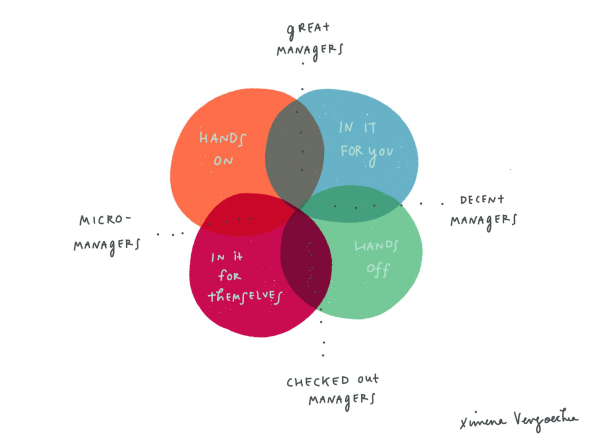
A design researcher at Pinterest as well as a Fast Company contributor who writes prolifically about management, work culture, and mentorship, Vengoechea believes most bosses basically fit into four categories:

  1. Hands on, and in it for themselves
  2. Hands on, and it it for you
  3. Hands off, and in it for themselves
  4. Hands off, and in it for you

“Obviously,” she adds, “the ones where they are in it for themselves are less effective for the individual.” Also a talented illustrator, Vengoechea maps out this framework like so:

[fusion_builder_container hundred_percent=”yes” overflow=”visible”][fusion_builder_row][fusion_builder_column type=”1_1″ background_position=”left top” background_color=”” border_size=”” border_color=”” border_style=”solid” spacing=”yes” background_image=”” background_repeat=”no-repeat” padding=”” margin_top=”0px” margin_bottom=”0px” class=”” id=”” animation_type=”” animation_speed=”0.3″ animation_direction=”left” hide_on_mobile=”no” center_content=”no” min_height=”none”][Illustration: Ximena Vengoechea]

Here’s her take on what employees need to know in order to deal with each type of boss.

1. HANDS ON, IN IT FOR THEMSELVES

Vengoechea doesn’t mince words: “Get a new manager!” Bosses who hover and nitpick, either because they’re on a power trip or they just assume you’ll screw it all up, are bad at the fundamentals of supervising other people. “It’s hard to grow when you’re being micromanaged and your manager is taking all the credit,” she points out. You can’t work for someone who doesn’t trust you and only looks out for their own interests.


Related:This Is How To Handle A Boss Who Overcommunicates


Of course, bad bosses who fall into this category can be broken down a bit further by their other quirks and habits. Some, for example, may be highly indecisive; others might set habitually unrealistic expectations. There are a few ways you can try to adapt to each of these habits, but that’s really just in order to make work livable while you finagle a transfer to another team internally or look for a new job altogether.

Like this Article?  Share It !    You now can easily enjoy/follow/share Today our Award Winning Articles/Blogs with Now Over 2.5 Million Growing  Participates Worldwide in our various Social Media formats below:

FSC LinkedIn Network:   www.linkedin.com/in/fscnetwork

Facebook:  http://www.facebook.com/pages/First-Sun-Consulting-LLC-Outplacement-Services/213542315355343?sk=wall

Google+:  https://plus.google.com/115673713231115398101/posts?hl=en

Twitter: Follow us @ firstsunllc

Question: Want the ‘the best/current articles/blogs on the web’ on Job Search, Resume, Advancing/Changing your Career, or simply Managing People?

Answer: Simply go to our FSC Career Blog below & type(#career, #leadership, #life) in Blog Search:https://www.firstsun.com/fsc-career-blog/

What Skill Sets do You have to be ‘Sharpened’ ?

Continue of article:

2. HANDS ON, IN IT FOR YOU

Yes, this type of boss may have some micromanaging tendencies, but as Vengoechea cautions, “Don’t assume the worst from ad hoc check-ins. Your manager may just be proactive about helping you grow.”

Give this type of boss the benefit of the doubt (sometimes micromanaging is a symptom of work-related stress, by the way) and use it as an opportunity to improve how you communicate. “Let them know where you need their help and brainpower,” Vengoechea advises. That includes sharing when you don’t need it.

But as long as you can tell that your boss has your best interests at heart, try to see their hands-on approach as an opportunity for mentorship. As Vengoechea explained previously in Fast Company, “If a manager checks in outside of your normally scheduled one-on-one meeting, relax. Don’t automatically assume the worst and put your guard up. Consider the possibility that rather than trying to micromanage, your new boss may be trying to find ways to help, so be more receptive.”


Related:These Are The 3 Traits Of Bosses That Everyone Wants To Work For


3. HANDS OFF, IN IT FOR THEMSELVES

If your boss seems mostly concerned about their own status and advancement and uninterested in yours, that’s of course not an ideal situation. But it doesn’t necessarily mean you should run for the hills.

Vengoechea suggests first trying to test your theory about why your boss is keeping their distance–and, as she explained in a separate Fast Company story, it’s usually due to one of two reasons: “They’re either checked out at work in general, or they totally trust you.” She breaks down the best strategies for both scenarios here, but claims that in general, it’s smart to “be proactive about following up, show that one-on-ones matter, [and] widen their window onto your work.”

These efforts can all help build a bridge to a distant manager. But if you don’t make progress at deepening your rapport, Vengoechea says it’s time to look for a different boss. “It’s hard to grow if your manager doesn’t have your best interests at heart.”

4. HANDS OFF, IN IT FOR YOU

It’s not the worst thing in the world to have a boss who keeps their distance simply because they trust you to get the job done.

Here, too, the onus is on you to communicate what you need. Vengoechea suggests expressing gratitude for their trust and “share when you want more input, check in on their goals and how you can help, [and] ask for feedback.” As she put it in her previous article, it’s all about “acknowledg[ing] that you feel empowered to make decisions and run with ideas autonomously, thanks to their support. But don’t be afraid to spell out scenarios where their perspective might be helpful and productive for you.” Typically, a manager who cares about your professional development will make a greater effort to get more involved when you need that.


Related:The Management Formula Every Leader Should Know (In One Easy Chart)


Researchers have found that employees’ relationships with managers is one of the most decisive factors in the decision to look for another job versus stay put,” Vengoechea points out, “which means that the type of manager you have matters a lot–it’s going to determine your growth in a role or in a company, as well as your happiness and fulfillment day-to-day.”

So no matter what type of manager you have, Vengoechea says, “make sure you are following the key tenets of ‘managing up’ : Understand their goals, and how you can help; learn what communication style works for them (and you!), give feedback on them, and on what you need; [and] share your wins.” Not all boss-employee relationships are win-wins, but for those who keep these basic rules in mind, more of them can be.

FastCompany.com | April 23, 2018 | BY RICH BELLIS 4 MINUTE READ

[/fusion_builder_column][/fusion_builder_row][/fusion_builder_container]

#Leadership : 9 No-Fail Tips for Giving #ConstructiveCriticism at Work (Infographic) ….Learning How to Give Honest, Constructive Feedback to All Types of Colleagues will Help you Be a #BetterManager and Will Help your #Employees Develop.

Though criticism is an inevitable part of any workplace, most people find it difficult to give negative feedback to direct reports. Whether you are offering real-time observations or engaging in a formal review discussion, it can be stressful to critique the work of your colleagues.

Don’t let yourself be intimidated by difficult feedback conversations! Honest evaluations are essential to employee development, engagement, and retention. Most employees understand the value of constructive feedback for their company and for their own personal development. A Zenger/Folkman surveyfound that 93% of people agree that when negative feedback is delivered correctly it can be an effective way to improve performance.

Learning how to give honest, constructive feedback to all types of colleagues will help you be a better manager and will help your employees develop. By providing specific direction based on employees’ actions, you can provide criticism in a way that will help people develop, without making them feel attacked.

Check out this infographic for tips on how to criticize constructively:


Fundera.com | March 23, 2018 | Meredith Wood

Original Post: https://www.fundera.com/blog/how-to-criticize

#Leadership : #OlderWorkers – Everyone In My Office Is 30 Years Younger Than Me… As SYPartners’ Senior Adviser & Entrepreneur-in-Residence, Sherri Leopard, 62, is Often the Oldest Person in the Room, and she Explains Why That’s a Plus.

Sherri Leopard has experienced being unique many times in her career. During her early professional life as a marketing consultant in technology, Leopard found herself in projects where she would be the only female member, as well as the youngest.

Having grown up in a lower-middle-class household, she also found herself at odds with many of her privileged friends who graduated from elite colleges. Yet she persevered and thrived, building and running a marketing consultancy with blue-chip clients such as IBM, SAP, Siemens, and Motorola. In 2006, she sold her consultancy, Leopard, to advertising giant WPP. Leopard became a wholly-owned subsidiary of Ogilvy & Mather.

Sherri Leopard [fusion_builder_container hundred_percent=”yes” overflow=”visible”][fusion_builder_row][fusion_builder_column type=”1_1″ background_position=”left top” background_color=”” border_size=”” border_color=”” border_style=”solid” spacing=”yes” background_image=”” background_repeat=”no-repeat” padding=”” margin_top=”0px” margin_bottom=”0px” class=”” id=”” animation_type=”” animation_speed=”0.3″ animation_direction=”left” hide_on_mobile=”no” center_content=”no” min_height=”none”][Photo: courtesy of SYPartners]

Many years later, as a senior adviser and entrepreneur-in-residence for SYPartners, Leopard would find herself–once again–as the unique person in the room.  But this time, it would be as the oldest person in an office full of twenty- and thirtysomethings. Leopard recently chatted to Fast Company about how working with younger employees has helped shaped her way of thinking, and the misconceptions about older workers that she wishes everyone would drop. Here’s her experience in her own words, edited for length and clarity.

WHAT IT’S LIKE TO BE DECADES OLDER THAN ALL YOUR COWORKERS

All of the people that I work with on a day-to-day basis are 20 to 30 years younger than me. The company is young, young, young, and many of them come from prestigious schools. Me? I went to Metropolitan State University in Denver. I came from a lower-middle-class upbringing–and I think part of the way that manifests in me is being really practical. Everyone else would have these debates about really minute things, and I tend to be super impatient and cut to the chase. Of course, I’ve had to learn to do it in a way that doesn’t stifle people’s creativity.

To be honest, I don’t think people tend to focus on the fact that I’m older. There is a designer on my team who is 24 years old, and the other day he told me, I think of you as a mentor, but you’re not someone who just gives me advice, because you’ve done all these things. We get in and figure out stuff together and when we’re solving a problem. We’re solving it as equals.

Related:I Was The Only Woman In My Company For Two Long Years 


ON LEARNING FROM YOUNGER WORKERS

As a former CEO who happens to be the oldest person in the office, over my three years at SYPartners, I’ve really struggled with not being right and the need to be right. It took a while for me to be comfortable with learning from the young people who challenge me. That’s been a journey. In one of my earliest projects, that was really hard. I was on a team that just saw things so differently.

The perspective shift came during my work with BlackRock–who we’ve been working with on their diversity and inclusion initiatives. Something finally jelled in my brain, and now it’s much easier to be in situations where people are challenging my thinking. Had I learned that earlier in my career, I would have been a much better CEO. I’ve realized that we need those differences in the workplace to solve the sorts of complex problems we’re presented with today.

Of course, there will always be a generational gap. When I hear about young women discussing salaries, I think, in my generation, people didn’t talk about what they got paid. But I think that young people are a lot smarter because that transparency is going to pay off.

Another obvious generational gap is my aversion to social media. I feel like young people around me try to pull me into that world and occasionally I’ll go, okay, I get it, I get why I need to do it. But I’ve had times where I’ve gone through six rounds of writing a Medium post and I can never bring myself to post it. The younger people will be telling me, “Just do it, and you’ll get more comfortable.” But I still can’t do it.


Related:Good American’s CEO On Being The Only Black Woman In The Room: “I Don’t Notice”


Like this Article ?  Share It !    You now can easily enjoy/follow/share Today our Award Winning Articles/Blogs with Now Over 2.5 Million Growing  Participates Worldwide in our various Social Media formats below:

FSC LinkedIn Network:   www.linkedin.com/in/fscnetwork

Facebook:  http://www.facebook.com/pages/First-Sun-Consulting-LLC-Outplacement-Services/213542315355343?sk=wall

Google+:  https://plus.google.com/115673713231115398101/posts?hl=en

Twitter: Follow us @ firstsunllc

Question: Want the ‘the best/current articles/blogs on the web’ on Job Search, Resume, Advancing/Changing your Career, or simply Managing People?

Answer: Simply go to our FSC Career Blog below & type(#career, #leadership, #life) in Blog Search:  https://www.firstsun.com/fsc-career-blog/

What Skill Sets do You have to be ‘Sharpened’ ?

Continue of article:

ON THE IMPORTANCE OF ENDURANCE

I think that my stamina is an advantage I have, as an older worker. When I was doing marketing and communications work, I did a lot of speech writing. I’d have clients call me very last minute, often very early in the morning. I remembered watching my then client, a senior VP at IBM, outwork me even though he was probably 20 years older. At that time I realized, oh my gosh, the game here is actually endurance. I realized then how important it is to be physically strong, eat healthy, exercise, and just be really mindful about my health. I think that investment I’ve been making for years in my health is really paying off. Today, young people in my team will go, geez, you’re the Energizer bunny!


Related:Why You Should Recruit Older Workers 


ON MISCONCEPTIONS ABOUT BEING AN OLDER WORKER

I feel like there’s this misconception that older people just can’t keep up, whether that’s keeping up with anything in the world, or physically. Well, I’m just going to prove in my little circle of the world that we can keep up. I do think that to succeed at this age, you need to have a growth mind-set. There are so many people my age who believe that the world is prejudiced against them. I deeply believe that there’s an experience in all of us that can be reshaped and reapplied in a new way. The question is, do you choose to reinvent yourself?

FastCompany.com | April 16, 2018 | BY ANISA PURBASARI HORTON 4 MINUTE READ

 [/fusion_builder_column][/fusion_builder_row][/fusion_builder_container]

#Leadership : How To Turn #Conflict Into A #Communication Tool…Many People Try to Avoid #Conflicts at #Work . But if you Know the Right Way to Lodge an Objection, It can Actually Smooth the Way for Better Communication.

Last year, I was working with leaders who had recently joined an Israeli company. One of them said to me, “Anett, I used to work for a Midwestern company, and now I’m working for a company that yells and pounds the table in meetings–you can even hear it on the phone! What do I do?”

Well, what happens after those meetings?” I asked. “They all go out for coffee!” she told me.

This is a texbook example of constructive conflict. Yes, it might have been emotionally charged and intense, but everyone respected each other enough to be friendly afterward. You might feel that it’s hard to see conflict as anything but a barrier to communication, but if you use it the right way, it can be an effective tool.

Here are some tips on how to do just that.

ATTACK THE IDEA, NOT THE PERSON

Intense conflicts can be civil. The key is not to let it get personal–which means making sure that you direct any criticism toward ideas, not people. Many of us know to avoid telling someone, “I don’t think you’ve done your research on this issue” or, “How could you possibly come to that conclusion?!” since these clearly sound like an attack on the person. But finding alternative phrasing isn’t always easy. When in doubt, delete any second-person (“your”/”your”) phrases from your vocabulary, and start with “I” phrase that zeroes in on the underlying concept. For example, “I struggle with that conclusion.” Now you can center the discussion around the conclusion itself–not the person who proposed it.


Like this Article ?  Share It !    You now can easily enjoy/follow/share Today our Award Winning Articles/Blogs with Now Over 2.5 Million Growing  Participates Worldwide in our various Social Media formats below:

FSC LinkedIn Network:   www.linkedin.com/in/fscnetwork

Facebook:  http://www.facebook.com/pages/First-Sun-Consulting-LLC-Outplacement-Services/213542315355343?sk=wall

Google+:  https://plus.google.com/115673713231115398101/posts?hl=en

Twitter: Follow us @ firstsunllc

Question: Want the ‘the best/current articles/blogs on the web’ on Job Search, Resume, Advancing/Changing your Career, or simply Managing People?

Answer: Simply go to our FSC Career Blog below & type(#career, #leadership, #life) in Blog Search:  https://www.firstsun.com/fsc-career-blog/

What Skill Sets do You have to be ‘Sharpened’ ?

Continue of article:

Related:Want More Creative Employees? Create Some Conflict 

BE ESPECIALLY CAREFUL WITH YOUR TONE

Sometimes what you say doesn’t matter as much as how you say it. And when you’re sharing a critique, you have to be especially mindful of your tone. My client’s colleagues might have participated in loud conversations–but those discussions weren’t overly emotional, sarcastic, or condescending. Tone isn’t about the volume of your voice; you can still be calm and collected while verbally putting someone down. As Fast Company’Lydia Dishman previously reported, passive-aggression comes in many forms. For example, you might start off by using logic to point out the flaws in your coworker’s point–but if you end by saying something like, “You don’t mind, do you?” your coworker might read your tone as patronizing.


Related: Here’s What Being Too Nice At Work Is Costing Your Company


DON’T FLOUT CULTURAL NORMS

Some companies are more comfortable with conflict than others, and every company will have its own “rules” about what’s acceptable and what’s not. Those rules might not be written anywhere, but if you look at how your organization has dealt with conflict in the past, you can usually get a sense of how its culture operates. Some workplaces are comfortable with constructive conflict as long as it stays behind closed doors, and employees and senior leadership show a united front in public. Others embrace displaying their conflict openly. So stay attuned to corporate culture as well as societal norms. As my client found, the way his Midwestern colleagues operated was pretty different than the approach his Israeli associates took. Neither was necessarily “better” or “worse” than the other, but in order to have productive disagreements, he needed to adapt to those teams’ respective cultures.

FOCUS ON MAINTAINING RELATIONSHIPS (EVEN IF IT MEANS BITING YOUR TONGUE)

Remember, just because you disagree with someone’s idea, you still need to show that you value their input. This might require extra effort on your part–like being selective about when to voice your criticism. If you argue too frequently, others may find it hard to believe you’re doing so in good faith. If, on the other hand, you share your disagreement a little more strategically, you’re more likely to strengthen your relationships–and improve the odds that your criticism will actually register, without hurting feelings.


Related: How I’ve Learned To Stop Arrogance From Silently Hurting My Career


CALCULATE THE OPPORTUNITY COST

On the other hand, if you’re on the fence about whether to raise an objection, consider the possible downsides to not engaging in constructive conflict. What potential consequences will staying silent bring? Depending on your company culture, you may be viewed as lacking conviction in your ideas if you seem afraid to stand up for them. In that case, not speaking up could actually backfire. Not to mention, if you don’t voice your disagreement early on, you might be setting yourself up for a bigger explosion later by keeping your thoughts bottled up.

Needless to say, no two situations will be the same. If you’re unsure of how direct you should be–start by listening and observing. You can learn a lot just by paying attention to people’s body language and how they respond. When it comes to constructive conflict, context is everything. But whatever you do, just don’t let it get personal.

ABOUT THE AUTHOR

Anett Grant is the CEO of Executive Speaking, Inc. and the author of the new e-book,CEO Speaking: The 6-Minute Guide. Since 1979, Executive Speaking has pioneered breakthrough approaches to helping leaders from all over the world–including leaders from 61 of the Fortune 100 companies–develop leadership presence, communicate complexity, and speak with precision and power.

More

FastCompany.com| April 14, 2018 | Anett Grant