#JobSearch : Career Change Guide – How to Get Unstuck, Create a Vision of the Career You Really Want and Land Your Dream Job

Are you tired of waking up each day dreading going into work? Tired of staring into your lunch each day, wondering if there’s a better job for you?

If so, this article is for you. It’s also a general guide to help you navigate the career change process. Read the entire thing or the section that interests you the most.

This article has the following sections:

  • Getting unstuck
  • Vision Statement Story
  • Networking
  • Resume – What story is it telling the reader?
  • Cover Letter
  • LinkedIn
  • Interview
  • Negotiation

Getting Unstuck

Getting unstuck and clear where you want to take your career

Many times in our career, our lives can get the best of us, and fear can hold us back. We get locked in our heads and fear restrains us from even making a move. It can feel like, if you do this, then that thing will happen. But, if I make this move, then I can’t do that over there. It feels like you’re stuck with no way out.

I’ve felt like that too and navigated my way to doing work I love. Like looking at a map, you need to know where you’re at first before you can make a move.

The Step to getting unstuck.

Do you know where you want to go? If you don’t, that’s okay. That’s fine, and many people hit points in their life where they don’t. Yet, most people know where they DON’T want to go and that’s where you should start.

Write about why you want to leave your current job. Next, step back and review that. Sometimes we need to vent a little to work out our current frustrations. Is it the job duties you don’t like? Is it the people? Can you not do the work any longer? Does it not pay enough? Get clear on that.

Then, from that new knowledge, you’ll be able to point yourself in the direction you want to go. A job you will be happier in and the beginnings of the new path.

For example. You’ve determined it’s the people, but you enjoy what you do. Then you should focus on the same type of work but in a new setting. If the people are fine, but the work itself is the issue, then it’s time to see what other interests you have. If it’s money, then it’s time to ask for a raise or look at other companies. It’s also time to review your finances too. If it is the skill and you’re tired of doing it, then it’s possible you’re ready to teach or mentor people. That’s a natural progression for someone who has mastered a skill.

Like this Article?  Share It!    You now can easily enjoy/follow/share Today our Award-Winning Articles/Blogs with Now Over 2.5 Million Growing Participates Worldwide in our various Social Media formats below:

LinkedIn: https://www.linkedin.com/in/chris-g-laughter-b46389198/

Facebook:  http://www.facebook.com/pages/First-Sun-Consulting-LLC-Outplacement-Services/213542315355343?sk=wall

Twitter: Follow us @ firstsunllc

Best Daily Choice: Follow the Best of FSC Career Articles/Blogs @

https://twitter.com/search?q=bestoffscblog&src=typeahead_click

Question: Want the ‘the best/current articles/blogs on the web’ on Job Search, Resume, Advancing/Changing your Career, or simply Managing People?

Answer: Simply go to our FSC Career Blog below & Type(#Jobsearch, #Resume, or #Networking) in Blog Search:  https://www.firstsun.com/fsc-career-blog/

What Skill Sets Do You have to be ‘Sharpened’ ?

Article continued …

Vision Statement Story

Now that you have a direction, let’s create your goal/vision of the new job. Answer the following questions and they will be used to guide you in creating a vision statement. Answer these questions as if you had a magic wand and could make the perfect job for you. If you don’t know it’s okay to leave blank as this process will help uncover those hidden areas. If you’re stuck, skip that question and move to the next one.

Questions and examples from my career.

Who do you serve or help in your new role? (Example: people stuck in their careers)

What pain or problem do you solve for people? (Example: Can’t find work they want to do)

How is their life better because of your contribution at work? (Example: People wake up happier getting to do what they want.)

How do you feel about this new role? (Example: I feel like I am contributing to people’s lives and feel great about that.)

What industry is your new job in? (Example: Career and Employment Industry)

What kind of company is it? (Example: Small Team environment with a passion for helping others succeed. A service-first mentality )

What’s the culture like? (Example: Having fun while being of service to others. The team collaborates and has a culture of trust.)

Do you work with people all day or by yourself? (Example: Most of the time by myself, but with the help of other teammates)

Are you inside or outside? (Example: Inside)

Is it an active role or behind a desk? (Example: Behind the computer)

How much money are you making?

Now you have a better picture of your goal you can create the outcome you want to have in your life. Let’s create the vision statement story you’ll be working towards.

Now, let’s create your vision statement. You’re going to create it in a different way than most goals. You will create it as if it’s already happened. For example. You’re telling a friend what happened over dinner about a month after you landed the job. Describe it, but from the point of view as if you’ve already got the job. Doing it this way will help your brain work in the background on your goal.

Vision Statement Story Example

Robert, let me tell you about the new job and how I got it. I remember getting clear on the career I wanted and decided to be a career coach. I chose to be a career coach in the employment industry because I love helping others do what’s important to them. I realized I feel great doing this work. The team I work with is awesome, and it’s a small company. In fact, the company has a great fun culture and I get to work by myself, but love the support of the team. I am getting paid more than I was at my last job and the benefits are great too. I’ve been there for a little over a month now and each day feels great. I love who I get to be.

This is your vision and goal! Tell this story to yourself every day in your job search.

Networking

You’ve got your vision and the next step is networking to help you land that job. Do you already have a network?

Even if you do, let’s create a network strategy. Answer these questions.

Where would the hiring managers hang out?

Where would the company hang out?

What events would they go to?

What meetup.com events could they be?

Is the job industry your interested in having a career fair in your area?

Where would they hang out online? LinkedIn Groups, Quora.com conversations, forums, etc.…

Once you’ve discovered a few places where they hang out go to those events and meet people. Before you go write an intention of why you’re going and be clear about it as you walk into the event. Be curious about them and show you’ve researched them. Be helpful and knowledgeable.

Then, ask the contacts you made if you could have coffee sometime. Use that time to build a relationship with them. Get to know them and share your story with them. Share why you’re creating a new job.

Reach out to your network and share your vision with friends, family, and past work colleagues.

Use contacting the hiring manager technique. Here’s an article on themuse.com with a more detailed strategy to do this. This technique is a proven way to go around HR and get the attention of the hiring manager.

Note: HR doesn’t say yes to hiring someone the hiring manager does. Spend your time building the connection there rather than HR. HR is the gatekeeper to the person who can get you the job.

Resume – What story is it telling the reader?

Your resume is your marketing piece that helps get your foot in the door. What story is the reader going to craft about you when they read it. Remember, they don’t know you and you only have 1-2 pages to show who you are. You only have a short period of time to grab the reader’s attention. That’s only if it makes it past the Applicant Tracking Systems (ATS).

Your resume should be in the following order for most job types.

Name and Contact info

Career Summary

Career Highlights

Professional Experience

Education

Extracurricular activities

Name and Contact info

Self-explanatory

Career Summary

This area summarizes your career and the area to showcase your career at a high level. How many years of experience and in what areas. The next area should be high-level accomplishments in your career. Also, any specific skills that are relevant to the job.

Career Highlights

In this section of the resume, you’ll want to list out three of your best career achievements. When you list them, focus on the difference you’ve made for the company or people. Put them in the relevance of importance for a company. Revenue, growth, customer satisfaction, etc. It’s okay to share the awards as long as that isn’t the focus. This will showcase you as someone who is a humble winner. What story is it telling the reader?

Professional Experience

This section highlights your career experience and should be in reverse chronological order. Your latest job should be the first job they see. The name of the company should be written first. Why? Because recruiters and HR personnel scan to see what companies you worked for. The impressive companies will stand out before a title. After that, put a small summary of what you accomplished, then your title. Next will be your bullet points. They should focus on your accomplishments. They should be accomplishments you’ve made and quantify them if you can. Again, revenue, market growth, customer satisfaction, retention, sales, cost reduction, etc.

Education

In this area list, you’ll want to list schools, degrees, certifications, and school projects.

Extracurricular activities

A shortlist of volunteers, foundations, charity work, non-profits, clubs, publications, media appearances. Only list these if they apply for the position, company, or its mission.

KILLER BONUS RESUME TIP

ATS tracking systems are the gatekeeper nowadays to you reaching the HR personnel. If your resume doesn’t pass that system, your resume will never be viewed. Period! You should do three things when you complete writing.

First, you want the resume to be a good match for the job description. Imagine you’re the hiring manager and you wrote the job description. Then you picked up your resume… Would your resume match what they want? Do the keywords match? Would you want to pick up the phone and call this person to say you wanted to talk more? It doesn’t have to be a perfect fit by any means but good enough for them to say this candidate has what we need.

Second, get a friend to read it and ask them what they notice first. Then ask them if you were the hiring manager would you want to reach out to me? Find a friend who’s brutally honest.

Third, use a website called www.Jobscan.co. It’s designed to compare your resume to the job description and how the ATS system will score it.

When done with those steps update your resume as needed and repeat until it’s a good fit.

NOTE: If you’re making a big career change you should focus the majority of your time on networking.

Cover Letter

The cover letter is your first impression on the employer. Its job is to grab the attention of the reader and get them to reach out to you. It’s NOT a full work history or a place to beg for a job. It has just a few key components to it.

The reason you’re reaching out

Share who you are and why you’re interested (share a quick and powerful story of your why) Show excitement for the job.

Here are two articles with advice on writing a cover letter that will grab their attention.

https://www.themuse.com/advice/31-attentiongrabbing-cover-letter-examples

https://www.themuse.com/advice/5-secrets-to-making-your-cover-letter-stand-out

LinkedIn Profile

Your LinkedIn profile is another marketing piece for you. You should treat it like that. It can be warm, friendly, and welcoming. Choose a picture that is professional and friendly. Even if you don’t like your smile, use a picture with a nice smile. It’s not your opinion that is being formed with the picture you choose. Research shows that people who see a smile are much more likely to form a positive opinion of that person.

Show your accomplishments and they should have numbers to back them up. Numbers grab attention and the longer a reader stays on your profile, the more likely they are to reach out.

Use the summary section much like your professional summary of your career. Avoid overuse of buzzwords in your industry. Is it telling a story?

Avoid any political or controversial posts except if you work in that industry.

Make recommendations for your friends and colleagues first. Don’t be afraid to ask for them too.

Again, like your resume, ask a friend or colleague to review it. What did they notice first? What feelings did they have after reading it? Did they feel compelled to know more?

Interview

The interview is the stage where all the work you’ve done up to here is all about. The best resume, cover letter, and LinkedIn Profile won’t get you hired if you don’t show up ready to be your best. I specialize in helping others feel confident in interviews. Here are a few great tips to help you show up confident.

Dress

Dress for the job you want and do your research about the company. If they were suits, so should you. If it’s a casual environment, it’s best to still dress up, but you may not need to wear a suit. Default to your research in either case.

Mindset

This job isn’t the only job that’s out there and you should treat it like this. The world keeps moving and new jobs, post every day. If you walk into the interview being attached to having that job, you’re already at a loss. Walk-in with the attitude of this will be practice and I will do a great job, regardless.

Show up prepared and ready to share who you are but unattached to having that job. You want to interview the company too. It’s a two-way relationship. It’s your job to find out if they are a good fit for you. It’s their job to find out if you are a fit for them. There’s a reason for the job being open. They need a human being to fill it. I know that seems obvious, but it’s easy to forget. They could use you as much as you could use them.

Prep

Be prepared and do your research on the company, its history, its goals, and the position. Have questions ready for them about what’s important to you. Know why you want to work there and why that’s important to you besides a paycheck. Know the role and help tell a story of how you’ll be a great fit for it.

Research about the team you are going to work with. Dig on LinkedIn about the hiring manager and find out if you have anything in common.

Use Glassdoor.com to check out the company before you go. They list common questions during interviews, salaries, and reviews of the company.

Be prepared for the STAR method in an interview. If they use the STAR method you’ll be asked questions in the following way.

Tell me about a time when?

What would you do when?

Have you ever?

Describe a time when you?

STAR definition

S – Situation – What was the situation?

T – Task – How did you take responsibility for this?

A – Action – What actions did you take to solve the problem or situation?

R – Result – What was the result or outcome you achieved?

Have a few go-to stories ready to share that share how you’ve accomplished something in your career. I like to frame them like this. Where did you start and what did you achieve along the way. How did things change as a result? When sharing your story add in little anecdotes about things that happened along the way. Add in some funny moments. The stories should feel compelling to the listener.

Want to blow their socks off?

Prepare a 30/60/90 day high-level plan for the job you’d like to have. Keep it high-level and detailed enough to show that you took the time to be prepared. This will show you will do what it takes to get the job done.

When finished with the interview and assuming you still want the job, it’s ok to ask where the company is in the hiring process. This will give a better expectation of what to expect after this.

Follow – up

When you’re done with the interview follow up with a thank-you note to the hiring manager.

I found this simple but powerful follow-up note from TheMuse.com and think it’s worth passing along. If you haven’t heard anything try it.

Quick, Powerful Follow-up note

Again, don’t be needy, but show your enthusiasm for wanting the job.

Negotiation

When they offer you the job, you already know what that position is paying in your area. Check out Glassdoor.com and Payscale.com and do your research.

Here are a few tips.

Never talk about salary upfront in the process or interview.

This is a two-way street. If they like you, they will pay more and if you like them, you’re willing to take less. So, it’s important to understand what value you add to the company. Remember, they are hiring someone for a reason. They need a person to do the job, and if you can show you will bring in tremendous value, they will offer you more.

Know the whole picture of the offer. How much vacation, training opportunities, travel, benefits, the team you’ll work with, start date, and the future opportunities there. Take all that into account when negotiating. Does it all align with your original vision?

Remain flexible. That doesn’t mean giving up your values. This is a relationship you’re building.

A note of reference is that the HR person isn’t the person in charge of the salary. That’s determined by the department where you will be in. HR will know the salary range to negotiate on. If you’re especially awesome and they want you, they will need to get approval to go higher you at a higher salary.

Give yourself time to respond and let them know when you’ll respond too. When you’ve come to an agreement, thank them, sign the offer, and celebrate that you just landed a great new job!


FSC Blog Author: Brad Finkeldei – Career Coach 

Brad is a career catalyst and interview coach, speaker, and best-selling author. He coaches professionals to create a career they love. His specialty is identifying where people are stuck and helping discover the confidence to do what they love.  He’s successfully navigated interviews, promotions, asking for raises, and can you help craft a plan to do the same. He has a knack for inspiring people to believe in themselves and create plans for success. He’s been featured on media outlets such as ABC, WGN-Radio, and many numerous podcasts. His diverse background in IT, speaking, and coaching will help you create a career plan and lifestyle that works for you while using your skillset to make the best career move. If you’re feeling less than confident about your career move or interview Brad will help make the process easier for you.


Get my Free How to Find Your Dream Job Course here:  www.bradfinkeldei.com
 FSC Career Blog | May 13, 2020

#ResumeWriting : Artificial Intelligence(AI) and Applicant Tracking Systems: How They Impact Your Job Search. Must Read for All!

In today’s job search climate, you need every advantage to get your resume into the hands of a recruiter or hiring manager. It can be difficult when they spend on average 8-20 seconds looking at a resume. It’s even more difficult when technology is used to weed out resumes before they are even seen by human eyes. Artificial intelligence (AI) is widely used in many different industries, and it’s only expected to continue to be utilized even more. It has particularly become more useful in making a recruiter’s job more efficient.

Artificial intelligence can handle certain tedious tasks automatically when it comes to sorting through resumes, so a recruiter or hiring manager can focus on the human element of developing relationships. Combine this with Applicant Tracking Systems (ATS), which helps recruiters narrow down resumes based on keywords and other criteria, and it’s easy to see what the future may hold for executive job seekers. Here’s what you need to know about these aspects when it comes to writing a professional resume. 

Hiring Professionals Are Using AI and ATS More

The combination of AI and ATS can save hiring managers a significant amount of time during the recruitment process and even onboarding candidates. By the time a resume gets to a hiring manager’s desk for a final review, it has already gone through many virtual checks to ensure the proper criteria was met. The top resume writing services can help you determine which keywords are most appropriate for passing through these initial automated checks. If you don’t have the right number of keywords or phrases, you could just be spinning your wheels during your job search.

Like this Article?  Share It!    You now can easily enjoy/follow/share Today our Award-Winning Articles/Blogs with Now Over 2.5 Million Growing Participates Worldwide in our various Social Media formats below:

LinkedIn: https://www.linkedin.com/in/chris-g-laughter-b46389198/

Facebook:  http://www.facebook.com/pages/First-Sun-Consulting-LLC-Outplacement-Services/213542315355343?sk=wall

Twitter: Follow us @ firstsunllc

Best Daily Choice: Follow the Best of FSC Career Articles/Blogs @

https://twitter.com/search?q=bestoffscblog&src=typeahead_click

Question: Want the ‘the best/current articles/blogs on the web’ on Job Search, Resume, Advancing/Changing your Career, or simply Managing People?

Answer: Simply go to our FSC Career Blog below & Type(#Jobsearch, #Resume, or #Networking) in Blog Search:  https://www.firstsun.com/fsc-career-blog/

What Skill Sets Do You have to be ‘Sharpened’ ?

Article continued … 

AI May Even Be Involved in The Interview Room

Once the best executive resume writers help you pass through ATS and lead you to get a job interview, you still may have to go through some AI tests. Some companies even incorporate artificial intelligence during an interview to detect a candidate’s body language, eye movements, facial expressions and more. These are often characteristics that are difficult for humans to detect but are important to do so when determining the honesty and personality of a candidate. 

Don’t Spend Too Much Time Optimizing for AI and ATS

While AI and ATS are critical components to consider in your job search, the top resume writing services will still tell you to not let them consume a lot of your time. The best executive resume writers can help you pass these tests on paper, but you still need to focus on the human element of a job search, including networking and developing relationships. Basically, you should keep AI and ATS in the back of your mind, but don’t let those aspects take up a significant portion of your job search.

It can be easy to become too focused on these technology issues when crafting your executive resume. But don’t let yourself become consumed. Remember that your connections are still the best way to get your foot in the door at your desired company. Keep reaching out and networking as you work your job search plan.


FSC Career Blog Author:  Ms. Erin Kennedy, MCD, CMRW, CPRW, CERW, CEMC, is a Certified Professional Resume Writer/Career Consultant, and the President of Professional Resume Services, named one of Forbes “Top 100 Career Websites”. Considered an influencer, she is consistently listed as a “Top Career Expert to Follow” on Twitter and LinkedIn.


FSC Career Blog | May 13, 2020


#JobSearch : Laid Off? 10 Lessons I Learned From My Job Search. Great Checklist!

I was laid off from my job a year ago with no warning due to a company-wide reduction-in-force. I had only been at that startup company for six months, and so had just recently gone through the job search experience. With all the layoffs happening right now in the era of COVID-19, I wanted to share some of the lessons I learned at the time, along with helpful tips for searching for a new job.

Being suddenly laid off certainly came as a shock, and it affected me emotionally. I recommend that anyone experiencing a layoff give themselves some time to clear their head and find ways to de-stress. Try finding a hobby or something enjoyable you can split your job hunting time with. Job searching and interviewing all day, every day, really wears on you, so making time for yourself is important. When I was laid off, I decided to learn how to sew, and it was a great way to balance the draining effects of job hunting with a new pastime I was excited about and helped me to feel calm.

While I recognize that the current situation we are faced with has its own special set of circumstances and challenges that make job hunting right now especially hard, I hope that some of what I learned may be helpful to others.

1. Update your LinkedIn profile

The first thing you should do is review, update, and enhance your LinkedIn profile:

  • Add bullet points that describe your roles and responsibilities at each of your previous companies.
  • Ensure your job titles and dates are correct.
  • Make sure your tagline is updated.
  • Update the summary section to include what you’ve done. If you’re openly looking (not currently employed), add what you’re looking for in your next opportunity.
  • Turn on the “Let recruiters know you’re open” feature by visiting “Jobs > Career Interests” and add a note to recruiters about what you’re looking for.


Like this Article?  Share It!    You now can easily enjoy/follow/share Today our Award-Winning Articles/Blogs with Now Over 2.5 Million Growing Participates Worldwide in our various Social Media formats below:

LinkedIn: https://www.linkedin.com/in/chris-g-laughter-b46389198/

Facebook:  http://www.facebook.com/pages/First-Sun-Consulting-LLC-Outplacement-Services/213542315355343?sk=wall

Twitter: Follow us @ firstsunllc

Best Daily Choice: Follow the Best of FSC Career Articles/Blogs @

https://twitter.com/search?q=bestoffscblog&src=typeahead_click

Question: Want the ‘the best/current articles/blogs on the web’ on Job Search, Resume, Advancing/Changing your Career, or simply Managing People?

Answer: Simply go to our FSC Career Blog below & Type(#Jobsearch, #Resume, or #Networking) in Blog Search:  https://www.firstsun.com/fsc-career-blog/

What Skill Sets Do You have to be ‘Sharpened’ ?

Article continued …

2. Build your network

While it’s a good practice to focus on building your network throughout your career, you can use LinkedIn to expand your network. LinkedIn is most useful when you can leverage your network, and that means everyone you are connected to, since you are now a 2nd-degree connection to everyone they are connected to as well.

Search through and invite as many LinkedIn connections as possible from past coworkers. Also add personal contacts. This can even mean people you went to school with and haven’t talked to in many years as long as they’re someone you might be comfortable reaching out to and asking for an introduction. Anyone you know that works in your industry/field or works in your city can be helpful. Especially in these tough times, it is safe to assume most connections are willing to help out, as everyone understands the struggle of being laid off during this pandemic.

3. Purchase and use LinkedIn Premium

I know it sounds irritating to spend $60 a month on LinkedIn; however, it was the single most useful tool I used to help me find a job. Ideally, you’ll only need it for a few months and then you’ll get a job. Think of it as an investment in yourself.

The most effective way to get interviews at companies is by receiving an internal referral from a current employee. Here’s my strategy for that: Start by using Google to look up job postings; for example: “events manager jobs in San Francisco.” Google will pull results from all the job boards on the internet. Once you have found a job you are interested in, do the following using LinkedIn Premium:

  • Look up the company on LinkedIn, click on “See all XX number of employees that work here,” and filter results by 1st- and 2nd-degree connections. You need LinkedIn Premium to do this, because without it, only the first few people at the company will be shown and you’ll get a message saying, “You need to upgrade to premium to view the rest.”
  • Once you have seen a job posting on an external site, visit the “careers” page of that company and make sure you see the job posting there, too. That’s where you’ll find the most accurate information. Unfortunately, many companies leave old job postings up even after they have been filled. When searching, I often filter by jobs posted in the last week to get the most current listings.
  • If you have any 1st-degree connections on LinkedIn, contact them and ask them to refer you to the job. Always include a link to the job description. It is best to wait until they reply before you send a resume, unless it’s someone you know well and are certain their answer will be yes. (Sample message: “Jim, I’m interested in applying to the [fusion_builder_container hundred_percent=”yes” overflow=”visible”][fusion_builder_row][fusion_builder_column type=”1_1″ background_position=”left top” background_color=”” border_size=”” border_color=”” border_style=”solid” spacing=”yes” background_image=”” background_repeat=”no-repeat” padding=”” margin_top=”0px” margin_bottom=”0px” class=”” id=”” animation_type=”” animation_speed=”0.3″ animation_direction=”left” hide_on_mobile=”no” center_content=”no” min_height=”none”][insert job title and link to job posting] role I saw listed at [insert company name]. Would you be willing to refer me for this position? I can send along my resume. Thanks!”)
  • If you don’t have any 1st-degree connections, but you have some 2nd-degree connections, that’s where the networking begins. Depending on how well you know the person you’re connected to, you can send a message to the connection asking for an introduction. (Sample message: “Hey Tina, how well do you know [2nd-degree connection name] over at [company name]? I see a job posting there I am interested in applying to, and I’m wondering if you know her/him well enough that you’d be willing to make an introduction or pass along my resume.”)
  • Then you wait for a reply. Don’t wait more than 24 hours before moving on to the next 2nd-degree connection if you have more than one. If it’s a job you really want, send 2-3 messages at once and go with whoever replies first.
  • If you don’t know your connection very well and don’t feel like reaching out for an introduction, this is where “InMail” comes in. InMail is a LinkedIn Premium feature that allows you to send a message to someone you are not already connected to. The way InMail works is that you are charged one InMail to message someone you aren’t connected to, but if they respond at all (regardless of what they say) you get that credit back. LinkedIn Premium comes with 30 InMails a month.
  • Here’s a sample InMail message to someone I was 2nd-degree connected to: “Hi, Molly. I came across your profile as I was looking at a job posting for [job title and link] at [company name]. I noticed we have many connections to people I attended school with, so I thought I’d reach out and see if you’d be willing to chat about the company and maybe pass along my resume as well. Thanks so much!”
  • In my experience, almost everyone who responds (not all did, but most do) is willing to help. Everyone understands the struggle of looking for a new job, and most people are happy to lend a hand. Additionally, many companies now offer referral bonuses, which is a great incentive for connections to refer you.
  • Leverage this person if they seem willing. If you get a first interview with the company, send them a thank you message updating them but also asking if they’d be willing to chat on the phone for 10 minutes while you ask them some questions about the company. Insider perspective is very valuable. Anything you don’t understand about the company, or questions about top competitors/customers are great.
  • You will also want to use the feature in LinkedIn that allows you to see who has viewed your profile (although some people decide to remain anonymous). The reason this is a useful tool only available with LinkedIn Premium is that if you’ve clicked on a ton of 2nd-degree connections at a company, and then you get notified that one of them has “viewed” you back, this is the perfect opportunity to send that person an InMail since it’s basically an invitation to explain why you were viewing their profile.
  • Another helpful LinkedIn Premium feature is its suggested jobs based on what you’ve searched. This is helpful because sometimes the job title is a little different than what you’ve been searching for, but the job description is spot on.

4. Be active on LinkedIn

It’s important to be active on LinkedIn. Good practices include the following:

  • Comment/message people when they update a new job or share an article.
  • “Like” or comment on an article that is posted.
  • Post articles or blog posts you may have written or that you think will be helpful or interesting to your network.
  • If you’re openly seeking a new job, you can make a post with relevant hashtags that encapsulates what you’re looking for. Some good hashtags to include are: #hiring #recruiting #startups #laidoff #marketingjobs #jobs
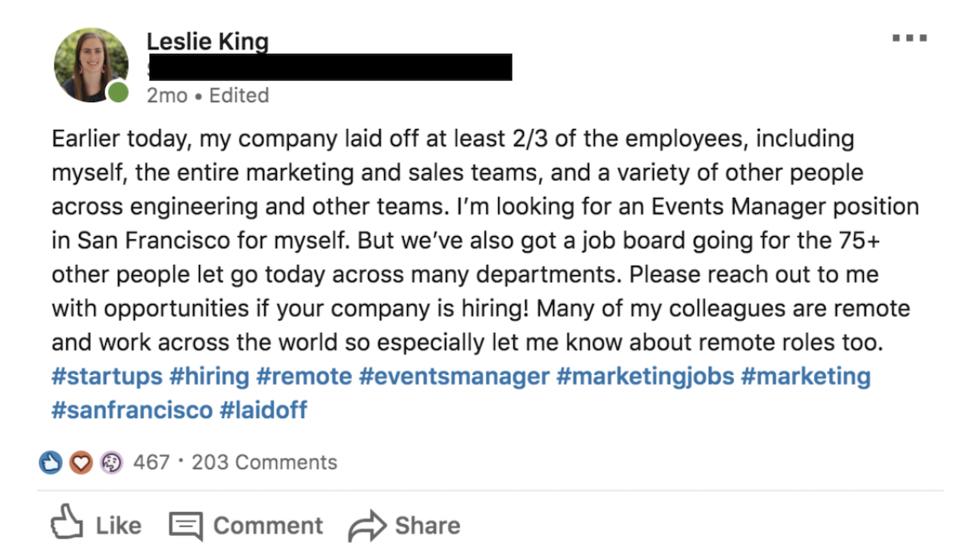
  • Here’s a photo of my LinkedIn post for reference. This was the single most popular thing I have ever posted on the internet, with thousands of people messaging me about jobs for myself or my colleagues. After all was said and done, the job that I ultimately landed at Databricks stemmed from someone tagging the department head of events in this post.

5. Revamp your resume

I learned that it’s important to revamp your resume. Here are some suggestions:

  • Look at the descriptions of your top 10 dream jobs and then use these words to describe what you do as much as possible. Recruiters often scan for keywords, so try to be as close of a match as you can.
  • Try to keep bullet points to one line whenever you can—it’s easier to read.
  • Start each bullet with an action word.
  • Get someone to give you solid resume feedback, ideally a professional. My friend Asis Campos did my resume design and helped a lot with the action item editing.
  • Get someone outside the industry to read your resume. This can help you eliminate needless jargon and make it more readable.
  • If you’re going for jobs that are even slightly different from your background, write a cover letter, connecting the dots of past experience and how it’s relevant to this job.

6. Prepare for the interview

If you are fortunate enough to get an interview, you must thoroughly prepare for it. Here are some suggestions:

Research the company extensively even before a call with the recruiter 

  • Look them up on Crunchbase, Glassdoor, Facebook, Twitter, Instagram, and LinkedIn
  • Write down the names of the leadership team for the company and the department you are interviewing for. Make notes about the company’s fundraising, mission, etc.
  • Read the company’s website thoroughly: blog, event pages, etc. Try to understand its products and target audience.
  • Watch YouTube videos the company has produced, especially ones explaining the product, but also any videos that might feature the CEO at speaking engagements.
  • If you can find someone you know who has used the company’s product, contact them and ask them questions. What do they like? What problems is it solving for them? Are their pain points being solved? Are there product features they wish would be created? Use these answers when you are asked the question “Why are you interested in this company?” It’s very impressive to show you’ve gone above and beyond to talk to a customer.

Prepare tailored answers to questions you will likely get

  • Nail down the “tell me about your background” question. Figure out the best examples of things you’ve done at past companies that will be most relevant for this job.
  • Here’s an example of the type of details you should provide: “When I started at PlanGrid, they’d done two branded happy hours. After I joined and became the program manager, my roles included training and enabling sales to produce these events with minimal involvement from Marketing. Additionally, I would help with venue search, catering, Marketo campaigns, and ordering of swag. By the time I left PlanGrid, we had scaled dramatically and were producing over 10 of these events per month worldwide.”
  • Always have an answer prepared for the “Why are you interested in this company?” question.
  • Read the company’s mission statement and try to tie in some of its language to your answer.
  • Make your stated reasons for wanting to join the company as personal as possible. Instead of talking about why the company’s product or business are good, talk about your personal relationship with it. If it’s an app, use it and talk about that. For example: “I used your app in my last job, and I loved these aspects of it, which made my job very easy. I also thought these aspects could get better, and I can help the whole product and company get better.”
  • If you are able to speak to a customer, use their answers to your advantage.
  • Read this article that lists The 40 Most Frequently Asked Job Interview Questions and think about how you might answer them.
  • A common question is “Tell me about a time when things didn’t go as planned and how you overcame that.” Make sure you come up with a few relevant stories based on past experiences.

When asked why you left/are leaving a previous company, always put a positive spin on it

  • Never disclose that you were unhappy with a boss or team member.
  • Use phrases like “it’s a great opportunity to pursue ___”

Conduct a mock interview

Consider doing a practice interview with friends or family members, especially if they have experience interviewing employees themselves. This practice will be helpful and give you more confidence. Ask for feedback on your answers, your body language, and your preparedness. Have the mock interviewer ask both common questions as well as offbeat ones to see how well you can think on your feet.

If/when you are first talking to a recruiter

Have a list of questions to ask about the company. Here’s some examples of questions you should always ask:

  • How many people are in the company?
  • How many people are on the team specifically?
  • Whom does the role report to?
  • Is this a new role or is it replacing someone?
  • What is the compensation range?
  • If the company is a startup, how well financed is it?

7. Find a way to stand out during your interview

It’s important to differentiate yourself from all the other candidates. For me, this meant creating a two-page, double-sided document that outlined different ideas for how to improve the company, along with creative ideas for events at the top, middle, and bottom of the marketing funnel. On the back side of the page, I outlined my strategy for my first 30 days at the company. I found that bringing something I’d prepared that I wasn’t asked to prepare beforehand helped me look well organized and particularly interested in the role.

8. Prepare smart questions for your interview

For in-person interviews, look up the people on LinkedIn who will be interviewing you, and prepare specific questions tailored to each of them. Here are some sample generic questions to ask:

  • What company do you view as your most threatening competitor?
  • Is there opportunity for growth within this position? How do you foresee the team growing?
  • Tell me about the structure of the team.
  • What is the cadence of communications/meetings?
  • Tell me about your customer profile. Whom do you target? What are their specific titles?
  • How do you see the headcount growing within the next year?
  • What are some challenges you’ve faced marketing to this target audience?
  • What do you like most about working for the company?
  • What do you see as the most challenging aspect of this job?
  • How is the success of the person in this role to be measured?
  • What are the key areas where you see us working together/where you need support?
  • What are some pain points you’ve seen as the company has scaled?
  • Where do you think the biggest room for improvement is, both within the marketing team and the company?
  • Tell me about the onboarding process—what is it like getting up to speed with the product/space?

9. Approach the salary issue carefully

Be prepared to talk about salary, but try to avoid saying a number or range first. If the recruiter asks you for your range, respond with something along these lines:

  • “To me, it’s most important that I find a role and a company that I’m excited about. Maybe you could give me an idea of the salary range for this role, and I can let you know if that’s in line with what I’ve been seeing elsewhere.”
  • Only if the salary range they share is lower than what you’ve been making, or lower than what other companies are offering, should you disclose numbers. If it’s a company you’re really excited about, but the salary is a little low, disclose the number you were making/had received as an offer and try to pre-negotiate to see if it’s possible to get something closer to your desired salary.

10. Don’t be shy about asking for help

Here’s what I would do differently if I was job hunting right now:

  • Check out this list of different companies and their current hiring status—hiring, laying people off, or implementing a hiring freeze.
  • Look for local Facebook groups in your area that post job listings and referrals, and perhaps also offer a mentor-pairing program. Here’s the group I like for the San Francisco Bay Area.
  • Tell everyone you know that you are looking for a new job, and share with them the type of companies and titles you are most interested in. Make public posts on all your social media accounts, and reach out to people individually as well. Now is not the time to be shy—it is the time for people to band together and help each other out. People can’t help you if you don’t ask for help, and this includes giving them information about what you’re looking for.

Related Articles:

About the Author: Leslie King

I am a Senior Events Specialist at Databricks, a software, data, and AI company in San Francisco. Databricks helps organizations make their data ready for analytics, empowers data science and data-driven decisions, and rapidly adopt machine learning. My experience includes live and virtual events and conferences, advertising, branding, e-commerce, and marketing. I am a graduate of the University of San Francisco with a degree in Advertising. I can be reached on LinkedIn and would be happy to refer to any open roles from the Databricks career page (currently hiring globally across multiple departments).

Forbes.com | May 12, 2020

[/fusion_builder_column][/fusion_builder_row][/fusion_builder_container]

#ResumeGaps : 5 Tips On How To Explain Gaps In Your Employment History. Must REad!

There’s a misconception that it’s a red flag to recruiters if they see breaks in employment on a résumé. Job seekers tend to assume that companies prefer candidates with work experience that seamlessly flows from one employer to the next; many people worry about how to explain common occurrences such as being laid off, quitting a bad job before having a new one, taking extended family leave or experiencing a personal emergency that temporarily takes them out of the workforce.

However, recruiters are used to dealing with candidates in these situations and rarely is it a cause for concern. It isn’t the break-in employment that hurts a candidate’s chances at landing their next job, it’s often how they choose to describe the situation that mistakenly creates a negative perception of their temperament or abilities.

If you find yourself conducting a job search while unemployed or needing to answer questions about a previous gap in your employment, here are five tips to help you comfortably discuss your time out of the workforce and cast it in the best possible light.

1. Assume that recruiters have good intentions

Asking about why you are currently looking for a new job or inquiring about a gap in the years on your résumé is a routine practice for recruiters. They aren’t trying to uncover hidden secrets; they are simply making sure they can answer any questions about your background that may be asked of them later.

Recruiters are selective and do want to find and assess the best talent for their company or client, but that doesn’t stop them from hoping you’ll turn out to be a good match. When you prove yourself to be a strong candidate it saves them time and relieves some of the pressure to keep searching. If a recruiter wants to have a screening call or video interview with you, assume that they are genuinely interested in your background and are hoping that you are a fit.

Remembering that recruiters have good intentions will help you remain calm and to be confident in your abilities, and therefore provide better answers throughout your interview.

Like this Article?  Share It!    You now can easily enjoy/follow/share Today our Award-Winning Articles/Blogs with Now Over 2.5 Million Growing Participates Worldwide in our various Social Media formats below:

LinkedIn: https://www.linkedin.com/in/chris-g-laughter-b46389198/

Facebook:  http://www.facebook.com/pages/First-Sun-Consulting-LLC-Outplacement-Services/213542315355343?sk=wall

Twitter: Follow us @ firstsunllc

Best Daily Choice: Follow the Best of FSC Career Articles/Blogs @

https://twitter.com/search?q=bestoffscblog&src=typeahead_click

Question: Want the ‘the best/current articles/blogs on the web’ on Job Search, Resume, Advancing/Changing your Career, or simply Managing People?

Answer: Simply go to our FSC Career Blog below & Type(#Jobsearch, #Resume, or #Networking) in Blog Search:  https://www.firstsun.com/fsc-career-blog/

What Skill Sets Do You have to be ‘Sharpened’ ?

Article continued …

2. Leverage familiar narratives

Most of the reasons that people find themselves unemployed are extremely common and can be explained quickly because recruiters and hiring managers are already familiar with the narrative.

Some examples of the kind of career disruptions employers run into again and again are: if you were laid off because it was (fill in the blank year when the economy was terrible or something bad happened in your industry), if a new CEO (or another senior leader) came in and replaced your entire team, or if your company was acquired, merged with another or went out of business. Employers also understand disruptions that are more personal, such as if you took time off to be a full-time parent if you tried to launch a start-up but decided it wasn’t for you, if you or another family member had some medical concerns that needed to be addressed, or if your spouse’s career required a relocation.

These are the easiest explanations to give about an employment gap so if any of these situations apply to you, make sure you are simply presenting the recruiter with what is already a known and valid reason to be out of work. Don’t go into any additional detail about your departure or time off unless asked because there is a good chance that using one of these descriptions will be enough to satisfy their curiosity.

3. Be honest, but keep it light and positive

While everything you say in an interview needs to be genuine and accurate, it is not the place to share your most vulnerable stories. Recruiters and hiring managers don’t know you well enough yet to see your career journey and to appreciate what you have endured and learned.

Still, sometimes the truth about why you left a particular job is messy, or reveals a mistake on your part, and you may worry that it’s impossible to be honest and positive when discussing it.

Most people have a job transition (or two) that they are somewhat embarrassed by and wouldn’t want to tell the full, detailed story in an interview. Talented and competent people can find themselves without a job if they take a job they aren’t qualified for or if they find themselves caught up in office politics. Furthermore, there are many times when people have to make personal decisions that unfortunately have a negative impact on their career.

While you may be harboring anger, regret or shame about these episodes, it’s critical that you don’t let these negative emotions influence your interview responses. The key is to candidly present the facts without going too deep into the story or letting the discussion turn negative. Instead, try to refocus the discussion on what you learned or how you plan to use that knowledge in the future.

4. Pivot to the present

Overall, you are looking to strike a balance between providing enough information to answer the question about why you are looking for a job (or why you left a particular employer) and using this response to pivot into a follow-up discussion about why you now want this job.

For example, if you couldn’t get along with the overbearing boss at your last job, a more positive way to position this is to say that you didn’t fit in with the competitive and bureaucratic culture. Then, pivot into a description of how this company’s focus on collaboration and giving employees the freedom to innovate is what interests you most about this job. If a previous employer was less than forthcoming about their financial problems and shut down without notice, use the story to explain what you learned about business strategy and financial planning from that experience and how you plan to use those skills in this job.

There’s no perfect answer but try your best to shift the focus of the reason you found yourself out of work and back onto the present opportunity.

5. Remember to connect

Impressions about how it would be to work with you are influenced by more than just the words you choose. The style in which you respond—things such as tone, body language, listening skills, how and when you choose to pause, and how confident you appear—will all weigh into the overall feeling that the interviewer will take with them from the discussion.

The secret to nailing a job interview isn’t just about having a strong résumé or giving the best answers to hard questions. Often, the winning candidate for a job opening is the person that was better able to build rapport with the interviewer.

While you work to explain your background and address any employment gaps, don’t forget that your main goal is to make a personal connection and leave the person able to envision working with you. Try not to get so caught up in answering any one question correctly that you fail to make eye contact, smile, and match the energy of your interviewer.

It’s important to prepare for discussions about your work history, but remember to take a deep breath, relax, and know that questions about these employment gaps will not necessarily make or break a hiring decision.

Author:   Kourtney Whitehead is a career expert and author of Working Whole. You can learn more about her work at Simply Service.


Forbes.com | May 11, 2020

#YourCareer : Should You Change Careers Because Of The Pandemic? Great Read for All!

The pandemic and its fallout definitely impact career planning. Unemployment numbers are ticking upward, so job seekers overall are competing in a more crowded overall market. Certain industries such as travel are hit hard, so workers in contracting fields in particular face dwindling opportunities. Even if you’re currently employed, you should pay attention to how well your employer can hold up in these challenging times.

If you find yourself in a troubled industry, should you change careers and target other areas? As with most career questions, there is no one-size-fits-all response to your individual career. Even though I just made some generalizations about the negative impact of the pandemic on career planning, the optimal next step for your career depends, not just on the market, but also on you.

Here are some arguments for and against changing careers because of the pandemic to help you choose the best course of action for you:

Yes, change careers because your industry may take longer to recover than you are willing or able to wait

I coached a client who loved her travel job but lost it along with 90% of her colleagues. Projected recovery for the travel industry could be next year or several years. Sure, jobs don’t totally disappear even from hard-hit industries. However, if you need to land quickly, you may want to change careers into a growing market.


Like this Article?  Share It!    You now can easily enjoy/follow/share Today our Award-Winning Articles/Blogs with Now Over 2.5 Million Growing Participates Worldwide in our various Social Media formats below:

LinkedIn: https://www.linkedin.com/in/chris-g-laughter-b46389198/

Facebook:  http://www.facebook.com/pages/First-Sun-Consulting-LLC-Outplacement-Services/213542315355343?sk=wall

Twitter: Follow us @ firstsunllc

Best Daily Choice: Follow the Best of FSC Career Articles/Blogs @

https://twitter.com/search?q=bestoffscblog&src=typeahead_click

Question: Want the ‘the best/current articles/blogs on the web’ on Job Search, Resume, Advancing/Changing your Career, or simply Managing People?

Answer: Simply go to our FSC Career Blog below & Type(#Jobsearch, #Resume, or #Networking) in Blog Search:  https://www.firstsun.com/fsc-career-blog/

What Skill Sets Do You have to be ‘Sharpened’ ?

Article continued …

No, don’t change careers because you love your field and want to stick it out

That said, if you have a passion for the industry you are in, you may want to stick it out. There are ways you can help your job search in a down market, such as revisiting old employers or targeting project work over permanent, full-time. Maximizing your career isn’t just about getting any job, but about landing a job you love.

Yes, change careers because you have severance that can fund your job search

But do you love your job? The industry or role you start with isn’t something you have to do forever. Some professionals get so caught up in the day-to-day busyness of their immediate job that they don’t take a long-term, more proactive view of their whole career. If you had been getting complacent in your current career, this pandemic may be just the jolt you need to reconsider and redesign your career. If you have been laid off, you could invest the severance or unemployment benefits you receive into yourself and a career pivot.

No, don’t change careers now because a changing careers takes longer than landing a similar job, and your severance may run out

That said, timing a career change during a down market is like swimming upstream. You already have a shrinking pool of jobs and employers who are feeling cost pressures. Add in the fact that as a career changer you are an unproven and therefore riskier choice. Are you prepared for a much more difficult job search? Do you have the time and financial means to stick it out?


Yes, change careers because you were thinking about making a change anyway

There is never a perfect time for a big life decision, like changing careers. If you had already been thinking about a career change and then the pandemic hit, this doesn’t necessarily mean you should abort your earlier plans. I have coached several professionals who make a change even at a peak in their careers – another time when arguably you shouldn’t make a change. Just because it doesn’t seem like the right time in general doesn’t make it the wrong time for you.

No, don’t change careers because getting experience in a down market is good experience

If you feel like you’re coasting on the job and you’re looking for a challenge, navigating a down market can be that challenge. If you have never experienced a down market in your current industry and/or role, this is good experience to have, especially if you aspire to the executive ranks one day. As a recruiter, I have seen many employers prioritize candidates who had a good track record, not just in growth times, but also in hard times. If you get tapped for a big cost-reduction effort, restructuring or turnaround initiative, you have the opportunity to get tangible, measurable results that can put you in a better position for bigger roles in the future.


Yes, change careers because you have an idea or inspiration prompted by the current market

If you change careers just to get away from your old career, that’s like a bad approach to dating. Instead, you want to be genuinely attracted to the new career. If the pandemic and its fallout have revealed a new interest for you – e.g., you love virtual meetings and decide to focus on remote learning – then that is an excellent sign to pursue that option. The best part is that you don’t have to quit your job right away, as the first step in career change is about making life changes, not launching a job search.

No, don’t change careers because you have other constraints vying for your time

Speaking of life changes, the pandemic has upended much more than just your career. If you’re in a dual-career household, if you have children, if you have elder care responsibilities, if you have a side passion that has been put on hold, then there are other areas of your life that may need more urgent tending than your career. The right time to make a career move needs to account for everything else going on in your life too.


Internal readiness trumps market conditions always

As you can see, there is no one answer to whether you should change careers because of the pandemic or not. Instead, I would divide the question into two parts: 1) should you change careers; and 2) because of the pandemic. Then, I would focus on the first part – whether or not you should change careers. The second part is just about how the market may impact you — and it may not. Your internal readiness to make a change — your willingness to do the work, your fortitude to stay the course — is more important than market conditions. If you want to make a change that badly, you will find a way.


This post is inspired by a question I received from Echo Me Forward, a career platform for diverse professionals. I love answering reader questions, and they run the gamut – like whether to target a familiar job or stretch role, how to market yourself to a new industry or whether to quit a job to care for elderly parentsWhat is your most pressing career question?

Author:  Caroline Ceniza-Levine

Career Change Expert and Author of “Jump Ship: 10 Steps To Starting A New Career”
Forbes.com | May 10, 2020

How to Change Careers: EveryThing you Need to Know about Making a Transition that will Leave you More Fulfilled and Less Stressed. Must REad!

Millions of Americans have lost their jobs in the wake of the novel coronavirus pandemic.  If you recently lost your job, fear it might happen, or are just looking for a change, it may be time for a career pivot.

Finding a new role may involve making big changes and overhauling your entire lifestyle, or trying a different role within your current team.

Below, Business Insider has listed the best (and most practical) career-change advice we’ve heard from a range of experts, plus super successful folks who’ve revamped their own work situations. Use these stories as inspiration for your own career transition in the year ahead.

Business Insider regularly interviews experts about career pivots. You can read them all by subscribing to BI Prime.

Searching for a job during an economic downturn

Networking email template: Use this exact email template from a LinkedIn career expert to network and find a new job during a recession

How to improve your career during quarantine: 8 steps to improve your career while self-isolating, so you can land a plum job after the quarantine

Using your stimulus check to invest in your career: How to use your $1,200 stimulus check to invest in your career, so you can find a dream job or finally advance in your current role

Finding a job during a recession: Recruiters and career coaches who survived the Great Recession share their most urgent advice for finding a job during a new economic downturn


Like this Article?  Share It!    You now can easily enjoy/follow/share Today our Award-Winning Articles/Blogs with Now Over 2.5 Million Growing Participates Worldwide in our various Social Media formats below:

LinkedIn: https://www.linkedin.com/in/chris-g-laughter-b46389198/

Facebook:  http://www.facebook.com/pages/First-Sun-Consulting-LLC-Outplacement-Services/213542315355343?sk=wall

Twitter: Follow us @ firstsunllc

Best Daily Choice: Follow the Best of FSC Career Articles/Blogs @

https://twitter.com/search?q=bestoffscblog&src=typeahead_click

Question: Want the ‘the best/current articles/blogs on the web’ on Job Search, Resume, Advancing/Changing your Career, or simply Managing People?

Answer: Simply go to our FSC Career Blog below & Type(#Jobsearch, #Resume, or #Networking) in Blog Search:  https://www.firstsun.com/fsc-career-blog/

What Skill Sets Do You have to be ‘Sharpened’ ?

Article continued …

Finding your career confidence

Gathering support at work and at home: A LinkedIn executive’s 3-step plan to making a meaningful career change can help anyone who feels stuck in their job

Overcoming fear: This poster in Facebook’s office inspired an early employee to make a huge career shift in his 40s

Focusing on your strengths instead of your insecurities: 6 important steps you need to take to successfully change careers, according to career coaches and real people who’ve done it

Experimenting before you take any big leaps: A career coach and former Googler breaks down the 4 steps to making a change in your career

If you want your dream job

Figuring out what you actually enjoy doing: The best question you can ask before changing careers has nothing to do with your work

Re-envisioning your overall career: A former Googler and Facebook exec says your parents’ career path is just about dead, and there’s a better way to move up in the world

Recognizing when you need a new challenge: The CEO of a consulting firm says if ‘you can see your future’ at work, you may not be in the right career

Finding out what your new life will really look like: Too many people skip a crucial step before making a career change

Distinguishing between hating your job and wanting to start your own business: The ultimate guide to figuring out how (and if) you should start your own company

Pinpointing the most impactful and fulfilling work you could do: A former Google exec reveals the 3 questions you should ask yourself before making a career change

Leveraging your past experience in your new role: You’re not ‘too old’ to make a career change — in fact, you’ve probably already done half the work

Taking small steps toward your ultimate goal: How to make a drastic career change, from an executive coach who’s helped countless people unhappy at work

Making tough decisions at work

What to do with your stock options: 5 immediate steps to navigate your stock options if you’ve been laid off from a startup and want to make the best financial choices for your future

Keeping an open mind about your career: An exercise Stanford professors developed to map out how your life will unfold removes the agony from big career decisions

Weighing the value of prestige and personal fulfillment: Ask yourself these 2 questions to decide between a job that’s more prestigious and a job that’s more fulfilling

Evaluating the opportunity for growth in your new role: Goldman Sachs’ outgoing talent chief shares the 3 questions he asks himself before taking any new role — including his next one as CEO of a HR tech startup

Deciding whether to move on from your organization: A former Netflix exec shares 3 simple questions to ask yourself if you’re thinking about leaving your job

Avoiding a bad reputation among your current coworkers: A woman who’s spent a decade in HR shares the No. 1 sign it’s time to quit your job

Riding out boredom: A former Googler and career coach says you shouldn’t always turn your passion into a full-time job

Seeing the signs that you’re ready to transition: A former Googler who left after 2 years to build her own startup explains how to know it’s time to quit your job

Minimizing risk: The 33-year-old CEO of a successful startup reveals the key to minimizing risk when you leave a steady job to become an entrepreneur

Telling your boss you’re quitting: A workplace expert shares the exact steps you should take to quit your job without burning bridges


BusinessInsider.com | May 8, 2020

[/fusion_builder_column][/fusion_builder_row][/fusion_builder_container]

#JobSearch : Standing Out- What is a Digital Handshake and Why is it Important?

If you get called for an interview today, it most likely will be a video interview. And many of us are having our meetings remotely through platforms like Skype and Zoom. These business video conferences are different than chatting with a friend on FaceTime. You are expected to conduct yourself as a professional at all times. So knowing these skills will help set the stage for a more productive, professional meeting.

One of The New Secrets to Rocking Your Skype Interview that Scott Dockweiler gives us on The Muse is the “digital handshake.” This substitute for a physical shaking of hands is a way to show you are friendly, professional, and ready to get started. This is how you do the first impression successfully, laying the foundation for good communication during the rest of the meeting. Without that good first impression, the rest of the meeting is an attempt to overcome bad vibes.

Like this Article?  Share It!    You now can easily enjoy/follow/share Today our Award-Winning Articles/Blogs with Now Over 2.5 Million Growing Participates Worldwide in our various Social Media formats below:

LinkedIn: https://www.linkedin.com/in/chris-g-laughter-b46389198/

Facebook:  http://www.facebook.com/pages/First-Sun-Consulting-LLC-Outplacement-Services/213542315355343?sk=wall

Twitter: Follow us @ firstsunllc

Best Daily Choice: Follow the Best of FSC Career Articles/Blogs @

https://twitter.com/search?q=bestoffscblog&src=typeahead_click

Question: Want the ‘the best/current articles/blogs on the web’ on Job Search, Resume, Advancing/Changing your Career, or simply Managing People?

Answer: Simply go to our FSC Career Blog below & Type(#Jobsearch, #Resume, or #Networking) in Blog Search:  https://www.firstsun.com/fsc-career-blog/

What Skill Sets Do You have to be ‘Sharpened’ ?

Article continued … 

Components of the Digital Handshake

  • Look at the camera
  • Lean slightly forward, shoulders & eyes focusing ahead
  • Nod your head in a slow, confident, deliberate gesture without breaking eye contact

Now I can hear some of you saying…”I’m looking at a camera! What’s the eye contact there?” You need to remember, in a video meeting that the camera is where you look when you are speaking. When the other party speaks, look at the screen, but when you speak, look at the camera. Some people use a photograph with a hole in it for the lens to put over the camera as a reminder.

But why is it important?

The whole video conferencing dynamic is reinventing itself, and we are still seeing things change. Since the use of video eliminates some of the geographic limitations, we are going to have to be prepared for some cross-cultural challenges along with the ordinary challenge of impressing a remote viewer with your professional abilities. 

That simple nod and the body language accompanying it says you are ready to listen and contribute to the meeting — so it can start. 

Many of us are on a steep learning curve when it comes to not only working remotely but communicating primarily through video. Just like we have had to learn to communicate effectively through email and text, this is another platform to learn and master as we move forward into this “new normal.”

FSC Career Blog Author:  Ms. Erin Kennedy, MCD, CMRW, CPRW, CERW, CEMC, is a Certified Professional Resume Writer/Career Consultant, and the President of Professional Resume Services, named one of Forbes “Top 100 Career Websites”. Considered an influencer, she is consistently listed as a “Top Career Expert to Follow” on Twitter and LinkedIn.

FSC Career Blog | May 8, 2020


#JobSearch : 3 Things You Need To Know About A May Job Search. You’ll Benefit if you Stay on Top of Hiring Trends.

It’s impossible to predict what the job market will have in store over the next few months. Even as economic data continues to trend downward, it is hard to guess in what ways hiring demand for the rest of the year will be shaped by the widespread reopening of the economy and the requirement to put in place new public health measures.

If you need or have a strong desire to get a new job, you’ll want to start getting ready for a multitude of scenarios. While the job market is slow at the moment, it could ramp up faster than you expect or in industries, you aren’t yet targeting.  

It’s fair to prepare yourself for a longer job search than you would have experienced this time last year, but don’t give up on your efforts. Before you launch or continue your job search, here’s what you need to know to help you face this month’s unique challenges and find new opportunities.

1. You’ll benefit if you stay on top of hiring trends

No matter how bleak hiring data may appear at the moment, many companies will still have new, interesting, and unexpected jobs that need to be filled this year.

Right now, companies are still trying to figure out how they will operate in this new environment once social distancing guidelines lessen or are removed. What they can’t foresee is how much customer demand they will have, how consumer behavior and personal values may have permanently changed, and what they will need to do to make their business more resilient in the future. All of these factors will create significant changes to their corporate strategy, exposing leadership gaps, and creating new talent needs.

As hard as it is to imagine right now, the business world will get back to operating at full capacity but likely in a very different form. Some companies will experience a long-lasting or permanent shrinking of their business while others will find ways to quickly innovate and expand. This process of resetting the corporate landscape will take some time and it hasn’t fully begun yet. Many leaders are still trying to deal with their most immediate problems which are largely centered around managing their cash flow.

You’ll have a head start and a huge competitive advantage if you pay close attention to the news over the next few months and prepare to target the new and unexpected jobs that will soon be needed. If you don’t make it a regular habit to follow sites that focus on business-related content or watch business-only news channels such as CNBC, this is the time that you need to start. Consider this research a major part of your job-searching tasks.

Admittedly, there is no guarantee that you will be qualified for the jobs that emerge or that they will be in the right geographic location for you. But you can’t even begin to assess the fit, work to match your skills to the new needs, or consider remote working options if you aren’t even aware that these new jobs exist.

Start this month by building the habit of monitoring the business world more closely than you normally would and be on the lookout for emerging hiring trends.


Like this Article?  Share It!    You now can easily enjoy/follow/share Today our Award-Winning Articles/Blogs with Now Over 2.5 Million Growing Participates Worldwide in our various Social Media formats below:

LinkedIn: https://www.linkedin.com/in/chris-g-laughter-b46389198/

Facebook:  http://www.facebook.com/pages/First-Sun-Consulting-LLC-Outplacement-Services/213542315355343?sk=wall

Twitter: Follow us @ firstsunllc

Best Daily Choice: Follow the Best of FSC Career Articles/Blogs @

https://twitter.com/search?q=bestoffscblog&src=typeahead_click

Question: Want the ‘the best/current articles/blogs on the web’ on Job Search, Resume, Advancing/Changing your Career, or simply Managing People?

Answer: Simply go to our FSC Career Blog below & Type(#Jobsearch, #Resume, or #Networking) in Blog Search:  https://www.firstsun.com/fsc-career-blog/

What Skill Sets Do You have to be ‘Sharpened’ ?

Article continued …

2. Your networking will be more effective when it’s done slowly

Unfortunately, there are few new ideas on how to best conduct a job search. You’ve likely heard it again and again, but networking is still the most efficient use of a job seeker’s time.

This month, work to reactivate and strengthen your network through personal outreach and check-ins. While you should focus on networking daily, resist the urge to mass email your résumé, or have transactional discussions. Difficult times and prolonged social distancing have left many people craving a sense of community, which creates the perfect environment for genuine networking.

Instead of jumping right to your desire to be on the radar for job leads or blasting out a copy and pasted emails about your background, try a slower and more methodical approach. Invest time in writing better emails and catching up without a specific ask at the end of your message. These tactics are much more effective in the long run. When the market warms up again, these efforts will have been beneficial in deepening your connections, so that the more direct inquiries you send later will be better received.

The key to developing a stronger relationship is to focus first on the connection with the individual and not on your job search. Be sure to remind people that you care about them beyond your professional needs. This will help them care enough to keep you top of mind when new opportunities inevitably start developing.

3. Once started, your hiring process may move faster than usual

In a booming job market, one of the hardest things about conducting a search is never knowing when a job lead is worth your effort. Many of the jobs you’d see online were outdated or low priorities for the recruiters and hiring managers. Other openings were for jobs that the company hadn’t thought through very well and weren’t sure what they actually wanted or needed in the position. Even in a hot market, it was a frustrating experience to find motivated hiring managers, and job processes often went on longer than necessary.

If there’s any good news about conducting a job search during hard economic times, it’s that almost every job lead you to see or hear about is indeed a well-formed position and a priority at the company. If it wasn’t, it would not be open right now.

Jobs that open in the next few months will be created out of necessity—something urgent needs to be built or fixed in the business or someone important resigned—and need to be filled as soon as possible. This can work in your favor if you stay diligent about monitoring job openings throughout the otherwise slow month ahead and are ready to engage your network to find a contact for these searches immediately.

Keep in mind that these jobs will be filled quickly and competition will be fierce. Due to the large number of applicants that are recently unemployed, it will be harder than ever to simply get noticed without personal contact. This is yet another reason why networking should be your top priority all month long.

Overall, it takes dedication to keep looking for jobs in a difficult market. You have to be emotionally prepared for the unavoidable ups and downs this month might hold. Set aside daily time for your job search, but don’t expect it to fill up forty hours a week. There simply may not be enough activity to work on and it will only burn you out if you force yourself to push past the point of productivity. When you’re not looking for jobs this month, use your time for other personal activities that may boost your spirits so you can continue your job search while trying your best to guard and bolster your well-being.

Author: Kourtney Whitehead is a career expert and author of Working Whole. You can learn more about her work at Simply Service.


Forbes.com | May 5, 2020

#JobSearch : What To Do If You Have Been Laid Off Due To COVID-19. Worst Words to Hear: “We have to let you go.”

More than 22 million Americans filing for unemployment as of April 16, 2020 have heard this sentence since the COVID-19 pandemic started escalating in March 2020.  The rise of companies and small businesses being forced to shut their doors temporarily or permanently has pushed unemployment rates through the roof.

This may feel like the rock bottom you never wanted to reach, but as someone who lost all of her financial success once before, let me remind you that there are things you can do to get out. You can reclaim your career, your sense of dignity, and believe it or not, you can come out stronger than ever before.

When a major life change like this hits you upside the head, being able to focus on the right action steps can feel difficult. Your emotions are running wild, and the world feels all doom and gloom.  But, with a little strategy and focus, there are steps you can take right now to stay afloat and prepare you for the future.  Here is what to do if you recently lost your job.

1. Gather information.

You walk away from the meeting where you were let go and hop on a job-hunting site. Although this may feel like a no-brainer move to make, it could land you in a job that you don’t want. Resist the urge to be reactive, and consider taking a few days to gather yourself and build a plan.

Begin by reviewing your previous employment information. When you leave, ask for a copy of your original employment letter or agreement, and look to see if there were any non-compete agreements set in place that may disqualify you from applying for certain companies. Also, note that each state has different laws about noncompetes. For example, California pretty much won’t enforce them (but I’m any lawyer over here). These details will save you time down the road.

Put together a list of contacts in your network that you can reach out to. This could include previous colleagues, bosses, alumni, friends, or networking connections. Build this list and then send each of them an email asking to have a virtual coffee or phone call.  Historically, most jobs, upwards of 85%, are filled without even being posted online.  So leverage your network to help you during this time of need, that is what they are there for after all.  Also remember that with everyone in quarantine, it’s a great time to network. People are more available than usual, and more likely to say yes to a networking conversation.

Before your phone calls, spend some time getting clear on what skill set you to bring to the table and which roles are most aligned with where you want to go.

Like this Article?  Share It!    You now can easily enjoy/follow/share Today our Award-Winning Articles/Blogs with Now Over 2.5 Million Growing Participates Worldwide in our various Social Media formats below:

LinkedIn: https://www.linkedin.com/in/chris-g-laughter-b46389198/

Facebook:  http://www.facebook.com/pages/First-Sun-Consulting-LLC-Outplacement-Services/213542315355343?sk=wall

Twitter: Follow us @ firstsunllc

Best Daily Choice: Follow the Best of FSC Career Articles/Blogs @

https://twitter.com/search?q=bestoffscblog&src=typeahead_click

Question: Want the ‘the best/current articles/blogs on the web’ on Job Search, Resume, Advancing/Changing your Career, or simply Managing People?

Answer: Simply go to our FSC Career Blog below & Type(#Jobsearch, #Resume, or #Networking) in Blog Search:  https://www.firstsun.com/fsc-career-blog/

What Skill Sets Do You have to be ‘Sharpened’ ?

Article continued …

2. File for unemployment.

If you lost your job due to COVID-19, you qualify for weekly unemployment payments from your state of employment. This isn’t only for corporate jobs, the CARE Act opened unemployment for gig workers, freelancers or other self-employed individuals.  Get this process started right away so that you have some form of income to hold you over during the job hunt.

This paycheck may be what gives you the peace of mind to focus during interviews without the financial pressure showering down overhead.

3. Take care of your health.

Healthcare typically ends at the end of the month where your employment was terminated.  Be sure to get your healthcare plans in place.  In most cases, you can keep your employer’s plan for up to three years with the federal program COBRA, but since the premiums tend to be very high, it could be worth exploring other options. If this isn’t a path, consider purchasing insurance through the Affordable Care act. At a time when health is wildly important, you don’t want to skip out on being protected.

The reality is, a job loss takes an emotional and physical toll on individuals. Data has found the effects of job displacement take off an estimated 1-1.5 years of life for individuals over forty, with the effects of a layoff being stronger for those who expected to remain in the workforce longer.

When you’re living your best life, it’s easy to take care of yourself.  When things are rough, falling into the trap of comfort food and cuddling up on the couch can become far too easy.  Take care of yourself, and create a sense of routine in your life that fosters preventative wellness.

In a world of green juice, supplements, and med spas, remember the basics are so underrated! Have you gotten enough rest? Are you drinking water? Have you eaten nutritious meals?

4. Don’t be afraid to get creative.

Depending on your financial state, you may have more or less leniency on what you can afford to do. This may look like taking a temporary job while you continue to apply for new jobs or it may look like building the side hustle you always wanted.

While it may feel hopeless to hear the news updates and ongoing crisis, recruiters are still hiring or looking to build relationships with individuals for the future. Evaluate your skill set and pursue opportunities at the companies that are still hiring. If you were a customer service representative for a travel agency, don’t be afraid to look for service jobs in the growing healthcare industry.  If you were a teacher, consider building an online learning course for students that parents could purchase.  The world is changing, and it is time for your thinking to change with it.

4. Brush up on your interview skills.

Take some time to review or edit your resume and cover letter. Be sure to gather any new or updated letters of recommendation.  If you left your previous employer on good terms, ask for a letter from your boss. Although they had to let you go, it looks great to have their support post-employment.

  • Practice and polish your answer to the most common interview question,  “tell me about yourself.”
  • Practice interviews over the phone and video with a friend, family member or career coach like myself.  The job search process is evolving, and hiring is almost solely occurring online right now.
  • Do your research on each company you are applying for.  Know their background, culture and current state, since 47% of hiring managers report passing on candidates that don’t clearly know their company.

Getting laid off doesn’t feel good, but it doesn’t have to tarnish your inspiration in your career.  Shift your perspective and view this as an opportunity to really showcase your potential and skills.  Anyone can make lemonade when there are lemons in their kitchen but are you willing to go out and find the lemons yourself?

Author:  Ashley StahlCareers

Forbes.com | May 5, 2020

#BestofFSCBlog : LinkedIn is Key to Attracting Recruiters During Your Job Search. A Must Read!

With about 87% of recruiters using LinkedIn to find viable candidates, this platform should be at the top of your job search strategy. And with today’s social distancing guidelines, LinkedIn is an even more useable job search platform, as there are less and less face-to-face interactions available. Whether you were hit hard by the recent economic crisis and are actively looking for a job, or are considering your options for the future and dipping your toes into the job search arena, LinkedIn is a valuable resource for you.


Recruiters are constantly searching on the platform to find the candidates they think would fit the opportunity they have available. When you optimize your LinkedIn profile in the right way, your name will show up in the searches more often than not. Simply having a profile isn’t good enough nowadays, so working with a professional LinkedIn profile writer can help take yours to the next level. 

With the competition for high-level jobs being at an all-time high, attracting recruiters is more critical now than ever before. Don’t neglect this key part of your job search strategy.

Complete Your Profile

During your LinkedIn profile development, you’ll see a status bar on the right-hand side of the page telling you how complete your profile is. Follow the basic steps to make your profile 100% complete. The reason is that completed profiles are more visible in searches, and will be more attractive to recruiters. Sometimes you might only get to 85 or 95%. Don’t sweat it if that is where you are at. Often times, LinkedIn wants you to include things that just don’t make sense to add (in my case… early experience that was basically waitressing while in college).

Like this Article?  Share It!    You now can easily enjoy/follow/share Today our Award-Winning Articles/Blogs with Now Over 2.5 Million Growing Participates Worldwide in our various Social Media formats below:

LinkedIn: https://www.linkedin.com/in/chris-g-laughter-b46389198/

Facebook:  http://www.facebook.com/pages/First-Sun-Consulting-LLC-Outplacement-Services/213542315355343?sk=wall

Twitter: Follow us @ firstsunllc

Best Daily Choice: Follow the Best of FSC Career Articles/Blogs @

https://twitter.com/search?q=bestoffscblog&src=typeahead_click

Question: Want the ‘the best/current articles/blogs on the web’ on Job Search, Resume, Advancing/Changing your Career, or simply Managing People?

Answer: Simply go to our FSC Career Blog below & Type(#Jobsearch, #Resume, or #Networking) in Blog Search:  https://www.firstsun.com/fsc-career-blog/

What Skill Sets Do You have to be ‘Sharpened’ ?

Article continued … 

Think About What Recruiters Search For

Once you’ve completed the basics of your LinkedIn profile development, it’s time to take it to the next level. Using keywords and buzzwords relevant to your job or industry throughout your profile will make your profile show up more often in searches.

One secret I’ve learned from recruiters is they often don’t search for job titles since titles can vary among different companies. Instead, recruiters search for specific skills and expertise, so those are more important than trying to match a title to what you think a recruiter wants to see. While you want to make sure all of your skills are displayed, you also want to make sure the text in your profile flows naturally. 

Always Develop Your LinkedIn Profile

While LinkedIn may indicate your profile is complete, you should always look for ways to develop and enhance it. A professional LinkedIn profile writer may suggest being active on your profile at least weekly or more often if you’re in the middle of a job search. This doesn’t mean you have to do a complete overhaul, but it could simply mean joining a new relevant group and making new connections in the group.

LinkedIn is a living document, so keep it updated with recent training you’ve completed, volunteer work you’ve done, or your most recent certification or project. There are many ways to optimize your LinkedIn profile, and all of them are important for attracting the attention of recruiters. Make sure that even if you become employed, you stay active on LinkedIn meaning commenting or posting. You don’t want to neglect your network, you want to nurture it.

Your executive resume is a critical part of your job search, but LinkedIn is becoming equally important. With the competition for high-level jobs being at an all-time high, attracting recruiters is more critical now than ever before. Don’t neglect this key part of your job search strategy.

FSC Career Blog Author:  Ms. Erin Kennedy, MCD, CMRW, CPRW, CERW, CEMC, is a Certified Professional Resume Writer/Career Consultant, and the President of Professional Resume Services, named one of Forbes “Top 100 Career Websites”. Considered an influencer, she is consistently listed as a “Top Career Expert to Follow” on Twitter and LinkedIn.