• About WordPress
    • WordPress.org
    • Documentation
    • Learn WordPress
    • Support
    • Feedback
  • Log In
  • LinkedIn
  • Facebook
  • X
p: 866.311.2514
First Sun Consulting, LLC | Outplacement Services and Career Transition Firm
  • Home
  • About
  • Services
    • Outplacement Services
    • Executive Coaching
    • Career Transition
  • Locations
  • Blog
    • Best of FSC Career Blog
    • FSC Career Blog
  • Members
    • FSC Career Modules
    • FSC LinkedIn Network
    • New! FSC AI Tools – Latest Technology for Resumes & Search
  • Our Clients
  • Contact Us
  • Menu Menu

Archive for category: First Sun Blog

You are here: Home1 / FSC Career Blog – Voted ‘Most Read’ by LinkedIn.2 / First Sun Blog

#Leadership : 7 Incredible Things That Happen Once You Learn To Enjoy Being Alone…Everyone Benefits from Solitude. Take the Opportunity this Week to Spend Some Time Alone.

August 16, 2016/in First Sun Blog/by First Sun Team

We live in a world of constant contact—a place that’s losing sight of the importance of being alone. Offices are abandoning cubicles in favor of shared desks and wide-open common spaces, and rather than sitting at their desks working independently, school children are placed in groups. It seems that a never-ending “ping” has become our culture’s omnipresent background noise, instantly informing us of every text, tweet, and notification. Even something as mundane as cooking dinner has become worthy of social sharing.

free- man at bench looking at city skyline

One result of all this social connection is that many of us rarely have any time alone. While we’re told that this connectivity is a good thing and that being around other people is necessary for a fulfilled life, you can certainly have too much of a good thing.

“All men’s misfortunes spring from their hatred of being alone.” – Jean de la Bruyere

A study of 600 computer programmers at 92 companies found that while productivity levels were relatively stable within each company, they varied greatly from one company to the next. The more productive companies had one thing in common: they ditched the ultra-hip open office in favor of private work spaces that granted freedom from interruptions. Of the top performers, 62% said they had adequate privacy at work, while only 19% of the worst performers shared that opinion. And, among the low performers, 76% said they were often unnecessarily interrupted.

Solitude isn’t just a professional plus; it’s also good for your mental and emotional well-being. To get the most out of life, you must learn to enjoy spending time alone. The benefits of solitude are too numerous to catalog, but here are some of the best.

1. You recuperate and recharge. All of us—even the hopeless extroverts among us—need time to recuperate and recharge. There’s nothing like spending time alone to make this happen. The peace, quiet, and mental solitude you experience when you’re by yourself are essential to recovering from the stresses of daily living.


Like this Article ?  Share It !    You now can easily enjoy/follow/share Today our Award Winning Articles/Blogs with Now Over 2.5 Million Growing  Participates Worldwide in our various Social Media formats below:

FSC LinkedIn Network: (Over 15K+ Members & Growing !)   www.linkedin.com/in/frankfsc/en

Facebook: (over 12K)   http://www.facebook.com/pages/First-Sun-Consulting-LLC-Outplacement-Services/213542315355343?sk=wall

  • Google+: (over 800K)https://plus.google.com/115673713231115398101/posts?hl=en
  • Twitter: Follow us @ firstsunllc

educate/collaborate/network….Look forward to your Participation !

Continue of article:

2. You can do what you want. As fun as it is to spend time with other people, it inevitably leads to compromise. You’re constantly modifying your ideas to accommodate other people’s desires and opinions. Being alone frees you up to do exactly what you want when you want. You can throw on whatever you feel like wearing, eat what you feel like eating, and work on projects that are meaningful to you.

3. You learn to trust yourself. Freedom is more than doing what you want; it’s the ability to trust your gut and to think clearly, without any pressure or outside influence. Being alone helps you form a clear understanding of who you are, what you know, and what’s right for you. It teaches you to trust yourself. When around others, even when you don’t realize it, you monitor people’s reactions in order to gauge the appropriateness of your own feelings and actions. When you’re alone, it’s all on you. You develop your own ideas and opinions, without having them watered down by what anyone else thinks. Once you learn to enjoy being alone, you’ll discover what you’re truly capable of, without the constraints of other people’s thinking.

4. It increases your emotional intelligence. Emotional intelligence (EQ) is your ability to recognize and understand emotions in yourself and others and your ability to use this awareness to manage your behavior and relationships. TalentSmart has tested more than a million people and found that 90% of top performers are high in EQ. Self-awareness is the foundation of emotional intelligence, and you can’t increase your EQ without it. Since self-awareness requires understanding your emotions and how you react to various people and situations, this necessitates careful self-reflection, and self-reflection happens best when you’re alone.

5. It boosts your self-esteem. Enjoying your own company is a huge confidence booster. If you’re bored and restless when you’re by yourself, it’s easy to start thinking that you’re boring or that you need other people around to enjoy yourself. Learning to enjoy time alone boosts your self-esteem by confirming that you are enough.

6. You appreciate other people more. Absence really does make the heart grow fonder. Time alone lets you see people in a whole new light, and it helps you to develop a renewed sense of gratitude for who they are and what they do.

7. You get more done. It’s said that “more hands make light work,” and while that might be true when it comes to raking leaves, it’s a completely different story with cognitive tasks. Even the effectiveness of brainstorming is more myth than reality. Researchers from Texas A&M found that group brainstorming hinders productivity due to “cognitive fixation.” Cognitive fixation is the tendency for people working in groups to get stuck on other people’s ideas, reducing their ability to come up with anything new, and the bigger the group, the more fixated everyone becomes. Spending time alone not only eliminates distractions but also ensures that you don’t have trouble with “too many cooks.”

Bringing It All Together

Everyone benefits from solitude. Take the opportunity this week to spend some time alone.

What does spending time alone do for you? Please share your thoughts in the comments section below as I learn just as much from you as you do from me.

Forbes.com | August 16, 2016 | Travis Bradberry

 

https://www.firstsun.com/wp-content/uploads/2016/07/free-man-at-bench-looking-at-city-skyline.jpeg 350 467 First Sun Team https://www.firstsun.com/wp-content/uploads/2018/05/logo-min-300x123.jpg First Sun Team2016-08-16 20:26:502020-09-30 20:51:06#Leadership : 7 Incredible Things That Happen Once You Learn To Enjoy Being Alone…Everyone Benefits from Solitude. Take the Opportunity this Week to Spend Some Time Alone.

Your #Career : 4 Ways To Prepare For Inevitable Career Disruption…Disruptive Change is Inevitable. It Doesn’t Have to Be Destructive. Choosing Change Before Immobilizing Obsolescence Knocks on your Door is Within your Control.

August 16, 2016/in First Sun Blog/by First Sun Team

“I Never Saw it Coming” is the All-Too Common Lament of Companies and Leaders Blindsided by Technological and Competitive Disruptions that Leave them Immobilized.  Take digital music. iTunes, Spotify, and Pandora obliterated the global commercial music industry. Office and manufacturing automation is eliminating jobs by the thousands. Artificial Intelligence will render roles like accountants, lawyers, stock brokers, and other knowledge-based workers far less useful. Driverless cars are imminent. What do all of these disruptions have in common? Despite being foreseeable, those most affected by them likely concluded, “Oh, that would never happen!” You may well be someone staunchly avoiding the disruption coming right at you.

business man draw business solutions and plan b concept with marker on glass isolated on white background in studio

I spoke with Jay Samit, author of the provocative and richly insightful book, “Disrupt You!” to learn more about how those who thrive and prosper through disruptive times differ from those that get annihilated by it. Samit says, “You will have your career disrupted. So you have to either proactively turn the impending change into something more enjoyable and fulfilling, or you sit in fear of the inevitable day when the hatchet comes your way and then not know what to do. People who prosper find the spark inside them to change their lives and turn potential catastrophes into career triumphs.”

Disrupt You! is chock full of wisdom from Samit’s multi-decade career in the entertainment world. It’s also full of rich explorations of individual, organizational, and industry-wide sea-changes that disrupted many aspects of life and history.

Reflecting on the deteriorating health in organizations within industries ripe for disruption, Samit notes, “Sadly, people have given up hope for positive change. They work just enough to get a paycheck because the system has driven out individuality. They work enough not to get fired, but not enough to actually care. Self-preservation is the first rule. They duck and cover, hoping someone else gets cut.” Samit advocates for individuals taking control of their destiny before disruption broadsides their career and derails an otherwise promising future. Here are four ways to prepare for disruption to your career or your company, rather than avoiding the inevitable with denial or wishful thinking.

1- Identify and be honest about the tapes playing in your head. Says Samit, “In our childhood, well-meaning parents tell you what you can’t do or become. So people who gave up on their dreams want you to give up on yours. They want you not to live through the heartaches they believe they avoided.” Many people live under the false assumption that we are hard-wired to be certain ways. Tapes that play in our head unconsciously shaping behavior, known as operative narratives, that tell us, “You’re stupid,” or “It’s too late for you” or “Others are better” or “If you try, you’ll fail.” And they trigger a fearful, risk-avoidant impulse that leads us to believe that homeostasis is safer than change. Samit says, “It’s like a big horse tied to a white plastic lawn chair. It’s so conditioned to think it can’t move from that place, he doesn’t bother to learn that if he just starts walking, the chair will go with him.” Be honest about the messages playing in your head that could be holding you back from needed actions that may require the discomfort of taking a risk.


Like this Article ?  Share It !    You now can easily enjoy/follow/share Today our Award Winning Articles/Blogs with Now Over 2.5 Million Growing  Participates Worldwide in our various Social Media formats below:

FSC LinkedIn Network: (Over 15K+ Members & Growing !)   www.linkedin.com/in/frankfsc/en

Facebook: (over 12K)   http://www.facebook.com/pages/First-Sun-Consulting-LLC-Outplacement-Services/213542315355343?sk=wall

  • Google+: (over 800K)https://plus.google.com/115673713231115398101/posts?hl=en
  • Twitter: Follow us @ firstsunllc

educate/collaborate/network….Look forward to your Participation !

Continue of article:

2-Confront denial head on. Stop and ask yourself what assumptions may be preventing you from stepping out into a different future . The more certain you are of something, the more you should find disconfirming data to refute it. Are you in an industry, company, or job that is ripe for disruption? Are you struggling to keep up with advances in technology? Do you cling to methods and processes that are more than 5-8 years old? Have you dismissed something that arrived into your field as just “a passing fad?” What are yourationalizing? Tenure in executive jobs is in a freefall, and most come stamped with an expiration date. To be sure, truthfully looking at shifting ground raises uncertainty and anxiety. But think about the alternatives if your assumptions prove wrong. Says Samit, “When you see the collapse of an otherwise successful career, it means that a signal was missed somewhere along the way.” When asked when the best time to change is, Samit always replies, “The second best time to change is right now. The best time was a year ago.”


2- Replace habits with learning. Being forced to is typically the most common reason behind why people change. When people have no choice, suddenly change isn’t so painful. But predictable routines make change that much harder. Samit suggest, “Habits allow us to accomplish more because then we don’t have to think about all our decisions. But that doesn’t mean we develop good habits. It’s just that routine makes us more productive. Dismantling those routines is a painful prospect.” Breaking free of routine requires reflection and learning new routines. We must be intentional about choosing to give up familiar things and investing the energy to learn unfamiliar things. Samit believes, “There’s no difference between the literate and the illiterate if you don’t read. You have to seek out knowledge. Lifelong learning has become the ‘new normal’ for individuals and organizations. If you want something you’ve never had, you have to do something you’ve never done.”


3- Solicit honest feedback Success is another significant barrier to change. Once you have mastered a skillset, and been reinforced and rewarded for a unique application of that skillset, you’re not likely going to be the first to acknowledge that skillset is headed for obsolescence. If you don’t have a regular source of honest feedback about your skills, what it’s like to work with you, what you could improve, and how you better optimize your strengths, then get one. Nothing helps calibrate reality than the honest perceptions of those who work closest to you . Samit reflects, “One of the greatest downfalls of otherwise promising entrepreneurs is that they are ‘ruined by praise, but saved by criticism.’ They fall so in love with their own ideas and become unable to separate their identity from what they create, that no one can tell them when their baby is ugly.” Leaders who go uncalibrated for too long lose touch with the raw truth of how others experience them. So they convince themselves “all is well” and are shocked when their career derails for behaviors and skill shortages that could have easily been rectified with honest feedback.

Disruptive change is inevitable. It doesn’t have to be destructive. Choosing change before immobilizing obsolescence knocks on your door is within your control. “We are all born into an imperfect world filled with opportunities for improvements,” says Samit. “I grew up in row housing in Philadelphia. If you’d told me many of my friends would be self-made billionaires who had nothing more special than anyone else, I’d have never believed you. For some, improvement comes from working to create a more just society or build products that make life better for customers. We get one time through life. Why would you not want to make the absolute most of this amazing adventure that you could?”


Forbes.com | August 16, 2016 | Ron Carucci , CONTRIBUTOR

https://www.firstsun.com/wp-content/uploads/2016/04/free-Man-Plan-A-or-B.jpg 4332 5652 First Sun Team https://www.firstsun.com/wp-content/uploads/2018/05/logo-min-300x123.jpg First Sun Team2016-08-16 12:55:582020-09-30 20:51:06Your #Career : 4 Ways To Prepare For Inevitable Career Disruption…Disruptive Change is Inevitable. It Doesn’t Have to Be Destructive. Choosing Change Before Immobilizing Obsolescence Knocks on your Door is Within your Control.

#Leadership : An Introvert’s Guide To Leadership…As Humans, We Often have a Tendency to Mistake Loudness for Confidence, and Aggression for Strength. As such, Extroverts Often have an Easier Time Rising to the Top of an Organization.

August 15, 2016/in First Sun Blog/by First Sun Team

I think a lot of people assume I’m an extrovert because I’m relatively visible in my role at BodeTree and enjoy engaging with people across the board. The truth, however, is that I’m more naturally inclined towards introverted tendencies. I’m more than comfortable keeping to myself and cherish the time I dedicate to quiet introspection.

Free- Bench on a Lonely Beach

As humans, we often have a tendency to mistake loudness for confidence, and aggression for strength. As such, extroverts often have an easier time rising to the top of an organization. Once at the top, however, I’ve found that the traits and behaviors most often associated with introverts are the ones that separate successful leaders from failures.

The key for introverted leaders, then, is to take the things they’re naturally good at – deep thinking, empathy, and the ability to listen – and augment those skills with a strategic dose of extroversion. If you’re able to strike the right balance, you’ll develop a leadership style that is uniquely suited for the modern workplace.

Listen and empathize

Leaders who are self-aware and introverted are typically better equipped to listen and empathize with the people with whom they interact. This ability, of course, is an invaluable skill in the modern workplace.

Throughout my six years as CEO, I’ve found that there is almost always more to a story than meets the eye. It’s tempting and, frankly, much easier to take a given problem at face value and hammer home a simple solution. For example, a convenient response to a team member’s underperformance is to say that they simply need to “buck up and do the job.”

However, this approach can easily lead to a tense culture and high turnover. Instead, it’s better to listen and empathize with the individuals in question. Many times, issues like underperformance stem from a lack of communication, unclear goals, or scenarios outside of a person’s control. While this isn’t always the case, good leaders explore all options before jumping to such a conclusion.

Think deeply but act with purpose

We’ve all encountered individuals in the workplace who speak first and think later. These types of people can be difficult to work with because they don’t respect the nuance and details of the situation at hand and act from a position of force.

When these people find their way into leadership positions, the team they’re working with often loses respect as a result of their behavior. This, in turn, leads to a disastrous cycle of frustration, poor results, and turnover.

Introverted leaders, on the other hand, can thrive where these individuals fail. Rather than speak first and think second, introverted leaders tend to think deeply about a given scenario before taking action. In contemplating the intricacies of a situation first, introverts are better equipped to communicate with their team and drive positive results.

The key, however, is to find a way to act with purpose once all aspects of the situation have been considered. A tendency towards introversion is not an excuse to be passive. Leaders must be able to think deeply but take action when the time comes.


Like this Article ?  Share It !    You now can easily enjoy/follow/share Today our Award Winning Articles/Blogs with Now Over 2.5 Million Growing  Participates Worldwide in our various Social Media formats below:

FSC LinkedIn Network: (Over 15K+ Members & Growing !)   www.linkedin.com/in/frankfsc/en

Facebook: (over 12K)   http://www.facebook.com/pages/First-Sun-Consulting-LLC-Outplacement-Services/213542315355343?sk=wall

  • Google+: (over 800K)https://plus.google.com/115673713231115398101/posts?hl=en
  • Twitter: Follow us @ firstsunllc

educate/collaborate/network….Look forward to your Participation !

Continue of article:

Remember that a light touch can move mountains

Rather than hammer people until they produce an expected outcome, introverted leaders bring an array of tools and approaches tailored to the situation at hand, enabling them to find the right path forward for everyone.

If you’ve ever read Aesop’s fables, you’ve probably encountered the parable of the sun and the wind. In it, the sun and the wind enter into a competition to see who is the strongest. They decide to see who can make a passing traveler remove his cloak.

The harder the wind blew, the tighter the man held onto his cloak in an attempt to keep warm. However, when the sun shone, the traveler got hot and simply removed the cloak. The moral of the story, of course, is that sometimes a lighter touch is more effective than forceful blustering.

The same thing applies to introverted leaders. When you’re a hammer, every problem looks like a nail. Leaders who can think deeply and act intelligently, however, can find the unique and often less abrasive ways to get the outcomes they desire.

Find your balance

Nothing in life is as cut and dried as we would like. Introverts and extroverts don’t exist in separate, well-defined buckets. Instead, they sit on a spectrum that is unique for everyone.

Introverts possess the skills and traits that are found in the best leaders. However, these cannot exist in a vacuum. To find success, introverts must learn to augment their natural abilities with the ability to drive change and move mountains.

Chris Myers is the Cofounder and CEO of BodeTree a web application designed to help financial institutions better interact with their small business clients.


Forbes.com | August 15, 2016 |  

Chris Myers ,  

CONTRIBUTOR

I write about my journey as a first-time CEO and startup founder.

https://www.firstsun.com/wp-content/uploads/2015/11/Free-Bench-on-a-Lonely-Beach.jpg 1100 1650 First Sun Team https://www.firstsun.com/wp-content/uploads/2018/05/logo-min-300x123.jpg First Sun Team2016-08-15 20:19:262020-09-30 20:51:06#Leadership : An Introvert’s Guide To Leadership…As Humans, We Often have a Tendency to Mistake Loudness for Confidence, and Aggression for Strength. As such, Extroverts Often have an Easier Time Rising to the Top of an Organization.

#Leadership : The Self-Driven Manager’s Guide to Leadership…I’ve often Found that Self-Driven People make Good Leaders. After all, They usually are Harder on Themselves than anyone Else Could Ever Be, Which Drives them Towards Success.

August 15, 2016/in First Sun Blog/by First Sun Team

Because of this, they act as their own accountability partners and they rarely need to be pushed. They also are not afraid of hard work; perfection must be reached, regardless of the hours. While self-drivers possess many qualities that help them climb the management ladder, they also might struggle when leading people who operate from different motivators.

Free- Stones stacked on each other

Here are three keys for self-driven leaders to remember:

1. There is no such thing as perfect.

For the self-driven leader, it’s not uncommon for them to demand perfection from themselves. The target is a benchmark that is impossibly lofty, but as a high achiever, you sometimes manage to reach it. The problem is when you try to hold your team to the same stringent standards as you do for yourself. People are never perfect. To err is human.

When perfectionists expect their teams to approach goals with the same degree of precision, the employees are doomed to never meet expectations. Not only that, this type of leader will tend to get annoyed by even the most inconsequential imperfections, causing enormous frustration.

Related: How Leaders Can Best Manage Conflict Within Their Teams

Does this mean that lowering expectations is the answer? Not necessarily. It’s a combination of choosing what to focus on and looking past stylistic differences. The perfectionist by definition wants everything to be just right. This can result in focusing too much attention towards what isn’t going right — even if it is not a key result area of your business. While you should not ignore an important constraint, ask yourself if it’s really where your attention should be concentrated. If not, focusing on the bigger picture can help you steer your team in the right direction.

Shifting emphasis away from the minor imperfections also can give your team more leeway to operate within their own style preferences versus strictly adopting yours. This can be tremendously valuable in not only getting the most out of each individual team member, but also in the discovery of better approaches you otherwise might not have pursued.


Like this Article ?  Share It !    You now can easily enjoy/follow/share Today our Award Winning Articles/Blogs with Now Over 2.5 Million Growing  Participates Worldwide in our various Social Media formats below:

FSC LinkedIn Network: (Over 15K+ Members & Growing !)   www.linkedin.com/in/frankfsc/en

Facebook: (over 12K)   http://www.facebook.com/pages/First-Sun-Consulting-LLC-Outplacement-Services/213542315355343?sk=wall

  • Google+: (over 800K)https://plus.google.com/115673713231115398101/posts?hl=en
  • Twitter: Follow us @ firstsunllc

educate/collaborate/network….Look forward to your Participation !

Continue of article:

2. Your drivers may differ from your team’s.

One aspect self-driven leaders often share is that they know exactly where they want to go and are in a hurry to get there. Whether it’s a big promotion, an income target or a juicy assignment — your motivators are clear and compelling. While this surely works for you, it’s very likely your team is going to be comprised of individuals with lots of other drivers. Great leaders don’t operate under a one style fits all model. They get to know the team first and work with each individual to put together a mutually beneficial plan.

Related: 10 Insights on Building, Motivating and Managing an Exceptional Team

3. Others may need your ability to push yourself.

One of the reasons some people rise up the ranks faster than others is because they are naturally able to grasp concepts quickly and apply them without much supervision. These individuals are able to produce prodigious results, whether their leader is exceptional or not. They are successful and have been promoted in many ways because they can operate largely in a self-sufficient manner. Through years of experience, these individuals have learned how to motivate themselves.

Upon being asked to lead others, these individuals can become frustrated that their teams do not have the same skill sets. This should not be mistaken for either a lack of effort or disinterest. It’s more likely they need someone to help hold them accountable. They require the occasional nudge, pat on the back or kick in the rear. Gradually, they can reach a level of greater self-sufficiency, but it needs to be coached, learned and practiced.

Related: 4 Smart Strategies for Managing a Small Team

The best leaders have the ability to relate to each member of their team, regardless of their diversity. Remembering that every member is unique — and allowing for such differences — can help determine whether you become a great versus good organization.


Entrepreneur.com | August 15, 2016 | Marty Fukuda


https://www.firstsun.com/wp-content/uploads/2015/11/Free-Stones-stacked-on-each-other.jpg 1100 1650 First Sun Team https://www.firstsun.com/wp-content/uploads/2018/05/logo-min-300x123.jpg First Sun Team2016-08-15 15:51:492020-09-30 20:51:07#Leadership : The Self-Driven Manager’s Guide to Leadership…I’ve often Found that Self-Driven People make Good Leaders. After all, They usually are Harder on Themselves than anyone Else Could Ever Be, Which Drives them Towards Success.

Your #Career : 9 Reasons To Love #LinkedIn … Study conducted by ROI Research, 59 percent of Respondents said LinkedIn is Their Most Important Account on Social Networks.

August 14, 2016/in First Sun Blog/by First Sun Team

It is one of any career-minded professional’s most important personal branding tools because it is replete with features that not only help you stand out and get noticed, they help you do your job better.

Linkedin Coffee

Here’s why:

1. It’s big! In fact, it is the largest professional network with over 400 million members (and growing). That means it gives you access – and makes you visible – to people from all around the world who can help you be successful.

2. It shows up first. When someone googles you, your LinkedIn profile is likely to show up at the top of the search results – making it a key tool for influencing those who want to get to know you. Since almost two thirds of all clicks go to the top three results, LinkedIn is the place where people will learn about you.

3. It helps you stay in touch. In a world where it is getting harder and harder to maintain contacts, LinkedIn provides the best way to keep in touch. When your former colleagues change companies, you don’t need to worry about finding their new email address. You can maintain all those professional relationships by being connected on LinkedIn.

Like this Article ?  Share It !    You now can easily enjoy/follow/share Today our Award Winning Articles/Blogs with Now Over 2.5 Million Growing  Participates Worldwide in our various Social Media formats below:

FSC LinkedIn Network: (Over 15K+ Members & Growing !)   www.linkedin.com/in/frankfsc/en

Facebook: (over 12K)   http://www.facebook.com/pages/First-Sun-Consulting-LLC-Outplacement-Services/213542315355343?sk=wall

  • Google+: (over 800K)https://plus.google.com/115673713231115398101/posts?hl=en
  • Twitter: Follow us @ firstsunllc

educate/collaborate/network….Look forward to your Participation !

Continue of article:

4. It provides Google juice. The links you provide from LinkedIn, leading people to your website and other sites that are important to you (LinkedIn allows you to include three outbound links in your profile), make the sites more valuable to Google. This makes them even more visible to people who are searching for what you have to offer; traffic generates more traffic when it comes to search-result rankings. Links to your website have more value with an inbound link from LinkedIn – just make sure you have your profile visible to everyone. Here’s how to do that.

5. It’s comprehensive. It’s your one-stop shop for managing all your contacts. You can organize your contacts using tags so you can communicate with subsets of them at a time. And they don’t even need to be LinkedIn connections. You can upload your Gmail contacts and iphone contacts too – keeping your entire professional network in one place.

6. It lets others speak for you. Personal branding is not all about you telling the world how great you are. It helps to get others help you tout your accomplishments. There are two ways LinkedIn lets you validate what you say about yourself –endorsements and recommendations. These features make you more credible to those who are checking you out. Just be sure to get endorsements for key skills and have recommendations from respected leaders in your industry.

7. It’s always available. The new version of the LinkedIn app gives you access to everything you need when you are on the move and gives you an opportunity to use those minutes (while waiting for the plane to take off or standing in line at Whole Foods) to reach out to connections – keeping those relationships in shape.

8. It’s exclusively focused on business. There are lots of social networks where you can post a picture of your family outing or your dog doing stupid tricks, but LinkedIn is truly the most powerful professional network for people who are serious about their career.

9. It helps you keep the saw sharp. LinkedIn Pulse provides access to luminaries and their latest thinking. Participating in groups and being engaged in conversations with your connections helps you learn and grow, benchmark processes, and innovate. You can also find mentors, source staff, and find people to coach and mentor outside your company – even outside your industry.

William Arruda is a partner in CareerBlast, a video platform and virtual coach that helps you get promoted faster.

Forbes.com | August 14, 2016 | William Arruda

https://www.firstsun.com/wp-content/uploads/2015/03/Linkedin-Coffee.jpg 677 1024 First Sun Team https://www.firstsun.com/wp-content/uploads/2018/05/logo-min-300x123.jpg First Sun Team2016-08-14 14:27:182020-09-30 20:51:07Your #Career : 9 Reasons To Love #LinkedIn … Study conducted by ROI Research, 59 percent of Respondents said LinkedIn is Their Most Important Account on Social Networks.

#Leadership : Conquering The 3 Most Common Types Of Company Crisis…As one Entrepreneur explains, “Crisis Management” Isn’t a Monolithic Process or a Skill that Suits every Situation.

August 13, 2016/in First Sun Blog/by First Sun Team

Sooner or later, no matter their size, location, or industry, all companies face some sort of crisis. The trouble, though, is that we often talk about “crisis management” like it’s a single skill or process: You have it or you don’t; you do it right or you totally mess it up.

Free- Bubble on the Bubble

But that isn’t the case at all, and the effects of this misunderstanding aren’t hard to see. Researchers at the University of Michigan and Emory University reviewed the data and found (unsurprisingly) that mismanaged crises often resulted from unprepared leadership teams and led to a wide range of long-term consequences, whereas companies that handled crisis effectively managed to recover fully and quickly.

Here’s a basic yet underappreciated taxonomy of business crises and a look at what it takes to weather them.

THREE TYPES OF CRISIS

1. Personnel crisis. This is when there’s serious individual misconduct and unethical or illegal activities by key players. The sexual harassment scandal that’s rocking Fox News right now, centered around founder and CEO Roger Ailes, is a flagrant example of this type of crisis. It not only reflects Ailes’s alleged personal conduct but the culture of the organization he led.

Even if some decisions involve the most basic of gut instincts, leaders navigating crises need to tell their teams precisely what they want, when, and why.

Former Volkswagen CEO Martin Winterkorn is under investigation for alleged market manipulation related to his involvement in the company’s emissions scandal, which began to unfold in 2014, alongside other VW board members. The company has already admitted to secretly installing software in some 11 million vehicles in order to pass emissions tests, a violation that investigators now appear to suspect may have been mismanaged (or even started) among top leaders.


Like this Article ?  Share It !    You now can easily enjoy/follow/share Today our Award Winning Articles/Blogs with Now Over 2.5 Million Growing  Participates Worldwide in our various Social Media formats below:

FSC LinkedIn Network: (Over 15K+ Members & Growing !)   www.linkedin.com/in/frankfsc/en

Facebook: (over 12K)   http://www.facebook.com/pages/First-Sun-Consulting-LLC-Outplacement-Services/213542315355343?sk=wall

  • Google+: (over 800K)https://plus.google.com/115673713231115398101/posts?hl=en
  • Twitter: Follow us @ firstsunllc

educate/collaborate/network….Look forward to your Participation !

Continue of article:

2. Systemic crises. Chipotle is still fighting its way back from a string of customer food poisoning incidents in late 2015. The company is finally back to in the black but still struggling to right itself. Chipotle’s failures were a matter of systemic operational crises up and down the organization—from its supply chain and quality control to customer interactions.

3. Contextual crises. Brexit, mass shootings, terrorism: From local incidents all the way on up through geopolitical upheavals, businesses can wake up one morning and suddenly have to navigate a variety of crises they couldn’t have seen coming. This type of crisis originates externally but dramatically changes the context in which a company operates. It creates psychological turmoil and unsteadies employees and customers alike.

Professor Peter Senge of MIT’s Sloan School of Management once wrote:

Leadership exists when people are no longer victims of circumstances but participate in creating new circumstances . . . Leadership is about creating a domain in which human beings continually deepen their understanding of reality and become more capable of participating in the unfolding of the world. Ultimately, leadership is about creating new realities.

That’s a high bar to clear—especially during a crisis. But if leaders grasp that their job is already about creating new circumstances, then sudden changes of fortune (even for the worse) may not actually seem so anomalous or frightening after all. You can’t set an action plan for every possible contingency, but you don’t have to. Here are two steps for navigating a crisis whose specifics you can never anticipate.

1. START WITH YOURSELF, THEN WORK OUTWARD

Managing crisis means accepting incredible levels of uncertainty with a calm, cool, and positive attitude. That’s never easy. But the sense of urgency to tackle tough situations always requires an even temper.

In order to communicate a decisive yet flexible plan as soon as crisis hits, you’ll need to assess the situation effectively:

  1. Ask yourself: What does this situation demand? Is it a personnel crisis, a systemic crisis, or a contextual one?
  2. Then craft an immediate-term response strategy based on how you want to emerge from this crisis at the end—even if you don’t know exactly how you’ll get there—and communicate it to your team, partners, and customers.
  3. Finally, as you begin rolling out that strategy, keep an eye on ability (your own and your organization’s) to execute it based on how the crisis evolves (and it will!)—without losing sight of your company’s assets, structure, and capabilities.

Sound like a lot to handle? To be fair, it is. In 2014, Mary Barra became General Motors’s (GM) first female CEO. After only two months in the role, GM had to recall 1.7 million cars with an ignition switch defect that was responsible for more than a dozen deaths—a clear-cut systemic crisis, with possible reverberations at the personnel level.

Barra snapped into action. She personally went on a media tour and apologized for GM’s grave mistake. As the New York Times reported, “It was a moment unlike any other at General Motors: The top executive stepping—personally and publicly—into the middle of one of the gravest safety problems in the company’s history. Her performance was a marked departure from the norm in the auto industry, where corporate chiefs routinely avoid talking about recalls unless subpoenaed by Congress.”

After assessing the situation, Barra took personal responsibility for dealing with GM’s crisis head on, preventing a systemic crisis from spiraling into an irrecoverable PR disaster and a failure of leadership to boot.

2. INFLUENCE OTHERS, THEN LET THEM INFLUENCE YOU

Successful leaders inspire and influence everyone in good times and bad—their executive team, employees, customers, clients, partners, investors, and many others. That’s also part of the job description. Even if some decisions involve the most basic of gut instincts, leaders navigating crises need to tell their teams precisely what they want, when, and why—then help them make it happen. Waiting too long to weigh countervailing opinions can spell doom.

Here’s what David Roberts, chairman of Nationwide Building Society, said immediately after the Brexit vote:

Britain has always been at its best at times of high uncertainty and volatility. There are important decisions coming, but for the next few days, weeks, and months, we all have a responsibility to work through the issues in a calm, thoughtful, and positive manner. Despite the naysayers, the economy will continue to function effectively; customers will still need to save, borrow, and invest, and we will all continue to be there for them as we were yesterday and in the weeks past.

Roberts didn’t resort to abstraction even while working to calm fears; he concisely describes what the U.K. economy’s goals must be and which consumers’ needs remain unchanged. It’s inspiring talk amid a contextual crisis, but it’s also marching orders of a sort—here’s what we all need to do next—reflecting Senge’s goal of helping people “become more capable of participating in the unfolding of the world.”

Communicating effectively in times of uncertainty means not just articulating your point of view, but listening actively—without bias or judgment and with a real willingness to consider different perspectives. Roberts acknowledges this, too, when he notes a shared responsibility for navigating the issues collaboratively.

That means paying heed not just to the content of others’ ideas, but to their emotional tone, too. Both are crucial for mutual understanding—and, ultimately, everyone getting back on their feet.


Serial entrepreneur Faisal Hoque is the founder of Shadoka, which enables entrepreneurship, growth, and social impact. He is the author of Everything Connects: How to Transform and Lead in the Age of Creativity, Innovation, and Sustainability (McGraw-Hill) and other books. Use the Everything Connects leadership app for free.


FAISAL HOQUE 08.12.16 5:00 AM

FastCompany.com


https://www.firstsun.com/wp-content/uploads/2015/11/Free-Bubble-on-the-Bubble.jpg 1100 1650 First Sun Team https://www.firstsun.com/wp-content/uploads/2018/05/logo-min-300x123.jpg First Sun Team2016-08-13 13:00:442020-09-30 20:51:08#Leadership : Conquering The 3 Most Common Types Of Company Crisis…As one Entrepreneur explains, “Crisis Management” Isn’t a Monolithic Process or a Skill that Suits every Situation.

#Leadership : 3 Ways to Know If an Employee Is a Culture Fit…Many Factors Go into Making the Right Hire. Here’s How to Make Sure your Candidate is Right for your Company’s Culture.

August 13, 2016/in First Sun Blog/by First Sun Team

A good resume can blow you away. Impressive universities and company histories may be exactly what you are looking for. A job applicant might say all the right thingsin the interview, at which they’re wearing a perfectly pressed suit and spit-shined shoes. This is the new hire, right?

Free- Men in Socks

Except, at your company, t-shirts and jeans aren’t just for casual Fridays. Where you went to school isn’t as important as the passions you pursue on a daily basis. Every project is a cross-discipline team effort, and everybody shares credit. That’s your company culture, and it’s made your business successful. So no, that candidate, as impressive as they are, is not your new hire.

The “best fit” candidate is in the eyes of the beholder, which means you can define your ideal applicant however you want to make sure you make the best decision for your job requirement and your culture.

When it comes to fitting in with your organization, the best candidates share these three attributes:

1. They understand your culture and core values going in

A candidate should never be in the dark about your company’s core values, work style, its approach to teamwork or its methods of problem solving. That’s on you as an organization to have figured out and streamlined.

In fact, you probably shouldn’t be hiring unless you could paint a picture of your ideal candidate and exactly how they would fill a particular need. Make sure you know why you’re hiring in the first place, and not just to fill a vacant desk as soon as possible.

When you put out the call for applicants, be as specific as possible about what a prospective employee can expect should they be hired. If you’re a dog-friendly office with flexible telecommuting opportunities, say that. If working weekends is common, say that too. Never hide the truth from anyone – if you like your culture how it is, don’t run the risk of bringing in someone who will stir the pot because their expectations differed from reality.

If you’re struggling to envision your ideal candidate, take bits and pieces from current or past staffers and build a collage of sorts. What are the qualities you admire in real people you already interact with every day? Think back to when those people were hired – what did they do to signal to you that they were a good fit? Write out a list of what you’re looking for and find the candidate who most closely matches it.


Like this Article ?  Share It !    You now can easily enjoy/follow/share Today our Award Winning Articles/Blogs with Now Over 2.5 Million Growing  Participates Worldwide in our various Social Media formats below:

FSC LinkedIn Network: (Over 15K+ Members & Growing !)   www.linkedin.com/in/frankfsc/en

Facebook: (over 12K)   http://www.facebook.com/pages/First-Sun-Consulting-LLC-Outplacement-Services/213542315355343?sk=wall

  • Google+: (over 800K)https://plus.google.com/115673713231115398101/posts?hl=en
  • Twitter: Follow us @ firstsunllc

educate/collaborate/network….Look forward to your Participation !

Continue of article:

2. They have a passion for your industry, not simply employment in general

You don’t want to hire a candidate who’s only looking for a stepping stone to add to his or her resume. No matter how specific you write the job requirements in your posting, applicants who are wrong for the job (and know they’re wrong for it) will still apply regardless.

Be leery of candidates who move around laterally, taking similarly-titled jobs in a variety of industries. They may be great at certain skills like managing small teams, but if you value cultural fits and passion, you want employees who have stuck around and moved vertically within your industry.

Enthusiasm can be faked in an interview, but real passion can’t (unless you’re interviewing an Oscar-worthy actor, in which case they’re in the wrong field anyway). When you sit candidates down, ask them to tell you real stories from their work history – challenging situations, moments they felt the happiest – and see how their body language changes as they recount those times. You’ll learn a lot about their thought processes and how their passions go beyond the job at hand and apply to the industry as a whole.

3. They work well with others

If your company requires applicants to submit references along with a resume, are you actually going forward and contacting those references? How well an employee fits in with others at your company is a huge indicator of job success – in fact, it’sabout 50 percent responsible for an employee’s success within the first 18 months.

The laws of attraction apply to hiring as much as they do to relationships. Chemistry is hard to measure and harder to describe, but the concept of love at first sight applies to the application process. Depending on how good the initial spark with a candidate is, you might make up your mind to extend a job offer on the walk between the lobby and the interview room. That’s not always the wisest idea, but it speaks to the power of interpersonal connectedness when building a company culture.

One way to ensure that you aren’t blinded by a great first impression is to involve more members of the team in the interview process. Don’t just pick employees whom the candidate will report to; bring in those who will report to the candidate as well. Observe the interaction as your current employees essentially interview their potential future boss, then debrief with them afterwards to find out if they feel comfortable working under this person.

The best person for the job might not be the one with the shiniest resume, or the longest track record of success. The ideal candidate is the one you feel that intangible connection with, someone who combines acumen for the position with passion and cultural alignment in equal measure.

The opinions expressed here by Inc.com columnists are their own, not those of Inc.com.
PUBLISHED ON: AUG 12, 2016
BY JEFF PRUITT

Chairman and CEO, Tallwave@jeffreypruitt
https://www.firstsun.com/wp-content/uploads/2016/07/Free-Men-in-Socks.jpg 350 525 First Sun Team https://www.firstsun.com/wp-content/uploads/2018/05/logo-min-300x123.jpg First Sun Team2016-08-13 12:08:212020-09-30 20:51:08#Leadership : 3 Ways to Know If an Employee Is a Culture Fit…Many Factors Go into Making the Right Hire. Here’s How to Make Sure your Candidate is Right for your Company’s Culture.

#Leadership : 10 Change-Management Strategies That Are Backed By Science… If Science helps Explain our Negative Reaction to Change, It also Offers Insights for Helping People Deal with Change.

August 12, 2016/in First Sun Blog/by First Sun Team

I’ve been speaking on change leadership for over 25 years, but only recently have researchers been able to use technology like functional magnetic resonance imagery (fMRI) to look at the brain and see what actually happens when we’re facing a major organizational change.

Free- Flower Sprouting

For example: Most of our daily activities including many of our work habits are controlled by a part of the brain called the basal ganglia. These habitual repetitive tasks take much less mental energy to perform because they become hard wired and we no longer have to give them much conscious thought. So it’s no wonder that the way we’ve always done it not only feels right, it feels good.

Change jerks us out of this comfort zone by stimulating the prefrontal cortex, a section of the brain responsible for insight and impulse control. But the prefrontal cortex is also directly linked to the amygdala and that’s the brain’s fear circuitry, which in turn controls our freeze, fight or flight response. And when the prefrontal cortex is overwhelmed with complex and unfamiliar concepts, the amygdala connection gets knocked into high gear. The result is all those negative feelings of anxiety, fear, depression, sadness, fatigue or anger that change leaders observe in their teams (and often in themselves).

But if science helps explain our negative reaction to change, it also offers insights for helping people deal with change:

1. First of all, make the change familiar. If you show people two pictures of themselves, one an accurate representation and the other a reverse image, people will prefer the second because that’s the image they see in the mirror everyday. It takes a lot of repetition to move a new or complex concept from the prefrontal cortex to the basal ganglia. Continually talking about change, focusing on key aspects will eventually allow the novel to become more familiar and less threatening.


Like this Article ?  Share It !    You now can easily enjoy/follow/share Today our Award Winning Articles/Blogs with Now Over 2.5 Million Growing  Participates Worldwide in our various Social Media formats below:

FSC LinkedIn Network: (Over 15K+ Members & Growing !)   www.linkedin.com/in/frankfsc/en

Facebook: (over 12K)   http://www.facebook.com/pages/First-Sun-Consulting-LLC-Outplacement-Services/213542315355343?sk=wall

  • Google+: (over 800K)https://plus.google.com/115673713231115398101/posts?hl=en
  • Twitter: Follow us @ firstsunllc

educate/collaborate/network….Look forward to your Participation !

Continue of article:

2. Let people create change. No one likes change that’s forced on them; and yet, most people respond favorably to change they create and brain research shows why this is so. At the moment when someone chooses to change, their brain scan shows a tremendous amount of activity as insight develops, and the brain begins building new and complex connections. When people solve a problem by themselves, the brain releases a rush of neurotransmitters like adrenaline and this natural high becomes associated positively with the change experience.

3. Simplify your communication. The prefrontal cortex can only deal well with a few concepts at a time. As tempting as it may be to lump everything you know about the change into one comprehensive chunk, don’t do it. Your job is to help people make sense of complexity by condensing it into two or three critical goals that they can understand and absorb.

4. Don’t sugarcoat the truth. The prefrontal cortex is always on guard for signals of danger. When overly optimistic outcomes or unrealistic expectations are exposed (and by the way, they always are) the prefrontal cortex switches to high alert looking for other signs of deception and triggering the primitive brain to respond with feelings of heightened anxiety.

5. Help people pay attention. The act of paying attention creates chemical and physical changes in the brain. In fact, attention is what is continually reshaping brain patterns. The term attention density refers to the amount of attention paid to a particular mental experience over a specific time. The greater concentration on a specific idea, the higher the attention density. High attention density facilitates long-term behavioral change. Now, one way to encourage people to pay attention is to package new ideas in continually different ways, attention grabbing ways. A story, a game, an experience, a humorous skit, a metaphor, an image or even a song.

6. Don’t underestimate the power of emotion. According to the neurologist and author Antonio Damasio, the center of our conscious thought (the prefrontal cortex) is so tightly connected to the emotion-generating amygdala, that no one makes decisions based on pure logic. Damasio’s research makes it clear that mental processes we’re not conscious of drive our decision making, and logical reasoning is really no more than a way to justify emotional choices. When leaders announce change, therefore, they need to go beyond logic and facts and include an appeal to the audience’s emotions.

7. In addition, remember that emotions are infectious. Like the common cold, emotions are literally contagious. You can “catch” an emotion just by being in the same room with someone. And since emotional leads tend to flow from the most powerful person in a group to the others, when the leader is angry or depressed, negativity can spread like a virus to the rest of the team, affecting attitudes and lowering energy. Conversely, upbeat and optimistic leaders are likely to make the entire team feel energized.

8. Watch your body language. When your body language doesn’t match your words, your verbal message is lost. Neuroscientists atColgate University study the effects of gestures by using an electroencephalograph (EEG) machines to measure “event related potentials” – brain waves that form peaks and valleys. One of these valleys, dubbed N400, occurs when subjects are shown gestures that contradict what’s spoken. This is the same brain wave dip that occurs when people listen to nonsensical language. So if you state that you are open to suggestions about implementing change, but as you talk about “openness,” you cross your arms in a “closed” gesture — you literally don’t make sense. And if forced to choose, people will believe what they see and not what you say.

9. Give people a stabilizing foundation. In a constantly changing organization, where instability must be embraced as inevitable, a sense of stability can still be maintained. The leader’s role here is to create stability through honoring the organization’s history, detailing current successes and challenges, and creating a powerful vision for the future. And, by using the term “vision,” I’m not referring to a corporate statement punctuated by bullet points. I’m talking about a clearly articulated, emotionally charged, and encompassing picture of what the organization is trying to achieve.

10. Optimize the power of inclusive relationships. Using (fMRI) equipment, researchers found that when someone feels excluded there is corresponding activity in the dorsal portion of the anterior cingulate cortex — the neural region involved in the “suffering” component of pain. In other words, the feeling of being excluded provokes the same sort of reaction in the brain that physical pain might cause. The new change-leadership fundamentals emphasize inclusive and collaborative relationships. Social networks – those ties among individuals that are based on mutual trust, shared work experiences, and personal connections are the  foundation for organizational success. Anything you as a leader can do to nurture these mutually rewarding relationships will also enhance the change readiness within your team and throughout your organization.

Carol Kinsey Goman is an international keynote speaker, leadership presence coach, and author of The Silent Language of Leaders: How Body Language Can Help – or Hurt How You Lead.

Forbes.com | August 12, 2016 | Carol Kinsey Goman

https://www.firstsun.com/wp-content/uploads/2015/11/Free-Flower-Sprouting.jpg 1100 1650 First Sun Team https://www.firstsun.com/wp-content/uploads/2018/05/logo-min-300x123.jpg First Sun Team2016-08-12 16:04:562020-09-30 20:51:09#Leadership : 10 Change-Management Strategies That Are Backed By Science… If Science helps Explain our Negative Reaction to Change, It also Offers Insights for Helping People Deal with Change.

#Leadership : 7 Things Deeply Intuitive People Do Differently…Steve Jobs Once Said that Intuition is More Powerful than Intellect.

August 12, 2016/in First Sun Blog/by First Sun Team

As it turns out, Jobs was onto something, and the scientific community backs him up. It seems that we’ve been giving intuition far too little respect.

Free- Man with Feet in Snow for Direction

“Intuition will tell the thinking mind where to look next.” — Jonas Salk

In a Salk Institute study, participants were asked to play a card game where they pulled cards from two different decks. The decks were rigged so that one would “win” more often than the other, but the participants didn’t know that — at least, not overtly. It took about 50 cards for participants to consciously realize that the decks were different and about 80 to figure out what that difference was. However, what was really interesting was that it only took about 10 cards for their palms to start sweating slightly every time they reached for a card from the “losing” deck. It was about that same time that they started subconsciously favoring the “winning” deck.

Related: 8 Habits of Incredibly Interesting People

While that’s all very interesting in a clinical setting, you have to ask yourself if it holds true in real life. Apparently, it does. When it comes to making major decisions, your intuition can matter just as much as your intellect.

The science is clear: intuition is a powerful force of the mind that can help us to make better decisions. Fortunately, intuition is a skill that you can hone by practicing the habits of highly intuitive people.

In one study, car buyers who relied on careful analysis of all of the available information were happy with their purchases about 25% of the time, while buyers who made quicker, more intuitive purchases were happy with their purchases about 60% of the time.

Intuition comes from the primitive brain; it’s an artifact of the early days of man when the brain’s ability to detect hidden dangers ensured our survival. These days, we use this capability so little that we don’t know how to listen to it properly.

Whether you listen to it or not, your intuition is healthy and functioning. If you want to make better decisions in life, you’d do well to brush up on your intuition skills. You can start by emulating some of the habits of highly intuitive people.

1. They slow down enough to hear their inner voice. Before you can pay attention to your intuition, you first have to be able to hear it amid the cacophony of your busy life. You have to slow down and listen, which often requires solitude. Taking some time away from the everyday, even something as brief as going for a walk, is a great way to turn up the volume of your intuition.


Like this Article ?  Share It !    You now can easily enjoy/follow/share Today our Award Winning Articles/Blogs with Now Over 2.5 Million Growing  Participates Worldwide in our various Social Media formats below:

FSC LinkedIn Network: (Over 15K+ Members & Growing !)   www.linkedin.com/in/frankfsc/en

Facebook: (over 12K)   http://www.facebook.com/pages/First-Sun-Consulting-LLC-Outplacement-Services/213542315355343?sk=wall

  • Google+: (over 800K)https://plus.google.com/115673713231115398101/posts?hl=en
  • Twitter: Follow us @ firstsunllc

educate/collaborate/network….Look forward to your Participation !

Continue of article:

2. They follow their inner voice. One of the primary reasons that some people are more intuitive than others is that they actually listen to their gut feeling instead of dismissing or doubting it. And that doesn’t mean that they ignore their analytical mind and their critical thinking skills; there’s a difference between using reason as a system of checks and balances and using it to talk yourself out of what your intuition knows to be true.

Related: 9 Signs You’re Successful — Even If It Doesn’t Feel Like It

3. They practice empathic accuracy. I’d probably lose you if I said that highly intuitive people read minds, so I’ll use the scientific term: empathic accuracy. It’s not magic; it’s an intuitive awareness of what other people are thinking and feeling, using cues such as body language and tone of voice. It’s an extremely powerful form of empathy that helps foster deep connections with other people.

4. They practice mindfulness. “Mindfulness” sounds even more New-Agey than trusting your intuition, but it’s really just a fancy term for focusing on being in the moment. Mindfulness is a great technique to filter out all of the distractions in your environment — and your brain. When you do that, you can hear your intuition loud and clear.

5. They nurture their creativity. Did you ever have one of those paint-by-number kits when you were a kid? Talk about turning art into a science — all you have to do is put the right color in the right little space. You may end up with a pretty painting, but the only intuition involved is guessing what colors you’re supposed to use in those really tiny spaces. No paint-by-numbers kit in the world can make a skilled artist create something as novel and monumental as the Sistine Chapel or the Mona Lisa. The missing ingredient is intuition. And, just as intuition is the secret ingredient in creativity, being intentionally creative strengthens your use of intuition.

6. They trust their gut. Have you ever made a decision and immediately started to feel sick, maybe even kind of clammy? Well, that affective experience is the body’s way of informing you that the decision your analytic mind came to is at odds with your instinct.

7. They analyze their dreams. If you accept the science that demonstrates the power of intuition, it’s not much of a leap to accept that our dreams are often manifestations of intuition. Sure, sometimes dreams are nonsense, but they often try to tell us something. Intuitive people don’t just think, “Wow, that was a weird dream!”; they ask themselves, “Where did that come from, and what can I take away from it?”

Related: 7 Amazing Things That Happen When You Spend Time Alone

Bringing It All Together

The science is clear: intuition is a powerful force of the mind that can help us to make better decisions. Fortunately, intuition is a skill that you can hone by practicing the habits of highly intuitive people.


Entrepreneur.com | August 12, 2016 | Travis Bradberry


https://www.firstsun.com/wp-content/uploads/2015/11/Free-Man-with-Feet-in-Snow-for-Direction.jpg 1100 1650 First Sun Team https://www.firstsun.com/wp-content/uploads/2018/05/logo-min-300x123.jpg First Sun Team2016-08-12 13:24:252020-09-30 20:51:09#Leadership : 7 Things Deeply Intuitive People Do Differently…Steve Jobs Once Said that Intuition is More Powerful than Intellect.

Your #Career : 6 Very Clear Signs That Your Job Is Due To Be Automated…And what about you? Are you Sufficiently Aware of the Signs that you Should? To Help you Get the Head Start you May Need, here are the Signs that it’s Time to Fly the Nest.

August 12, 2016/in First Sun Blog/by First Sun Team
 In H. G. Wells’s classic The War of the Worlds, the narrator pauses a moment to rue the fact that he didn’t react sooner to the arrival of an “intelligence greater than man’s”—in his case, Martians landing on earth. Comparing himself to a comfortable dodo in its nest, he imagined those ill-fated birds also dithering as hungry sailors invaded their island: “We will peck them to death tomorrow, my dear.”

And what about you? As intelligent technologies take over more and more of the decision-making territory once occupied by humans, are you taking any action? Are you sufficiently aware of the signs that you should? To help you get the head start you may need, here are the signs that it’s time to fly the nest. All of them are evidence that a knowledge worker’s job is on the path to automation.

1. IT INVOLVES LITTLE PHYSICAL CONTACT OR MANIPULATION OF THINGS

If you don’t have to touch your work or see your customer face-to-face in order to perform your job, there’s less reason not to automate it. If you deal primarily in documents (as real estate and many other types of attorneys do, for example) or images (like radiologists), systems can digest that content and determine its meaning. If your job requires you to wrestle with something physical in unpredictable ways, it’s not going away very soon. An anesthesiologist friend, for example, says he often has to move patients around a lot to clear airways, so he doubts robots will put him out of work.


Like this Article ?  Share It !    You now can easily enjoy/follow/share Today our Award Winning Articles/Blogs with Now Over 2.5 Million Growing  Participates Worldwide in our various Social Media formats below:

FSC LinkedIn Network: (Over 15K+ Members & Growing !)   www.linkedin.com/in/frankfsc/en

Facebook: (over 12K)   http://www.facebook.com/pages/First-Sun-Consulting-LLC-Outplacement-Services/213542315355343?sk=wall

  • Google+: (over 800K)https://plus.google.com/115673713231115398101/posts?hl=en
  • Twitter: Follow us @ firstsunllc

educate/collaborate/network….Look forward to your Participation !

Continue of article:

2. IT INVOLVES ANSWERING DATA-DEPENDENT QUESTIONS

We already know that analytics and algorithms are better at creating insights from data than most humans. They have already replaced some insurance policy underwriters and financial planners. They’ll probably replace more, since this human/machine performance gap will only increase.

For example, a company called Kensho Technologies has created an intelligent software system called Warren, which can already answer questions like, “What happens to the share prices of energy companies when oil trades above $100 a barrel and political unrest has recently occurred in the Middle East?” The company stated that by the end of 2014, its software would be able to answer 100 million different distinct financial questions involving complex data.

3. IT INVOLVES QUANTITATIVE ANALYSIS

One might think that quantitative analysts would be immune from job loss in the “Age of Analytics,” but there are technologies that place their jobs at risk, too. Many quantitative analysts’ jobs will be replaced—or at the least heavily augmented—by machine-learning systems. Machine learning is probably best used to augment human analysts and improve their productivity in analysis and model development.

If you’re a quantitative analyst who understands machine learning, you may well keep your job. If you don’t understand it, you’ll probably be replaced by it.

But in some settings, such as online advertising, it’s virtually impossible not to employ machine-learning approaches to generate models at the necessary pace. The number of models needed to target a particular consumer and a particular advertising opportunity easily ranges into the thousands per week, and the likelihood of a successful conversion (say, the customer buying the advertised product within a week) is about one in a thousand at best—meaning it’s not worth human attention. Models generated through machine learning are the only possibility in this industry and a growing number of other ones.

Of course, it takes an expert quantitative analyst to design the machine-learning approach, but one such analyst can ultimately generate millions of models over time. If you’re a quantitative analyst who understands machine learning, you may well keep your job. If you don’t understand it, you’ll probably be replaced by it.

4. CONSISTENT PERFORMANCE IS CRITICAL TO YOUR ROLE

Computers are unfailingly consistent; that’s why they already determine who gets credit in financial services, for example. Where consistency matters in other job domains—insurance claims adjusting, financial stress testing, perhaps even judging crimes and issuing punishments—computers will increasingly take on the task. In insurance claims, for example, “auto-adjudication” can automatically evaluate and approve up to 75% of claims. Human claims adjusters are left to approve only the most challenging ones.

5. IT INVOLVES THE CREATION OF DATA-BASED NARRATIVES

Jobs involving the narrative description of data and analysis were once the province of humans, but automated systems are already beginning to take them over. In journalism, companies like Automated Insights and Narrative Science are already creating data-intensive content. Sports and financial reporting are already at some risk, although the automation of these domains is on the margins thus far—high school and fantasy sports, and earnings reports for small companies.

Other companies, like AnalytixInsight, create investment analysis narratives on more than 40,000 public companies with its CapitalCube service. The job at risk in this case is that of investment analyst. Wealth management in financial services, which already relies on computer systems in many cases to determine the ideal portfolio for a particular type of investor, is also at risk. Wealth managers and brokers today often take automated recommendations and translate them into narratives for their customers. As customers grow more sophisticated and computer-literate, the translation function will be less necessary.

6. THERE ARE WELL-DEFINED RULES FOR PERFORMING THE WOR

The easiest domains to automate have always been those with clear, consistent rules. Now rule-based systems can handle increasingly complex problems. If we were training for a career in financial auditing, for example, we’d be concerned. There are already some systems that automate key aspects of auditing. In tax preparation—a job that is entirely based on following complex rules—much of the work has already been taken over by systems like TurboTax and TaxCut for consumers and small businesses, and Lacerte, ProSystem, and UltraTax for corporate returns.

Think of these as the attributes of “dodo jobs”—those that are sitting there just waiting to be gobbled up by technology. It may be that we’ll be left with fewer of them and not none; the most experienced knowledge workers in careers affected by these technologies may keep their jobs, while no new positions open up for entry-level workers. But for your own well-being, or your children’s or grandchildren’s, we’d advise you to run from them while you can.

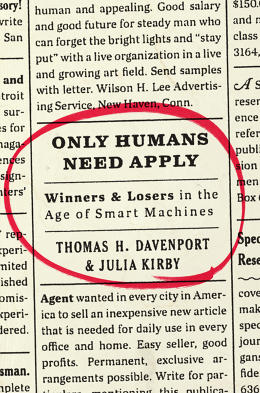
This article is excerpted from Only Humans Need Apply: Winners and Losers in the Age of Smart Machines by Thomas H. Davenport and Julia Kirby, published by Harper Business, an imprint of HarperCollins Publishers. It is reprinted with permission.

THOMAS H. DAVENPORT AND JULIA KIRBY 08.11.16 5:00 AM
FastCompany.com
https://www.firstsun.com/wp-content/uploads/2018/05/logo-min-300x123.jpg 0 0 First Sun Team https://www.firstsun.com/wp-content/uploads/2018/05/logo-min-300x123.jpg First Sun Team2016-08-12 10:17:512020-09-30 20:51:10Your #Career : 6 Very Clear Signs That Your Job Is Due To Be Automated…And what about you? Are you Sufficiently Aware of the Signs that you Should? To Help you Get the Head Start you May Need, here are the Signs that it’s Time to Fly the Nest.
Page 159 of 235«‹157158159160161›»

Blog Search

Login/Register

  • Log in
  • Entries feed
  • Comments feed
  • WordPress.org

FSC Career Videos

  • Job Search Techniques | Start Here
  • Resume/Cover Letter
  • Interviewing
  • Additional Career Videos
  • FSC Career Blog – #1 Career Library LinkedIn

Recent Posts

  • #JobSearch : 3 Simple Ways To Make LinkedIn Work For You In 2026. A MUst REad for All! April 29, 2026
  • #JobSearch : A Successful Job Search & Career Needs A Strong Network—Here’s How To Build One. Great Quick Read! March 25, 2026
  • #ResumeWriting : 8 In 10 Hiring Managers Spot AI Resumes-These 3 Mistakes Give It Away. Guide to How To Write Your Resume Using AI. March 20, 2026
© Copyright - First Sun Consultation - Website Maintained by BsnTech Networks - Enfold WordPress Theme by Kriesi
Scroll to top