#Leadership : I’ve Worked Remotely For 5 Years, And It’s Stressing Me Out…One #TechWorker reflects on all the #Stress Factors–some More Obvious than others–that made #RemoteWork Difficult in the Long Run.

In software engineering, remote working makes a lot of sense since, most of the time, you only need a computer and an internet connection to perform your duties. There are fewer reasons to force people to sit in an office every day. As a result, it’s become an important feature of a lot of IT jobs, even here in Belgium–which in my experience isn’t always the most forward-looking job market–where remote work is common for at least a couple days a week.

I’ve been working remotely for a little more than five years now, and it doesn’t come without stress. I think it’s taken a toll on me over the last couple years in particular, especially when I went almost fully remote for a year, from June 2016 to June 2017. In that period I’ve sometimes felt like I existed in a “remote-developer black box”:
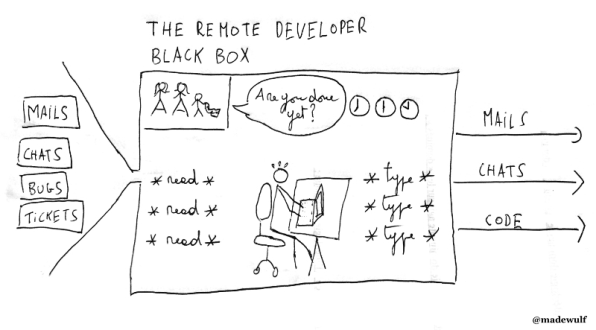
[fusion_builder_container hundred_percent=”yes” overflow=”visible”][fusion_builder_row][fusion_builder_column type=”1_1″ background_position=”left top” background_color=”” border_size=”” border_color=”” border_style=”solid” spacing=”yes” background_image=”” background_repeat=”no-repeat” padding=”” margin_top=”0px” margin_bottom=”0px” class=”” id=”” animation_type=”” animation_speed=”0.3″ animation_direction=”left” hide_on_mobile=”no” center_content=”no” min_height=”none”][Image: courtesy of Martin De Wulf]

Here are some of the biggest downsides to that experience.


Related: My 400-Person Company Has A Great Work Culture–And We All Work Remotely


Like this Article ?  Share It !    You now can easily enjoy/follow/share Today our Award Winning Articles/Blogs with Now Over 2.5 Million Growing  Participates Worldwide in our various Social Media formats below:

FSC LinkedIn Network:   www.linkedin.com/in/fscnetwork

Facebook:  http://www.facebook.com/pages/First-Sun-Consulting-LLC-Outplacement-Services/213542315355343?sk=wall

Google+:  https://plus.google.com/115673713231115398101/posts?hl=en

Twitter: Follow us @ firstsunllc

Question: Want the ‘the best/current articles/blogs on the web’ on Job Search, Resume, Advancing/Changing your Career, or simply Managing People?

Answer: Simply go to our FSC Career Blog below & type(#career, #leadership, #life) in Blog Search:  https://www.firstsun.com/fsc-career-blog/

What Skill Sets do You have to be ‘Sharpened’ ?

Continue of article:

IT’S HARD TO COMMUNICATE

Communication tends to stick to structured channels when you work remotely: the chats, daily standups, maybe a few global meetings every other week, Jira for the tasks and bug reports, and lots and lots of emails.

This works well to accomplish structured tasks, but it’s easy to feel disconnected sometimes. The fact that most of this communication happens in written form or in front of groups makes them unsuitable for small talk or more informal information sharing. And it can hamper your work, as just chatting about the general atmosphere at work can deliver important information about the smooth progress of projects. Worse, it can prevent you from feeling like part of a community.

In addition, written exchanges are more prone to misinterpretation, even with people you know very well. Plus, if you already spend your day typing on a keyboard to accomplish your technical tasks, it’s annoying to have to communicate in written form, too; you end up feeling like a text-processing machine. I began to miss the coffee chats that I’d previously thought to be unproductive wastes of time. I felt detached from the team, especially when the teams I worked with were made of people working in the same place (and seemed to be having fun).


Related: The Remote Worker’s Guide To Going Back To The Office


IT CAUSES INTERRUPTIONS AND MULTITASKING

When working remotely as a developer, chat platforms (usually Slack or HipChat) quickly become your lifeline; that’s the way most people contact you. And to me, being responsive on chat accomplishes the same as being on time at work in an office: it creates an image of reliability. If you don’t want to give the impression that you’re taking a lot of breaks, you might find yourself checking your notifications during lunch, for example. Whereas had people seen you working the whole morning, or had you just talked face-to-face with your coworkers by then, you wouldn’t feel the need to be so responsive. I’ve noticed other remote colleagues get criticized for not answering quickly by chat.

Since people don’t see you physically, they can’t really judge if it’s a good moment to interrupt you. So you get interrupted a lot, and if you’re like me, you feel forced to answer quickly. So you interrupt your own work a lot (programmers in particular tend to loathe this, since it saps their productivity and breaks their focus).

The other problem with remote chat is that people don’t know whether you’re already speaking with somebody else. I can’t count the number of times I’ve been juggling three different conversations at the same time, which to me can become stressful, especially when I have tasks to finish by the end of the day.

There are often “leisure” chats as well, about non-work stuff (usually a lot of memes), which can become very, very chatty. To keep my sanity, I mute these chats most of the time, but when you come back, catching up on everything that was said can be a daunting task, even though it may be my only opportunity to take part in the “office spirit” I’m missing by being a remote worker.


Related: Hiring Remote Workers Made My Whole Team More Productive


IT ENCOURAGES OVERWORK

Most jobs come with at least two types of obligation:

  1. Obligations of results, where you commit to give a certain result by a given date. Typically for a developer that means completing a sprint with a given set of bugs/features to develop by a certain deadline.
  2. Obligations of means, where you mainly commit to spending some of your time every day on your work, and you just deliver the results you’ve managed to produce within that time.

I’m not naïve, and I know that in the end (especially in software engineering), most jobs are really about results–you’ll get fired if you produce nothing–and not means. But since people can’t see you work remotely, you might feel more obliged to show results every day, even if it forces you to work way past eight hours a day. I can’t count the number of times a configuration problem or a customer call took a few hours of my day, but I still felt forced to finish the task I’d committed to that day, just so nobody could assume I was slacking off instead of working. Had my coworkers seen me in front of my computer all day, I probably would’ve felt relaxed enough to finish it that task later.

This instinct has led to two things for me: being really appreciated for the reliability of my output, and being seriously overworked. According to Basecamp CEO Jason Fried, this is “the true challenge of managing remote workers: People who work too hard.” In the end, it comes down to the question of trust: My employer trusted me a lot, allowing me to work on my own terms, and in exchange I’ve always felt compelled to work a lot more than if I were in an office.


Related: Stress Is Making You Micromanage, Which Is Making Everything Worse


IT’S CHALLENGING BEING A STAY-AT-HOME DAD

When you spend a good part of your time at home, your family sees you as more available than they sometimes should. Even if you have places dedicated to work that should be off-limits to your kids, it’s still tempting for them to come ask you “just a little something.” It’s hard to expect children to compartmentalize their home–actually, it’s hard for me, too.


I also know some people have problems resisting the need to perform home duties, like cleaning the kitchen. This has never been too much of an issue for me, but it’s created tension with my wife from time to time, since it was difficult for her to understand how I could’ve left a dirty dish on the dining room table all day while I was actually at home. (Answer: I was working and avoiding interruptions . . . )

IT CAN FEEL LONELY

Working at home can mean a lot of loneliness. I do enjoy being alone quite a lot, but even for me, after two weeks of only seeing colleagues through my screen, and then my family at night, I end up feeling quite sad. I miss feeling integrated in a community of pairs.

Interacting on social networks might help you fight that loneliness a little, but the experience isn’t different enough from working on your computer. Plus, it’s also well-known that spending a lot of time on social networks tends to make you less happy than the opposite. Eventually, I really started to hate being alone; it began to impact my mental health and my mood (another well-documented phenomenon).

WORKING OUTSIDE YOUR HOME HAS DRAWBACKS

One of the most common ways to fight this is to work in coworking spaces. But I find them a mixed bag; they cost real money (which your employer might agree to pay, or not) and often ask for time commitments (usually at least a month). They can create social environments and work opportunities, but at the risk of feeling a bit too much like a vacation camp, with activities every day (cooking, massages, meet-ups) designed to force people to socialize. I actually found myself going to coworking spaces only when those events weren’t scheduled–and gave up going altogether rather quickly, since it seemed pointless to use a coworking space to avoid loneliness only to not talk to anybody.

Commuting to a coworking space takes time, and when you’re there, you may work with headphones all day to avoid distractions, barely taking breaks (because you lost time commuting), and feeling awkward for not taking advantage of the community. As an added problem, video calls are more difficult to do in these settings, since there’s not much space to be alone, always a bit of noise, and the risk you’ll annoy people in earshot (or you have things to say that you don’t want them hearing).

Working remotely outside my home–whether in a coworking space or not–sometimes means not knowing where I’ll be working every day, and it’s stressful having to think about which hardware I need to take with me (keyboards, DVI adapters, chargers). Coffee shops are usually a bad idea, at least for full days: there’s too much noise, and I don’t like feeling obligated to buy something to eat or drink periodically to justify my presence.

Obviously, when you work remotely you don’t leave your workplace at night. And if your coworkers are in different time zones, you end up communicating a lot after your workday is over (I did that for months when working with people based in New York or San Francisco). It often makes sense; otherwise you might have few chances to speak with your team, which can really slow down projects, but it means there’s little time free of work-related concerns.

Finally, working at home doesn’t leave time to cool off while coming back home from work. For me, the ideal commuting duration is 15–20 minutes. That gives you some time to walk (which means at least some physical exercise) and change your thoughts a bit. Many evenings, I’d go from a video meeting to a family dinner in 30 seconds, making it hard to offer my kids my full attention.

IT COMES WITH UNFORESEEN COSTS

If you want to gain responsibilities over time, working with limited visibility can be a problem. At one employer I felt that people in the office were preferred for promotions. To be sure, working remotely over the last few years has been a boon to my family while our kids were small. It made it possible for my wife and me to pursue our careers with minimal hassle, since I was more available to take care of the kids when they were sick (which happens a lot in their infancy). And while that meant catching up on work in the evenings and weekends, I appreciated that flexibility.

Remote working also allowed me to join high-quality teams I wouldn’t have found in my local job market. So while I’m still a fan of remote work, it really took a toll on my mental comfort sometimes, which has impacted my family relationships–mainly just through my own irritability. In my experience, remote work can cut you off from the human interactions that make all those work-related tasks feel meaningful. Ultimately, for all its benefits, I don’t like being in the remote-developer black box.


FastCompany.com | February 3, 2018 | BY MARTIN DE WULF 9 MINUTE READ

 [/fusion_builder_column][/fusion_builder_row][/fusion_builder_container]

Your #Career : How to Write a Disruptive #CoverLetter in 2018…The Cover Letter is your Opportunity to Connect with the #Employer, Show that You Understand Them (Not You)

Ah, the dreaded cover letter. For many job seekers, the cover letter is harder to write than a resume. And while some job applications list it as optional, this does not mean that a cover letter is a waste of time. In fact, this one piece of paper (or that one email attachment) can make or break your chances of landing an interview.

We chatted with career coach and CEO of WorkItDaily, J.T. O’Donnell, about the keys to getting hired in 2018 and she insisted that wowing recruiters boils down to delivering the right kind of cover letter.

Wait, there are different kinds of cover letters?

Yes!

The biggest trend in cover letters is the concept of “disrupting” the reader. Disruptive cover letters tell a compelling story that creates a connection between the applicant and the hiring manager or recruiter. The goal? To be “original, different, refreshing.

The cover letter is your opportunity to connect with the employer, show that you understand them,” says J.T. O’Donnell. “Recruiters and hiring manager want an informed candidate. This cover letter is not about you, it’s about them. It’s about what you know about the company, why you’ve connected with them, and why you so badly want to work for them.”

In her recent lifestream webinar, “Help Me Get Hired,” J.T. dug into what it takes to get hired in 2018 and outlined some of the most common cover letter mistakes, as well as the solutions. Here are our favorite takeaways:

1. Don’t regurgitate; Innovate

“A cover letter should not be an overview of your resume. That’s the biggest mistake. Showcasing your experience and qualifications is what the resume is for, not the cover letter. Making this mistake will get your application sent to the ‘No’ pile.”

2. Grab their attention

“A good cover letter grabs the reader at ‘hello.’ You want the first sentence of the cover letter to grab the reader and completely disrupt. Come up with an attention-grabbing first sentence. Make a statement or have a really interesting question that you start with and bold in the center of the page. This will pique the reader’s interest and entice them to continue reading.

Like this Article ?  Share It !    You now can easily enjoy/follow/share Today our Award Winning Articles/Blogs with Now Over 2.5 Million Growing  Participates Worldwide in our various Social Media formats below:

FSC LinkedIn Network:   www.linkedin.com/in/fscnetwork

Facebook:  http://www.facebook.com/pages/First-Sun-Consulting-LLC-Outplacement-Services/213542315355343?sk=wall

Google+:  https://plus.google.com/115673713231115398101/posts?hl=en

Twitter: Follow us @ firstsunllc

Question: Want the ‘the best/current articles/blogs on the web’ on Job Search, Resume, Advancing/Changing your Career, or simply Managing People?

Answer: Simply go to our FSC Career Blog below & type(#career, #leadership, #life) in Blog Search:  https://www.firstsun.com/fsc-career-blog/

What Skill Sets do You have to be ‘Sharpened’ ?

Continue of article:

3. Tell a story

“Stories are memorable because they create emotion and they create connection. You want to show that you’ve done your research and understand where you can add value to the company. They should be able to feel a connection with you when reading your cover letter.”

4. Ditch the formalities

“Another mistake people make is being too formal instead of being personal. The biggest example of this is strategic a cover letter with ‘To whom it may concern.’ There is nothing more impersonal and dry than this phrase. It shows a lack of effort. In this day and age you can find a recruiters name, find the hiring manager’s name. If you cannot find this, there’s a better option: ‘Dear Hiring Team.’ That is more personal and warmer.”


#Leadership : Work Smart- 5 Ways To Make Sure Your #Meeting Will Be #Productive …Don’t Accept another Meeting Invite without Making Sure it Meets all of These Criteria.

Meetings can be the bane of working life, but they don’t have to be a waste of time if you ask yourself a series of questions before every meeting, and only attend meetings that are really necessary.

So before you click “accept” on that new calendar invitation, look out for these signs that indicate it’s not going to be a waste of your time.

1) YOU KNOW EXACTLY WHAT THE MEETING IS ABOUT AND WHAT IT’S TRYING TO ACCOMPLISH

Part of the reason that a meeting tends to drag on for longer than it needs to is because there is no clear purpose. As a result, attendees might be more likely to veer off topic for long periods of time. Christopher Frank, a VP at American Express, asks everyone to answer the question, “What exactly are we meeting about?” at the start of each meeting. He said, “This will show you if everyone is on the same page or not, and if your meeting topic is focused enough. Are the answers inconsistent or too long? Refocus the meeting and try again.”


Related: How To Nail The First 90 Seconds Of That Big Meeting


2) YOU KNOW WHAT TYPE OF DISCUSSION WILL TAKE PLACE

Each meeting has a different purpose and commands a different type of discussion. Cameron Herold, business consultant and author of Double Double: How to Double Your Revenue and Profit in Three Years or Less, told Fast Company in 2015 article that there are three types of meetings: information share, creative discussion, and consensus meetings.

In information-share meetings, attendees are expected to listen, and discussions are generally limited to “requests for clarification.” Creative discussion meetings tend to be an exercise in brainstorming, and consensus meetings require participants to make a unanimous decision. Having a good idea of what type of discussion will take place ahead of time lets you be better prepared, and allows you to plan accordingly. 

Like this Article ?  Share It !    You now can easily enjoy/follow/share Today our Award Winning Articles/Blogs with Now Over 2.5 Million Growing  Participates Worldwide in our various Social Media formats below:

FSC LinkedIn Network:   www.linkedin.com/in/fscnetwork

Facebook:  http://www.facebook.com/pages/First-Sun-Consulting-LLC-Outplacement-Services/213542315355343?sk=wall

Google+:  https://plus.google.com/115673713231115398101/posts?hl=en

Twitter: Follow us @ firstsunllc

Question: Want the ‘the best/current articles/blogs on the web’ on Job Search, Resume, Advancing/Changing your Career, or simply Managing People?

Answer: Simply go to our FSC Career Blog below & type(#career, #leadership, #life) in Blog Search:  https://www.firstsun.com/fsc-career-blog/

What Skill Sets do You have to be ‘Sharpened’ ?

Continue of article:

3) THERE IS A CLEAR AGENDA TO ACHIEVE THE OBJECTIVE

Having an objective is one thing, but a productive meeting focuses on what needs to happen in order to meet that objective. Connie Williams, CMO & chief knowledge officer at Syneticsworld, a company that studies meeting processes, told Fast Company that instead of focusing on the problem, facilitators should frame the agenda in “problem-solving” language. Some examples: How can we build a better campaign? How can we find new clients? As Williams explained, encouraging people to think about solutions means that they’re less likely to focus on the problems. 

4)  ITEMS ARE PRIORITIZED ACCORDINGLY

In addition to being solution-focused, a productive meeting prioritizes the most important items and tackles those first. Mat MacInnis, CEO and founder of digital content platform Inkling, previously wrote in Fast Company that his team would always prioritize the meeting items based on what they need to get done that week, and park any debates that spin into “strategic, long-term conversations” for later discussions. At the end of the meeting, everyone knows exactly what they need to execute for the rest of the week.


Related:  This Silicon Valley-Style Meeting Can Transform Your Whole Team 


5)  THERE ARE SYSTEMS IN PLACE TO PREVENT MULTITASKING AND INTERRUPTIONS

Sometimes, it’s not the meeting itself that’s unproductive, but the attendees. Whether they’re answering emails instead of listening to an important announcement, or they’re constantly interrupting another, there needs to be a system in place to prevent this from derailing your meeting. For one, you can either ban digital devices in meetings, or limit them to those who may need them for meeting purposes, such as pulling up a presentation. If it is interruption that you’re trying to fix, you can assign someone to monitor and interject the interruptors, setting the expectation that people should be able to finish what they want to say at every meeting.

ABOUT THE AUTHOR

Anisa is the Editorial Assistant for Fast Company’s Leadership section. She covers everything from personal development, entrepreneurship and the future of work.

More

FastCompany.com | February 1, 2018 |  BY ANISA PURBASARI HORTON 3 MINUTE READ

Your #Career : Use these 5 Prompts to Show off your #SoftSkills on #JobInterviews ….So Here are a Few Prompts to Help you Zero in On a Concrete Narrative From your #WorkExperience

This week’s issue of my early-careers newsletter, Hit the Ground Running, is all about “soft skills,” those people-focused capabilities you keep hearing about. One thing I’ve heard from jobseekers is that just knowing about an in-demand skill is fine, but the real challenge is telling hiring managers about a time they actually demonstrated it.

Like this Article ?  Share It !    You now can easily enjoy/follow/share Today our Award Winning Articles/Blogs with Now Over 2.5 Million Growing  Participates Worldwide in our various Social Media formats below:

FSC LinkedIn Network:   www.linkedin.com/in/fscnetwork

Facebook:  http://www.facebook.com/pages/First-Sun-Consulting-LLC-Outplacement-Services/213542315355343?sk=wall

Google+:  https://plus.google.com/115673713231115398101/posts?hl=en

Twitter: Follow us @ firstsunllc

Question: Want the ‘the best/current articles/blogs on the web’ on Job Search, Resume, Advancing/Changing your Career, or simply Managing People?

Answer: Simply go to our FSC Career Blog below & type(#career, #leadership, #life) in Blog Search:  https://www.firstsun.com/fsc-career-blog/

What Skill Sets do You have to be ‘Sharpened’ ?

Continue of article:

So here are a few prompts to help you zero in on a concrete narrative from your work experience:

  1. Managing inclusively: “That time I led a diverse team and our project turned out great . . .”
  2. Problem-solving: “That time something went wrong unexpectedly and I came up with a way to solve it . . .” (Hint: Think small! “I overhauled our supply chain” is fine but needn’t be so complicated.)
  3. Adaptability: “That time my boss got fired/a reorg took place/my team’s marching orders changed, and I had to adapt by . . .”
  4. Emotional intelligence: “That time I looked at the numbers–even though I’m not a data wonk–and figured out what our customers really wanted . . .”
  5. Empathy/storytelling: “That time I built a tool or came up with a new process, pitched it to my boss/coworkers, and they actually adopted it . . .”

RB

FastCompany.com | January 31, 2018 

#Leadership : #WorkSmart -These Seven To-Do List Mistakes Could Be Derailing Your #Productivity …Why you Shouldn’t Write your List in the Morning, and the Items you Should Leave Off Completely.

When it comes to getting things done, sometimes the simple productivity methods are the best. Case in point: the to-do list. This handy tool keeps you on track by putting tasks top of mind . . . unless you’re doing it wrong. Mistakes on your to-do list could be putting your workday in jeopardy, say experts.

“A to-do list is a road map for your day,” says Paula Rizzo, author of Listful Thinking: Using Lists to Be More Productive, Successful, and Less Stressed. “It sets an intention so you know what you’re doing, but you can get derailed if you don’t use it correctly.”

Before you write your next to-do list, make sure you aren’t making these seven common mistakes:

1. WRITING THE LIST IN THE MORNING

It may feel natural to create your to-do list first thing in the morning, but that’s too late, says Eileen Roth, author of Organizing For Dummies. “If you do that and you have an 8 a.m. meeting across town, you probably won’t be there,” she says. Instead, create your list the night before.

Writing the list at the end of the day allows you to leave work behind and transition into personal time, says Roth. “You go home and can stop thinking about your to-do list because you already created it and know what tomorrow’s to-do’s look like. Your mind can rest,” she says.


Like this Article ?  Share It !    You now can easily enjoy/follow/share Today our Award Winning Articles/Blogs with Now Over 2.5 Million Growing  Participates Worldwide in our various Social Media formats below:

FSC LinkedIn Network:   www.linkedin.com/in/fscnetwork

Facebook:  http://www.facebook.com/pages/First-Sun-Consulting-LLC-Outplacement-Services/213542315355343?sk=wall

Google+:  https://plus.google.com/115673713231115398101/posts?hl=en

Twitter: Follow us @ firstsunllc

Question: Want the ‘the best/current articles/blogs on the web’ on Job Search, Resume, Advancing/Changing your Career, or simply Managing People?

Answer: Simply go to our FSC Career Blog below & type(#career, #leadership, #life) in Blog Search:  https://www.firstsun.com/fsc-career-blog/

What Skill Sets do You have to be ‘Sharpened’ ?

Continue of article:

2. INCLUDING TOO MANY TASKS

If your to-do list includes so many tasks that it would take a few weeks or even months to complete, you’re setting yourself up for failure, says Rizzo. “When you list too many things, it’s overwhelming,” she says.

Three tasks are ideal, says Kyra Bobinet, author of Well Designed Life: 10 Lessons in Brain Science & Design Thinking for a Mindful, Healthy, and Purposeful Life. “Your brain understands things in groups of three,” she says. “Take advantage of this by creating a ‘top three’ at the beginning of your to-do list. Most people have a list that is longer than three items.”

Long lists are a problem because most people aren’t aware of how few productive hours we truly have in a day, says Christina Willner, founder of the productivity software Amazing Marvin. “Our mental energy is a far more limiting factor than time,” she says. “We only have about three to six good hours of work in us each day.”

Another reason that long lists are common is that people tend to underestimate how long a task takes, says Willner. Instead, she suggests estimating each task’s duration, and writing it next to the task. Then track your time to help make future estimates more accurate.

3. INCLUDING SOMEDAY ITEMS

Aspirational tasks, like writing a book, don’t belong on a to-do list; instead, create a separate bucket list. “If your to-do list says, ‘Climb Mount Everest and pick up milk,’ those are two separate lists,” says Rizzo.

Daily to-do lists should be focused. If you have a big project you want to complete, you can put it on your to-do list if you chunk it out into smaller, more attainable tasks, says Rizzo.

Someday items belong on a master list that holds all the tasks you want to do and is constantly growing and shrinking, says Willner. “You don’t want to work directly from your master list,” she says. “Not only is it overwhelming to see so many tasks; it’s also not satisfying to never be able to complete it. Instead, you want to make a separate daily list where you plan which tasks to tackle the next day and only work off that list.”

4. TREATING EACH ITEM EQUALLY

A good to-do list should be a priority list, says productivity coach Nancy Gaines. “Only add items that will move your career or business forward,” she says. “If it’s not a priority, it should not be on the list. Non-priorities are just distractions.”

She suggests following the “3-3-3 system when writing out your list.” “Delete three of the items since they probably aren’t that important,” says Gaines. “Delegate three of the items to someone else, as they are not the best use of your time or talents. And do three of the items that are the highest priority.”

5. NOT BEING SPECIFIC

People often write vague notes on a to-do list, but it can be difficult to take action if you have to stop and think how to proceed, says Maura Thomas, author of Personal Productivity Secrets. If you have 10 minutes to get something done and a vague to-do list, you’ll waste time trying to reconnect with each item on the list and remember what it means.

“Take the few extra seconds, while you’re in planning mode and writing the list, to be as specific as you can be, so that when you’re taking on a task on the fly, you can just get it done,” she says. For example, instead of writing “expense report” on your to-do list, write “enter receipts into spreadsheet.”

And skip the vague-sounding action words, such as “plan,” “implement,” or “develop” from your list of tasks. “If you only have a few minutes, seeing a word like ‘develop’ on your list will act like a speed bump, and you’ll probably skip over it,” says Thomas. “Save those vague words for your projects list, which is for those big-picture items that aren’t immediately actionable by themselves.”

6. USING THE SAME LIST UNTIL IT’S DONE

Too often, people create one to-do list and use it until all of the items are done, says Roth. “The problem with that theory is that every day changes, so what you did today is not what you will do tomorrow,” she says. “And what you think you are going to do tomorrow may change before today is over.”

Instead, create a fresh list for each day. “Some people who work only on projects can work on a weekly to-do list, but even that will change as the days progress through the week,” says Roth.

7. NOT LINKING YOUR LIST AND CALENDAR

Having a full calendar that does not include the actions on your full to-do list is another mistake, says Katie Mazzocco, author of Revolutionary Productivity: How to Maximize Your Time, Impact, and Income in Your Small Business.

“Recognize that there is only so much time each day,” she says. “If you have a full calendar and a full to-do list that aren’t connected, you’ll never have time to take action on your to-do list, short of robbing yourself of sleep, family time, weekend relaxation, or vacation.”

Instead, block out time on your calendar to take action on your to-do list items.

FastCompany.com | January 31, 2018 | BY STEPHANIE VOZZA 5 MINUTE READ


#Leadership : How To Get Your Point Across To These Five Personality Types… Not Everyone Thinks the Same Way. Here’s How to Repurpose a Three-Decade-Old #Management Theory to Tailor your Message to Just about Anybody.

The VP of finance for a major multinational company recently came to me with a problem. “I’ve been trying to start a conversation with the VP of marketing, and he won’t talk to me,” he said. “Whenever I try to ask him what he thinks about my ideas, he doesn’t respond.”

I asked him to describe the marketing VP to me. As he talked about his personality, I thought of a potential solution: “Don’t ask him what he thinks about your ideas,” I said. “Ask him what’s wrong with them.”

A few weeks later, I heard back from my client. “Your advice was amazing!” he said. “We spent two hours discussing issues, and he wants to meet with me every week now!”

Why did I give him that advice? Because as he described the marketing VP to me, I realized what type of speaking approach would most likely resonate: one that appealed to his colleague’s problem-solving personality.

While psychological research has progressed quite a bit since Edward de Bono released his influential  book Six Thinking Hatsin 1985, I find framework still offers a handy set of metaphors for adjusting your speaking style to fit listeners’ thinking styles and personalities (though I typically prefer sticking to just five). Here are five ways to frame your message, riffing on de Bono’s 33-year-old idea, according to the people or person you’re communicating with.


Related:Six Communication Styles That Every Single Person Uses


1. PROBLEM SOLVERS

A “black hat” approach to speaking is all about solving problems. When you’re addressing someone who thrives on figuring out puzzles (like that VP of marketing), you need to focus on what’s wrong with something–usually in solutions-oriented, technical terms.

Let’s say you’re tasked with giving a presentation about productivity. With a black hat approach, your key message might be, “By reducing the gaps in our sourcing systems, we can increase productivity.” Then you’d go on to point out what those gaps actually are, and guide your audience toward brainstorming ways of closing them.


Related:How To Get Straight To The Point No Matter What You’re Trying To Say


Like this Article ?  Share It !    You now can easily enjoy/follow/share Today our Award Winning Articles/Blogs with Now Over 2.5 Million Growing  Participates Worldwide in our various Social Media formats below:

FSC LinkedIn Network:   www.linkedin.com/in/fscnetwork

Facebook:  http://www.facebook.com/pages/First-Sun-Consulting-LLC-Outplacement-Services/213542315355343?sk=wall

Google+:  https://plus.google.com/115673713231115398101/posts?hl=en

Twitter: Follow us @ firstsunllc

Question: Want the ‘the best/current articles/blogs on the web’ on Job Search, Resume, Advancing/Changing your Career, or simply Managing People?

Answer: Simply go to our FSC Career Blog below & type(#career, #leadership, #life) in Blog Search:  https://www.firstsun.com/fsc-career-blog/

What Skill Sets do You have to be ‘Sharpened’ ?

Continue of article:

2. DATA GEEKS

Analytical thinkers typically require a slightly different approach. The “white hat” approach to speaking is objective and straightforward. Rather than emphasize the problem areas, you lay out all the relevant information you’ve got–focusing on data and analysis. You’ll also want to rely more on charts and statistics to get your message across than you otherwise might.

So if you’re taking a “white hat” approach to your productivity presentation, you’d analyze your team’s output in terms of amount of hours saved, money saved, and forecasted benefits–all backed up by hard facts and concrete numbers. Your key message might be, “By improving our system, we can increase productivity by x and contribute y to the bottom line.”

3. TEAM PLAYERS

Sometimes you’re speaking to people who aren’t exactly number crunchers but think in terms of shared purpose and teamwork. In that case, your goal is to connect with the hearts of your listeners with an emotional appeal that inspires belief, propels action, and instills a feeling of togetherness.

A “red hat” approach to the productivity issue would be more of a pep talk; you’d discuss how increasing morale and building team spirit can increase productivity. Your key message might be, “By working together, we can conquer new frontiers and build an organization that keeps getting better and better.”

4. CREATIVE TYPES

The “green hat” approach to speaking focused on creativity. If your listeners are “outside the box” thinkers, you’ll need to use visual imagery to get your audiences to imagine possibilities they may not have even considered.

In your productivity presentation, you’d want to discuss potential innovations that could help increase productivity. Rather than analyze the past, you’d brainstorm programs and initiatives you could try in order to boost productivity in the future, encouraging your team to think inventively. Your key message might be, “By innovating, we can propel the organization to better results and discover new opportunities we haven’t even imagined yet.”


Related:Working With Creatives (A Guide For Everyone Else)


5. OPTIMISTS

Finally, if you’re speaking to glass-half-full thinkers who are good at looking at the bright side, you should do the same. Stress the positive and focus on what’s ahead–like a bright beacon guiding everyone to safety and security.

Taking this “yellow hat” approach for your productivity presentation would mean focusing on what’s going right already, and where it’s bound to take you if you stay the course. Your key message might be, “By capitalizing on our strengths, we can catapult our company to new heights with our customers.”

As de Bono himself realized, these strategies are all about being flexible. Our personalities are highly contextual–more tendencies than fixed properties–and people change “hats” all the time. Your room full of yellow hat optimists might turn into black hat problem solvers when the going gets tough. So always think about what your message is, and to whom you’re delivering it. You’ll find a little color can go a long way.

ABOUT THE AUTHOR

Anett Grant is the CEO of Executive Speaking, Inc. and the author of the new e-book,CEO Speaking: The 6-Minute Guide. Since 1979, Executive Speaking has pioneered breakthrough approaches to helping leaders from all over the world–including leaders from 61 of the Fortune 100 companies–develop leadership presence, communicate complexity, and speak with precision and power.

More

FastCompany.com | January 31, 2018 | Anett Grant

Your #Career : Tired Of Working So Hard Without #Success? Learn How #TopPerformers Do Less & Achieve More… Many Individuals Wake Up at a Certain Point in their Life, Only to Recognize that this Intensity of #Work hasn’t Been Beneficial at All.

Thousands of professionals around the world long to be true experts in their fields, and to stand out through their experience, know-how and effort. Many of them attempt to do that by racking up hundreds of hours of extra time at work, thinking that if they work harder than their colleagues, and put in more effort, that they’re surely get ahead and achieve more.

But many of those same individuals wake up at a certain point in their life, only to recognize that this intensity of work hasn’t been beneficial at all – it hasn’t elevated them or catalyzed their growth, or even lead to greater success or reward. And it certainly hasn’t given them a greater quality of life, or a sense of deep meaning, purpose and true accomplishment that they’re longing for.

 So what are they doing wrong?

To learn more about how to work smarter, I caught up with Morten Hansen, author of the new book Great at Work: How Top Performers Do Less, Work Better, and Achieve More. In the book, Hansen codifies the most actionable insights from his research into “Seven Smarter Work Practices” to show how we can work smarter instead of harder by selecting a few activities and applying intense targeted effort.

A management professor at University of California, Berkeley, Hansen is the coauthor with Jim Collins of the New York Times bestseller Great By Choice and of the highly acclaimed Collaboration. Formerly a professor at Harvard Business School and INSEAD (France), Professor Hansen holds a PhD from Stanford Business School, where he was a Fulbright scholar. His academic research has won several prestigious awards, and he is ranked one of the world’s most influential management thinkers by Thinkers50. Hansen was also a manager at the Boston Consulting Group, where he advised corporate clients worldwide.

 His new book was named by Adam Grant as the 20 “new idea books” of 2018 on LinkedIn, and Washington Post’s On Leadership spotlighted it as a book to watch out for in 2018.

Here’s what Hansen shares:

Kathy Caprino: Why do we often equate more hours worked with better performance, and how is this detrimental to our productivity?

Morten Hansen: We know that we must put in at least a fair amount of time and effort to achieve a goal, so in a commonsensical way, we assume that if we simply work longer hours and pile on more effort, we’ll achieve even more. In other words, we assume that hours worked and performance increase in a linear fashion. But that’s not true. As my research with 5,000 managers and employees showed, if you work between 30 and 50 hours per week, adding more hours on the job lifts your performance.

But once you’re working between 50 and 65 hours per week, the benefit of adding additional hours drops off. And if you’re working 65 hours or more, overall performance declines as you pile on the hours (these are averages and numbers may vary according to job and industry). It’s like squeezing juice from an orange. At first, you get a lot of liquid. But as you continue to squeeze and your knuckles turn white, you extract a drop or two. Eventually, you reach the point where you’re squeezing as hard as you can, but producing no juice. You would have done better just to leave the well-squeezed orange alone.

The upshot: you need to work hard (say, about 50 hours a week), but beyond that you reap no real performance benefit from adding more hours. Unfortunately, the “work harder” mentality is deeply engrained in modern work cultures, affirmed by bosses, colleagues, and experts alike. As a result, managers and employees seldom question it.

Like this Article ?  Share It !    You now can easily enjoy/follow/share Today our Award Winning Articles/Blogs with Now Over 2.5 Million Growing  Participates Worldwide in our various Social Media formats below:

FSC LinkedIn Network:   www.linkedin.com/in/fscnetwork

Facebook:  http://www.facebook.com/pages/First-Sun-Consulting-LLC-Outplacement-Services/213542315355343?sk=wall

Google+:  https://plus.google.com/115673713231115398101/posts?hl=en

Twitter: Follow us @ firstsunllc

Question: Want the ‘the best/current articles/blogs on the web’ on Job Search, Resume, Advancing/Changing your Career, or simply Managing People?

Answer: Simply go to our FSC Career Blog below & type(#career, #leadership, #life) in Blog Search:  https://www.firstsun.com/fsc-career-blog/

What Skill Sets do You have to be ‘Sharpened’ ?

Continue of article:

Caprino: Why do the highest achievers do less and “obsess” as you say?

Hansen: Doing less and “obsessing” allows you to avoid two traps that frequently snare people. First, there is the “spread too thin trap,” whereby you are doing so much that you can’t devote sufficient attention to doing any of your tasks well.

Secondly, increasing the scope of your activities leads to a “complexity” trap. Not only do you have to deal with each of these activities, but also with the interrelationships between them. Coordinating between activities requires mental exertion, rendering you less effective at each individual activity. Some studies have shown that switching between tasks can decrease your productivity by as much as 40%. In my study, 65% of people strongly or completely agreed that their organization was “very complex—many departments, policies, processes, and plans that require coordination.” The result is inferior performance.

Doing fewer things avoid these traps. Yet it also comes with a rather harsh requirement. You also have to obsess over the few activities you have chosen. Stellar quality requires both prolonged effort and a fanatic attention to detail. You simply can’t invest that kind of time and attention if you have too many work activities.

In my study, people who did less and obsessed far outperformed those who did less without putting in the extreme effort to excel. Overall, people who mastered “do less, then obsess” placed 25 percentage points higher in our performance ranking than those who didn’t embrace this practice.

Caprino: The idea of “work smart, not hard” has been around a long time. What’s different now?

Hansen: The phrase “work smarter, not harder” has been thrown around so much over the past decade that it has become a cliché. Who wants to “work dumb?” But many people do in fact work dumb, because they don’t know exactly how to work smart. And I don’t blame them, because it’s hard to obtain solid guidance.

When I first began my research on performance at work, I scanned for existing advice on how to work smarter, and the picture I arrived at was incoherent and overwhelming. Every author seemed to say something different. Prioritize. Delegate. Keep a calendar. Avoid distractions. Set clear goals. Execute better. Influence people. Inspire. Manage up. Manage down. Network. Tap into passion. Find a purpose. The list went on, over 100 pieces of advice. Few offered data to back up their contentions.

My study of 5,000 managers and employees is one of the first to provide an evidence-based, comprehensive understanding of what allows individuals to perform at work. It yields a simple and practical framework of seven “work smart” practices that any of us can use to work at our best. These practices are largely counter-intuitive.

For instance, to perform at your best, don’t simply collaborate more, as many people think. Select just a few, high-value collaborations, and make the most of them. Likewise, don’t just follow your passion. Instead, combine passion with a strong sense of purpose on the job (that way, you’ll energize yourself and maximize the intensity of your efforts for each hour you work).

Overall, I think of these seven practices as akin to Stephen Covey’s The Seven Habits of Highly Effective Peopleupdated to reflect the realities of work today, and backed by an unprecedented statistical analysis.

Caprino: So what have you learned about how top performers approach the job they are given?

Hansen: Most people who start in new roles adopt goals based on their job descriptions, and then start working toward those goals. The best in our study did something different. They started with an eye toward value, before they settled on goals. They redesigned their work, asking: “How can I create the most value in this role, for customers or others in the organization?” That may involve doing things that no one had thought of, or ditching conventional tasks of little value. Once they have redesigned work to maximize value, then and only then do they draft specific goals. First value, then goals.

Caprino: What have you found to be wrong with the popular idea that it takes 10,000 hours to master a skill?

Hansen: The idea that it takes 10,000 hours of practice to master a skill is misleading.  One year of practice repeated in the same way for ten years doesn’t make perfect. Rather, a certain kind of practice makes perfect—what Professor Anders Ericsson and his colleagues have called “deliberate practice.”

Individuals who progress the most meticulously assess outcomes, solicit feedback based on known standards of excellence, and strive to master tiny flaws that the feedback has uncovered. This purposeful and informed way of practicing explains why some learn at a much faster rate than others.

 Deliberate practice has allowed people to achieve stellar results in pursuits like sports, music, chess, and spelling bees, so you would think that legions of employees in the working world would rely on this approach to master their job-specific skills. Yet most individuals don’t. Experts haven’t articulated how people can use a continuous learning technique like deliberate practice in their daily work. And most organizations aren’t geared to supporting such techniques.

As a result, people conduct meetings or give presentations or make sales pitches just as they’ve always done. They become “good enough,” but not great at work. As my study found, employees and managers who deploy a modified version of deliberate practice on the job — what I call the “learning loop” — performed better than those who don’t.

 Caprino: Finallytell us what you believe about following your passion and why that’s wrong?

Hansen: “Follow your passion” really implies that you should let passion dictate what you do, regardless of other considerations. Otherwise, you’re not really following your passions. That approach, unfortunately, can lead people astray. As many a failed actor in Los Angeles will tell you, following your passion can lead to unemployment. But what’s the alternative? Ignoring your passion isn’t so great, either. It leads people to plod along, doing dull, empty work to earn a paycheck.

My study of 5,000 managers and employees turned up a third option, what I call “matching.” Some people pursue passion in navigating their careers, but they also manage to connect this passion with a clear sense of purpose on the job — they contribute, serve others, make a difference. They have matched passion with purpose.

My statistical analysis of 5,000 people shows that people who match passion with purpose perform much better, on average, than those who lack either purpose or passion or both.

The key therefore is to take steps to infuse your work with both passion and purpose, and in many cases, people can do that while remaining in their present organizations.

For more information, visit Morten Hansen and his new book Great at Work.

To build more success, visit Kathy Caprino’s Amazing Career Project training series and her new podcast Finding Brave

Forbes.com | January 30, 2018 | 

Your #Career : 7 Ways to Get #Recruiters & #JobOffers to Come to You… Today we are Going to Take a Look at Seven Ways to get #Recruiters and #JobOffers to Come to You, Instead of the Other Way Around.

Did you know that you don’t have to spend hour upon hour trying to find a job, and that you can do things that will have potential employers approaching you instead? Yes, this is a reality for many people, but it isn’t something that just happens. You have to work at it, and you need to market yourself in a way that is going to make you very desirable to potential employers.

Today we are going to take a look at seven ways to get recruiters and job offers to come to you, instead of the other way around.

1. Start Networking

It is true that a lot of people aren’t hired because they filled out a job application or sent in a resume. They are hired because they have connections, people that they network with who are able to help them in their career search. Now is the time to get out there and network with everyone you know, from friends and family to former coworkers, employers, professors, etc. The more networking you can do, the better off you will be in the long run. Let everyone in your network know that you are looking for a job, and make sure that they are well aware of your education, skills, and experience. If they think you are a fit for a certain job, they won’t hesitate to recommend you.


Like this Article ?  Share It !    You now can easily enjoy/follow/share Today our Award Winning Articles/Blogs with Now Over 2.5 Million Growing  Participates Worldwide in our various Social Media formats below:

FSC LinkedIn Network:   www.linkedin.com/in/fscnetwork

Facebook:  http://www.facebook.com/pages/First-Sun-Consulting-LLC-Outplacement-Services/213542315355343?sk=wall

Google+:  https://plus.google.com/115673713231115398101/posts?hl=en

Twitter: Follow us @ firstsunllc

Question: Want the ‘the best/current articles/blogs on the web’ on Job Search, Resume, Advancing/Changing your Career, or simply Managing People?

Answer: Simply go to our FSC Career Blog below & type(#career, #leadership, #life) in Blog Search:  https://www.firstsun.com/fsc-career-blog/

What Skill Sets do You have to be ‘Sharpened’ ?

Continue of article:

2. Build Your Brand Online

“You are your own brand, and you need to build that brand and promote it as much as possible. It is important that you start building your brand online, because this is where employers are going to be looking for potential employees,” suggests Dima Midon, an expert from TrafficBox. Use all of the online tools at your disposal, particularly LinkedIn, which is a professional network that allows you to really promote yourself as a professional, and someone who is an expert in your field. This is a great tool for job seekers. Make sure that you keep your profile up to date, especially when it comes to contact information, so when an employer searches you, they will be able to contact you if they are interested in learning more.

3. Create a Professional Website

Let’s say that you have already applied for a job that you really want. The employer is going to want to learn as much about you as possible, and they are usually quite impressed when they see that candidates have their ownprofessional websites. Your website is basically an extension of your resume, where you have the opportunity to really expand on your education, skills, experience, and knowledge. You can include samples of your past work, your portfolio, contact information, and a lot more. Make sure that your resume is up to date and included as its own separate section of your website, and also include your LinkedIn profile. Consider trying a platform like Squarespeace to get started!

4. Keep on Applying for Jobs

Even if you are waiting for employers to start seeking you out, don’t stop applying for other jobs while you are waiting. After all, you could end up waiting for a long time, and you don’t want to be out of work and not able to pay your bills just because you are waiting for the perfect job to come along. Remember, most people who apply for jobs are rejected at least 15 times before they actually receive an offer of employment. Figure out what you have done wrong at the other interviews, and keep on applying until you get it right, and get the job offer you really want. The only real problem this is going to cause is that you could end up with several job offers, and have to decide which one you are the most interested in.

5. Dress for the Job

You may not have the job yet, but you should always be dressed as if you do. If you are interested in a certain type of profession, you should dress for that profession on a regular basis. Don’t run to the store looking sloppy. This could be just the time when you end up running into someone in your network, a potential employer, etc., and they are not going to see you at your absolute best. Another bonus to dressing for success is that the better you look, the better and more confident you are going to feel. It is particularly important to dress for the role when you are meeting employers for interviews, applying for jobs, etc. You need to look the part for every type of job you are interested in.

6. Don’t Badmouth Former Employers

The last thing a potential employer wants is an employee who badmouths their former employers. For one thing, no one likes to have someone around who is constantly complaining about something. You need to have a positive outlook, and as the saying goes, if you don’t have anything nice to say about someone, don’t say anything at all. One of the most common job interview mistakes that many people make is saying bad things about their former employers. Yes, you do have to be honest about why you are no longer employed by the company, but you need to find ways to put a positive spin on things.

7. Let Recruiters Know You are Open

Let’s get back to LinkedIn. It isn’t just enough to have a LinkedIn profile. You need to let recruiters that you are “open”. There are several ways that you can do this, including having your phone number and email address in the summary section (many recruiters don’t bother going any further than the summary, so you need to give them what they are looking for). Make sure your profile has a professional headshot photo. If you have a silly photo, or none at all, it is going to make potential employers think that you are not going to be professional and take your job seriously. Also, make sure that your profile is “on” so they know you are available.


GlassDoor.com | January 25, 2018 | Posted by 

#Leadership : This Is How To Turn Procrastination Into A #Management Technique…Sometimes the Best Thing you can Do is Not Answer your #TeamMembers’ Questions Right Away.

You’ve just been promoted to a supervisory role, and you reallydon’t want to be the absentee boss who inspires articles like this one. So you make a concerted effort to be attentive and responsive–answering questions whenever your employees ask, and making yourself available whenever they need you. So much so that some days, you feel like you barely have any time to get your work done.

But it’s just part of being a manager, right? ……..Well, yes and no.

It is important to train your direct reports on the skills they need to do their jobs well–because if they excel, that’s going to reflect well on you. However, sometimes that training involves knowing when to put off their requests. Yes, you heard right: There are times when procrastinating can actually be a powerful management strategy. Here’s when and why.


Related: The Five Hidden Benefits Of Procrastination


YOU TEACH YOUR EMPLOYEES TO BE RESOURCEFUL

Think of a time when you desperately needed an answer to a question, but there was no one to ask. What did you do? You probably tried to find the answer yourself–whether it’s typing questions into Google, Slacking a coworker, or searching the company’s server because you know those files are in there somewhere.

So if your direct report comes to you for help, consider procrastinating. Push the request off a few hours. If someone approaches you in the morning, tell them you’ll get back with them to help first thing in the afternoon if they haven’t figured it out by then. Similarly, punt afternoon requests to the next morning.

As a manager, putting off certain requests–at least for a little while–prevents you from becoming a one-stop-shop for your direct reports. That way, they’ll learn to search for things themselves before coming to you. Over time, many of the issues, questions, and requests they approach you with initially will begin to evaporate. Everybody wins: You get some time back, and your team members learn to solve more problems on their own.

And when they do come to you with a question, you can be confident that they’ve attempted to find the answer themselves–and you’re more likely to have a productive discussion about the issue.


Related: Why Trying To Be A People Pleaser Makes You A Bad Boss 


Like this Article ?  Share It !    You now can easily enjoy/follow/share Today our Award Winning Articles/Blogs with Now Over 2.5 Million Growing  Participates Worldwide in our various Social Media formats below:

FSC LinkedIn Network:   www.linkedin.com/in/fscnetwork

Facebook:  http://www.facebook.com/pages/First-Sun-Consulting-LLC-Outplacement-Services/213542315355343?sk=wall

Google+:  https://plus.google.com/115673713231115398101/posts?hl=en

Twitter: Follow us @ firstsunllc

Question: Want the ‘the best/current articles/blogs on the web’ on Job Search, Resume, Advancing/Changing your Career, or simply Managing People?

Answer: Simply go to our FSC Career Blog below & type(#career, #leadership, #life) in Blog Search:  https://www.firstsun.com/fsc-career-blog/

What Skill Sets do You have to be ‘Sharpened’ ?

Continue of article:

YOU HELP YOUR TEAM MEMBERS BECOME BETTER LEADERS

More importantly, when you don’t leap to help with requests immediately, you’re teaching a lesson about leadership that your direct reports wouldn’t otherwise learn. Some day, some of your team members will be sitting in your position fielding the requests that you’re fielding.

By encouraging them to solve problems on their own beforecoming to you, you’re developing them into more efficient, high-value workers and reinforcing the fact that you have your own priorities (which they should respect). Likewise, they’ll learn that it’s perfectly acceptable to prioritize their own work as long as they help out their teammates in a timely fashion.


Related: Five Questions You Should Ask Before Accepting A Management Position


When you push back a request a few hours, encourage the person who’s made it to keep working and not use your delay as an excuse to put the task aside.

Of course, sometimes the person making the request has exhausted every option, and they’re coming to you because they’re at their wits’ end on how to proceed. When their words or body language tell you this, go ahead and help. It really is okay to drop everything and help every now and again–just not all the time.

FastCompany.com | January 29, 2018 |  BY ART MARKMAN 2 MINUTE READ

#Leadership : Screw #EmotionalIntelligence –Here’s The Key To The #Future Of #Work …This Y Combinator Alum & Former #IBMWatson Strategist Believes the Market Value of One Particular Capability will Soon Outpace EQ.

On the walk back from her high school, Max drops by the corner bodega to pick up a NeuroStim pill, a prescription neuroplasticity stimulator. She’ll pop it at exactly 10 a.m. tomorrow as she sits down to take the “AEI.” NeuroStim will accelerate her brain’s ability to create new synaptic pathways, helping Max quickly learn new behaviors and spot new connections when exposed to rapidly changing stimuli. The AEI is a standardized test, implemented 10 years ago, in 2035, to replace the SAT. It has become a globally accepted metric for aptitude and projected performance in the modern workplace.

Colloquially called “the Qs,” the AEI tests three variables:

  • Adaptability quotient (AQ)
  • Emotional quotient (EQ)
  • Intellectual quotient (IQ)

While each “Q” matters, the AEI weights AQ the most. Strong scores in adaptability mean that you’re eligible for the “salaried track,” which leads to a three-year contract with an employer that commits significant sums toward your retraining every one to six months.

With lower scores, you must rely on the “gig track,” which can mean more flexibility and higher near-term rewards, but only short-duration contracts and no supported retraining. There is no inherent safety net if you bet too long on the wrong gigs in dying industries instead of continually refocusing on emergent needs.

Welcome to the future.


Related: This Is The Mind-Set You’ll Need To Thrive In The Future Of Work


WHY ADAPTABILITY WILL SOON MATTER MORE THAN EVER

It’s no secret that technology is changing at an exponential rate, requiring us to learn faster than humans have ever had to before. The behaviors we’ve honed for decades will become obsolete in a few short years. Our off-the-shelf “neuroplasticity” might not be enough for us to succeed in a 45-year (or, likely, longer) career, where each year’s work dramatically differs from the last’s. As a result, our “adaptability quotient” (AQ) will soon become the primary predictor of success, with general intelligence (IQ) and emotional intelligence (EQ) both taking a back seat.

In the late 1990s, we witnessed an emotional intelligence boom, with scholars and psychologists led by Daniel Goleman arguing that we’d been over-indexing on IQ instead of prioritizing the “people side” of smart. In business, the concept of EQ was course altering, taking even Goleman by surprise, “particularly in the areas of leadership and employee development,” as he reflected in 2012.

But while EQ is important, it’s only one leg of the stool. I subscribe to psychologist Carol Dweck’s “growth mind-set”: IQ and EQ aren’t fixed properties but can be developed through dedication and hard work. I believe AQ works similarly: Some of us are born with more potential to adapt, but each of us can get better at it over time. We all have that friend who loathes change and another who thrives on new experiences. We’re already aware that AQ exists and varies from person to person, but we’re not talking about it enough–and don’t have a compelling way to test or improve it.

To help fix that, it’s worth looking at a few examples of how AQ plays out at societal, organizational, and individual levels.


Related: 5 Habits That Let Emotionally Intelligent People Adapt To Anything


Like this Article ?  Share It !    You now can easily enjoy/follow/share Today our Award Winning Articles/Blogs with Now Over 2.5 Million Growing  Participates Worldwide in our various Social Media formats below:

FSC LinkedIn Network:   www.linkedin.com/in/fscnetwork

Facebook:  http://www.facebook.com/pages/First-Sun-Consulting-LLC-Outplacement-Services/213542315355343?sk=wall

Google+:  https://plus.google.com/115673713231115398101/posts?hl=en

Twitter: Follow us @ firstsunllc

Question: Want the ‘the best/current articles/blogs on the web’ on Job Search, Resume, Advancing/Changing your Career, or simply Managing People?

Answer: Simply go to our FSC Career Blog below & type(#career, #leadership, #life) in Blog Search:  https://www.firstsun.com/fsc-career-blog/

What Skill Sets do You have to be ‘Sharpened’ ?

Continue of article:

NATIONAL AQ: SWEDEN VERSUS THE UNITED STATES

The New York Times published a fascinating article last month on Sweden’s approach to automation and the impact to their collective livelihood. Times reporter Peter S. Goodman interviews Mika Persson, a remote mine operator who tests self-driving vehicles to replace truck drivers.

Persson doesn’t fear automation because of Sweden’s strong social safety net; the government provides healthcare and free education, and employers finance extensive job-training programs. As the Swedish employment minister tells Goodman, “The jobs disappear, and then we train people for new jobs. We won’t protect jobs. But we will protect workers.” Plus, Swedish unions “generally embrace automation as a competitive advantage that makes jobs more secure,” Goodman writes.

He notes that the U.S. healthcare system, by contrast, is largely dependent on employers, so “losing a job can trigger a descent to catastrophic depths. It makes workers reluctant to leave jobs to forge potentially more lucrative careers. It makes unions inclined to protect jobs above all else.” Goodman cites a recent Pew survey, in which 72% of Americans report worrying about automation, alongside a European Commission survey finding 80% of Swedes feeling positively about it. If the AEI test existed today, I think Sweden as a whole would receive a higher AQ score than the U.S.

ORGANIZATIONAL AQ: IBM VERSUS KODAK

According to a 2012 report by Innosight that crunches almost a century’s worth of market data, corporations in the S&P 500 Index in 1965 stayed in the index for an average of 33 years. By 1990, average tenure in those upper ranks had narrowed to 20 years, then fell to 18 years in 2012. It’s now forecast to shrink to 14 years by 2026. At the current churn rate, writes AEI’s Mark J. Perry about these findings, about half of S&P 500 firms will be replaced over the next 10 years as we enter “a stretch of accelerating change in which lifespans of big companies are getting shorter than ever.”

IBM, my previous employer, is among the 12% of companies that made both the 1955 Index and the 2016 Index. Why has it succeeded for so long? I’d argue–and I’ve seen it firsthand–that IBM has a strong organizational AQ. On Day 1 of my corporate training in Herndon, Virginia (mandatory for every U.S. employee), I distinctly recall a slide about IBM’s core competency: IBM is not a hardware company, nor is it a software company, it harped–IBM sells innovation.

Innovation naturally evolves, thus IBM has well positioned itself to ride the shifting tides over the years. From 1880 to 1924, IBM sold tabulating machines; in 1933, electric typewriters; in the 1960s, it was one of the first on the market with mainframe computers. Since then, IBM has profited on everything from PCs to scanning tunneling microscopes to software and management consulting. While at IBM Watson in 2014, I worked with a partner who was one of IBM’s top machine-learning experts. Fast forward to 2017, and his LinkedIn profile now reads “Bitcoin & Digital Currency Industry Expert.” IBM changes course quickly, always in the direction of the money.

Contrast IBM’s trajectory with Kodak’s–the nearly cliché case study in failure to adapt. Starting in the ’90s, Kodak began a steep decline in the face of mobile technology and, eventually, social media photo sharing. Its business model was deeply rooted in photographic film, which proved to be a dying art. The company struggled to capitalize on new revenue streams and was slow to adopt relevant products like digital printing and digital picture frames. Unlike IBM, Kodak was not organizationally adaptable enough to survive, and was ultimately forced to file Chapter 11 bankruptcy in 2012.

INDIVIDUAL AQ: YANGYANG CHENG

In 2003, Yangyang Cheng was a recent college graduate and CPA working as an auditor for Ernst & Young in Hong Kong. By 2007, she’d moved across the globe to teach Chinese language and culture as an adjunct professor at Pepperdine University, while taking improv lessons at the famed Upright Citizen’s Brigade at night.

In 2009, Cheng parlayed her cross-cultural understanding into a role as the host of Hello! Hollywood, a TV show filmed in L.A. but aired in mainland China. The show was a hit; 300 million Chinese viewers watched Cheng bring the “Hollywood lifestyle” into their homes. In 2012, despite her success, she pivoted for the fourth time to create “Yoyo Chinese,” an educational video platform to help English speakers learn Mandarin online. Yoyo Chinese has since delivered over 12 million lessons to over 300,000 students worldwide. In my favorite video below (viewed more than 48,000 times), Cheng teaches Mandarin through the songs in La La Land.

Cheng is clearly highly adaptable, not only because she’s navigated four successful careers in under 15 years, but also because of the growth mind-set she’s shown at each step. She is motivated by curiosity–hence the nightly improv classes–and able to see future themes across her experiences, tying threads between her professorship and entertainment roles into a big vision for Yoyo Chinese.

IBM, Sweden, and Yanyang Cheng are enough to convince me that we might be well on our way toward a future of high-school AQ tests and NeuroStim pills. But before any of that happens, I expect these other things will:

  • As a society, we’ll agree that adaptability is an important indicator of future success for which we need a solid metric: AQ.
  • We’ll seek new ways both test to test our AQ and improve it over time.
  • A sizable industry will emerge to boost our AQ, from pharmaceuticals to training, games, and media–and maybe even a TV show hosted by Yangyang!

No matter what, though, the future is fast approaching–and we’ll all need to adapt to it.


FastCompany.com | January 29, 2018 | BY NATALIE FRATTO  7 MINUTE READ